![Siacoin Mining [BLAKE2b]: Why Is SC So Profitable?](https://res.cloudinary.com/duoaxhyqn/image/upload/v1790011975/blog/covers/WhatsApp%20Image%202026-09-21%20at%2019_1790007875902_d46vt6.jpg)
Introduction
Siacoin is not a new cryptocurrency created during the latest mining boom. Its story began more than a decade ago with a much broader idea: building a decentralized alternative to traditional cloud storage.
What makes Siacoin particularly interesting to cryptocurrency miners in 2026 is not that the network suddenly switched from another consensus system to Proof of Work. It did not. Sia has used Proof of Work from the beginning.
The major change in 2026 happened elsewhere.
A Bitcoin-derived chain known as BTCB2, or Bitcoin BLAKE2b, split from Bitcoin in August 2026 and later replaced Bitcoin's SHA-256d mining algorithm with BLAKE2b. That decision unexpectedly created a new market for ASIC hardware originally developed for the Sia mining ecosystem.
Understanding that distinction is essential to understanding why Siacoin-related mining hardware suddenly attracted so much attention.
The Origins of Sia
The whole idea behind Sia actually started back in 2013, when David Vorick and Luke Champine first imagined a decentralized network for data storage.
What they wanted To pull off was simple but massive: Build an open marketplace where anyone could rent out their extra hard drive space, so people wouldn't have to rely on big, centralized cloud companies.
They laid out the technical details in November 2014 when they released the Sia whitepaper, explaining how a blockchain could lock in storage contracts and keep everything secure using cryptography.
The network finally went live on June 6, 2015, with the mining of its very first block.
Right from day one, Sia relied on Proof of Work to keep the network secure. People who mine it earn Siacoins as a reward, and those same coins are the actual currency used to buy and sell storage space on the platform.
What Is Siacoin?
Siacoin, abbreviated SC, is the native utility token of the Sia network.
At its core, the coin keeps the whole storage market moving. If you need to store files on the platform, you pay in Siacoin—and if you host data for others, that’s how you get paid. So instead of existing purely as something for traders to speculate on, the token has a direct, real-world purpose tied to actual storage.
Mining is another huge piece of the puzzle.
Sia uses Proof of Work to keep its network secure and reward miners for firing up their rigs. Back when the chain first went live, the initial payout was a massive 300,000 Siacoins per block. From there, that reward slowly ticked down by exactly one coin with every single new block until hitting block height 270,000, where it settled permanently at **30,000 **SC per block.
The Evolution of Sia Mining
Sia's mining ecosystem changed considerably over the years.
Like many proof-of-work networks, Sia initially had an environment in which general-purpose hardware could participate in mining. Eventually, specialized ASIC hardware became increasingly important.
That transition created a new economic relationship between the blockchain and its miners.
ASICs are extremely efficient at a specific computational workload, but they are also much less flexible than GPUs. A manufacturer can build an ASIC specifically for a particular algorithm, but the resulting machine depends heavily on networks that continue to use compatible consensus rules.
That characteristic became particularly important in Sia's history.
The 2018 ASIC Hardfork
One of the most significant events in Sia's mining history occurred in November 2018.
Following substantial controversy surrounding ASIC mining, Sia activated an ASIC-related hardfork. The change introduced new rules affecting block nonces and effectively excluded Bitmain's A3 and other non-Obelisk ASICs from the main supported Sia chain.
The event demonstrated something that remains important for ASIC miners today:
Mining hardware is only useful as long as the blockchain's consensus rules remain compatible with it.
An ASIC can continue operating physically even when it is no longer capable of mining the intended chain.
This was not the end of Sia's development, however.
The Sia Foundation and Continued Development
In 2021, another major hardfork established the Sia Foundation's ongoing role in supporting and developing the network.
Sia subsequently continued working on its protocol and software infrastructure.
The next major milestone arrived in June 2025, when Sia activated its v2 hardfork.
The upgrade introduced a substantial redesign of the network's consensus architecture, including the adoption of a Utreexo-based approach for managing blockchain state. It also introduced changes to file contracts, spend policies, attestations and other parts of the protocol.
Importantly for miners, Sia confirmed that existing and new mining hardware based on Blake2b-Sia would continue to be supported after the upgrade.
Where BLAKE2b Enters the Story
The BLAKE2b algorithm is the technical connection between Siacoin and the unexpected mining opportunity that appeared in 2026.
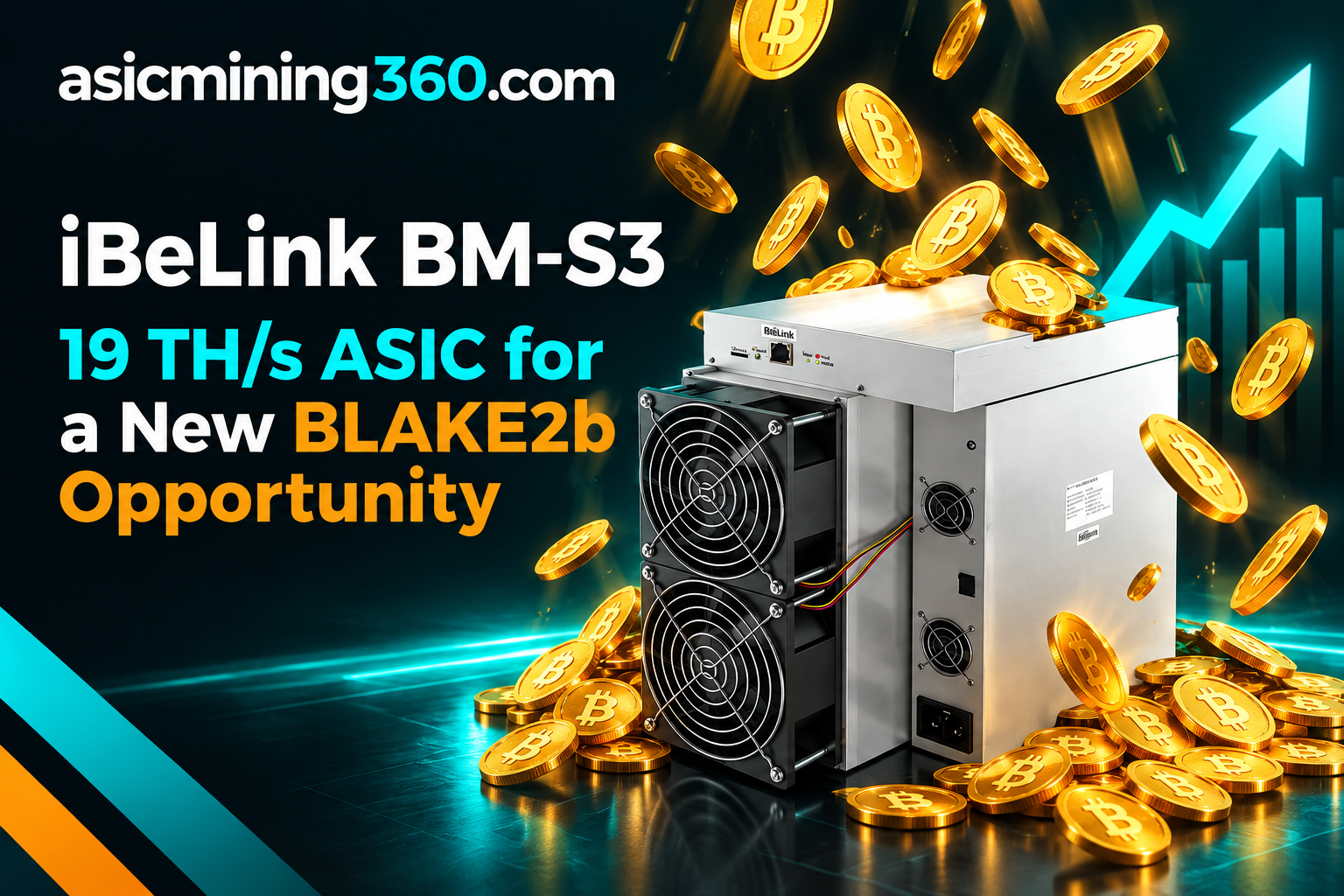
Sia's specialized ASIC ecosystem developed around Blake2b-Sia. Machines such as the iBeLink BM-S3 were designed specifically for this environment.
The BM-S3,for example, delivers approximately 19 TH/s at 3,100 W, using Blake2B-Sia.
For years, the economic value of such hardware was closely tied to the Sia mining market.
Then Bitcoin experienced a controversial chain split.
The August 2026 Bitcoin Split
On August 8, 2026, a Bitcoin-derived chain split from Bitcoin at block 961,632.
The split was connected to the dispute surrounding BIP-110, a proposal involving restrictions on certain non-monetary data within Bitcoin transactions. The resulting minority chain retained Bitcoin's historical ledger up to the point of divergence.
However, the new chain did something unusual.
It did not simply continue using Bitcoin's SHA-256d proof-of-work. Instead, on August 30, 2026, at block 961,640, the chain activated BLAKE2b Proof of Work.
That technical decision fundamentally changed the hardware requirements.
Why Did BTCB2 Move to BLAKE2b?
The reason was closely connected to the security of a minority chain.
Bitcoin's established mining ecosystem is dominated by SHA-256 ASIC hardware. If a small fork continued to use the same algorithm, it would remain technologically compatible with the enormous SHA-256 mining ecosystem surrounding Bitcoin.
By switching to BLAKE2b, BTCB2 created a separate mining environment.
Bitcoin's conventional SHA-256 ASICs could no longer mine the new chain.
Instead, the compatible hardware came from a very different part of the ASIC market: machines originally built for networks such as Sia.
This included hardware from manufacturers such as iBeLink and Goldshell.
The Unexpected Second Life of Sia ASICs
This is where the history of Siacoin becomes directly connected to the 2026 mining story.
ASIC hardware that had been developed for the Sia ecosystem suddenly became relevant to another proof-of-work network.
The machines did not become compatible because their manufacturers redesigned them.
They became relevant because both networks used BLAKE2b-compatible proof-of-work.
That distinction is important.
The BM-S3 was not originally designed as a Bitcoin miner. It was developed for the Sia ecosystem. BTCB2 simply created another compatible destination for that type of hardware.
The result was a sudden change in the economics surrounding BLAKE2b ASICs.
Why Mining Returns Rose So Quickly
The initial opportunity was driven by a relatively small amount of compatible mining hardware competing for the rewards of a new network.
That created a familiar proof-of-work cycle:
Limited hashrate → higher revenue per machine → miners enter → network hashrate rises → competition increases → revenue falls.
OneMiners reported that BTCB2's network hashrate was around 5.1 PH/s in early September 2026, with reported growth of approximately 30.4% in a single week.
Mining communities also began discussing unusually high returns from BLAKE2b ASICs during the early period.
Such figures should not be interpreted as permanent income. They represent a rapidly changing mining environment in which network difficulty, hashrate, coin price and hardware availability can change the economics within a very short period.
Siacoin Did Not Fork From Bitcoin
This distinction deserves emphasis.
Siacoin did not split from Bitcoin in August 2026.
Sia is an independent blockchain that launched in 2015 and has its own development history, consensus rules and hardforks.
The cryptocurrency that split from Bitcoin was the BLAKE2b-based BTCB2 chain.
The connection between the two is the mining algorithm.
Sia developed and supported a BLAKE2b ASIC mining ecosystem. BTCB2 later adopted BLAKE2b as its Proof-of-Work algorithm. As a result, specialized hardware originally built for Sia became compatible with the new Bitcoin-derived chain.
That is why the 2026 event is significant for Siacoin miners even though Siacoin itself did not participate in the Bitcoin fork.
A Decade of Evolution
Sia's history can therefore be viewed as a series of technical and economic transitions.
It began with the idea of decentralized cloud storage in 2013.
The Sia whitepaper followed in 2014.
The mainnet launched in 2015.
The network evolved through several hardforks, including changes to storage-proof validation and difficulty adjustment.
The 2018 ASIC hardfork reshaped the mining ecosystem.
The 2021 Foundation hardfork established a new structure for long-term development.
The 2025 v2 upgrade modernized the underlying blockchain architecture.
And in 2026, the BLAKE2b ecosystem surrounding Sia suddenly became relevant to a completely different blockchain through BTCB2.
Conclusion
The recent attention surrounding Siacoin mining is not the result of Siacoin suddenly changing from one consensus mechanism to another.
Sia has been a Proof-of-Work blockchain since its launch.
The important 2026 event happened on another chain.
BTCB2 split from Bitcoin in August 2026 and subsequently replaced SHA-256d with BLAKE2b. That change separated the new chain from Bitcoin's established ASIC mining ecosystem and created an unexpected role for hardware originally designed for Siacoin.
For miners, the story demonstrates why ASIC economics cannot be understood by looking at a single cryptocurrency alone.
An ASIC is tied to an algorithm, while an algorithm can be used by multiple networks. When a new network adopts that algorithm, hardware that appeared economically limited can suddenly find a second market.
That is exactly what happened to the BLAKE2b ASIC ecosystem in 2026.