
INTRODUCTION
In late 2025, amidst a carefully orchestrated victory celebration, Donald Trump signed a piece of legislation with great fanfare, labeling it the "savior of the crypto future." It was dubbed the GENIUS Act—a name Trump claims was chosen in his honor, though it is technically an acronym for: "Guiding and Establishing National Innovation for U.S. Stablecoins." The event served as a powerful political gesture toward a crypto ecosystem that has become increasingly vocal in its support for Trump. The room was filled with industry titans, including Brian Armstrong (Coinbase), Paolo Ardoino (Tether), Jeremy Allaire (Circle), and the Winklevoss twins. For these leaders, this law represents the culmination of a years-long struggle against regulatory hostility, SEC obstruction, litigation, and account freezes. Trump handed them a "truce" on a silver platter.
What Is the GENIUS Act? Full Breakdown of the U.S. Stablecoin Regulation Framework
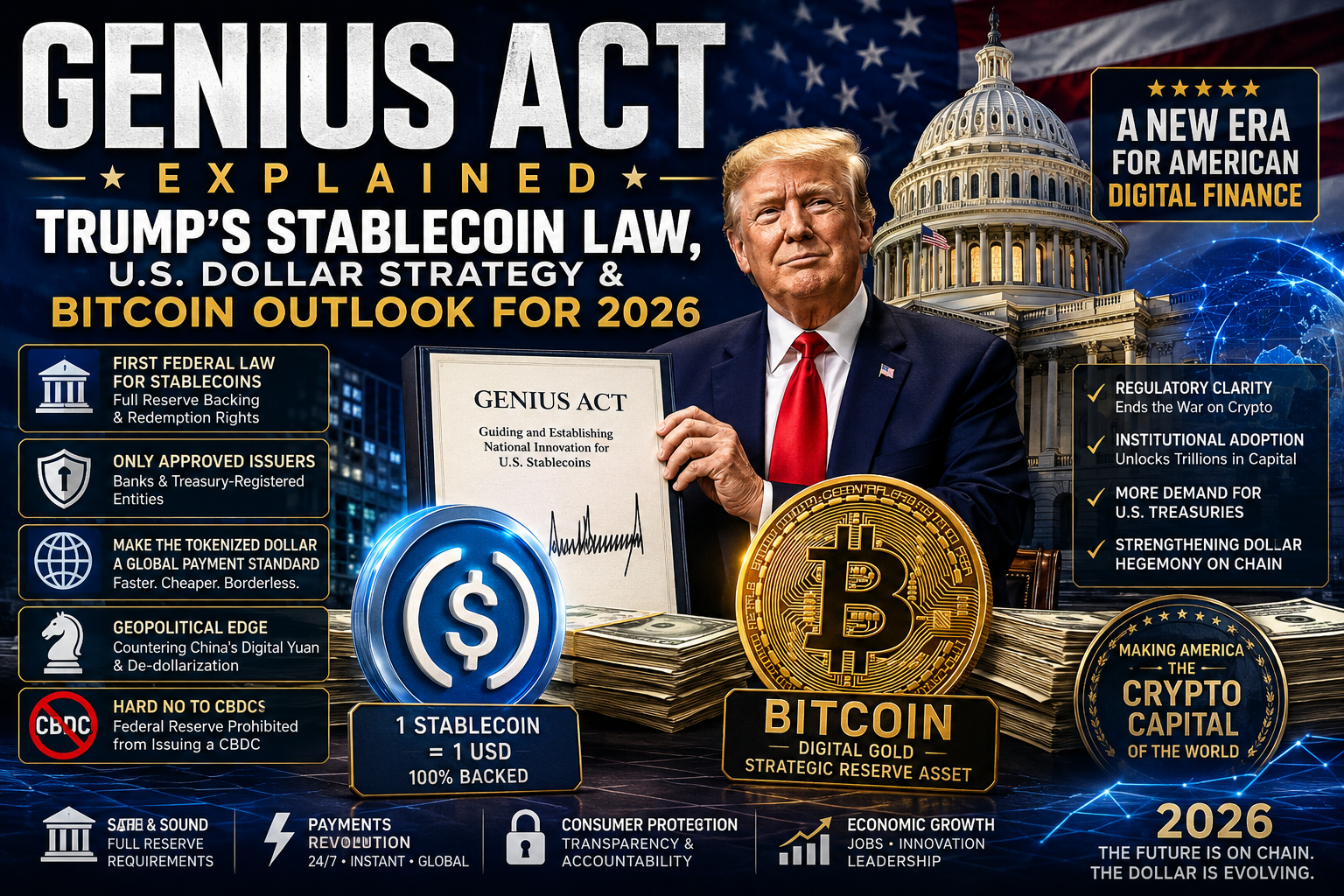
Beyond the name—which carries a hint of megalomania—the law is the first U.S. federal legislative framework dedicated exclusively to Stablecoins. This law is about tokens that are tied to the dollar and fully backed by cash or Treasury bills.
Who Can Issue U.S. Dollar Stablecoins Under the GENIUS Act?
Only approved groups, like federal banks or companies registered with the Treasury Department, can issue these tokens.
Full Reserve Requirements: Cash and Treasury Backing Explained
Every token has to be fully supported by easy-to-sell assets, and you must be able to swap them for dollars whenever you want.
Making the Tokenized Dollar a Global Payment Standard
The goal is to make the Tokenized Dollar a worldwide standard, making payments quicker, cheaper, and open to everyone.
Geopolitical Strategy: Countering China’s Digital Yuan and Decentralized Rivals
It seeks to bolster dollar hegemony against competitors, specifically China’s "Digital Yuan" and decentralized currencies.
Why the GENIUS Act Explicitly Bans a U.S. Central Bank Digital Currency (CBDC)
A major turning point in the legislation is the explicit prohibition of the Federal Reserve from launching a Central Bank Digital Currency (CBDC). While earlier drafts left the door slightly ajar, Republicans amended the text to ensure no direct government control over digital currency. The state is saying "Yes" to private stablecoins and "No" to a government-managed digital dollar.
Regulatory Shift After Gary Gensler: A New Era for Crypto Policy
Trump used the signing ceremony to attack the previous administration, asserting that he had purged the sector of Gary Gensler (the former SEC Chair), who was widely regarded as crypto's "Enemy Number One." Gensler has been replaced by a "visionary" commissioner who seeks to build rather than ban. Trump views the tokenized dollar as the greatest financial technological revolution since the invention of the internet, describing it as a strategic tool to increase demand for U.S. debt and Treasuries.
Criticisms and Risks: Big Tech, Banks, and Privacy Concerns Around the GENIUS Act
Despite the celebration, the law has faced sharp criticism:
Big Tech Dominance and Stablecoin Market Concentration
Organizations like the "American Economic Liberties Project" warn that the law opens the door for companies like Circle to dominate the monetary system, creating a new "cartel" that controls issuance and fees without the strict constraints imposed on traditional banks.
Traditional Banks vs. Crypto Firms: Federal Charter Conflict
Major banks have expressed resentment as crypto firms apply for federal banking charters. The banking lobby has called for a freeze on these applications, fearing a drain on deposits and an evasion of oversight—a conflict mirroring the "Uber vs. Taxi" struggle, but within the banking sector.
Privacy, Surveillance, and Consumer Protection Issues
The text remains vague regarding user protection and who holds the power of arbitration if a coin fails. Critics fear this could become a tool for unprecedented financial tracking under the guise of the private sector.
De-Dollarization vs. Digital Dollar Expansion: The BRICS Factor
Geopolitically, the GENIUS Act is seen as a tactical response to the BRICS nations' (led by China) attempts to decouple from dollar hegemony. Instead of fighting blockchain technology, the U.S. has decided to lead it. As Trump put it: "Every dollar-backed stablecoin is an extra dollar in the system."
Bitcoin and the GENIUS Act: Strategic Reserve, Institutional Adoption, and Market Impact
Although the GENIUS Act was designed specifically for stablecoins, the shadow of Bitcoin loomed large over the proceedings. While Bitcoin isn't mentioned as a payment tool in the text, it is a core pillar of Trump’s "Grand Strategy" to make America the world’s crypto capital.
How the Act Intersects with Bitcoin:
Strategic Bitcoin Reserve and U.S. National Crypto Strategy
The signing coincided with Trump’s renewed commitment to creating a Strategic Bitcoin Reserve. This suggests that stablecoin regulation is the "infrastructure" that will eventually allow the integration of Bitcoin as a state reserve asset alongside gold and Treasuries.
Institutional Legitimacy and Liquidity Flows Into Bitcoin Markets
By ending the era of "regulatory ambiguity," the law allows institutional funds to handle Bitcoin with greater flexibility. A legal, stable "tokenized dollar" facilitates massive liquidity flows directly into the Bitcoin market.
Bitcoin as the Only Decentralized Alternative After the CBDC Ban
By banning a CBDC, the law indirectly crowns Bitcoin. It removes a potential government competitor and reinforces Bitcoin’s position as the only "decentralized" option for those seeking to avoid central bank surveillance.
Financial Sovereignty: Bitcoin as an Inflation Hedge
Trump believes that regulating stablecoins will protect the dollar, while Bitcoin acts as a "shield" against global inflation. This synergy turns the Bitcoin-Stablecoin duo into a weapon against the ambitions of the Digital Yuan.
"The GENIUS Act is not just a stablecoin regulation; it is the green light Wall Street has been waiting for to treat Bitcoin as an integral part of the new American financial system."
Conclusion: Is the Dollar Evolving Into a Blockchain-Based Global Reserve?
Here's something to think about: Maybe the world isn't abandoning the dollar. Perhaps it's the dollar that's changing, going past what we've always known it to be. Imagine the dollar spreading into every corner of the blockchain. This could really solidify American influence in the digital age.
FAQ: GENIUS Act, Stablecoins, and Bitcoin in 2026
Q1: What is the GENIUS Act and why is it important for crypto markets?
The GENIUS Act is a U.S. federal law establishing a regulatory framework for dollar-backed stablecoins. It defines who can issue them, requires full reserve backing, and prohibits a U.S. CBDC. The law reduces regulatory uncertainty, which could increase institutional participation in both stablecoins and Bitcoin markets.
Q2: Does the GENIUS Act regulate Bitcoin directly?
No, the GENIUS Act focuses specifically on stablecoins tied to the U.S. dollar. However, by creating legal clarity for tokenized dollars and banning a CBDC, it indirectly strengthens Bitcoin’s position as the primary decentralized digital asset in the United States.
Q3: Why did the law ban a U.S. Central Bank Digital Currency (CBDC)?
The legislation explicitly blocks the Federal Reserve from issuing a CBDC to prevent direct government control over digital money. Lawmakers favored privately issued, fully backed stablecoins instead of a government-managed digital dollar, citing concerns about surveillance and centralization.
Q4: How could the GENIUS Act affect Bitcoin’s price in 2026?
By reducing regulatory ambiguity and legitimizing digital dollar infrastructure, the Act may encourage institutional capital inflows into crypto markets. Greater liquidity, clearer rules, and strategic reserve discussions could create conditions supportive of Bitcoin price growth in 2026.
Q5: How does the GENIUS Act respond to global de-dollarization efforts?
The Act positions the U.S. dollar inside blockchain networks worldwide. By promoting dollar-backed stablecoins, it aims to counter BRICS-led de-dollarization strategies and China’s Digital Yuan, reinforcing dollar dominance in the digital financial system.
Q6: Could stablecoin growth increase demand for U.S. Treasuries?
Yes. Since compliant stablecoins must be backed by cash or Treasury bills, expanded stablecoin issuance may increase structural demand for U.S. government debt, potentially strengthening the dollar’s global financial role.