How Rain-Powered Electricity Could Transform Renewable Energy
In the world of high-performance computing and crypto mining, we don’t just run code—we burn energy. We’ve reached a point where the best hardware doesn't win; the person with the cheapest electricity does. Energy isn’t just an overhead anymore; it’s a ceiling that dictates how far and how fast we can scale.
That’s why we’ve stopped looking at the weather as a nuisance and started looking at it as an unexploited balance sheet. While most see a rainy day as a reason to stay indoors, we see gigajoules of kinetic energy literally washing down the drain. From the perspective of a data center operator, innovations like rain-powered electricity aren't "cute" science projects—they are potential tactical advantages in a market where every cent saved per kilowatt-hour is a direct injection into the bottom line.
What Is Rain Energy Harvesting and How Does It Work?
Every year, enormous amounts of rain fall on rooftops, roads, and cities—and most of that energy simply disappears into drains and gutters. In a world where electricity prices are rising and power systems are under pressure, that feels like a missed opportunity.
What if some of that everyday rain could be turned into useful electricity?
A research team from Singapore recently demonstrated a new way to do exactly that. Using a clever fluid-flow design, they showed that falling water droplets can generate far more electricity than earlier attempts—by orders of magnitude.
The idea doesn’t replace dams or solar panels, but it opens a new and surprisingly practical niche in the energy landscape.
To understand why this matters, and where it realistically fits, we need to look at both the physics and the economics of electricity.
Why Traditional Hydropower Alone Can't Meet Future Energy Demand
Hydropower is one of humanity’s oldest and most reliable sources of renewable electricity.
Many countries still depend on it for a significant share of their power.
Germany, for example, operates thousands of hydroelectric plants that together deliver tens of terawatt-hours each year.
The challenge is simple: most of the good locations are already used.
The expansion problem can be summarized in a few key points:
-
The best and most efficient rivers are already dammed.
-
New projects face significant environmental, social, and political resistance.
-
In many regions, adding large new hydropower plants is no longer realistic.
This doesn’t mean water-based energy is obsolete.
It means the future gains will likely come from smaller, more distributed systems rather than massive dams.
And that’s where rain enters the picture.
Rain Energy: An Untapped Renewable Energy Source
In countries like Germany, the Netherlands, or the Scandinavian states, annual rainfall can reach hundreds of millimeters.
Every roof becomes a collection surface.
Every storm represents moving mass, height difference, and therefore potential energy.
Until now, most ideas for harvesting energy from rain were either:
-
Technically inefficient.
-
Too complex for practical use.
-
Produced too little power to be economically useful.
The new Singapore approach changes that by rethinking how water flows through the system.
How Rain Generates Electricity: The Science Behind Rain Energy
When water flows along a solid surface, something subtle but important happens at the boundary.
Water molecules naturally split into positively charged hydrogen ions (H^+) and negatively charged hydroxide ions (OH^-) in tiny amounts.
At the interface between water and a solid wall, these charges tend to separate:
-
Negative ions stick closer to the wall.
-
Positive ions move with the flowing water.
This creates a small electrical potential difference.
In theory, if you guide that flow through a device with electrodes, you can extract electricity.
Challenges of Rain Energy Harvesting Technology
Earlier experiments tried to maximize this effect using extremely small channels—microtubes and nanotubes—to increase surface area.
That created two major problems:
-
Capillary forces: In very thin tubes, water doesn’t flow freely; it sticks, climbs walls, or needs pumps to move. The energy used to push the water often exceeded the electricity generated.
-
The Debye length limit: The charge separation layer at the surface is extremely thin—on the order of nanometers. Beyond that, charges quickly neutralize each other, setting a natural limit on usable current.
In practical terms, the physics itself capped the output at very low levels.
New Rain Energy Technology: The Plug-Flow Principle Explained
The Singapore team didn’t try to fight these limits.
They worked around them.
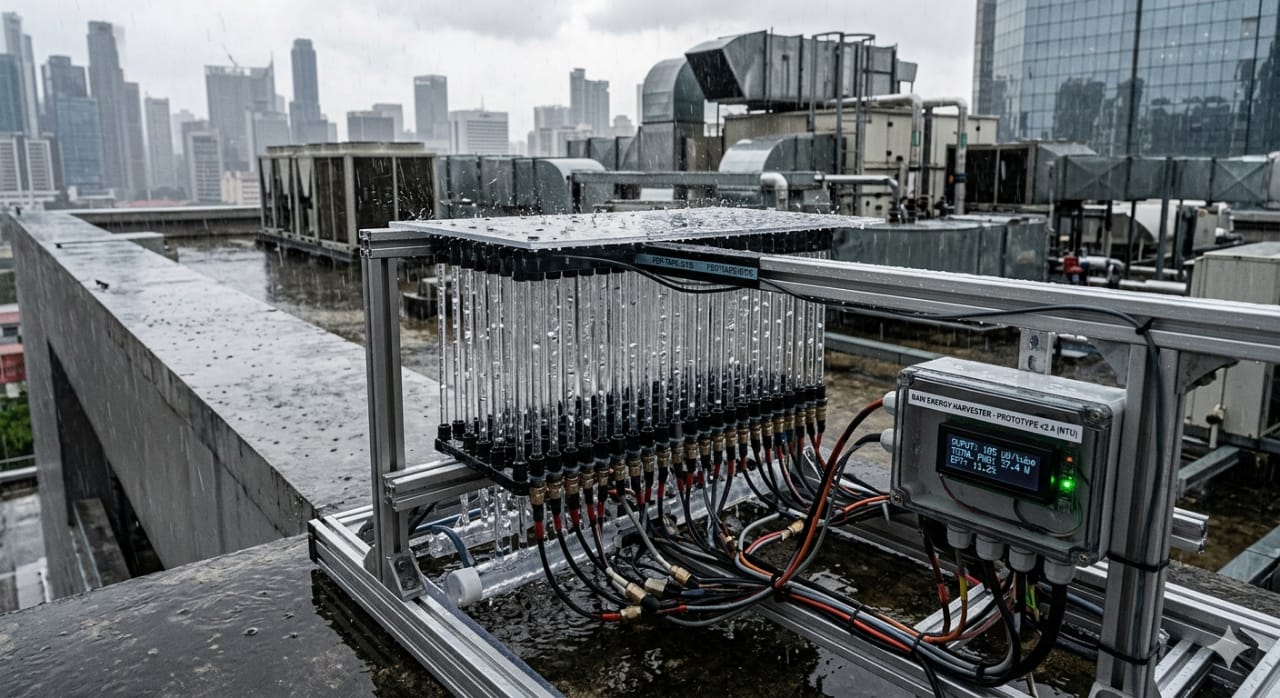
Instead of a continuous stream of water, their system creates a sequence of water “plugs” separated by air inside a small vertical tube.
This is called plug flow.
Each time a water plug moves, two things happen:
-
At the front and back edge of the plug, the wall alternates between wet and dry.
-
At these moving boundaries, charge separation happens again and again.
So instead of relying on a single, ultra-thin surface layer, the system recreates the charge separation process many times along the tube.
The separated charges can now be transported over centimeters instead of nanometers, bypassing the old Debye-length bottleneck.
Rain Energy Efficiency: What Current Research Shows
In controlled experiments, the researchers used a vertical tube about 30 cm long with an inner diameter of around 2 mm and a slow flow rate driven only by gravity.
With just one tube, they measured power outputs in the hundreds of microwatts.
More importantly:
-
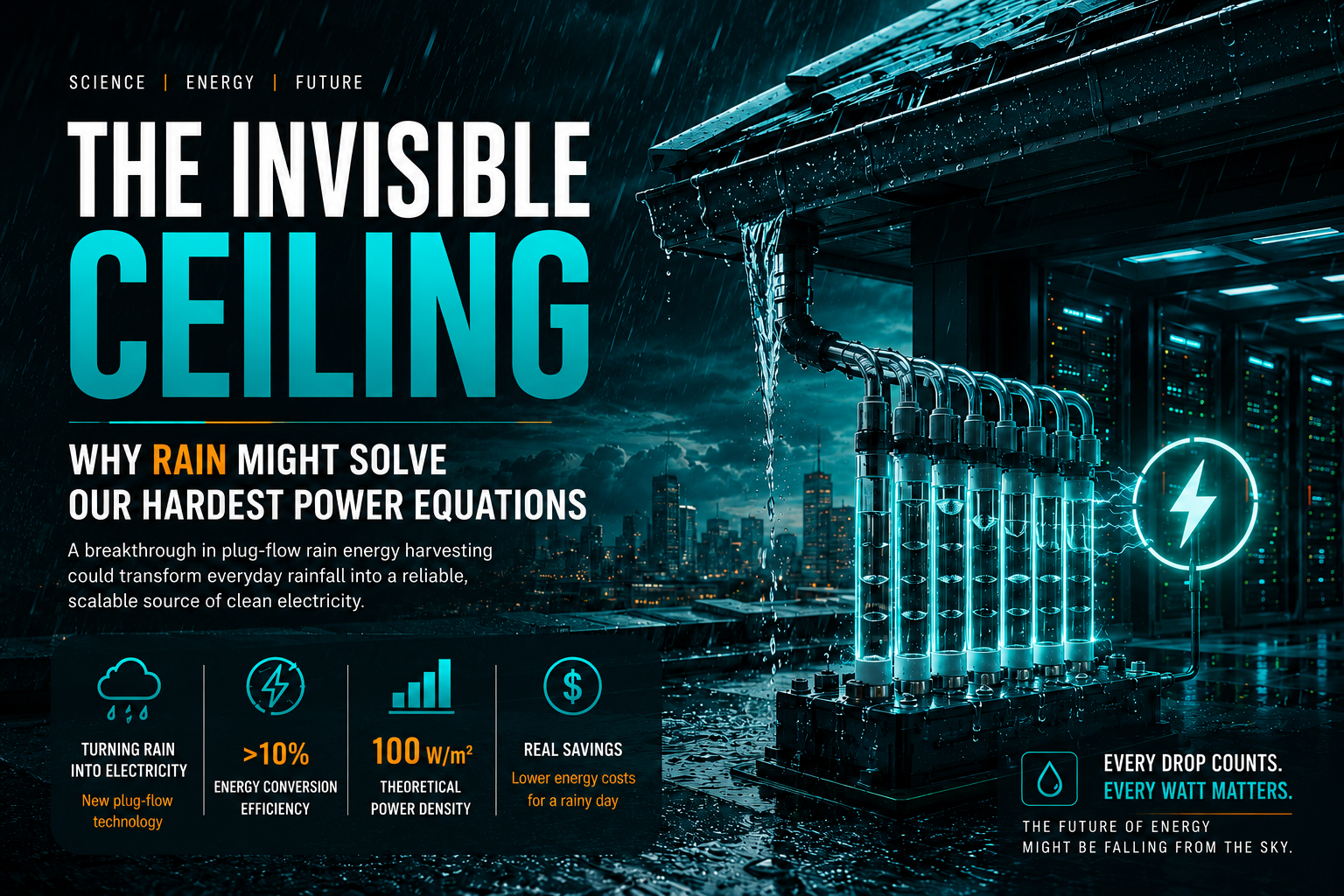
The energy conversion efficiency exceeded 10% of the water’s gravitational potential energy.
-
The theoretical power density could reach around 100 W/m² under ideal conditions.
Cost, Maintenance & Scalability of Rain-Powered Electricity
This is where engineering meets economics.
In a dense rooftop installation, you might need kilometers of tubing, which raises several cost drivers:
-
Material costs (using polymers like FEP).
-
Mounting and structural support.
-
Electrical connections and power conditioning.
-
Maintenance and cleaning.
Furthermore, real-world rainwater brings challenges like dust, organic material, algae growth, and freezing temperatures.
Any serious deployment would need filtration and long-term durability testing.
Best Applications for Rain Energy Harvesting Systems
From a power-system perspective, this technology is most interesting in places where:
-
Electricity prices are high.
-
Grid constraints make peak power expensive.
-
Weather is often cloudy and rainy.
-
Rooftop space is already being used efficiently.
How Rain Energy Fits into Modern Renewable Energy Systems
| Energy Source | Output Stability | Best Conditions | Cost Impact | Role in System |
|---|---|---|---|---|
| Rain Harvesting | Low–Medium | Rainy / Cloudy Days | Cost Reduction Layer | Secondary / Complement |
| Solar | High | Sunny Days | Primary Cost Saver | Core Energy Source |
| Grid Electricity | Very High | Always Available | Most Expensive | Backup / Base Load |
Rain Energy ROI: Cost Savings and Investment Potential
| System Size | Estimated Annual Output | Electricity Price | Annual Savings |
|---|---|---|---|
| 100 m² | 500 – 1200 kWh | $0.15 / kWh | $75 – $180 |
| 1000 m² | 5000 – 12000 kWh | $0.20 / kWh | $1000 – $2400 |
Is Rain-Powered Electricity the Future of Renewable Energy?
Let’s be clear: plug-flow rain harvesting isn’t going to kill the solar industry or replace the power grid tomorrow. But in an era where energy margins are razor-thin, ignoring a 10% efficiency breakthrough is a luxury we can no longer afford.
The science has crossed the finish line; now, it’s up to the engineers to survive the "real world" test. If this technology can migrate from a 30cm lab tube to a scalable rooftop array without drowning in maintenance costs, it changes the geography of mining and AI. We are looking at a future where a storm in Northern Europe or a monsoon in Southeast Asia isn't just weather—it’s a localized power surge for our racks.
It’s not a revolution yet, but it’s a damn good insurance policy. And in this business, the person with the most diversified energy portfolio is the one who stays online when the rest go dark.
Q1: "Is this just another 'cool lab project' or is it actually viable for my home?"
Honestly, we’ve seen "rain energy" concepts before that couldn't power a calculator.
But the Singapore breakthrough is different because it uses "plug-flow"—basically breaking water into segments to bypass the old physics bottlenecks.
A 10% efficiency rate is a massive jump.
It’s not going to take you off-grid tomorrow, but for high-performance users (think homelabs or miners), it’s the difference between hitting a power ceiling and having a bit of breathing room during a storm.
Q2: "Why would I install this if I already have Solar panels?"
It’s not an "either/or" situation—it’s about filling the gaps.
Solar is king until the clouds roll in.
In places like Seattle, London, or Southeast Asia, your solar output drops exactly when the rain energy potential peaks.
Think of it as a "weather-based hedge."
When your primary source (Solar) dips, your secondary source (Rain) kicks in.
It’s about building a diversified energy portfolio so your racks don’t go dark when the sun does.
Q3: "Small tubes + Outdoor debris = A maintenance nightmare. How do we handle the 'gunk'?"
This is the "elephant in the room" on every tech thread.
We’re talking about 2mm tubes.
In the real world, you’ve got dust, algae, and bird "surprises."
If the tubes clog, your ROI goes to zero.
For this to move from the lab to your roof, we need a solid solution for filtration and self-cleaning.
It’s a classic engineering trade-off: the physics is solved, but the "janitorial work" is where the battle will be won or lost.
Q4: "Is the ROI actually worth the effort for industrial users?"
If you're a data center operator or a crypto miner, every cent per kWh matters.
According to the data, a 1000 m² roof could save you up to $2,400 a year.
In a business where margins are razor-thin, that’s not pocket change—it’s a direct injection into the bottom line.
It’s an insurance policy against rising grid costs.
If you have the square footage, you're essentially leaving money on the table (or letting it wash down the drain) by not harvesting that kinetic energy.