Why the World’s Largest AI Data Centers Are Becoming the Backbone of Digital Infrastructure
We often talk about Artificial Intelligence as if it exists in the ether—a phantom intelligence floating somewhere in "the cloud." In reality, AI is heavy. It’s made of silicon, copper, high-grade concrete, and staggering amounts of electricity. The software revolution we’re witnessing is entirely dependent on a physical one: a massive build-out of infrastructure designed to handle workloads that would melt a traditional data center.
The global AI race has effectively become a land and power grab. Companies aren't just looking for "server space" anymore; they are architecting a new digital backbone. We’re seeing a convergence of hyperscale efficiency and the raw muscle of High-Performance Computing (HPC). For anyone in the crypto, cloud, or hardware sectors, these projects are the ultimate bellwethers. They represent the frontline of competition for the world’s most precious commodities:
power, specialized cooling, and advanced networking. Here is a deep dive into the five projects currently defining the limits of what’s possible in digital infrastructure.
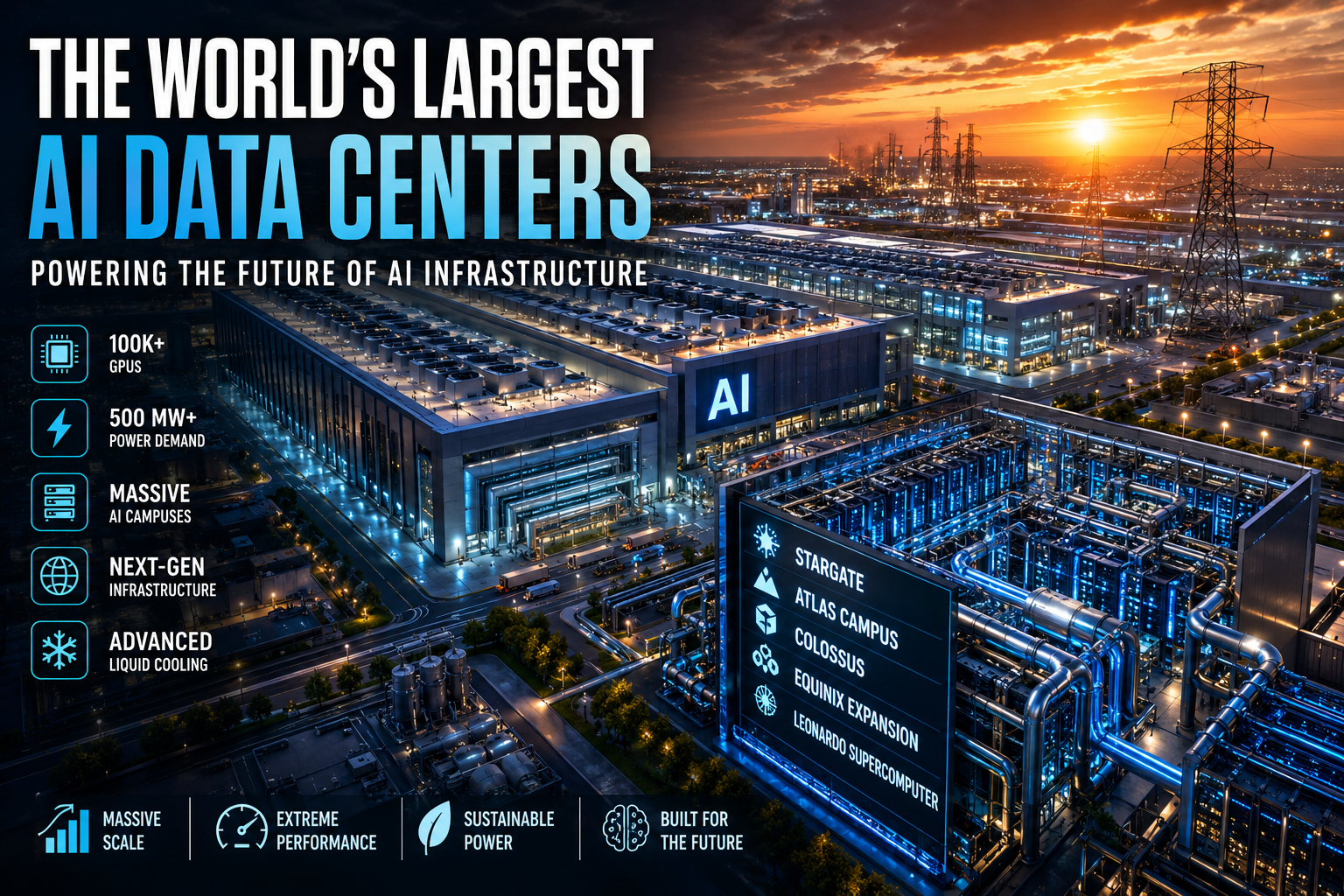
Overview of the Largest AI Data Center and Supercomputing Projects
| Project | Location | Estimated Cost | GPUs / Compute Scale | Power Demand | Facility Size | Primary Purpose |
|---|---|---|---|---|---|---|
| Stargate | Texas, USA | ~$100 Billion | Frontier-scale GPU clusters | ~500 MW+ | Massive AI campus | Training next-generation AI models |
| Atlas Development Campus | Georgia, USA | Multi-billion | Hyperscale cloud infrastructure | ~300 MW+ | ~5 million sq ft | AI & cloud workloads |
| Colossus | Memphis, USA | Not disclosed | 100,000–200,000 NVIDIA H100 GPUs | ~150–300 MW | Large GPU training facility | Large AI model training |
| Equinix Hyperscale Expansion | Global | Multi-billion | High-density AI racks | 100+ MW per campus | Multiple global campuses | AI colocation infrastructure |
| Leonardo | Bologna, Italy | €240+ Million | ~14,000 GPUs | ~30 MW | HPC facility | Scientific HPC & AI research |
1. Stargate Project: The $100 Billion National-Scale AI Infrastructure Initiative
The Stargate Project isn't just an expansion; it’s a moonshot. Framed as a $100 billion joint venture involving OpenAI, SoftBank, Oracle, and MGX, this initiative is arguably the most ambitious piece of private infrastructure ever proposed on U.S. soil. While the name sounds like science fiction, the construction in Abilene, Texas, is very real.
Technical Architecture Behind the Stargate AI Data Center
From an engineering perspective, Stargate is a masterclass in density. It moves away from the "general-purpose" cloud model toward a specialized AI environment. Key technical pillars include:
- Massive GPU Clusters: Architected specifically for the training of "frontier" models—the kind that require months of uninterrupted compute.
- Next-Gen Interconnects: In AI training, the bottleneck is often the speed at which chips talk to each other. Stargate prioritizes ultra-low-latency networking to ensure thousands of GPUs act as a single, cohesive brain.
- Thermal Resilience: You can’t run this much power without rethinking cooling from the ground up. Stargate integrates industrial-scale thermal management to maintain stability under the relentless load of LLM training.
Operational Impact of Stargate on the AI Industry
Stargate signals a shift from "just-in-time" capacity to "foundational" infrastructure. By building for the future of AI demand today, the partners are attempting to corner the market on raw intelligence.
2. Atlas Development Data Center Campus: A Hyperscale AI Infrastructure Megaproject
In Georgia, Project Sail (better known as the Atlas Development Campus) is a sobering reminder that at the end of the day, tech is a real estate and energy play. Spanning nearly 5 million square feet across 13 buildings, this campus is less of a "building" and more of a private industrial city.
Strategic Location and Energy Advantages of the Atlas Campus
What Makes Atlas Significant? The genius—and the challenge—of Atlas lies in its geography. By nesting the campus near major energy assets like Plant Yates, the developers are solving the number one problem in modern tech: grid saturation.
Typical Power Consumption of Modern AI Data Centers
| Infrastructure Type | Typical Power Consumption | Example Usage |
|---|---|---|
| Traditional Data Center | 5–20 MW | Enterprise servers |
| Hyperscale Data Center | 50–100 MW | Cloud providers |
| AI Training Facility | 100–300 MW | LLM training clusters |
| Mega AI Campus | 500 MW – 1 GW | National-scale AI infrastructure |
Energy Proximity: Transporting electricity over long distances is inefficient and expensive. Placing 5 million square feet of compute next to a power source is a strategic masterstroke.
Scalability: The modular design allows for rapid expansion. In the AI world, being "first to rack" is a competitive advantage.
Infrastructure Lessons Atlas Shares With Crypto Mining Facilities
If you’ve ever managed a large-scale crypto mining operation, the logic of Atlas will feel familiar. It’s about the "spread"—the margin between your hardware’s output and your energy costs. Atlas takes this **mining **logic and applies it to the hyperscale cloud, proving that the future of AI is inseparable from regional energy strategy.
3. Colossus: xAI’s Massive GPU Supercomputer for AI Model Training
While others are planning, xAI’s Colossus in Memphis is already sprinting. This project is a testament to what happens when you apply a "Silicon Valley" timeline to heavy industrial engineering. In record time, the facility deployed 100,000 NVIDIA H100 GPUs, with plans to double that to 200,000.
Major GPUs Used in Modern AI Training Infrastructure
| GPU Model | AI Performance Level | Typical Deployment |
|---|---|---|
| NVIDIA H100 | Extremely High | AI training clusters |
| NVIDIA A100 | Very High | Data centers |
| NVIDIA B100 | Next-generation | Future AI infrastructure |
| AMD MI300X | High | AI & HPC workloads |
How Colossus Functions as an AI-Native Supercomputer
Colossus is a specialist. Most supercomputers are designed for a variety of tasks—weather modeling today, physics simulations tomorrow. Colossus is built for one thing: training proprietary AI models at a speed that leaves competitors in the dust.
- GPU Packing: The density here is extreme. This requires a rethink of power delivery at the rack level.
- Networking at Scale: Managing 200,000 GPUs requires a networking fabric that can handle petabits of data without breaking a sweat.
Why Colossus Represents a New Era of AI Infrastructure Deployment
Colossus proves that "speed to market" is now a physical metric, not just a software one. By bypassing traditional, slower construction cycles, xAI has turned infrastructure into a weapon.
4. Equinix Hyperscale Expansion: Global Colocation Infrastructure for AI Workloads
Equinix has long been the "landlord of the internet," but their multibillion-dollar move into hyperscale expansion proves they aren't content with just renting out space. They are evolving to meet the brutal demands of AI.
Core Infrastructure Components Required for AI Data Centers
| Infrastructure Component | Why It Matters |
|---|---|
| High-density GPUs | Essential for parallel AI computation |
| Advanced Networking | Allows GPUs to communicate with ultra-low latency |
| Liquid Cooling | Handles extreme heat generated by AI chips |
| Massive Power Supply | AI clusters require enormous electricity capacity |
| High-speed Storage | Supports massive AI datasets |
Advanced Cooling Technologies in Equinix AI Data Centers
Unlike Stargate or Colossus, which are largely "private" projects, Equinix serves the broader market. This creates a unique technical challenge: they have to build infrastructure that is both massive and flexible.
The Liquid Cooling Pivot: As AI racks move toward 100kW+ per rack, air cooling is no longer enough. Equinix is a leader in implementing liquid-to-the-chip cooling, which is fast becoming the industry standard for high-density compute.
Why Equinix Is Key to Democratizing AI Infrastructure
Equinix represents the "democratization" of AI infrastructure. Their expansion ensures that you don't have to be a trillion-dollar tech giant to access the cooling and power density required for modern machine learning.
5. Leonardo Supercomputer: Europe’s Flagship Pre-Exascale HPC System
While the U.S. leads in commercial AI, Europe’s Leonardo system in Bologna reminds us that scientific supercomputing is still pushing the envelope. Leonardo is a cornerstone of the EuroHPC initiative, blending classical science with the AI era.
Hybrid HPC Architecture Powering the Leonardo System
Leonardo is a hybrid marvel. It’s designed to handle a researcher’s climate model just as easily as a startup’s neural network.
-
Architecture: With 14,000 NVIDIA Ampere GPUs and InfiniBand networking, it delivers roughly 250 petaflops of performance.
-
Efficiency: Located in a converted tobacco factory, it’s a prime example of "brownfield" development—repurposing old industrial space for the digital age.
Why Leonardo Remains Critical for Future Data Center Innovation
Leonardo is the R&D lab for the rest of the world. The lessons learned here regarding storage hierarchy and modular compute modules eventually trickle down into the commercial data centers of tomorrow.
Evolution of Data Center Power Capacity Over Time
| Era | Typical Data Center Size | Technology Drivers |
|---|---|---|
| 2000–2010 | 1–5 MW | Enterprise computing |
| 2010–2020 | 10–50 MW | Cloud infrastructure |
| 2020–2025 | 100–300 MW | AI and hyperscale computing |
| 2025–2035 (Projected) | 500 MW – 1 GW | AI mega campuses |
Key Differences Between HPC Supercomputers and AI Data Centers
| Feature | HPC Supercomputer | AI Data Center |
|---|---|---|
| Main Purpose | Scientific simulations | AI model training |
| Hardware | CPUs + GPUs | Mostly GPUs |
| Networking | High-speed interconnect | Ultra-low latency GPU fabrics |
| Workload | Scientific computing | Machine learning |
Conclusion: The Infrastructure Arms Race Behind the AI Revolution
The projects we’ve looked at today—Stargate, Atlas, Colossus, Equinix, and Leonardo—are more than just impressive stats. They are the physical manifestations of our digital future.
Whether it's the sheer scale of Stargate or the rapid-fire deployment of Colossus, the trend is clear: we are moving toward a world of hyper-dense, energy-integrated, and highly specialized compute. For anyone involved in tech, from software engineers to infrastructure investors, understanding these five projects is key to understanding where the next decade of innovation will be built.
FAQ: AI Data Centers, Supercomputers, and Future Compute Infrastructure
Q1: What is the largest AI data center project currently under construction?
One of the most ambitious AI infrastructure projects currently underway is the Stargate Project in Texas. Backed by companies like OpenAI, Oracle, and SoftBank, the initiative aims to build a massive AI computing ecosystem designed specifically for training frontier AI models, potentially costing more than $100 billion and redefining hyperscale computing infrastructure.
Q2: How many GPUs do modern AI supercomputers typically use?
Modern AI supercomputers can deploy tens of thousands to hundreds of thousands of GPUs. For example, the Colossus AI system developed by xAI already runs around 100,000 NVIDIA H100 GPUs, with plans to scale to 200,000. These massive GPU clusters allow extremely large AI models to be trained faster than traditional computing systems.
Q3: Why are hyperscale AI data centers built near power plants?
Large AI facilities require enormous amounts of electricity. Locating data centers close to power plants or large substations reduces energy transmission losses and improves grid stability. It also allows operators to secure long-term energy contracts, which is critical since electricity is the largest operational cost for AI infrastructure.
Q4: What cooling technologies are used in AI data centers?
Traditional air cooling is often insufficient for modern AI hardware. Many facilities now use liquid cooling systems where coolant flows directly across processors or GPUs. This method removes heat much more efficiently and allows racks to operate at power densities exceeding 100 kilowatts per rack.
Q5: How are AI data centers similar to cryptocurrency mining farms?
Both AI data centers and crypto mining farms rely on high-performance hardware operating continuously at full capacity. They require large power supplies, efficient cooling systems, optimized rack density, and low operational costs. Because of these similarities, some former crypto mining facilities are now being converted into AI computing clusters.
Q6: What is the difference between HPC supercomputers and AI training clusters?
Traditional high-performance computing (HPC) systems are designed for scientific simulations such as climate modeling or physics calculations. AI training clusters focus primarily on machine learning workloads. However, modern systems are increasingly hybrid, combining HPC architecture with massive GPU arrays optimized for deep learning and large language models.