Introduction
The era of civilian nuclear energy really got started back in 1951, when a nuclear reactor over at the Experimental Breeder Reactor I (EBR-I) in Idaho, USA, generated electricity for the ultra-first time. Mind you, this was merely a tiny proof-of-concept reactor, far from an actual large-scale commercial power plant.
Shortly after, the Soviet Union managed to generate power from a nuclear reactor in 1954. The Obninsk Nuclear Power Plant is widely seen as the world's very first nuclear facility built to supply peaceful, civilian electricity straight into a power grid. It went live on June 27, 1954, pushing out roughly 5 megawatts of power.
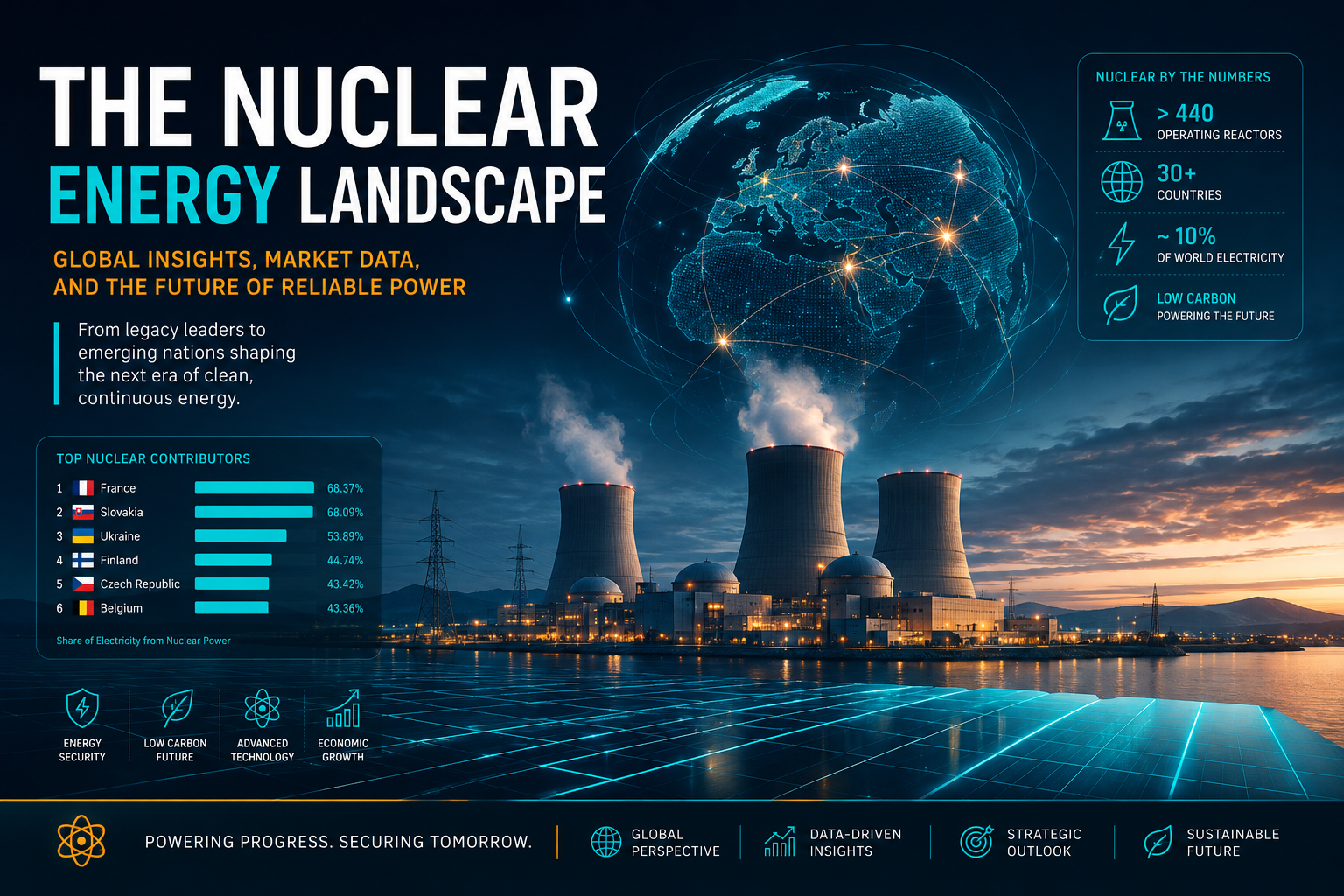
Since those initial steps back in 1954 straight through to 2026, the worldwide nuclear industry has expanded on a massive scale. As it stands today, well over 440 commercial reactors are actively powering communities across more than 30 countries. A few countries—like Iran and North Korea—keep their power generation and operational metrics somewhat hazy or locked away, while others are just getting started on their very first major plants. Take Egypt, for instance: they're currently rolling out the El Dabaa Nuclear Power Plant, which is slated to start cranking out power in the coming years, with its four-reactor design eventually aiming for a total output around 4.8 GW.
Looking back at the timeline of commercial nuclear power, a pair of catastrophic events fundamentally shifted how the world feels about the technology's safety. First was the 1986 Chernobyl disaster in Ukraine, where Reactor 4 ripped open mid-test after a safety check went completely wrong, driving radioactive plumes high into the atmosphere. Fast-forward to March 11, 2011, and the disaster at Fukushima Daiichi in Japan. A brutal earthquake triggered a massive tsunami that crashed right into the facility, killing the backup generators and wrecking the cooling systems. That’s what ultimately caused the core meltdowns, sending radioactive material leaking all over the surrounding areas.
Nuclear energy doesn't have a long history compared to other power sources, yet its pros and cons remain heavily debated. Plenty of nations have put the brakes on or flat-out rejected nuclear power using strict laws, tight regulations, or full-on public votes. Take Italy, for instance, which walked away from nuclear energy altogether after voters turned it down in referendums. Other countries tread far more carefully simply because of their small footprint and dense populations, where handling the fallout from a major nuclear accident would be an absolute nightmare.
This debate keeps going strong even though nuclear tech has come a long way. The industry has now stepped up to Generation III+ reactor designs, which pack far more sophisticated safety systems built specifically to lower the odds—and fallout—of a major accident. Still, plenty of communities remain pretty hesitant about nuclear power, mainly because the fear of radioactive contamination is still deeply burnt into the public memory.
Nuclear technology is also not equally accessible to every country. Many nations interested in developing nuclear power must rely on countries with established nuclear industries, including Russia, the United States, and other nuclear technology providers. At the same time, some countries that already possess nuclear capabilities have chosen to reduce their dependence on the technology or invest more heavily in alternative sources of electricity.
One of the strongest arguments in favor of nuclear power, however, is its very low carbon footprint. Nuclear electricity is among the lowest-carbon forms of electricity generation. Life-cycle assessments generally place nuclear power at only a few tens of grams of CO₂-equivalent per kilowatt-hour, far below the emissions associated with fossil-fuel-based electricity.
Nevertheless, concerns about nuclear risks remain strong, particularly among populations that have experienced the consequences of radioactive contamination. The history of nuclear radiation also extends beyond civilian nuclear power accidents. The world remembers the atomic bombings of Hiroshima and Nagasaki, where extremely intense radiation exposure was one of the devastating consequences of nuclear weapons. Algeria also carries its own painful legacy of nuclear testing. France conducted nuclear weapons tests in the Reggane region of southern Algeria, beginning in 1960, leaving a lasting environmental and human legacy that remains a subject of concern and debate.
At the end of the day, people’s fear of radiation has always dictated how they feel about nuclear energy. But despite all the hesitation, it’s still a life-saver for a lot of big countries—especially today, with energy demands shooting through the roof and global conflicts messing up power supplies everywhere.
The massive energy crunch in Europe after Russia invaded Ukraine laid bare just how exposed countries are when relying heavily on imported fossil fuels. Look at Germany, for instance—it had to completely overhaul its energy playbook in 2022 after Russian gas flows dried up and both Nord Stream 1 and Nord Stream 2 pipelines were sabotaged. These same energy security bottlenecks have hit plenty of other nations too, like Pakistan, where severe shortages triggered widespread blackouts, alongside Egypt and several other countries wrestling with severe grid pressures.
For these reasons, nuclear power remains attractive to many governments as a source of continuous and reliable electricity, despite its high construction costs and the complex safety requirements involved in developing nuclear infrastructure.
Below are the 25 countries for which we have comparable data and that rely on nuclear technology to generate part of their electricity, ranked according to the share of electricity generated from nuclear power.
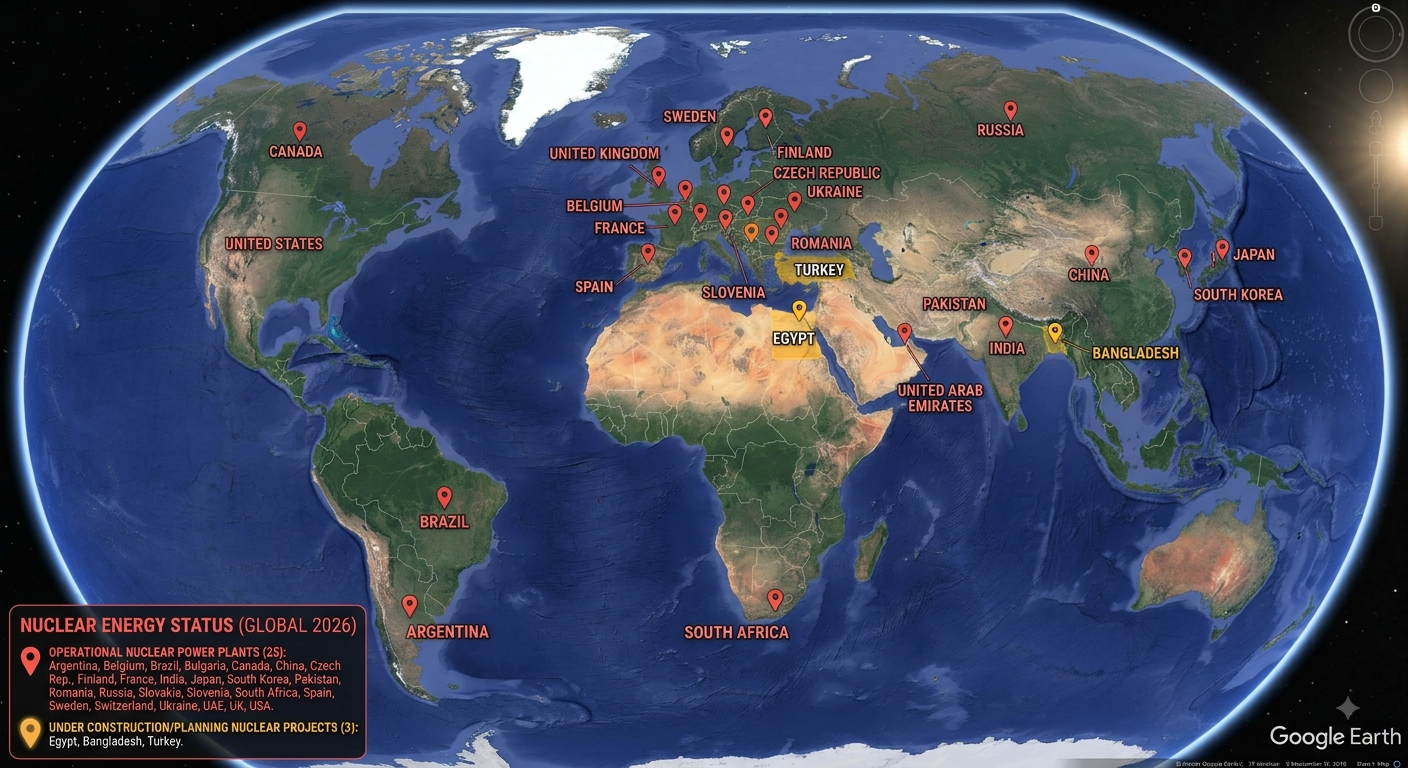
Nuclear Energy Contribution by Country
| Rank | Country | Nuclear Share of Electricity (%) | Total Electricity Generation (TWh/year) | Nuclear Electricity Generation (TWh/year) | Operating Nuclear Reactors |
|---|---|---|---|---|---|
| 1 | France | 68.37% | 537.20 | 367.28 | 57 |
| 2 | Slovakia | 68.09% | 28.55 | 19.44 | 5 |
| 3 | Ukraine | 53.89% | 96.91 | 52.22 | 15 |
| 4 | Finland | 44.74% | 79.28 | 35.47 | 5 |
| 5 | Czech Republic | 43.42% | 73.66 | 31.98 | 6 |
| 6 | Belgium | 43.36% | 72.38 | 31.38 | 2 |
| 7 | Bulgaria | 43.04% | 38.63 | 16.63 | 2 |
| 8 | Slovenia | 33.47% | 16.75 | 5.61 | 1 |
| 9 | South Korea | 33.45% | 577.80 | 193.27 | 26 |
| 10 | Sweden | 31.18% | 169.50 | 52.85 | 6 |
| 11 | Switzerland | 31.11% | 75.07 | 23.35 | 4 |
| 12 | UAE | 23.07% | 169.00 | 38.99 | 4 |
| 13 | Romania | 20.42% | 49.24 | 10.05 | 2 |
| 14 | Spain | 19.78% | 267.20 | 52.85 | 7 |
| 15 | Russia | 18.62% | 1,160.20 | 216.03 | 34 |
| 16 | USA | 18.00% | 4,392.60 | 790.67 | 94 |
| 17 | Pakistan | 15.44% | 151.90 | 23.45 | 6 |
| 18 | United Kingdom | 13.90% | 268.00 | 37.25 | 9 |
| 19 | Canada | 13.56% | 611.30 | 82.89 | 17 |
| 20 | Japan | 9.56% | 907.00 | 86.71 | 14 |
| 21 | Argentina | 7.20% | 147.50 | 10.62 | 3 |
| 22 | China | 4.53% | 10,162.00 | 460.34 | 60 |
| 23 | South Africa | 3.20% | 242.80 | 7.77 | 2 |
| 24 | India | 2.71% | 2,051.80 | 55.60 | 23 |
| 25 | Brazil | 2.21% | 737.10 | 16.29 | 2 |
Three Emerging Nuclear Power Countries: Egypt, Bangladesh, and Türkiye — New Nuclear
As we've seen, plenty of countries are finding it tough to keep up with their energy demands—whether that's keeping factory lines running or just turning on the lights at home. Take Bangladesh and Egypt, for instance: both are dealing with rapid population growth on top of a massive surge in heavy industries like cement and steel. Turkey finds itself in a similar boat, with massive economic and industrial expansion driving electricity demand through the roof.
What these three have in common is that none of them are true energy powerhouses—even Egypt, despite its modest reserves, can’t rely solely on fossil fuels for full independence. That's why joining the peaceful nuclear club became a strategic priority for them. They found their golden opportunity by handing the reins to a single developer: Russia's state nuclear giant, Rosatom. The very same company is actually building all three mega-projects, taking on massive infrastructure builds running upwards of $20 billion for the Turkish and Egyptian models, and a slightly scaled-down setup for Bangladesh.
| Rank | Country | Nuclear Power Plant | Main Nuclear Technology / Contractor | Contractor's Country | Reactors | Total Capacity (MW) | Status |
|---|---|---|---|---|---|---|---|
| 1 | Egypt | El Dabaa Nuclear Power Plant | Rosatom | Russia | 4 | 4,800 | Under Construction |
| 2 | Bangladesh | Rooppur Nuclear Power Plant | Rosatom | Russia | 2 | 2,400 | Commissioning / Start-up |
| 3 | Türkiye | Akkuyu Nuclear Power Plant | Rosatom | Russia | 4 | 4,800 | Commissioning / Construction |
Conclusion
Nuclear power comes with a steep upfront price tag, a long payback window, and zero room for error—yet once that initial debt is cleared, it turns into one of the most reliable and steady power sources money can buy for decades on end. For developing industrial economies short on domestic energy reserves, that kind of predictability is a game-changer: it keeps electricity bills under control, gives local manufacturing a competitive edge, and builds real energy independence.
The technology is also getting a lot safer. Generation III+ reactors already feature built-in, advanced safety protocols, while Generation IV designs are paving the way for the next era of nuclear energy. On top of that, small modular reactors could unlock new possibilities—powering data centers, heavy AI computing infrastructure, and energy-hungry industries.
But nuclear power is not for everyone. Money can build a reactor, but geography, population density, natural hazards, and strong institutions determine whether a country can safely live with one. For countries that meet these conditions, nuclear energy is not simply an electricity source—it is a long-term investment in economic and energy security.
Frequently Asked Questions (FAQ)
Q1: How many nuclear power plants are operating in France?
France relies mainly on about 57 operational nuclear reactors—meaning currently working—which keep factories and homes powered across most regions of the country, covering about two-thirds of France's total electricity needs.
Q2: how many nuclear power plants are operating in the United States?
The United States has about 94 nuclear reactors currently in operation, spread across several U.S. states, making it the country with the most nuclear reactors producing electricity.
Q3: does Switzerland own nuclear reactors for producing electrical energy?
Yes, absolutely. Switzerland is among the countries that possess peaceful nuclear technology, owning four nuclear reactors distributed across three different sites in the country, and these reactors contribute about 31% of the country's total electricity needs.
Q4: which countries are most reliant on nuclear power for electricity generation?
Among the countries most reliant on producing electricity from nuclear energy is France, which relies on nuclear reactors for 68% of its electrical power.
Q5: which countries are building new nuclear reactors this year?
There are three major projects in the world to build nuclear reactors for electricity production: the El Dabaa nuclear plant in Egypt, the Rooppur plant in Bangladesh, and the Akkuyu plant in Turkey, all in partnership with the Russian company Rosatom, in addition to ongoing expansions in countries like China, India, and Russia.
Q6: Which countries will enter the world of peaceful nuclear electricity production?
The countries that will enter are Egypt, Turkey, and Bangladesh.
Q7: How many nuclear reactors are operating now to produce electricity in the world?
Today, there are more than** 440 **commercial nuclear reactors working to produce electricity in more than 30 countries around the world. For some countries, official data exists, but for countries like North Korea, Iran, and Israel, data is not available.