Introduction
Let’s look at where the global economy is heading right now. The world is practically running on artificial intelligence, cloud computing, and massive data centers They are the engines of the modern economy, and countries are fighting tooth and nail to attract the investments needed to build this infrastructure. If you want proof of what’s driving things today, just look at Nvidia. They design the GPUs that everyone is scrambling to buy, and they are essentially leading the charge for the US economy, promising to power data centers all over the planet.
Because of this, the biggest international conflict right now isn't just about territory; it’s a war over silicon. The United States is playing hardball, blocking China from getting their hands on advanced chip-manufacturing equipment, while Beijing is working relentlessly to figure out 2-nanometer and 3-nanometer tech on their own.
The Great Semiconductor Divide
Right now, countries like Taiwan, South Korea, the US, and to a lesser extent, China, are dominating the design and manufacturing of these chips. Europe, much like Russia, is sitting on the sidelines. The only real European player is the Dutch company ASML, which builds the critical EUV machines, but even they are kept on a tight leash by US sanction policies.
This lack of domestic chip production is a huge deal. Advanced silicon isn't just for AI models; it’s the lifeblood of anything requiring serious computational power. Take crypto mining, for example. If you look at modern hardware like the Antminer S23, it’s packed with incredibly complex chips to push out massive hash rate power within a small physical footprint. As blockchain algorithms get harder to solve, having the most advanced chips is the only way to stay in the game.
So, we can agree that Europe is lagging far behind in both AI software and hardware. But in theory, they could still compete by building the data centers needed to host and train these models. The catch? Data centers require a colossal amount of energy. Europe is structurally poor in fossil fuels, which is why countries like France, the Netherlands, Slovakia, and the Czech Republic have poured money into nuclear energy to get cheap, stable electricity. But recent geopolitical shifts are tearing that strategy apart.
The Crypto Mining Exodus: Why Europe is Losing its Edge
This energy problem brings up a massive roadblock for the continent, and you can see it playing out in the cryptocurrency mining sector right now.
Europe’s power grid is deeply interconnected. Countries are constantly importing and exporting electricity with each other—France, for instance, sends a lot of its nuclear-generated power over to Germany. Because they all share this massive grid, electricity prices don't vary all that much from one country to the next. Lately, those rates have been sitting above $0.20 per kilowatt-hour (kWh).
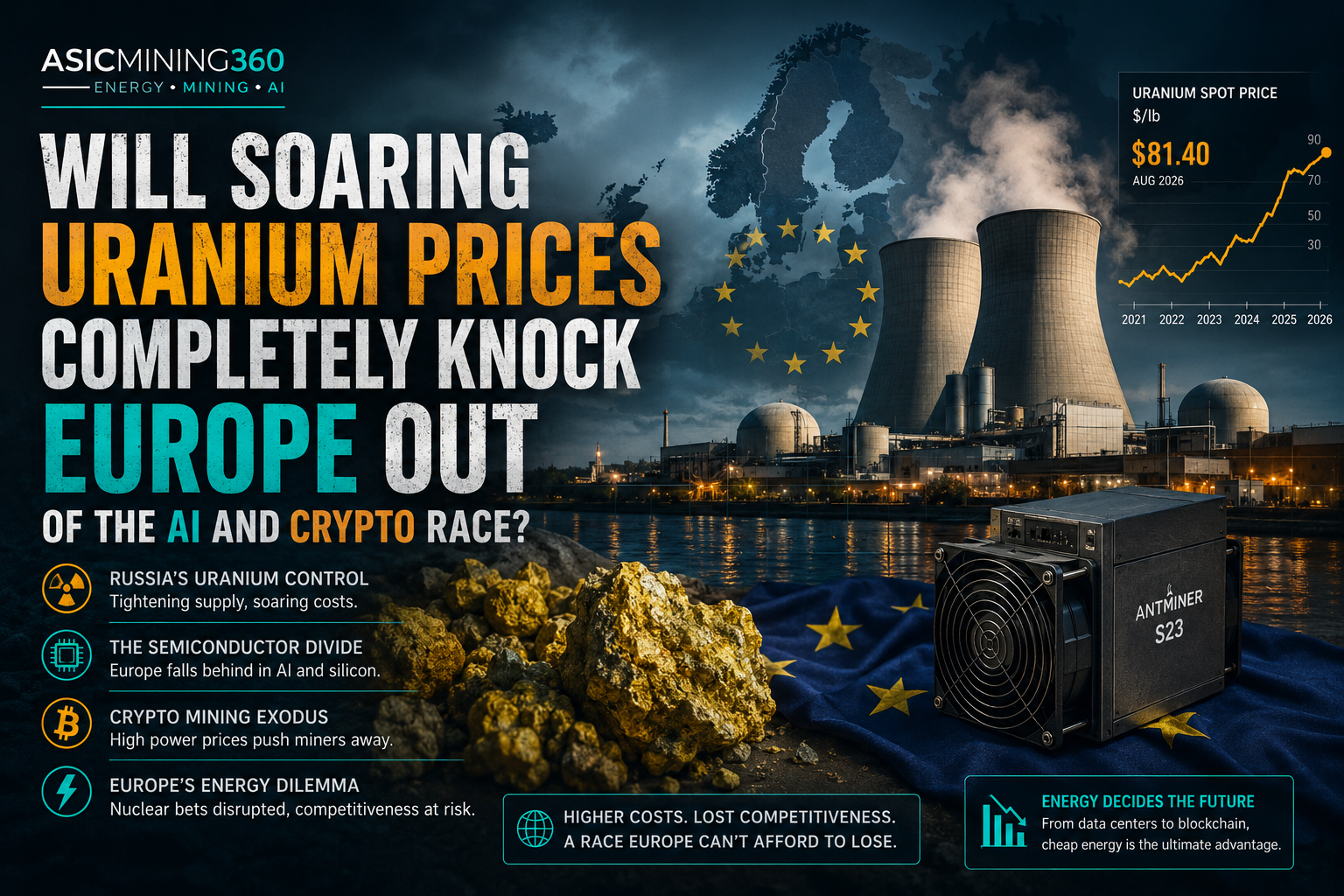
Let's be real: at the current, average prices of Bitcoin and other cryptocurrencies, mining in Europe is practically a dead end. Sure, if we see scenarios where Bitcoin touches that $120,000 mark it has flirted with in projections, miners might squeeze out a decent profit. But that's a best-case scenario. The reality is that the geopolitical setbacks we're seeing—specifically Russia's tightening grip on uranium—are pushing power generation costs even higher.
If electricity prices jump to $0.25 or $0.27 per kWh, Europe is completely shut out of the mining business. It won't matter if you are running a massive industrial facility or just a few rigs at home; it will be mathematically impossible to turn a profit. The global hash rate will simply pack up and migrate to regions with cheaper energy. We are going to see power consolidate in places like the Middle East—especially the UAE—along with Kazakhstan, the United States, Canada, and pockets of South America.
What this really means is that Europe is going to lose out on any new technology that fundamentally relies on low-cost electricity.
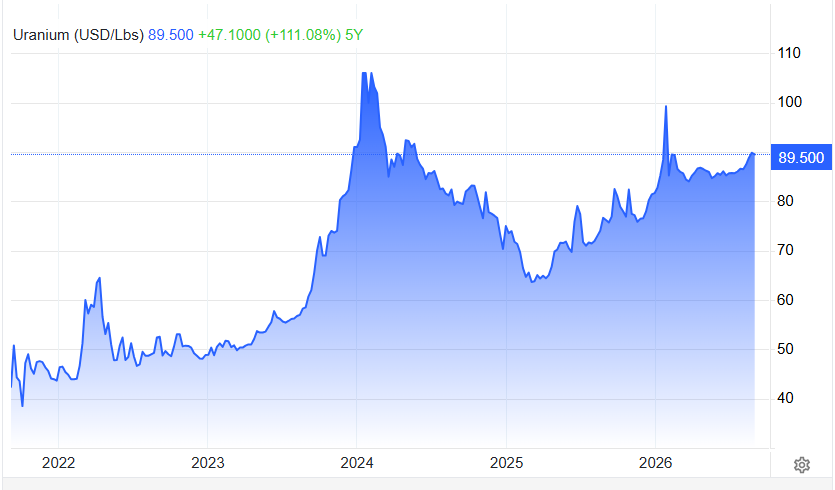
Figure: 5-Year Uranium Spot Price Surge ($/lb) showing the upward trajectory impacting European nuclear generation costs.
The Geopolitical Trap: Niger and Russia
So why are Europe's nuclear energy costs climbing so fast? It comes down to the supply chain. Europe relies heavily on enriched uranium, a market where Russia already holds massive influence. But now, the raw materials are slipping away, too.
Look at what happened in Niger. The country holds about 6% of the world's uranium reserves and used to be France's reliable, captive source for nuclear fuel. But since the military coup a few years ago, that dynamic has completely collapsed. France has been kicked out, losing its access to those vital reserves, and Russia has stepped right into the vacuum to take control.
The situation is only getting more entrenched. Just recently, Algeria stepped in to back the new government in Niger, sending Su-30 fighter jets and support aircraft to help them fend off what they claimed were destabilization attempts orchestrated by France and the UAE. With Algeria and Russia now aligned in protecting the current government in Niger, those uranium reserves are further out of France's reach than ever before.
Russia’s Chokepoint Strategy: How Moscow Weaponizes Enriched Uranium
While much of the global trade energy focus has been on oil and natural gas, Russia quietly established a near-monopoly on the most critical bottleneck of nuclear energy: Uranium Enrichment.
Raw uranium directly from mines cannot power commercial nuclear reactors. It must undergo a complex, high-tech industrial enrichment process to increase the concentration of the fissile isotope U-235. Through its state nuclear giant, Rosatom, Russia controls nearly 44% to 45% of total global commercial uranium enrichment capacity and over 35% of the world’s uranium conversion capacity.
This creates a terrifying structural vulnerability for Western power grids, particularly in Eastern Europe, France, and even the United States. Many European reactors—especially the Soviet-designed VVER reactors in Slovakia, Hungary, Bulgaria, and Czechia—rely almost exclusively on Russian-engineered nuclear fuel assemblies. Western enrichment facilities (such as Urenco or Orano) are currently operating at near-maximum capacity and require years of capital deployment and construction to scale up.
Consequently, Russia holds a virtual "kill switch" over European nuclear energy. By throttling or restricting exports of Low-Enriched Uranium (LEU) or next-generation High-Assay Low-Enriched Uranium (HALEU), Moscow can force nuclear operators into fuel shortages, triggering artificial grid instability and driving power prices to historic highs.
By systematically controlling both the upstream raw supplies in West Africa and the downstream enrichment infrastructure in Siberia, Russia doesn't just export fuel—it exercises operational leverage over foreign nuclear reactors, effectively pricing Europe out of the low-cost energy required for the next industrial era.
European Dependency on Russian Nuclear Fuel & Services
| Country | VVER Reactor Units (Soviet/Russian Design) | Share of Russian Nuclear Fuel Assemblies | Reliance on Russian Enrichment & Conversion Services | Strategic Diversification Status |
|---|---|---|---|---|
| Hungary | 4 Units (Paks) | 100% | High (~100%) | Strongly opposes EU sanctions on Rosatom; signed expansion contracts for Paks II with Russia. |
| Slovakia | 5 Units (Bohunice & Mochovce) | 100% (Historically) | High | Highly dependent on TVEL; transitioning to alternative contracts (Westinghouse/Framatome). |
| Czechia | 6 Units (Temelín & Dukovany) | ~100% (Prior to 2023) | Moderate to High | Signed replacement contracts with Westinghouse/Framatome to phase out Russian fuel. |
| Bulgaria | 2 Units (Kozloduy) | 100% (Historically) | High | Transitioning Unit 5 and Unit 6 fuel supplies to Westinghouse and Framatome. |
| Finland | 2 Units (Loviisa VVER) | 100% (Historically) | Moderate | Refused new Rosatom build contracts; shifting Loviisa fuel assemblies away from Russia. |
| France | 56 Units (Western Design) | 0% (Assemblies) | ~20% - 25% (Re-enrichment & Conversion) | Uses Rosatom/Tenex facilities for recycling re-processed uranium due to lower cost. |
To understand the scale of this vulnerability, we only need to look at how heavily reliant European nations are on nuclear power for their baseload electricity:
EU Countries Most Reliant on Nuclear Power
| Country | Nuclear Share of Domestic Electricity (%) | Total Nuclear Electricity Generated (GWh) | Operational Reactors | Key Geopolitical & Strategic Notes |
|---|---|---|---|---|
| France | 67.3% | 380,451 | 56 | Europe’s largest nuclear generator; exports power heavily to neighbors including Germany. |
| Slovakia | 61.6% | ~18,000 | 5 | Heavily reliant on Russian VVER reactor designs and nuclear fuel supply chains. |
| Hungary | ~48.0% | ~15,500 | 4 | Operates the Paks Nuclear Power Plant; expanding capacity via direct contracts with Russia’s Rosatom. |
| Bulgaria | ~40.0% | ~15,000 | 2 | Relies on Kozloduy Nuclear Power Plant for stable baseload power. |
| Belgium | ~40.0% | ~23,000 | 5 | Reversed phase-out plans due to energy security and high electricity prices. |
| Finland | 40.0% | 32,599 | 5 | Boosted production with the Olkiluoto 3 reactor to reduce regional grid reliance. |
| Czechia | ~40.0% | ~28,000 | 6 | Relies on Temelín and Dukovany plants; transitioning away from Russian fuel contracts. |
| Slovenia | ~36.0% | ~5,600 | 1 | Shares the Krško Nuclear Power Plant output 50/50 with neighboring Croatia. |
| Sweden | ~30.0% | 50,665 | 6 | Major supplier in Scandinavia; expanding nuclear investment to meet industrial power demands. |
| Spain | ~20.0% | 54,510 | 7 | Second-largest total nuclear generator in the EU behind France. |
| Germany | 0.0% (Direct) | 0 | 0 | Shutdown its last reactors in April 2023, yet imports French nuclear electricity to balance grid demand. |
Note: Despite broad Western sanctions on Russian energy, the nuclear fuel sector remains unsanctioned. Transitioning Soviet-designed VVER reactors to alternative suppliers requires years of safety qualifications, and political resistance (led by Hungary) prevents an EU embargo. This hesitation exposes Europe's structural trap: cutting ties with Moscow risks immediate grid destabilization, jeopardizing its AI and advanced tech transition.
Priced Out of the Future
When you put it all together, the picture for Europe is grim. The cost of raw uranium has skyrocketed over the last five years, and the enrichment process is heavily controlled by Moscow.
If these fuel costs stay high—and all signs indicate they will—the cost of running European nuclear plants will keep climbing. If the European Union and its nuclear-reliant member states cannot guarantee stable, cheap electricity, they aren't just going to lose out on cryptocurrency mining. They are going to be completely priced out of the race to build data centers and train AI models, leaving the future of the tech economy increasingly dependent on access to cheap, reliable power—and making alternatives such as micro nuclear reactors strategically important for energy-intensive digital infrastructure.
FAQ
Q1: Is European solo crypto mining completely dead right now, or is there any scenario where it makes a comeback?
At current electricity rates sitting above $0.20 per kWh, mining in Europe is practically a dead end for industrial and home setups alike unless Bitcoin surges past aggressive targets like $120,000. However, with grid power costs climbing due to tightening uranium supplies and enrichment bottlenecks, the hash rate is inevitably migrating out of Europe entirely to regions with cheaper, stable power like the Middle East, the US, and Canada.
Q2: Why are European nuclear plants struggling so much with fuel costs if they’ve been operating for decades?
The crisis isn't about running out of nuclear reactors; it's a massive upstream and downstream supply chain trap. Upstream, the loss of captive West African reserves in Niger (where Russia has stepped in) has disrupted raw yellowcake supply. Downstream, Russia's state giant Rosatom controls nearly 45% of global commercial uranium enrichment, giving Moscow a literal chokehold on the Low-Enriched Uranium (LEU) European operators rely on.
Q3: Can’t Eastern European countries just swap out their old Soviet reactors for Western ones to avoid Russian fuel?
It's not that simple. Many Soviet-designed VVER reactors across Slovakia, Hungary, Czechia, and Bulgaria run on specialized nuclear fuel assemblies historically supplied by Russia's TVEL. Transitioning these units to Western alternatives like Westinghouse or Framatome requires years of rigorous safety qualifications and capital deployment, leaving countries like Hungary legally and politically locked into Russian contracts.
Q4: What does Europe’s nuclear and energy grid crisis have to do with the AI data center boom?
Everything. AI training and large-scale data centers require massive, uninterrupted baseload power. Because Europe lacks abundant domestic fossil fuels, it heavily leans on nuclear energy (especially France) to stabilize its interconnected grid. If nuclear fuel and enrichment costs push grid electricity prices to $0.25–$0.27 per kWh, Europe won't just lose crypto mining—it will be completely priced out of hosting the physical infrastructure needed for the next generation of artificial intelligence.
Q5: Are there any alternative power solutions being looked at for high-compute digital infrastructure?
Yes, industries are increasingly looking at localized and alternative power models to bypass centralized grid vulnerabilities. This includes exploring modular or mobile nuclear micro-reactors and dedicated energy-repurposing setups designed to power energy-intensive compute infrastructure independently of politically unstable regional grids.
Sources
- International Atomic Energy Agency (IAEA) - Reports on nuclear reactor capacity and the distribution of VVER units across Central and Eastern Europe.
- World Nuclear Association (WNA) - Data on global market shares for uranium enrichment and conversion (Rosatom, Urenco, Orano).
- Energy and Uranium Market Data - Spot uranium price indices and long-term contract trends.
- ASICMining360 Infrastructure & Energy Research - Comparative cost analyses of electricity per kilowatt-hour ($/kWh) across the European Union, North America, and the Middle East.
- Algerian Army Magazine (مجلة الجيش) - Official defense and strategic publications analyzing regional geopolitical dynamics, security shifts in the Sahel, and military logistics in North Africa.