
Introduction
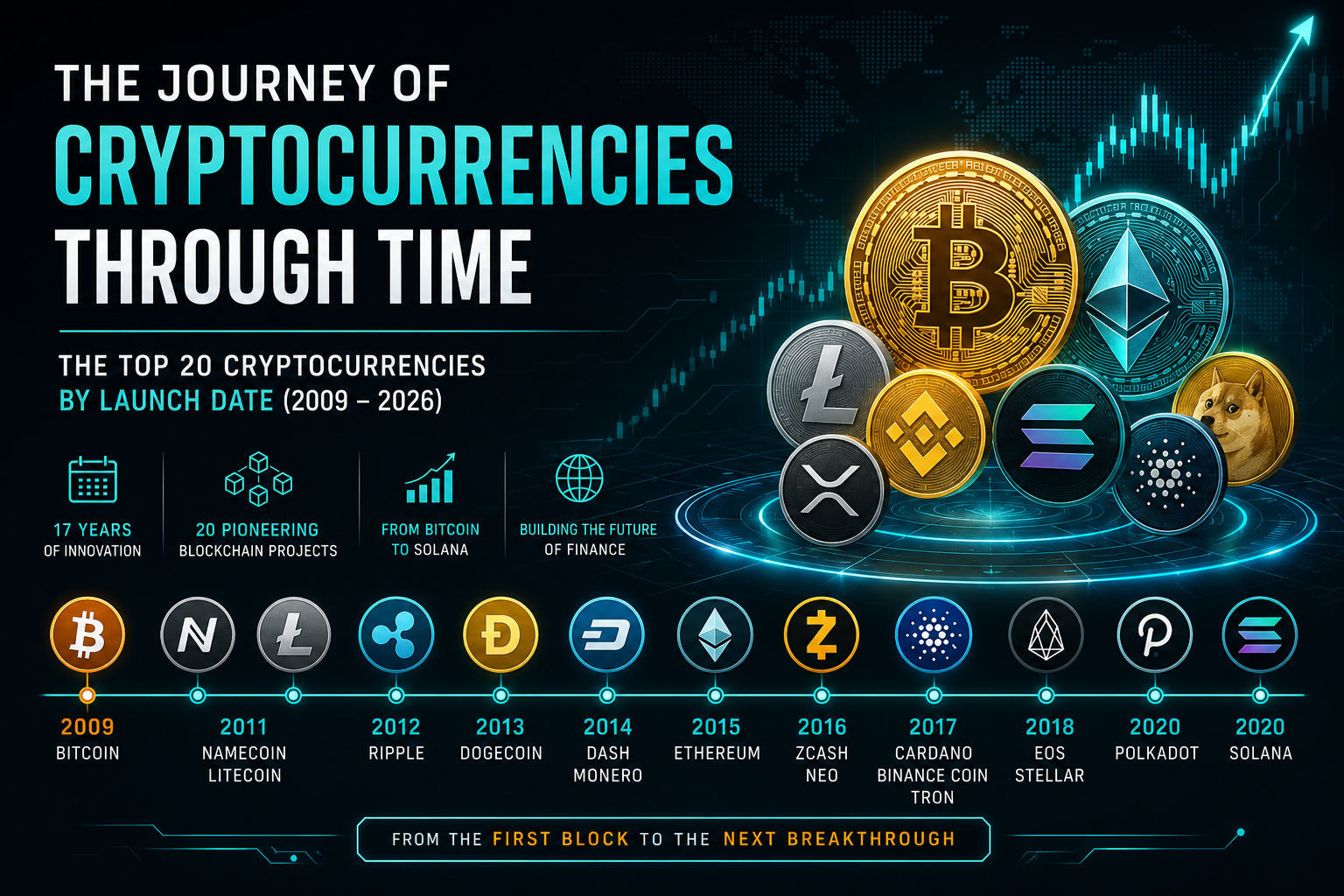
Only a few weeks ago, on January 3, 2026, the 17th anniversary of the launch of the first cryptocurrency in history passed. The world of cryptocurrencies has been witnessing rapid development since the emergence of Bitcoin in 2009, as this field transitioned from a limited digital experiment into a global financial ecosystem comprising thousands of projects. With the difference in goals and technologies, knowing the history of the launch of cryptocurrencies and their chronological order remains an important matter for understanding the evolution of blockchain, and identifying the pioneering currencies that formed the foundation, and those newer ones that came with more advanced solutions and technologies. In this article, we review the arrangement of the 20 most valuable and famous cryptocurrencies from the oldest to the newest depending on the actual launch date of the network, to provide a clear picture of the path of evolution of this sector in 17 years of struggles with the oldest financial system.
Timeline of the Top 20 Cryptocurrencies by Launch Date
The table below summarizes the top 20 cryptocurrencies by launch date and highlights their primary use cases within the blockchain ecosystem.
| # | Cryptocurrency | Symbol | Launch Year | Category |
|---|---|---|---|---|
| 1 | Bitcoin | BTC | 2009 | Store of Value |
| 2 | Namecoin | NMC | 2011 | DNS / Infrastructure |
| 3 | Litecoin | LTC | 2011 | Payments |
| 4 | Ripple | XRP | 2012 | Financial Infrastructure |
| 5 | Peercoin | PPC | 2012 | Hybrid Consensus |
| 6 | Dogecoin | DOGE | 2013 | Meme / Payments |
| 7 | Nxt | NXT | 2013 | Smart Platform |
| 8 | Dash | DASH | 2014 | Privacy Payments |
| 9 | Monero | XMR | 2014 | Privacy |
| 10 | Ethereum | ETH | 2015 | Smart Contracts |
| 11 | Ethereum Classic | ETC | 2016 | Smart Contracts |
| 12 | Zcash | ZEC | 2016 | Privacy |
| 13 | NEO | NEO | 2016 | Smart Economy |
| 14 | Cardano | ADA | 2017 | Smart Contracts |
| 15 | Binance Coin | BNB | 2017 | Exchange Ecosystem |
| 16 | TRON | TRX | 2017 / 2018 | Content / DApps |
| 17 | EOS | EOS | 2018 | DApps Platform |
| 18 | Stellar | XLM | 2014 | Payments Network |
| 19 | Polkadot | DOT | 2020 | Multi-chain |
| 20 | Solana | SOL | 2020 | High Performance |
Cryptocurrency Launch Details
1. Bitcoin (BTC) – Launched in 2009
Bitcoin (BTC) is the first cryptocurrency in the world that was officially launched in January 2009 when the first block (Genesis Block) was mined by the anonymous person or group Satoshi Nakamoto. BTC is considered a decentralized digital currency that works on a blockchain network that allows sending and receiving value without an intermediary such as banks. It relies on the Proof of Work (PoW) mechanism to secure the network and verify transactions. The project started with the goal of creating an independent digital financial system that is subject to mathematical rules and not to any central authority, inspiring the emergence of thousands of other currencies. Today, Bitcoin is the largest in terms of market capitalization and is used as an investment asset and a means of storing value, with its price fluctuating around $70,000 – $90,000.
2. Namecoin (NMC) – Launched in 2011
Namecoin (NMC) is one of the oldest cryptocurrencies after Bitcoin, launched in April 2011 as a decentralized currency built on the Bitcoin code. The Namecoin project aims to provide a decentralized domain name system (Decentralized DNS) that allows registering .bit websites and protecting them from censorship. NMC is more of a technical/infrastructure currency than an investment one, and its use has declined over time, trading today at a very low value compared to major currencies.
3. Litecoin (LTC) – Launched in 2011
Litecoin (LTC) was launched in October 2011 by Charlie Lee as one of the first alternative currencies after Bitcoin. It aims to improve transaction speed and reduce costs compared to Bitcoin through the use of the Scrypt algorithm and a faster block time. LTC is often viewed as “silver against the gold of Bitcoin,” trading today at a relatively high value among the best currencies after Bitcoin and Ethereum.
4. Ripple (XRP) – Launched in 2012
Ripple (XRP) was launched in 2012 as a semi-centralized digital currency linked to the RippleNet project, which aims to speed up cross-border financial transfers between banks at low cost. Unlike Bitcoin, XRP does not rely on mining but rather on a special consensus mechanism, making it suitable for institutional use. Today, XRP is considered one of the oldest and most famous currencies in the market, trading at a variable value around less than one dollar.
5. Peercoin (PPC) – Launched in 2012
Peercoin (PPC) was launched in 2012 and is known for being the first project to integrate Proof of Work (PoW) and Proof of Stake (PoS), aiming to reduce energy consumption and improve sustainability. Despite its historical importance, its presence has declined, and it trades today at a relatively low value compared to major currencies.
6. Dogecoin (DOGE) – Launched in 2013
Dogecoin (DOGE) was launched in December 2013 as a light and fun memecoin by software engineers Billy Markus and Jackson Palmer. Originally a joke inspired by the Shiba Inu meme, it quickly attracted a wide community due to low transaction fees and strong popularity on social media. DOGE is primarily used as an asset for trading and speculation, often trading around $0.08 – $0.15.
7. Nxt (NXT) – Launched in 2013
Nxt (NXT) was launched in November 2013 as a decentralized digital currency relying entirely on the Proof of Stake (PoS) mechanism. The Nxt project aims to provide an integrated blockchain platform for transferring money, creating digital assets, smart contracts, and a digital voting system. Today, NXT trades at a relatively low value compared to major currencies.
8. Dash (DASH) – Launched in 2014
Dash (DASH) was launched in January 2014 and aims to provide fast and private transactions using the Masternodes system. The project focuses on facilitating daily payments and making them more private compared to Bitcoin. Today, Dash trades at a medium value among the best digital currencies.
9. Monero (XMR) – Launched in 2014
Monero (XMR) was launched in April 2014 as a decentralized digital currency focusing on privacy. It uses technologies like Ring Signatures and Stealth Addresses to hide transaction details. Today, XMR is among the leading currencies in the privacy category, trading at a relatively high value.
10. Ethereum (ETH) – Launched in 2015
Ethereum (ETH) was launched in July 2015 by Vitalik Buterin and his team. It is a decentralized digital currency and a blockchain platform that supports smart contracts and decentralized applications (DApps). Today, ETH is the second-largest digital currency by market capitalization, trading at a high value around $2,000 – $3,500.
11. Ethereum Classic (ETC) – Launched in 2016
Ethereum Classic (ETC) was launched in July 2016 after a hard fork due to the hacking of the DAO project. It remains the original unmodified branch of Ethereum, supporting smart contracts while adhering to the principle of “Code is Law.” Today, ETC trades at a medium value, usually around $40–50.
12. Zcash (ZEC) – Launched in 2016
Zcash (ZEC) was launched in October 2016, focusing on privacy using Zero-Knowledge Proofs (zk-SNARKs). It allows for secure transactions while keeping sender and recipient information private. Today, ZEC trades at a medium to high value, usually around $80–100.
13. NEO – Launched in 2016
NEO was launched in October 2016 in China, aiming to create a Smart Economy through smart contracts and digital assets. Today, NEO trades at a medium value, usually around $20–30.
14. Cardano (ADA) – Launched in 2017
Cardano (ADA) was launched in September 2017 by Charles Hoskinson. It relies on the Proof of Stake mechanism for security and aims to develop a scalable platform for smart contracts and DApps. Today, ADA trades at a medium value, often around $0.25 – $0.50.
15. Binance Coin (BNB) – Launched in 2017
Binance Coin (BNB) was launched in July 2017 by the Binance platform. It is used within the Binance ecosystem for fees and trading. After the launch of the Binance Smart Chain (BSC) in 2020, BNB's uses expanded. Today, BNB trades at a high value, usually around $600 – $750.
16. TRON (TRX) – Launched in 2018
TRON (TRX) was launched in September 2017 and aims to create a decentralized entertainment system for digital content. Today, TRX trades at a relatively low value, usually around $0.08 – $0.30.
17. EOS – Launched in 2018
EOS was launched in June 2018 and aims to facilitate the creation of DApps with high speed and efficiency. Today, EOS trades at a medium value, usually around $1–2.
18. Stellar (XLM) – Current Network Launch in 2018
Stellar (XLM) was launched in July 2014 and aims to facilitate international financial transfers quickly and cost-effectively. Today, XLM trades at a relatively low value, usually around $0.10–0.15.
19. Polkadot (DOT) – Launched in 2020
Polkadot (DOT) was launched in May 2020 and enables communication between different blockchain networks. Today, DOT trades at a medium to high value, usually around $20 – $35.
20. Solana (SOL) – Launched in 2020
Solana (SOL) was launched in March 2020 and aims to enable DApps and smart contracts with high speed and low costs. Today, SOL trades at a medium to high value, usually around $75 – $120.
From Experiment to Empire: A 17-Year Evolution (2009–2026)
This chronological journey isn't just a list of dates; it’s a record of a fundamental shift in how the world perceives money and technology. Here is the big picture:
-
The Genesis Era (2009–2012): It started as a digital rebellion. Bitcoin introduced "Digital Gold," proving we could move value without a middleman. Early followers like Litecoin and Namecoin focused on refining that original recipe—making it faster or adding basic utility.
-
The Utility Boom (2013–2015): The focus shifted from "money" to "programmability." Ethereum changed the game forever by introducing Smart Contracts, turning the blockchain from a simple ledger into a global, decentralized computer.
-
The Era of Specialization (2016–2020): Crypto found its niche markets. We saw the rise of Privacy Coins (Monero, Zcash), Institutional Tools (XRP), and the "Speed Kings" (Solana, Polkadot) designed to handle massive scale. This period transformed crypto from a hobbyist's tool into a high-performance financial infrastructure.
The Bottom Line
While Bitcoin remains the undisputed king of value (trading at ~$91,000 in early 2026), the last 17 years have proven that the ecosystem is no longer just about "coins."
Crypto is no longer an experiment — it is a parallel financial system that is actively reshaping global finance, energy markets, and digital infrastructure.
FAQ – Chronological Order of Major Cryptocurrencies
Q1: What was the first cryptocurrency ever launched?
Bitcoin (BTC) was the first cryptocurrency, officially launched in January 2009 by the anonymous creator Satoshi Nakamoto. It introduced blockchain technology and decentralized digital money secured by Proof of Work (PoW), laying the foundation for the entire crypto industry.
Q2: Which cryptocurrencies were launched after Bitcoin?
After Bitcoin in 2009, early cryptocurrencies included Namecoin (2011), Litecoin (2011), Ripple (2012), Peercoin (2012), Dogecoin (2013), Nxt (2013), Dash (2014), Monero (2014), and Ethereum (2015). These projects introduced innovations such as faster transactions, privacy features, and smart contracts.
Q3: Why is the chronological order of cryptocurrencies important?
Understanding the chronological order of cryptocurrencies helps track the evolution of blockchain technology. It shows how innovations progressed from basic peer-to-peer payments (Bitcoin) to smart contracts (Ethereum), privacy coins (Monero, Zcash), and multi-chain ecosystems (Polkadot, Solana).
Q4: What are the newest major cryptocurrencies in this list?
Among the newest major cryptocurrencies in this ranking are Polkadot (2020) and Solana (2020). These platforms focus on scalability, interoperability, and high-performance decentralized applications (DApps).
Q5: Which cryptocurrency introduced smart contracts?
Ethereum (ETH), launched in 2015, popularized smart contracts and decentralized applications (DApps). While earlier projects experimented with blockchain scripting, Ethereum became the first major programmable blockchain platform widely adopted by developers.
Q6: How has cryptocurrency technology evolved since 2009?
Cryptocurrency technology evolved from simple decentralized payments (Bitcoin) to privacy-focused networks (Monero, Zcash), smart contract platforms (Ethereum, Cardano), exchange ecosystems (BNB), and scalable multi-chain infrastructures (Polkadot, Solana). Each generation improved speed, scalability, governance, or energy efficiency.
Q7: Are older cryptocurrencies still relevant today?
Yes, several older cryptocurrencies such as Bitcoin, Litecoin, Ethereum, and XRP remain highly relevant and widely traded. While some early projects declined in popularity, many foundational coins still hold significant market capitalization and historical importance in the crypto ecosystem.