Introduction
The race to benefit from artificial intelligence is no longer only a race for the fastest chips, the largest data centers, or the cheapest electricity.
There is another resource quietly becoming part of the equation: water.
Companies such as Microsoft, Google, and OpenAI have acknowledged, directly or indirectly, that the extraordinary growth in demand for artificial intelligence comes with substantial infrastructure costs. Training and operating increasingly powerful AI models requires enormous computing capacity, and that computing capacity generates heat. The heat has to go somewhere.
For data centers, cooling is therefore not an optional feature. It is a fundamental requirement.
And in some facilities, water has become an important part of that cooling equation.
This creates an uncomfortable question for the global AI industry: what happens when the demand for computing grows rapidly in places where water is already scarce?
The question is particularly important for countries that have cheap electricity, large energy resources, or strong potential for data-center development but face serious constraints on freshwater availability.
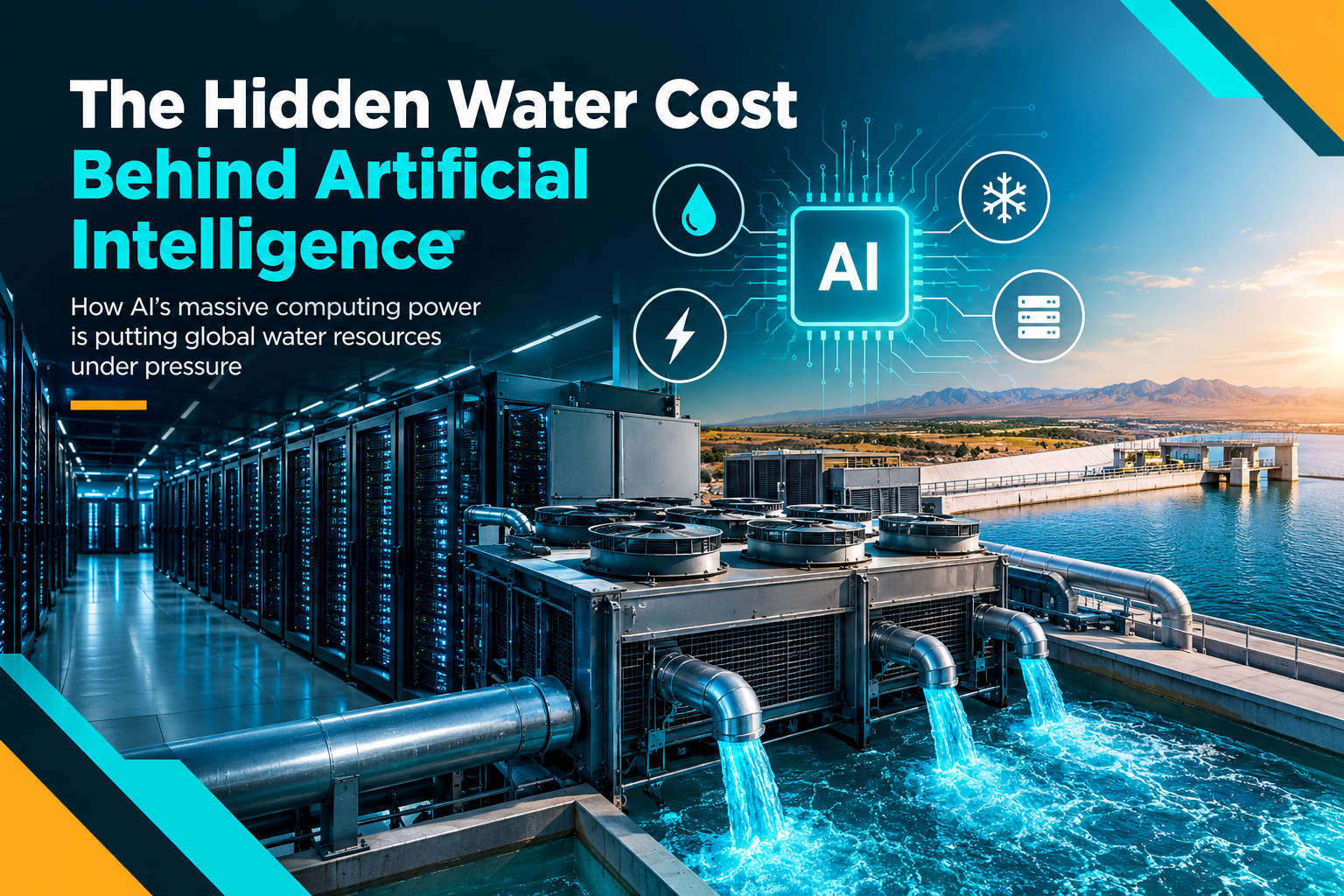
The hidden water cost behind artificial intelligence
Few people in Iowa probably imagined that the arrival of ChatGPT would become connected to the state's water resources.
Yet OpenAI's early infrastructure was reportedly connected to a supercomputer located near West Des Moines, close to the agricultural landscape of central Iowa. The location illustrates something that is becoming increasingly important in the AI economy: sophisticated computing infrastructure does not exist in a vacuum.
It needs electricity.
It needs buildings.
It needs cooling systems.
And, depending on the technology used, it can need substantial quantities of water.
Research examining the water footprint of AI has attempted to estimate how much water can be associated with interactions with systems such as ChatGPT. One widely discussed estimate suggested that a conversation involving a number of questions could correspond to roughly half a liter of water when indirect water consumption is included.
The important point is not whether every individual AI prompt literally consumes a bottle of water.
It doesn't.
The important point is that AI operates inside a physical infrastructure whose environmental costs are easy to overlook when the service appears to exist entirely on a screen.
Behind every question is computing equipment. Behind that computing equipment is a data center. And behind the data center are electricity generation, cooling systems, transmission networks and, in some cases, significant water consumption.
Microsoft's own numbers raise another question
The issue becomes even more interesting when looking at corporate disclosures.
Microsoft reported a significant increase in its global water consumption between 2021 and 2022, with the company's reported consumption rising by roughly 34%.
Google also reported an increase during the same period, with water consumption rising by around 20%.
These figures do not prove that artificial intelligence alone caused those increases. Data-center expansion, changing operations, geography and other industrial factors also matter.
But the timing coincides with a period in which the technology industry was rapidly increasing investment in AI infrastructure.
That is why the question deserves more attention.
The AI industry has spent enormous amounts of money competing for GPUs, advanced semiconductor manufacturing capacity, electricity and data-center space.
It may now have to compete for something much more basic.
Water.
Why cooling is becoming such a critical problem
Modern computing equipment produces enormous amounts of heat.
As processors become more powerful and data centers become denser, managing that heat becomes increasingly difficult. Traditional air cooling can work effectively in many environments, but it becomes less attractive as computing density rises.
Liquid-based cooling can transfer heat more efficiently than air because water and other liquids have much greater heat capacity.
This is one reason the growth of AI infrastructure is creating new interest in advanced cooling technologies.
But water-based cooling introduces another geographical constraint.
A data center can be built almost anywhere with sufficient land and electricity.
It cannot necessarily be operated economically and sustainably anywhere without considering water availability.
This distinction could become increasingly important as AI infrastructure expands beyond the current technology centers.
Cheap electricity is no longer enough
For years, countries competing for data centers could emphasize a familiar list of advantages:
- Cheap electricity
- Reliable power grids
- Political stability
- Fiber-optic connectivity
- Available land
- Tax incentives
- Renewable or nuclear energy
- Access to natural gas
Those factors remain extremely important.
But AI may add another item to the list:
This creates an unusual situation.
A country can have abundant natural gas and extremely cheap electricity, yet still be a difficult location for certain types of data-center development if freshwater is scarce.
The opposite can also be true.
A country with a cooler climate, abundant water and reliable electricity may become increasingly attractive even if it does not have the world's cheapest power.
This is where the geography of the AI race could begin to change.
North Africa faces a difficult equation
Consider North Africa.
Countries such as Algeria, Morocco, Tunisia, Libya and Egypt have different energy systems, climates and water situations, but they share a broad regional challenge: water availability is an increasingly important strategic issue.
For some of these countries, the energy side of the equation is attractive.
Algeria and Libya possess major hydrocarbon resources. Egypt has significant energy infrastructure and an important geographic position. Morocco has invested heavily in renewable energy. Tunisia has proximity to European markets and a relatively developed technology ecosystem.
Yet energy potential does not automatically translate into AI infrastructure potential.
A large AI data center needs reliable electricity around the clock, but it also needs a sustainable cooling strategy.
In a hot and dry climate, cooling becomes even more demanding.
This creates a potential contradiction.
The same countries that may have relatively attractive energy costs can face difficult conditions for conventional water-intensive cooling.
Algeria: energy abundance versus water constraints
Algeria is a particularly interesting example.
The country has substantial natural gas resources, a large electricity-generation system and geographic proximity to Europe.
On paper, these are useful advantages for data-center development.
But Algeria is also a water-stressed country, particularly when considering the distribution of water resources and the concentration of population and economic activity in the northern part of the country.
That means Algeria cannot simply copy the data-center model used in a cool, water-rich country and expect the same result.
If AI infrastructure expands substantially in Algeria, cooling technology will matter.
Air cooling, hybrid cooling, closed-loop systems, immersion cooling and other technologies could become more important precisely because water cannot be treated as an unlimited industrial resource.
The question therefore becomes less about whether Algeria has enough electricity and more about whether it can develop AI infrastructure with an acceptable water footprint.
The Gulf has the same problem in a different form
The Gulf states present an even more striking example.
The United Arab Emirates, Saudi Arabia, Qatar, Bahrain, Oman and Kuwait have enormous energy resources, sophisticated infrastructure and significant financial capacity.
Several of them are actively positioning themselves as future AI hubs.
But the region is also one of the most water-stressed parts of the planet.
The Gulf therefore presents an unusual AI equation:
abundant energy + abundant capital + advanced infrastructure + limited natural freshwater.
This does not mean Gulf countries cannot become major AI centers.
Quite the opposite.
Their financial resources allow them to invest in advanced cooling systems, desalination, nuclear power, renewable energy and highly engineered data-center infrastructure.
But it does mean that the traditional relationship between energy and computing may have to change.
A data center in the Gulf cannot assume that water is simply another inexpensive utility.
Water itself becomes part of the infrastructure strategy.
The countries that may gain an unexpected advantage
Now consider the opposite scenario.
Imagine a country with:
- A relatively cool climate
- Abundant freshwater
- Reliable electricity
- Low-carbon or inexpensive power
- Strong internet connectivity
- Political stability
- Large areas suitable for data centers
That country suddenly has an interesting competitive advantage.
This is one reason countries such as Canada, Norway and Iceland deserve attention in the long-term AI infrastructure race.
Canada combines enormous electricity resources with extensive freshwater availability and a generally cooler climate.
Norway has abundant hydropower and a cool climate, while Iceland offers abundant renewable electricity and naturally favorable temperatures for data-center operations.
Northern regions of the United States can also benefit from similar conditions, depending on the location and infrastructure.
These countries do not necessarily need to win the AI race by producing the largest number of AI models.
They can participate by providing something the AI industry increasingly needs:
places where enormous computing facilities can operate efficiently.
Climate could become an AI infrastructure asset
For decades, cold climates were often viewed primarily through the lens of their disadvantages.
Heating buildings costs money.
Winter weather can complicate construction and transportation.
But data centers have a completely different problem.
They need to get rid of heat.
A colder outside environment can therefore become an infrastructure advantage.
This is particularly interesting when combined with reliable electricity.
In some locations, favorable temperatures can reduce the amount of mechanical cooling required, while abundant water can provide additional options for cooling systems.
The result is that geography begins to matter in a new way.
The global AI map may not simply follow the map of semiconductor companies or technology headquarters.
It may increasingly follow the map of electricity, water and climate.
Egypt is a special case
Egypt deserves separate consideration because its water situation is fundamentally different from that of many other North African and Middle Eastern countries.
The Nile provides the overwhelming foundation of the country's freshwater system.
But Egypt also has a very large and growing population concentrated around a limited water resource, while the Nile basin is affected by complex regional developments, including the Grand Ethiopian Renaissance Dam.
This does not mean Egypt lacks water infrastructure or cannot develop data centers.
Rather, it means that water must be treated as a strategic resource with competing demands from households, agriculture, industry and energy.
An AI data center cannot be evaluated only according to how much electricity it consumes.
Its location should also be evaluated according to where its cooling water comes from, whether that water is freshwater, how much is actually consumed rather than circulated, and whether the system can operate without putting additional pressure on local water supplies.
Pakistan, Iran and other water-stressed economies face similar questions
The same logic extends beyond North Africa and the Gulf.
Countries such as Iran and Pakistan have significant energy resources, large populations and important regional markets, but both face substantial water-related challenges.
That creates a difficult strategic equation for AI infrastructure.
Cheap electricity can attract computing capacity.
But if cooling requires resources that are already under pressure, the economic advantage of cheap electricity can be partially offset.
This is an important distinction because AI data centers are not ordinary office buildings.
A large facility can represent an extremely concentrated industrial load.
The question is therefore not simply:
"How much electricity can this country provide?"
It is also:
"How much computing can this country support without creating unacceptable pressure on its water system?"
AI computing cannot remain concentrated forever
There is another reason this issue matters.
The United States currently dominates much of the world's AI computing ecosystem, while China represents another enormous center of technological and industrial capacity.
But global demand for AI computing is growing too quickly for the industry to assume that computing capacity can remain concentrated in only a handful of locations.
AI is being integrated into search, software development, robotics, finance, healthcare, manufacturing, defense, transportation and countless other industries.
The amount of computing required will continue to increase.
This means the world will need more data centers.
And eventually, those data centers will have to be distributed across different regions.
That distribution creates an opportunity for countries with favorable combinations of energy, water and climate.
The next AI competition may be about location
The first stage of the AI race was largely about algorithms and talent.
Then it became a competition for GPUs and semiconductor manufacturing.
Then electricity became one of the biggest constraints.
The next constraint may be more fundamental.
Where can we physically place all this computing?
A country with cheap gas but severe water scarcity may not have the same advantage as it appears to have on paper.
A country with abundant hydropower, freshwater and a cool climate may suddenly become much more attractive.
This does not mean water will replace electricity as the most important resource.
It means that the two have to be considered together.
The cheapest kilowatt-hour is not necessarily the cheapest environment in which to operate an AI data center.
The industry has to rethink what "efficient" means
There is also a broader issue here.
When technology companies discuss efficiency, the conversation often focuses on computational efficiency.
How many tokens can a GPU process?
How much computing power can a server deliver?
How much electricity does a model require?
These measurements are important, but they do not tell the whole story.
A genuinely efficient AI system should eventually be evaluated across a broader environmental equation:
Compute + electricity + cooling + water + carbon + infrastructure.
That is the real physical cost of artificial intelligence.
And as AI becomes larger, these factors become harder to separate.
Water-saving cooling technologies could change the equation
The good news is that water consumption is not necessarily a permanent limitation.
Technology itself can help solve the problem.
Data centers are already experimenting with increasingly sophisticated cooling architectures, including closed-loop liquid cooling, direct-to-chip cooling, immersion cooling, heat recovery and more efficient air-cooling systems.
The objective is not necessarily to eliminate water from every cooling system.
It is to reduce the amount of freshwater that must be consumed.
This distinction matters enormously for water-stressed countries.
A data center using a closed-loop system in a desert environment is a very different proposition from a facility that continuously consumes large volumes of freshwater.
Future competition could therefore reward not only countries with natural advantages, but countries capable of deploying water-efficient cooling infrastructure at scale.
The uncomfortable conclusion
Artificial intelligence is often presented as something almost weightless.
You type a question.
A response appears.
You open an AI application on your phone and everything seems digital.
But behind that interface are thousands of physical machines operating inside enormous industrial facilities.
Those machines consume electricity.
They generate heat.
They require cooling.
And cooling can require water.
The challenge for the AI industry is therefore not to stop developing.
The AI revolution is already underway, and demand is unlikely to disappear.
The challenge is to make sure that the physical infrastructure supporting that revolution is compatible with the planet's most basic constraints.
Water is one of them.
For countries such as Algeria, Morocco, Tunisia, Libya and many Gulf states, the question will not simply be whether they can generate cheap electricity.
It will be whether they can build large-scale computing infrastructure without turning scarce freshwater into an invisible cost of artificial intelligence.
For Canada, Iceland, Norway and other cooler, water-rich regions, the same constraint could become an opportunity.
And that could lead to an unexpected shift in the geography of artificial intelligence.
The countries that win the next phase of the AI race may not simply be those with the most GPUs.
They may be the countries that can provide the right combination of electricity, water, climate and computing infrastructure.
The AI race is becoming a physical race.
And increasingly, water is part of the battlefield.