Introduction
Electricity has become the single largest operating cost for many ASIC mining farms, GPU clusters, and small AI compute centers. In 2026, the conversation is no longer just about “going solar,” but about which hardware choices actually reduce long-term cost per kWh while keeping systems simple, reliable, and scalable.
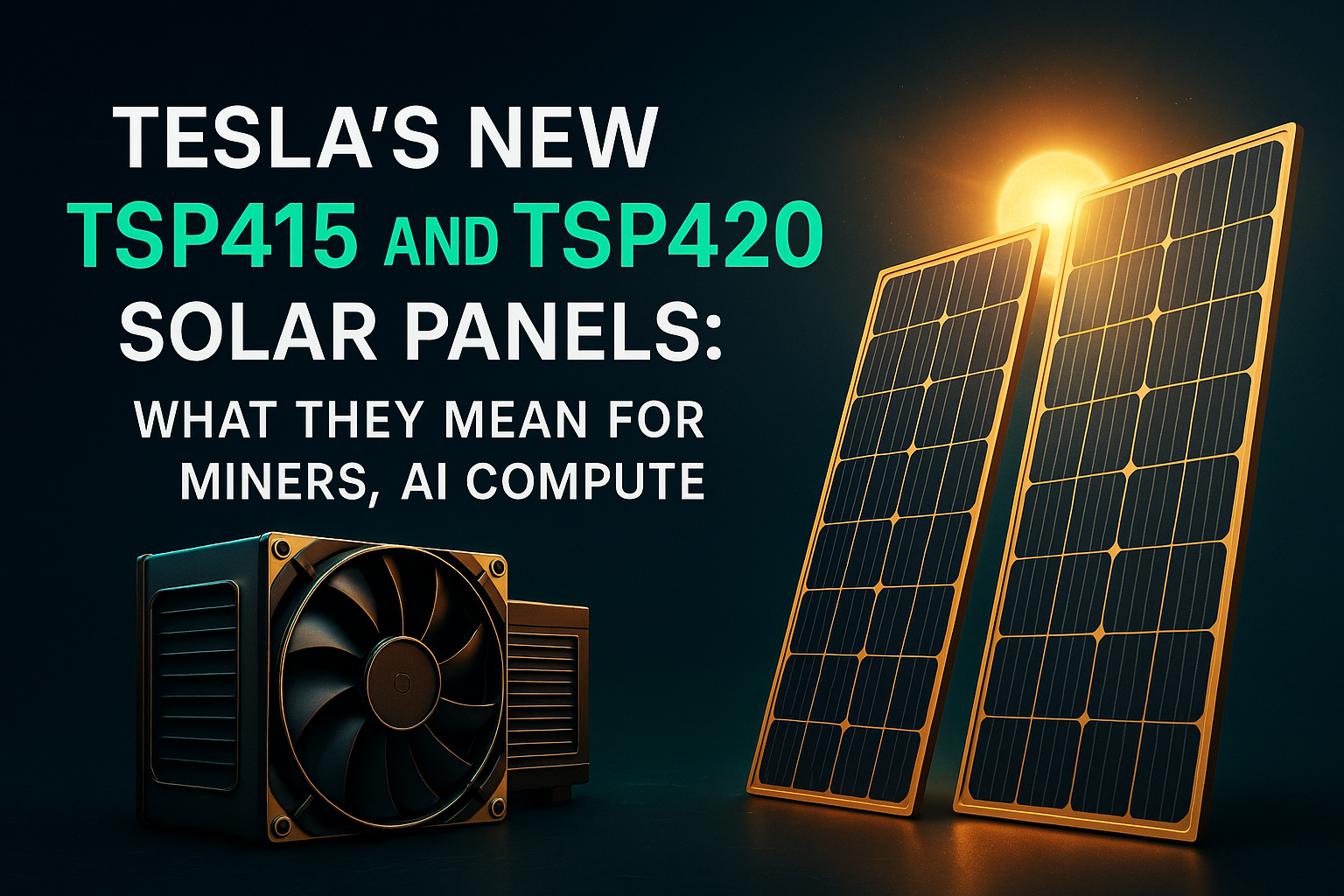
Tesla’s decision to design and manufacture its own solar panels—the TSP415 and TSP420—is a notable shift in the market. For years, Tesla Energy sold solar products that were largely built by partners. Now, with in-house manufacturing at the Gigafactory in Buffalo, New York, Tesla is signaling that energy hardware is no longer a side project, but a core business line.
This article breaks down what these new panels really offer, how they compare to current market standards, and—most importantly—what they mean for investors and operators running energy-hungry workloads like mining and AI.
Tesla’s Shift Toward In-House Energy Hardware
Historically, Tesla’s solar business was a mix of branding and partnerships. Inverters came from companies like Delta, panels were often sourced from manufacturers such as Qcells, and many systems relied on third-party solutions like SolarEdge for power electronics. Even after acquiring SolarCity, Tesla’s role in the solar ecosystem was not always clearly defined: was it a technology company, an installer, or simply a sales platform?
That ambiguity has been fading over the last few years. The launch and rapid adoption of Powerwall 3, now one of the best-selling home batteries in the U.S., marked a turning point. Tesla began bringing more of the critical hardware stack under its own control—design, integration, and now manufacturing.
The TSP415 and TSP420 panels are part of that strategy. They are not just another rebranded product; they are Tesla-designed and Tesla-built, starting in Buffalo and likely expanding to additional facilities as production ramps up. For investors watching Tesla Energy, this move suggests a long-term commitment to being a full-stack energy hardware company.
Basic Specifications: Power, Efficiency, and Positioning
Tesla introduced two models:
- TSP415: 415 W DC
- TSP420: 420 W DC
The numbers directly reflect the nominal DC output under standard test conditions. In today’s market, modules in the 400–450 W range are common for residential and small commercial installations, so Tesla’s offering sits comfortably in the mainstream category.
Efficiency: Solid, Not Class-Leading
Reported module efficiency for these panels appears to range roughly between ~20% and ~21%, depending on configuration and measurement source. To put that into context:
-
In 2026, panels above 22% efficiency are generally considered high-efficiency or premium.
-
Many cost-optimized, mass-market panels sit in the 20–21% range.
So, Tesla’s panels are not chasing record-breaking efficiency. Instead, they are clearly positioned as cost-efficient, mass-deployable modules. For mining and AI operators, this is often the right trade-off. When you are installing tens or hundreds of kilowatts, total system cost, reliability, and simplicity usually matter more than squeezing out an extra 1% of efficiency.
Warranty and Bankability
Tesla offers a 25-year product and performance warranty, which has effectively become the industry standard among Tier 1 manufacturers. This means two things:
-
Product warranty: The physical panel is covered against defects and failures.
-
Performance warranty: The panel is guaranteed to retain a specified minimum output over 25 years.
From an investor perspective, this puts Tesla’s panels in the same risk category as other established brands. For mining farms or AI operators planning multi-year deployments, this kind of warranty coverage is essential for financing models and long-term ROI calculations.
The 18 Power Zones: A Different Approach to Shade and Reliability
One of the most interesting design choices in Tesla’s new modules is the 18 independent power zones built into each panel.
Traditionally, shading has been managed in two main ways:
-
Bypass diodes inside the panel, which protect cells but still reduce output when part of a panel is shaded.
-
Module-level power electronics (MLPE) such as microinverters or DC optimizers, which allow each panel—or even parts of a panel—to operate more independently.
Tesla’s approach integrates more granular segmentation directly into the module. If one zone is shaded (for example, by a vent pipe, cable, or nearby structure), the other zones can continue operating closer to their optimal output.
Do We Still Need Optimizers and Microinverters?
This design supports a broader industry trend: moving away from module-level power electronics in favor of simpler, high-voltage DC-coupled systems.
There are real advantages to this shift:
- Fewer components on the roof
- Lower installation time and labor cost
- Fewer potential failure points over 20–30 years
- Easier maintenance and troubleshooting
Systems like Powerwall 3 and other modern battery-inverter platforms increasingly accept direct high-voltage DC input from solar arrays. For large energy users—like mining or AI facilities—this simplicity can translate into both lower capex and lower long-term opex.
However, it’s important to be realistic: extreme or complex shading scenarios may still benefit from MLPE. Tesla’s design reduces the need, but it does not magically eliminate all shading-related losses in every installation.
Installation Strategy: Rail-Less Mounting and Cost Control
Tesla’s new panels are designed to integrate with a rail-less mounting system. These systems attach panels directly to the roof structure without long aluminum rails running underneath.
From an engineering perspective, rail-less systems have pros and cons:
Advantages:
- Faster installation
- Fewer parts
- Lower material costs
- Potentially cleaner aesthetics
Trade-offs:
-
Less flexibility in panel positioning
-
Tighter tolerances during installatio
-
Some installers prefer traditional rails for complex roofs
Why does this matter for miners and AI operators? Because labor and balance-of-system costs often rival the price of the panels themselves. Anything that reduces installation time and hardware complexity can meaningfully lower the total cost per installed watt.
Tesla’s long-standing goal has been to push solar toward the lowest possible installed cost, not just cheaper modules. Rail-less mounting fits that philosophy.
Made in the USA: Supply Chains, Incentives, and Financing
Manufacturing these panels in Buffalo, New York positions Tesla to meet domestic content requirements in the U.S. market. This has several practical implications:
- Greater insulation from international supply chain disruptions
- Potential eligibility for domestic manufacturing incentives
- Easier compliance for projects that require U.S.-made components
The Role of Third-Party Ownership (TPO) in 2026
For many end users, especially in residential and small commercial segments, third-party ownership (TPO) models—leases and power purchase agreements (PPAs)—remain a key way to deploy solar.
Even as some direct homeowner tax credits have changed or expired, leasing companies can still monetize available incentives and pass part of that value to customers through lower monthly payments.
For mining and compute operators, this can be attractive in specific cases:
- Preserving capital for hardware instead of infrastructure
- Locking in predictable energy costs
- Reducing exposure to electricity price volatility
Tesla’s domestic manufacturing strengthens its position in these financing structures, making its panels more attractive to large integrators and energy service companies.
How Do These Panels Compare to High-End Alternatives?
It’s important to be clear: Tesla’s TSP415 and TSP420 are not premium, maximum-efficiency modules. You can find panels on the market with:
-
Higher efficiency (>22%)
-
Better temperature coefficients
-
More compact form factors for space-constrained sites
But those panels usually come at a higher price per watt.
Tesla’s strategy appears to focus on:
- Cost control
- System-level simplicity
- Vertical integration with batteries and inverters
- Scalable manufacturing
For large roofs, warehouses, mining sheds, or ground-mounted arrays where space is not the limiting factor, this is often the rational choice. The goal is not to win a lab efficiency contest—it is to minimize levelized cost of electricity (LCOE) over 20+ years.
What This Means for Mining and AI Compute Operators
For energy-intensive workloads, the real questions are practical:
- Can this reduce my long-term cost per kWh?
- Does it simplify my system architecture?
- Is it reliable and financeable at scale?
Tesla’s new panels, combined with DC-coupled battery-inverter systems, point toward simpler, more integrated energy stacks:
- Fewer conversion stages
- Fewer rooftop components
- Easier expansion and replication across sites
This matters especially for operators who want to standardize deployments across multiple locations or scale capacity quickly.
However, no panel choice should be made in isolation. Site conditions, load profiles, grid interaction, and local incentives all play a role. For some high-density urban sites, higher-efficiency panels may still make more sense. For many industrial or semi-rural installations, cost-optimized modules like Tesla’s could be the better economic decision.
| Category | TSP415 | TSP420 | Why it matters (Mining / AI / High-load users) |
|---|---|---|---|
| Nominal DC Power | 415 W | 420 W | Higher module wattage reduces module count for the same kW size (faster install, fewer connectors). |
| Module Efficiency (reported range) | ~19.8% – ~21% | Not “premium-high efficiency” (>22%), but can still be cost-effective if pricing + BOS is favorable. | |
| Efficiency Tier (2026 market) | Mainstream / cost-optimized | Often better ROI when roof/land area isn’t the limiting factor (warehouses, sheds, mining sites). | |
| Warranty | 25 years product + performance | Important for bankability, financing, and long-term LCOE calculations. | |
| Shade Mitigation Design | 18 internal power zones | Limits production loss from partial shading (vents, cables, nearby objects). | |
| MLPE Requirement (optimizers/microinverters) | Not inherently required (site dependent) | Fewer rooftop electronics = lower failure risk and lower maintenance cost. | |
| System Architecture Fit | High-voltage DC-coupled systems | Simplifies wiring and pairs well with modern battery-inverter platforms. | |
| Mounting | Tesla rail-less mounting system | Faster installation can reduce labor cost, a major part of total $/W installed. | |
| Manufacturing Location | USA — Buffalo, NY | Supports domestic content rules and reduces supply-chain risk. | |
| Best Use Case | Cost-efficient installs where space is available | Good for mining and AI sites focused on lowering long-term cost per kWh. | |
| Trade-offs vs premium panels | Lower efficiency than >22% class modules | If space is limited, premium high-efficiency modules may deliver more kWh per m². | |
Conclusion
Tesla’s **TSP415 **and TSP420 solar panels are not about pushing technical boundaries in efficiency. They are about control, integration, and cost discipline. By bringing panel manufacturing in-house, Tesla is aligning its solar hardware with its broader energy strategy centered on batteries, inverters, and simplified system design.
For miners, GPU farm operators, and AI compute investors, these panels represent a pragmatic option: not the most advanced on paper, but potentially among the most cost-effective when deployed at scale within an integrated energy system.
In a world where electricity costs increasingly define competitiveness, hardware choices like this are less about brand names—and more about long-term economics and operational simplicity.
FAQ
Q1: Are Tesla’s TSP415 and TSP420 high-efficiency panels?
No. With efficiency around 20–21%, they are solid mainstream panels, not premium high-efficiency models (>22%).
Q2: What is the main advantage of the 18 power zones design?
It improves tolerance to partial shading by allowing different sections of the panel to operate more independently, reducing overall power loss.
Q3: Do these panels eliminate the need for microinverters or optimizers?
Not in every situation, but they support a growing trend toward simpler, DC-coupled systems with fewer rooftop electronics.
Q4: Are these panels suitable for mining farms and AI compute sites?
Yes, especially for sites where space is available and the priority is lowering total system cost rather than maximizing efficiency per square meter.
Q5: Does U.S. manufacturing affect financing options?
It can. Domestic production may improve access to certain incentives and makes the panels more attractive for third-party ownership and large-scale deployments.
Q6: Should I choose these over higher-efficiency panels?
It depends on your site constraints and financial model. If space is limited, higher-efficiency panels may make sense. If cost per kWh is the priority and space is available, cost-optimized panels like these can be the better choice.