Why Battery Storage Matters for High-Load Compute
Electricity is no longer just a utility cost for miners and AI operators—it is the core operational risk. ASIC farms, GPU clusters, and small AI compute centers run 24/7, often in regions where grids are either expensive, unstable, or both. Solar and wind can reduce long-term energy costs, but without storage, they cannot guarantee uptime or predictable performance.
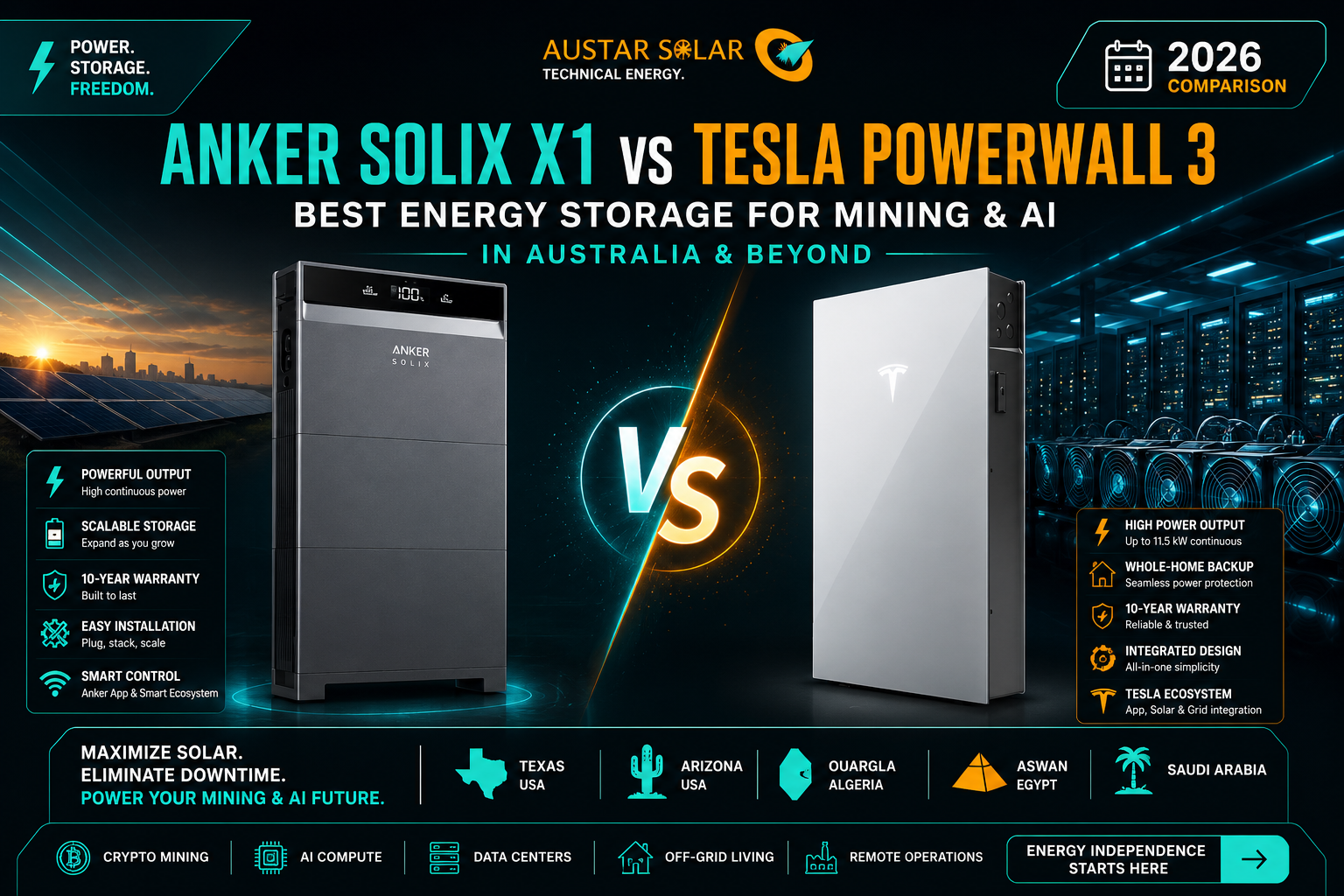
Battery systems solve this problem by turning intermittent renewable energy into a controllable, dispatchable resource. In 2026, two names keep appearing in serious discussions: Tesla Powerwall 3 and Anker Solix X1. Both are designed for residential and light commercial use, but their design philosophies are very different—and those differences matter a lot for investors, miners, and operators planning energy-heavy infrastructure.
This article compares both systems across six practical categories: power, storage capacity, warranty, cost, ease of installation, and a final “X-factor” that covers features not easily captured by specs alone. The goal is not to declare a universal winner, but to help you understand which approach fits your use case—especially if you are running or planning high-consumption workloads like mining or AI compute.
We will also put these systems into global context by referencing some of the world’s strongest solar regions—Texas, Arizona, Ouargla (Algeria), Aswan (Egypt), and Saudi Arabia—where battery-backed solar makes the most economic sense.
The Global Solar Context: Where Storage Makes the Most Sense
Before diving into hardware, it is important to understand where these systems shine the most.
Texas and Arizona (USA): High solar irradiance, long sunny seasons, and growing pressure on the grid from data centers and crypto mining make battery-backed solar increasingly attractive.
Ouargla, Algeria: One of North Africa’s strongest solar regions, with extremely high sun exposure and massive potential for off-grid or hybrid energy systems.
Aswan, Egypt: A benchmark location for solar in the MENA region, with stable sunshine and large-scale solar already proven at utility scale.
Saudi Arabia: Vast solar resources, ambitious renewable targets, and increasing interest in data centers and compute infrastructure.
In all these regions, the economics are similar: solar is cheap and abundant, but storage is what turns cheap energy into reliable energy. That is where systems like Powerwall 3 and Solix X1 come in.
Evaluation Framework: Six Practical Categories
We will look at both systems using six real-world criteria:
-
Power output (how much load the system can support at once)
-
Storage capacity (how long it can run your loads)
-
Warranty and longevity
-
Cost and value per kWh
-
Ease of installation (which directly affects total project cost)
-
X-Factor (unique features that can change real-world usability)
Each category is scored on a five-point scale for a conceptual total of 30 points, not as marketing, but as a structured way to compare design choices.
Tesla Powerwall 3: Integrated and High Power Density
Power Output
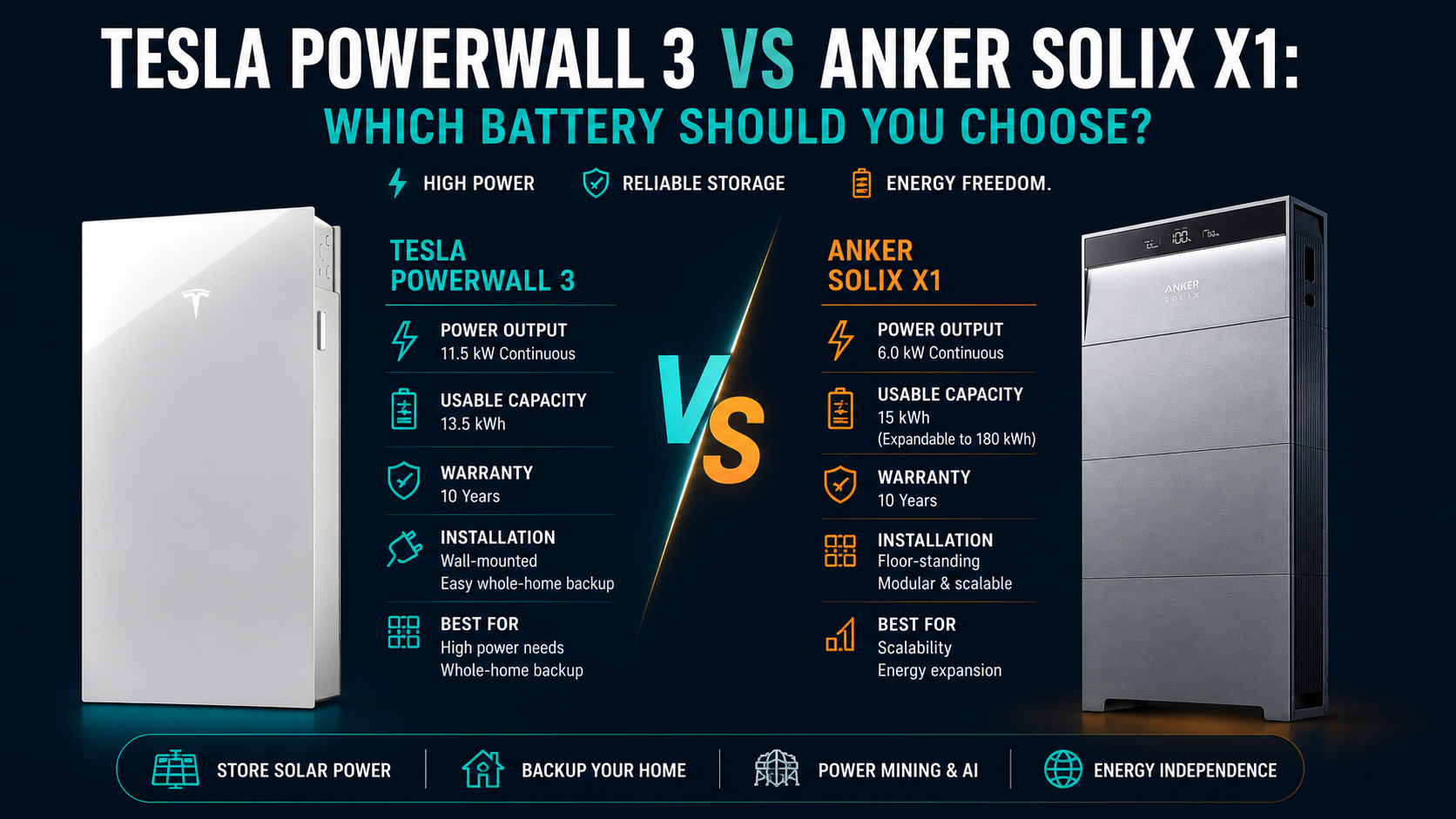
The Tesla Powerwall 3 delivers roughly 11 to 12 kW of continuous power from a single unit. That is a very high figure for an all-in-one residential battery system. In practical terms, this is enough to handle:
- Large HVAC systems
- Electric water heaters
- A full set of standard household loads at the same time
For small mining setups or edge AI servers, this level of power means you can run several kilowatts of compute without instantly hitting the system’s ceiling. For many users, one unit can cover most “whole house” or “small workshop” scenarios, at least in terms of instantaneous power.
Storage Capacity
Powerwall 3 offers around 13 to 14 kWh of usable storage per unit. This is similar to previous Powerwall generations. In real-world terms:
- This is usually enough for critical loads for about a day.
- For heavier loads (like mining rigs or AI servers), runtime will be much shorter.
- True full-day autonomy under heavy compute loads typically requires two or more units, bringing total storage to roughly 26–28 kWh or more.
Tesla’s strategy here is clearly power-first, storage-second. You get strong output per unit, but moderate energy capacity.
Warranty and Longevity
Tesla provides a 10-year warranty, which has become the industry baseline for serious home and small commercial battery systems. While some niche products advertise longer coverage, 10 years is currently the realistic standard for lithium-based storage in this class.
For investors, what matters more than the number itself is Tesla’s track record in battery manufacturing and large-scale deployment, which reduces long-term technology risk.
Cost and Value
The Powerwall 3 sits on the lower-to-middle end of the premium battery market. It is not the cheapest option—especially with many low-cost Asian brands entering the market—but it offers a strong value proposition because:
- The system integrates the inverter and battery in one unit.
- This can reduce the need for separate inverter hardware.
- Fewer components often mean lower system complexity and potentially lower installation costs.
When comparing cost, it is more useful to look at total system cost per usable kWh, not just the sticker price of the battery.
Ease of Installation
Here, the Powerwall 3 is a mixed case. The unit weighs roughly 130–140 kg (around 300 lbs), which means:
-
Installation usually requires more than two technicians.
-
In some cases, lifting equipment is needed.
However, Tesla’s backup switch (meter collar adapter) is a major advantage. It allows whole-house backup without complex rewiring, transfer switches, or rebuilding critical load panels. This can:
- Save significant labor time.
- Reduce disruption inside the building.
- Lower overall project risk.
In practice, this balances out to moderate installation complexity: physically heavy, but electrically streamlined.
X-Factor: Ecosystem and Integration
Tesla’s biggest intangible advantage is ecosystem integration. If you already use Tesla solar, EVs, or energy management software, everything lives in one platform and one app. The industrial design is also among the cleanest in the market, which matters more than many people admit—especially in residential or client-facing environments.
Anker Solix X1: Modular and Storage-Focused
Power Output
Each Solix X1 power module provides about 6 kW of continuous output. On its own, this is lower than a Powerwall 3, but the system is designed to scale:
- Two power modules can be combined for around 12 kW.
This makes it competitive with Tesla in total output for whole-house or small commercial setups. For mining or AI workloads, this modular approach allows you to match power capacity more precisely to your load profile.
Storage Capacity
This is where the Solix X1 clearly differentiates itself. The system uses stackable battery modules, each around 5 kWh. A typical configuration can reach:
-
15 kWh in a single stack (three modules).
-
Up to 30 kWh or slightly more per power module with expanded configurations.
In practice, this means you can design systems that prioritize longer runtime rather than just peak power—a major advantage for overnight operation, off-grid setups, or regions with unstable grids.
Warranty and Longevity
Like Tesla, Anker offers a 10-year warranty, aligning with current market standards. The more interesting aspect here is modularity: if one module fails outside warranty, you replace a part, not the entire system, which can reduce long-term maintenance risk and cost.
Cost and Value
The Solix X1 is positioned as very competitive on a cost-per-kWh basis, especially as you scale storage upward. Because the system is modular:
- You can start smaller and expand later.
- You avoid overpaying for unused capacity at the beginning.
- The total cost scales more linearly with actual needs.
For mining and AI operators who often expand in phases, this flexibility has real financial value.
Ease of Installation
This is one of the strongest points of the Solix X1. No single module weighs more than about 90 kg (under 200 lbs), which means:
- Two technicians can handle the entire installation.
- No special lifting equipment is usually required.
Installation is faster, safer, and cheaper in labor terms. For projects in remote or developing regions—such as parts of Algeria, Egypt, or rural Saudi Arabia—this can make a huge difference in total project feasibility.
X-Factor: Redundancy and Generator Integration
The Solix X1 platform supports generator recharging, which adds a third energy source on top of solar and the grid. This is extremely valuable for:
- Off-grid mining or compute sites.
- Regions with long grid outages.
- Operations that cannot afford extended downtime.
In bad weather or during prolonged grid failures, a generator can recharge the batteries, after which the system returns to silent, solar-based operation. This hybrid resilience is a serious advantage for mission-critical compute.
Side-by-Side Summary (Conceptual Scoring)
While exact numbers depend on configuration, a practical comparison looks like this:
Power:
-
Powerwall 3: Strong single-unit output (high score).
-
Solix X1: Scales with modules (slightly lower per unit, strong in multi-module setups).
Storage:
-
Powerwall 3: Moderate per unit.
-
Solix X1: Excellent scalability and higher maximum capacity per system.
Warranty:
- Both: 10 years, industry standard.
Cost:
- Both: Competitive, with Solix often winning on cost per kWh at larger sizes.
Installation:
-
Powerwall 3: Electrically simple, physically heavy.
-
Solix X1: Physically easy, modular, faster to deploy.
X-Factor:
-
Powerwall 3: Ecosystem integration and design.
-
Solix X1: Generator support and true modular resilience.
In a typical scoring model, Powerwall 3 might land around 20 points, while Solix X1 could reach 22–23 points, mainly due to modularity and installation advantages. But the “winner” depends entirely on your use case.
What This Means for Mining and AI Compute
For small to medium mining farms or edge AI clusters in high-solar regions like Texas, Arizona, Ouargla, Aswan, or Saudi Arabia:
-
If you need high instantaneous power in a compact, integrated package, Powerwall 3 is attractive.
-
If you need longer runtime, gradual scaling, and maximum installation flexibility, Solix X1 is often the better engineering choice.
In both cases, the real value comes from combining solar generation with storage to stabilize energy costs, reduce grid dependence, and protect uptime.
On paper, both systems look similar. In reality, they behave very differently under continuous load.
Real-World Runtime Comparison (Mining & AI Workloads)
| Scenario | Load | Powerwall 3 | Solix X1 |
|---|---|---|---|
| 1 ASIC Miner (S21 class) | ~3 kW | ~4–5 hours | ~5–10 hours* |
| 2 ASIC Miners | ~6 kW | ~2 hours | ~3–6 hours* |
| Small GPU Rig / AI Node | 1–2 kW | ~6–10 hours | ~8–15 hours* |
| Home + Compute Hybrid Load | 3–5 kW | ~3–5 hours | ~5–12 hours* |
| Best Use Case | — | High Power / Short Duration | Long Runtime / Scalable Storage |
*Solix X1 runtime depends heavily on the number of battery modules installed.
Conclusion
Tesla Powerwall 3 and Anker Solix X1 represent two different philosophies of energy storage in 2026. Tesla focuses on high power density and ecosystem integration, while Anker emphasizes modularity, scalability, and installation efficiency.
For miners and AI compute operators, the decision should not be based on brand or marketing, but on load profile, expansion plans, installation constraints, and local energy conditions—especially in high-solar regions like Texas, Arizona, Ouargla, Aswan, and Saudi Arabia.
In short: both are strong tools. The smarter investment is the one that fits your operational reality, not just your spec sheet.
FAQ
Q1: Can these systems realistically power mining rigs or AI servers?
Yes, but usually as part of a hybrid system with solar and possibly the grid or a generator. They are best for reducing peak costs and improving uptime, not for running large farms alone.
Q2: Which system is better for off-grid setups?
The Anker Solix X1 has an advantage due to modular scaling and generator integration, which adds an extra layer of redundancy.
Q3: Is 13–14 kWh enough for serious compute loads?
For heavy loads, no. You will typically need multiple battery units or a larger modular system to get meaningful runtime.
Q4: How important is installation complexity in total cost?
Very important. Labor, equipment, and time can add a significant percentage to total project cost, especially in remote regions.
Q5: Do these systems make more sense in high-solar regions?
Absolutely. In places like Texas, Arizona, Ouargla, Aswan, and Saudi Arabia, high solar output makes battery-backed systems far more economical.
Q6: Should investors prioritize power or storage capacity?
It depends on the workload. Short, high peaks favor power; long, steady loads favor storage. Most compute operations need a balance of both.
Disclosure: This article is not sponsored, not paid for, and not affiliated with Tesla or Anker. The comparison is based on publicly available manufacturer specifications and independent technical analysis for educational purposes only.