
INTRODUCTION
Choosing a hardware wallet is one of the most important security decisions in crypto. Most people assume that “getting hacked” is the main danger. In reality, data from blockchain analytics firms and incident reports tell a different story: the majority of losses come from user mistakes, not from sophisticated exploits.
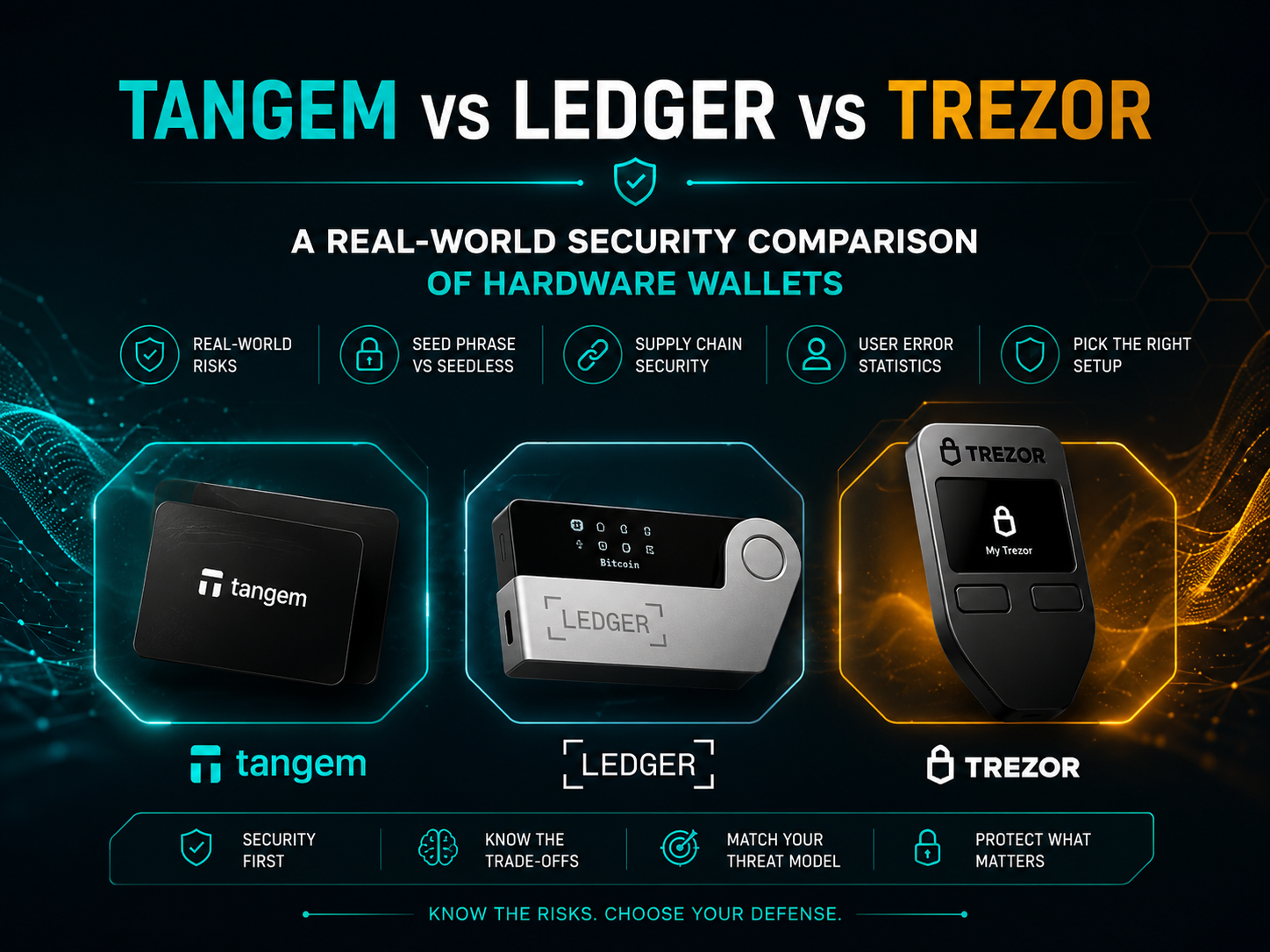
This article compares three popular approaches to cold storage—seed phrase wallets (like Ledger and Trezor) and seedless card wallets (like Tangem). The goal is not to declare a perfect winner, but to map the real-world risks, show where people actually lose funds, and explain how different designs shift those risks around.
No wallet is magic. Every model has trade-offs. But understanding where failures usually happen can help you pick the setup that fits your habits and threat model.
How People Really Lose Their Crypto
Public reports from companies such as Chainalysis consistently show the same pattern: most losses are caused by social engineering and user error, not by direct cryptographic breaks.
Yes, vulnerabilities exist. But cases where a regular user follows basic security practices and still gets drained by a pure protocol exploit are relatively rare. The largest category of losses comes from people being tricked into giving away sensitive information:
- Phishing emails and messages
- Fake websites and wallet interfaces
- Malicious browser extensions or apps
- Scam SMS and social media links
In 2025 alone, well over 100,000 wallets were reportedly drained through phishing-style attacks. In almost all of these cases, the attacker did not “hack” the blockchain or break encryption. They convinced the user to hand over the keys.
This matters because different wallet designs expose users to different kinds of mistakes.
Seed Phrase Wallets: Ledger and Trezor
What a Seed Phrase Actually Is
Wallets like Ledger and Trezor are based on a seed phrase (usually 12 or 24 words). This phrase is a human-readable representation of your master private key. If you lose your device, you can restore everything by entering those words on a new wallet.
This design has a huge advantage: you are never locked out as long as you still have the seed. But it also creates the single biggest target for attackers.
If someone gets your seed phrase, they don’t need your device. They don’t need to “hack” anything. They can simply import your wallet elsewhere and drain it.
The Real Risk: Humans, Not Hardware
In practice, scammers don’t attack the chip inside your wallet. They attack you.
They pretend to be:
- Wallet support
- A “security update” page
- A DeFi website asking for “verification”
- A fake app or browser extension
Beginners are especially vulnerable because the concept of a seed phrase is abstract and confusing. Many people don’t fully internalize that:
Anyone who sees these words owns your funds.
Ledger and Trezor devices themselves are well-engineered. The weak point is how easy it is for users to be tricked into revealing the seed. And statistically, this is where the majority of real-world losses happen.
Firmware and Supply Chain Risk
There is another, more subtle risk: firmware updates and the software supply chain.
Hardware wallets need updates to fix bugs and add features. That means users must trust that:
- The company’s update infrastructure is secure
- The code being shipped is not malicious
- The distribution process hasn’t been compromised
We have already seen real incidents in this area. In late 2023, a supply chain attack involving Ledger’s ecosystem allowed attackers to push malicious code through a compromised component, leading to hundreds of thousands of dollars in losses. The secure element inside Ledger devices wasn’t “broken,” but the surrounding software stack was abused.
Trezor deserves credit here for being open source, which allows the community to audit code. That doesn’t eliminate risk, but it does improve transparency.
The key point: with seed phrase wallets, part of your risk sits with the company and its update pipeline, not just with you.
Tangem: A Different Security Model
Tangem takes a noticeably different approach.
No Updatable Firmware
Tangem card wallets are designed so that their firmware is not updatable. This removes an entire class of supply chain and backdoor update risks. If there is no update channel, attackers can’t abuse it.
That’s a real security trade-off: fewer features and less flexibility, but also a smaller attack surface.
Seedless Mode: Removing the Biggest Target
Tangem allows two setups:
- A traditional seed phrase backup
- A seedless mode (which Tangem recommends)
In seedless mode, the private key never leaves the cards. It is generated and stored inside two or three physical cards, and there is no recovery phrase written on paper or stored in a file.
This design does something very important: it removes the most common failure point in crypto security—the seed phrase that can be copied, photographed, phished, or pasted into the wrong website.
You can’t leak what you don’t have.
Instead, security shifts to physical custody: you must keep your cards safe and stored separately.
The Real Risks of Tangem
No system is risk-free. Tangem simply moves the risk to different places.
1- Losing All Cards (and the PIN)
If you lose all your cards and forget your PIN, your funds are gone. There is no seed phrase to rescue you. This is the price of eliminating seed phrase exposure.
In practice, this is similar to losing both your hardware wallet and your backup—but here it is more explicit and more final.
2- Blind Signing and Phone Compromise
Tangem cards do not have screens. Transaction details are shown on your phone, not on the card itself. This means you must trust that your phone is displaying the correct information.
In theory, a heavily compromised phone could:
- Show you a fake transaction screen
- Swap the destination address in the background
- Trick you into signing something you didn’t intend
This kind of attack is well known in the world of hot wallets and infected PCs. So far, there are no public cases of this happening to Tangem users, and executing such an attack is complex. Still, the risk exists in principle, which is why basic phone hygiene (updates, no shady apps, no rooted devices) matters.
3- Physical PIN Attacks
In 2025, security researchers demonstrated that with specialized equipment and physical access, it is possible to brute-force weak PIN codes on Tangem cards. A simple 4-digit PIN can be cracked relatively quickly. An 8-digit PIN, by contrast, would take hundreds of days with the same method.
This is not a “street thief” attack. It requires tools and expertise. And it is easily mitigated by using a longer PIN.
Putting the Risks Side by Side
Ledger and Trezor (Seed Phrase Wallets)
Risk is split in two places:
1- Company and supply chain
- Firmware updates
- Software distribution
- Infrastructure security
2- User behavior
- Protecting the seed phrase
- Avoiding phishing and fake apps
- Understanding what never to share
Statistically, the second category dominates. Estimates often suggest that 80–90% of user losses are tied to mistakes around key management and social engineering.
| Feature | Ledger & Trezor | Tangem (Seedless) |
|---|---|---|
| Private Key Origin | Derived from a 12/24 word Seed Phrase | Generated & locked inside the chip |
| Primary Vulnerability | Phishing / Social Engineering | Physical loss of all cards |
| Firmware Type | Updatable (Potential software hooks) | Immutable (Audited, non-updatable) |
| Recovery Logic | Manual backup on paper/steel | Card-to-card NFC backup (No paper) |
| Screen Verification | On-device (Trusted Display) | Smartphone-based (Requires clean OS) |
| Security Chip | Secure Element / Multi-chip setup | EAL6+ Certified Military Grade Chip |
| Real-world Risk | Storing digital copies of seed phrases | Storing all cards in the same location |
| Ecosystem Maturity | Industry Standard (Wide App Support) | Innovative / High Portability |
The table above summarizes the core security differences between traditional seed phrase wallets like Ledger and Trezor and Tangem’s seedless card-based approach. Instead of focusing on theoretical attacks, it highlights where risks actually appear in real-world usage: user mistakes, phishing exposure, firmware trust, and physical custody. This side-by-side view makes it easier to see how each design shifts security responsibility either toward managing a recovery phrase or toward protecting physical cards and the smartphone environment.
Tangem (Seedless Mode)
Risk shifts to:
-
Physical security
- Keeping multiple cards safe
- Not losing all backups
-
Device hygiene
- Keeping your phone clean and updated
- Avoiding malware and shady apps
These failure modes represent a much smaller share of real-world losses today compared to seed phrase leaks and phishing.
From a purely statistical perspective—based on how people actually lose crypto—removing the seed phrase from the equation can reduce the most common type of catastrophic mistake. That’s why many users argue that a seedless model can be several times safer for the average person, even if it introduces different, more physical risks.
Which One Should You Choose?
There is no universal answer.
-
If you want maximum transparency, ecosystem maturity, and flexibility, seed phrase wallets like Trezor and Ledger are proven tools—as long as you are disciplined about seed security.
-
If you want to minimize the most common human errors and are comfortable managing physical backups, a seedless approach like Tangem can significantly reduce your exposure to phishing and social engineering.
The most important insight is this: Crypto security is not just about cryptography. It is about human behavior. The safest wallet is the one whose failure modes you are least likely to trigger.
Conclusion
Most people don’t lose crypto because encryption fails. They lose it because they are tricked, rushed, or confused. Seed phrase wallets concentrate risk around one extremely sensitive secret that users often mishandle. Seedless designs like Tangem remove that secret but replace it with physical custody and device security concerns.
Neither model is perfect. But if you look at real-world loss data, eliminating seed phrase exposure removes the single biggest source of user-driven disasters. For many everyday users, that alone can be a meaningful security upgrade—provided they take physical backup and phone security seriously.
In the end, good security is not about chasing “the best wallet.” It’s about choosing the risk profile you can manage reliably over the long term.
FAQ
Q1: Are hardware wallets completely safe from hacking?
No. They are much safer than hot wallets, but risks still exist—especially from phishing, malware, and supply chain issues.
Q2: Why are seed phrases such a big target?
Because anyone who gets your seed phrase can take your funds without your device. It’s the single point of total failure.
Q3: Does Tangem really not use a seed phrase?
In seedless mode, no. The private key stays inside the cards, and recovery depends on having your backup cards.
Q4: What happens if I lose all my Tangem cards?
Your funds are permanently lost. That’s the trade-off for removing seed phrase risk.
Q5: Is blind signing a serious risk?
It’s theoretically possible if your phone is badly compromised, but there are no known real-world Tangem cases so far. Basic phone security greatly reduces this risk.
Q6: Is Trezor safer than Ledger because it’s open source?
Open source improves transparency and auditability, but it doesn’t remove all risks, especially those related to user behavior and phishing.
Q7: Which wallet is best for beginners?
Beginners often struggle most with seed phrase management. For them, a seedless model can reduce the most common mistakes—if they are careful with physical backups.