Introduction
For investors who have moved beyond simply buying and holding cryptocurrency, the banking problem can become almost as important as the investment itself.
Moving a large amount of money from a crypto exchange into a traditional bank can trigger additional compliance checks, requests for source-of-funds documentation, or delays. That does not necessarily mean the transaction is suspicious. It reflects the fact that banks have strict obligations when dealing with large or unusual transactions.
This is where Sygnum Bank takes a different approach.
Headquartered in Switzerland with a major footprint in Singapore, Sygnum is a fully regulated digital asset bank. Instead of treating crypto like an outsider to standard banking, they built their entire model around connecting traditional financial infrastructure directly with digital assets.
That makes Sygnum particularly relevant to professional investors, companies, and institutions that need regulated access to both fiat and crypto.
What Is Sygnum Bank?
Sygnum is a Swiss-regulated bank focused on Digital assets and institutional financial services. Its client base includes professional and institutional investors, corporations, banks, financial institutions, and companies operating in the distributed-ledger technology sector.
It is important to clarify one point before considering the bank.
Sygnum is not a conventional retail bank for everyone. The bank states that it does not onboard retail clients and has specific eligibility requirements for private qualified investors. For private qualified investors, Sygnum currently states that a deposit or trading volume of at least CHF 50,000 is required to begin a business relationship.
The qualification requirements themselves can be more demanding than the initial deposit requirement. Under Swiss rules, private individuals qualifying as private qualified investors generally need sufficient financial knowledge and assets of at least CHF 500,000.
This distinction matters because the headline minimum and the overall eligibility requirements are not the same thing.
Crypto Banking Instead of Crypto-Friendly Banking
There is a difference between a bank that simply accepts money originating from a cryptocurrency exchange and a bank that has built infrastructure specifically for digital assets.
Sygnum belongs to the second category.
Its services include cryptocurrency custody, trading, staking, tokenisation, and other digital-asset services alongside conventional banking infrastructure.
This structure can be useful for investors who do not want their crypto holdings completely separated from their traditional financial accounts.
The bank also offers custody structures designed to protect client crypto assets from the bank's own balance-sheet risk. Sygnum states that client crypto assets are held off balance sheet and are bankruptcy remote. Fiat deposits are covered by Switzerland's deposit-protection framework up to CHF 100,000 per client.
Bitcoin, Ethereum and Other Digital Assets
One of Sygnum's main differences is the depth of its digital-asset infrastructure.
Instead of sending cryptocurrency to an external exchange every time an investor wants to trade, clients can access digital-asset services within a regulated banking environment.
The exact assets and services available depend on the client, jurisdiction, and product.
This is particularly relevant to professional investors who need custody, execution, reporting, and banking services within a single relationship.
Sygnum also provides staking services for supported proof-of-stake assets. For investors already holding assets such as Ethereum, this can provide access to staking without moving the assets into an unrelated consumer platform.
Crypto-Backed Lending
Another important feature is lending against digital assets.
The basic idea is straightforward: instead of selling Bitcoin or another supported asset to obtain liquidity, an eligible client may be able to use the asset as collateral for a loan.
This can be useful when an investor needs liquidity but does not want to immediately dispose of a long-term position.
However, crypto-backed borrowing should not be confused with free liquidity.
Your collateral is still at the mercy of market swings. If the value takes a serious dive, your loan-to-value ratio gets thrown off. Depending on your agreement, that could force you to put up more assets to cover the difference—or even trigger a liquidation.
The tax treatment also depends entirely on the investor's jurisdiction.
How Does Sygnum Compare With a Traditional Bank?
A traditional private bank may be very comfortable handling large fiat balances, securities, and international transfers while having limited infrastructure for Bitcoin.
A crypto exchange, on the other hand, may provide excellent trading infrastructure but is not necessarily designed to replace a private banking relationship.
Sygnum sits between those models.
The idea is not simply to make crypto acceptable to a bank. It is to make digital assets part of a regulated financial relationship.
That distinction becomes increasingly important as institutional investors move larger amounts of capital into the crypto market.
Opening a Sygnum Account
The onboarding process is designed for professional clients rather than mass-market retail users.
Sygnum states that private client accounts are typically opened within around two weeks after the required documentation is completed, although some cases can be completed faster and more complex cases can take longer.
The required documentation depends on the type of client and the onboarding method.
This is normal for a regulated bank dealing with substantial financial assets.
Investors should therefore expect questions about identity, residence, source of wealth, source of funds, and the intended use of the account.
Fees and Costs
One of the most important differences between Sygnum and an ordinary digital bank is that pricing is not necessarily presented as a simple consumer subscription.
Sygnum states that onboarding for private individuals is free, while different screening or opening fees can apply to corporate and institutional clients.
Other costs depend on the services being used, including custody, trading, financing, and other institutional products.
For that reason, investors should request a complete fee schedule rather than relying on a single headline number.
Who Is Sygnum Bank For?
Sygnum is primarily relevant to people who need more than a normal crypto exchange account.
That includes:
-
Professional crypto investors
-
Family offices
-
Digital-asset companies
-
Institutional investors
-
Blockchain businesses
-
Financial institutions
-
Investors seeking regulated crypto custody
It is less relevant to someone who simply wants a low-cost bank account for everyday spending.
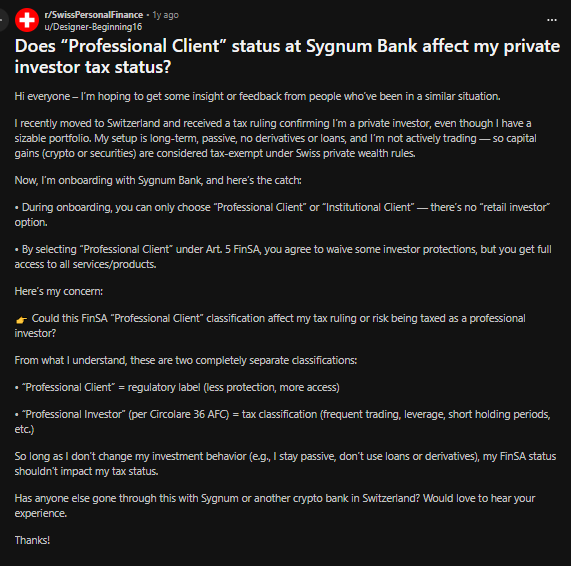
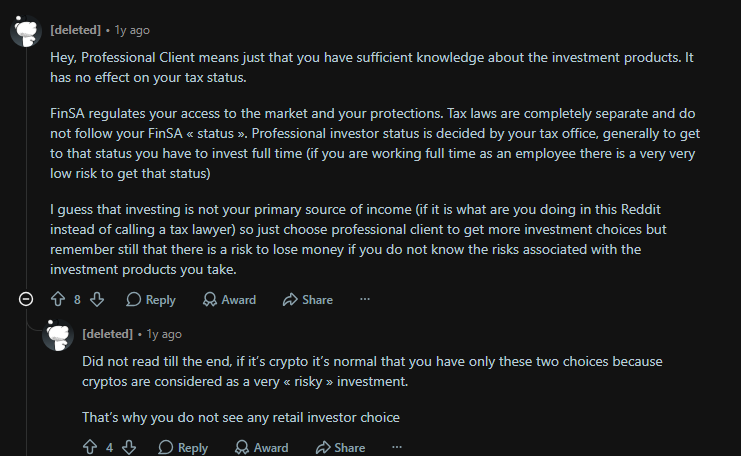
Reddit Community Review: Sygnum Bank and Professional Client Status
What to Make of This
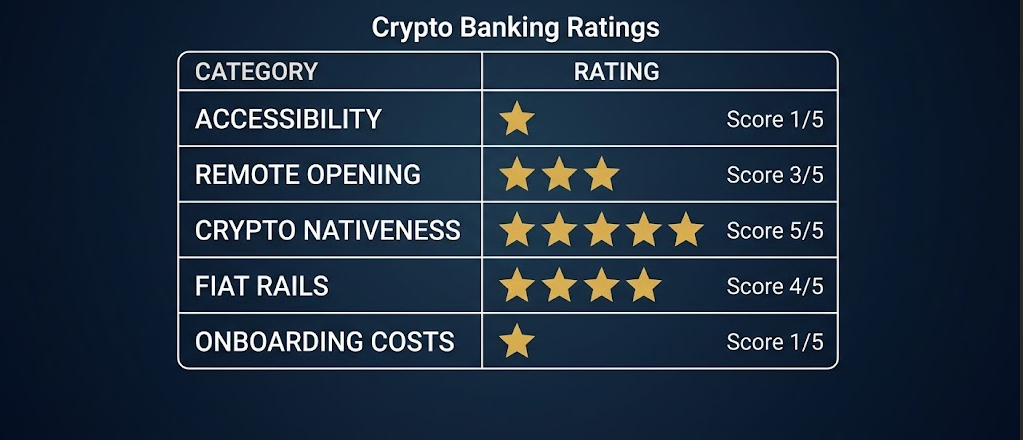
This Reddit thread brings up a common point of confusion for anyone going through Sygnum Bank's onboarding for the first time: getting categorized as a "Professional Client" is strictly a regulatory status, not your personal tax classification.
The discussion also highlights why onboarding at Sygnum feels nothing like opening a standard retail bank account. Because they focus on institutional and accredited investors rather than everyday retail clients, the rules around product access and investor protections are completely different.
As always, take forum posts with a grain of salt—individual Reddit comments aren't official tax advice or bank policy. How you're classified and how your investments are taxed will depend entirely on your specific situation and local regulations.
If you're considering Sygnum, keep your account status, regulatory standing, and tax obligations in separate buckets. If you aren't 100% clear on the tax side of your investments, verify the details with Sygnum and run them by a qualified tax advisor before moving forward.
Final Thoughts
Sygnum's main proposition is not that it makes banking easier for every crypto holder.
Its proposition is more specific: it provides regulated banking infrastructure designed to accommodate digital assets alongside traditional finance.
That makes it particularly interesting for investors and businesses operating at a professional level.
The most important thing to understand before applying is that Sygnum is not a mass-market retail bank. Eligibility, jurisdiction, documentation, and the nature of the client's financial activity all matter.
For anyone considering it, the current requirements and pricing should be confirmed directly with the bank before transferring funds.
Editorial Disclosure
This review is completely independent, based on public records, official sources, and our own research. We were not paid, sponsored, or commissioned by the company covered here, nor did we accept any compensation for this write-up.
Everything here is strictly for informational purposes and shouldn't be taken as financial, investment, legal, or tax advice.