
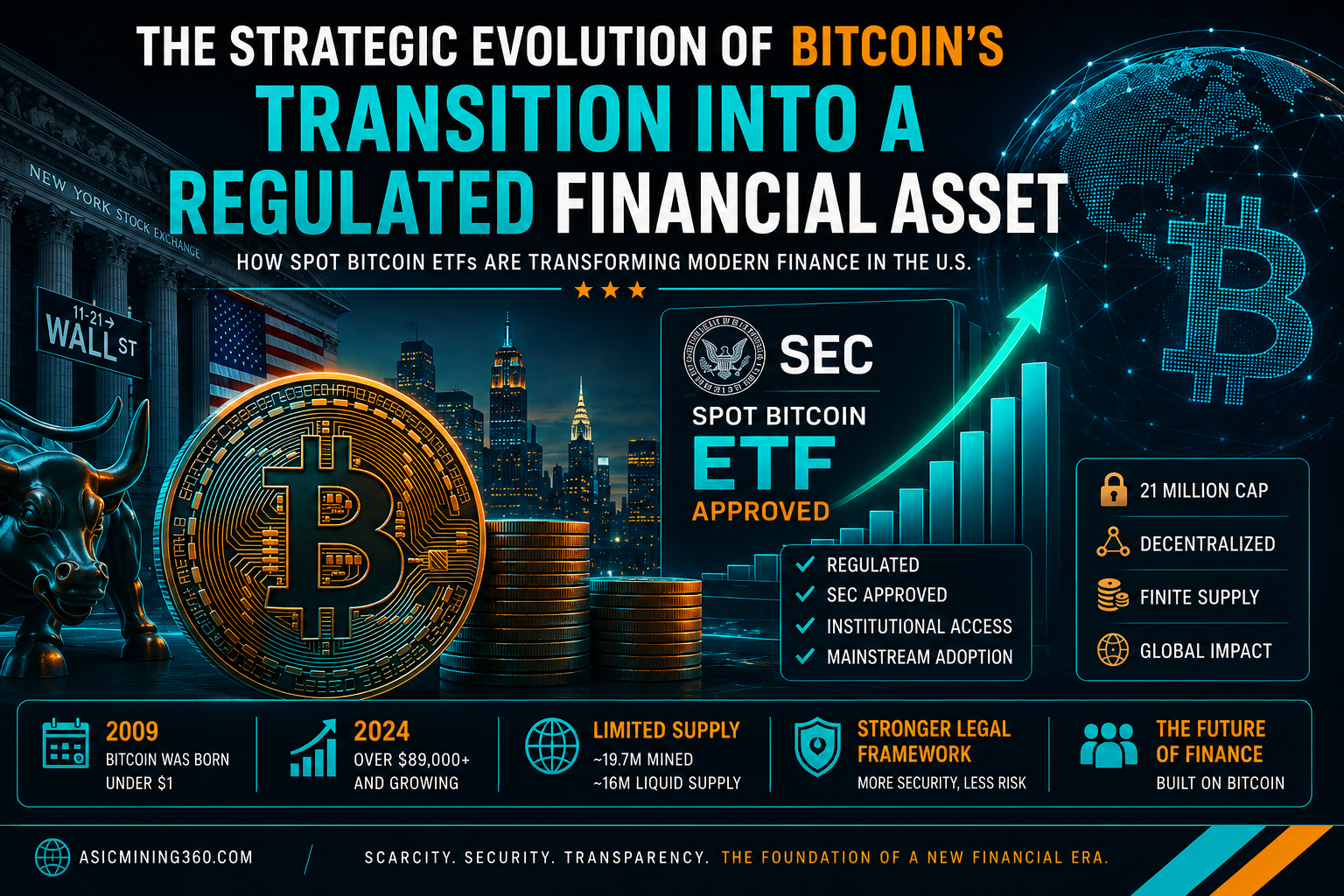
How the Historic Shift Toward Regulated Spot Bitcoin Trading is Transforming Modern Finance
The future is shifting toward digital currencies. The American authorities have officially allowed spot Bitcoin trading within regulated platforms, and this is the first time in the history of the United States that such approval has been granted. Naturally, anyone who owns Bitcoin today holds a strong form of wealth — and even more so those who bought cryptocurrency many years ago when its price was extremely cheap. Today, its value has multiplied in dramatic ways, giving early holders massive assets.
However, analysts view this regulatory move as a decisive turning point, one that transforms Bitcoin from a speculative, unregulated market into an officially recognized financial space. This shift opens the door for any investor, including major institutional investors, and positions digital assets as one of the pillars of the American financial system.
Understanding the SEC Spot Bitcoin ETF Approval
The game changed when the SEC finally gave the green light to Spot Bitcoin ETFs. It wasn't just another regulatory update; it was the moment the door between crypto-native enthusiasts and Wall Street swung wide open. For the first time, anyone with a standard brokerage account could get Bitcoin exposure without the headache of managing private keys or navigating unregulated exchanges.
This wasn't just a win for the U.S.—it was a global signal that digital assets have officially graduated from a niche experiment to a legitimate financial pillar.
What’s truly fascinating is how this bridges two worlds that used to be total opposites. By wrapping Bitcoin in a regulated investment vehicle, big-money institutional investors can finally pull up a seat at the table. We’re watching Bitcoin weave itself into the fabric of mainstream finance, yet it remarkably holds onto its core identity: a decentralized asset that doesn't need a government to give it permission to exist.
Analyzing Bitcoin’s Price Evolution and Market Growth From 2009 Until Today
If we look back briefly:
-
Bitcoin was created around 2009, and the price of one BTC was less than $1.
-
Today, Bitcoin costs around $89,000+.
-
This represents one of the most powerful transformations in financial history.
Will Bitcoin Benefit From This Support and Increased Legal Legitimacy?
Today, Bitcoin certainly benefits from this new legal environment and the accompanying safety for individuals who hold it. Previously, Bitcoin holders were often viewed with suspicion. Today, anyone who legally owns BTC can openly declare it and even take loans against it. Countries like the U.S. and the U.K. now allow borrowing with Bitcoin as collateral.
Individuals can now store their Bitcoin on traditional platforms, trade it, convert it to dollars or gold, and treat it like any other valuable asset. This elevates Bitcoin’s status and gives it more legitimacy.
Will Stricter Regulations Reduce Volatility and Limit Market Manipulation?
Speculation still occurs within the crypto market, orchestrated by “whales” who hold massive amounts of digital assets. Some countries also accumulate Bitcoin while publicly declaring the opposite — such as China and Russia — because they know the future of global trade will require digital assets.
Bitcoin will continue to experience fluctuations, mainly because large holders attempt to accumulate it at the lowest possible price before mass global adoption increases demand. Some analysts suggest that Bitcoin could eventually reach $1,000,000 per BTC, a number that seems highly speculative today but becomes more plausible when considering long-term adoption scenarios explored in our analysis of Bitcoin price predictions after 2026.
The Reality of Bitcoin Mining: How the Blockchain Actually Works
Think of mining as the heartbeat of the network. It isn't just about creating new coins; it’s about using specialized Bitcoin mining hardware to verify transactions and keep the blockchain secure. While the creator, Satoshi Nakamoto, hard-coded a total limit of 21 million BTC, the actual "liquid" supply is much tighter than people realize.
Here is a quick breakdown of where we stand today:
-
The Circulating Supply: We’ve already crossed the 19.7 million mined BTC mark.
-
The "Lost" Fortune: It’s estimated that roughly 3.7 million BTC are lost forever—trapped in forgotten hard drives or wallets from the early days when Bitcoin was worth pennies.
-
The Real Supply: This means only about 16 million BTC are realistically available for the entire world to fight over.
Because of the way mining difficulty is designed to increase, that final stretch of supply is going to take a long time. We won't see the very last Bitcoin mined until somewhere around the year 2140.
Is the 21 Million Cap Truly Final?
In a world of endless money printing, this is the most common question. The answer is a firm yes.
Bitcoin cannot exceed 21 million coins because that hard cap is the backbone of its entire protocol. Unlike a central bank that can decide to print more currency, Bitcoin is governed by a decentralized network. For the limit to change, the global community of miners and node operators would have to collectively agree to destroy the very scarcity that gives Bitcoin its value. It’s a self-correcting system designed to stay finite, no matter what.
📚 SOURCES