Introduction
When people discuss the global expansion of solar energy, the conversation often turns toward manufacturing giants like China or sunny regions such as Spain and Portugal. These locations benefit from strong solar irradiation, which naturally favors photovoltaic electricity generation.
However, in recent years, solar capacity has expanded rapidly across several parts of Europe, including Central and Eastern European countries. Yet despite this regional growth, Spain still remains one of the most attractive locations for large-scale solar energy infrastructure due to its exceptionally high solar exposure.
For industries that require large amounts of electricity, such as cryptocurrency mining farms, AI computing clusters, and hyperscale data centers, the combination of solar resources, falling photovoltaic costs, and improving grid infrastructure makes Spain particularly interesting.
This article looks at Europe’s solar energy expansion while focusing on why Spain may become one of the most important energy hubs for power-intensive digital infrastructure, including ASIC mining operations.
Solar Energy Expansion Across Europe
Solar power has grown dramatically across the European Union since the early 2010s. Photovoltaic systems have become increasingly affordable thanks to improvements in manufacturing efficiency and global supply chains.
By the end of the 2010s, solar electricity represented around 8–10% of power generation in several southern European countries such as Italy and Greece.
Across the EU as a whole, solar electricity generation increased significantly between 2019 and 2024. During that period, total EU solar generation increased roughly 2 to 2.3 times. Several Central and Eastern European countries experienced even faster growth.
While solar adoption is spreading throughout the continent, geographic conditions still play a major role in determining where large-scale solar infrastructure can operate most efficiently. This is exactly where Spain stands out.
Spain: Europe’s Strongest Solar Resource
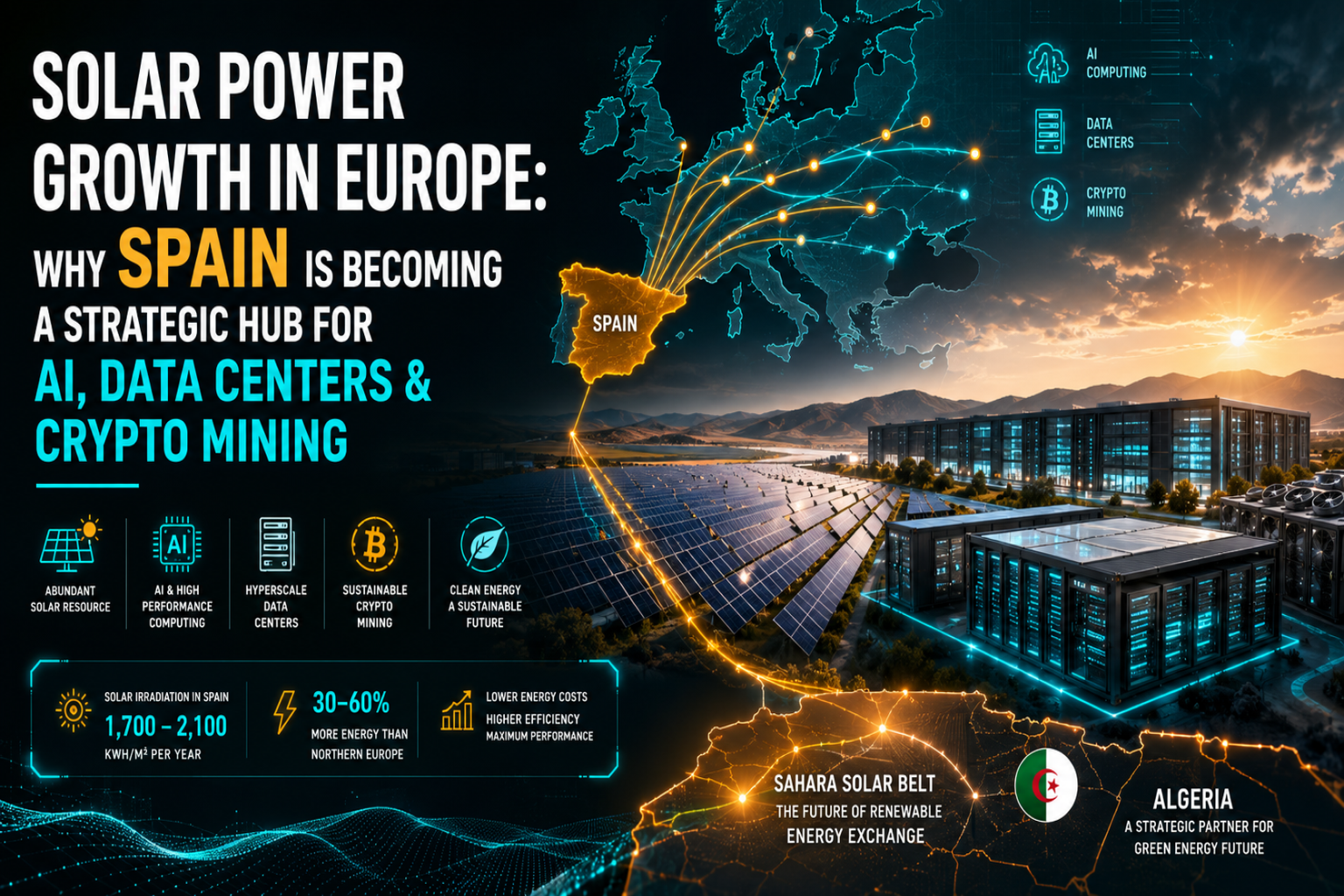
Among European countries, Spain has one of the highest solar irradiation levels. In many regions of Spain, annual solar irradiation ranges between 1,700 and 2,100 kWh per square meter, which is significantly higher than in most parts of Central or Northern Europe.
For comparison, Central Europe typically receives around 1,000–1,200 kWh/m², while Northern Europe often receives even less. This difference dramatically affects photovoltaic performance.
A solar installation operating in Spain can generate 30–60% more electricity compared to a similar system installed in northern or eastern regions of Europe. For energy-intensive infrastructure such as cryptocurrency mining facilities, this translates directly into lower electricity costs per kilowatt hour.
Simply put, Spain gives miners more energy from the same solar hardware — and that is a big deal.
Solar Growth in Eastern Europe
Although Spain remains the solar irradiation leader, several Eastern European countries have recently expanded their solar capacity at a remarkable pace.
| Country | Solar Share of Electricity | Solar Growth Trend | Energy System Context |
|---|---|---|---|
| Poland | Rapidly increasing | One of the fastest solar expansions in Europe | Transition from coal dominated energy system |
| Hungary | High and growing | Solar recently surpassed gas in electricity mix | Diversifying away from fossil fuels |
| Lithuania | Around 15–20% | Rapid renewable expansion | Energy independence strategy from Russian imports |
| Bulgaria | Moderate but growing | Solar capacity tripled in recent years | Expanding renewable infrastructure |
| Romania | Increasing | New solar projects under development | Growing renewable electricity sector |
For example, Poland has undergone a rapid solar transformation over the past decade. Historically dependent on coal, Poland began aggressively expanding photovoltaic installations after 2019. Solar generation increased by roughly 1,700–1,900% in just a few years.
As a result, coal electricity production declined by roughly 20–25%, and carbon emissions dropped by tens of millions of tons annually. Installed solar capacity also increased dramatically, with Poland going from approximately 0.3 GW of solar capacity in 2016 to more than 11–12 GW by 2024.
This rapid expansion shows how quickly renewable electricity infrastructure can scale when policy incentives and technology costs align.
Lithuania and Hungary’s Solar Transition
Other countries across the region have also expanded solar generation. In Lithuania, solar energy now contributes roughly 16–18% of national electricity supply. Combined with wind energy, renewable electricity accounts for a majority share of the country’s power production.
Lithuania’s energy transition accelerated after the Baltic states reduced their reliance on Russian energy imports and synchronized their electricity systems with the continental European grid.
Meanwhile, Hungary has steadily increased solar generation since the mid-2010s. Solar power recently surpassed natural gas as one of Hungary’s largest electricity sources, illustrating how rapidly photovoltaic capacity can reshape national energy systems.
Other countries have also expanded solar installations in recent years.
Why Solar Energy Is Expanding So Fast
Three major factors explain the rapid growth of solar power across Europe:
-
Declining Solar Technology Costs: Over the past decade, photovoltaic module prices have fallen dramatically. Improved manufacturing processes and large-scale production have significantly reduced the cost of solar panels, inverters, and installation. These price declines allow both households and large infrastructure projects to deploy solar systems more easily — basically, the economics just make more sense now.
-
Government Incentives: Several European governments introduced subsidy programs to accelerate renewable energy adoption. In Poland, the My Electricity program helped households install solar panels through direct financial support. In the Czech Republic, the New Green Savings program provides subsidies for solar installations as part of a broader climate strategy. These programs dramatically increased distributed solar generation across the grid.
-
Energy Independence: Geopolitical concerns also played a role. After Russia’s invasion of Ukraine, many Eastern European countries accelerated their transition away from fossil fuels imported from Russia. Renewable energy, including solar and wind, became an important component of national energy security strategies.
The Storage Problem: Solar Needs Batteries
Despite the rapid expansion of photovoltaic capacity, electricity grids still face an important technical challenge. Solar energy production fluctuates throughout the day. Peak production typically occurs around midday when electricity demand is not always at its highest. Without energy storage systems, excess electricity may need to be curtailed.
For example, during some periods of high solar production in Poland, roughly 10–12% of solar electricity could not be used because the grid lacked sufficient storage capacity.
Battery storage systems are essential for solving this problem. Large-scale battery installations allow excess electricity to be stored and released later when demand increases. Several European countries are now investing heavily in battery infrastructure. Poland, for example, has announced plans to invest roughly $4–5 billion into battery storage projects.
However, storage deployment still lags behind solar expansion in several countries — kind of ironic, actually.
Solar Power and Crypto Mining Infrastructure
The expansion of solar electricity in Europe could have significant implications for cryptocurrency mining operations. ASIC mining hardware requires enormous amounts of electrical power. A modern high-performance ASIC miner typically consumes between 3 and 5 kilowatts of electricity. Large mining farms may operate thousands of units simultaneously, requiring tens of megawatts of electrical capacity.
Solar energy alone cannot support continuous 24-hour mining without storage systems. However, solar generation can significantly reduce electricity costs during daylight hours. Spain’s high solar irradiation makes it particularly attractive for hybrid mining energy systems.
In such systems:
-
Solar panels power miners during peak daylight hours.
-
Battery systems store excess electricity.
-
Grid electricity supplements power when needed.
This hybrid energy model can significantly improve mining efficiency while lowering operational energy costs.
Why Spain Could Become a Solar Mining Hub
Spain’s energy profile makes it uniquely suited for renewable-powered digital infrastructure. Key advantages include:
-
High solar irradiation: Spain receives some of the highest solar exposure in Europe, enabling more efficient photovoltaic generation.
-
Large land availability: Rural regions offer large areas suitable for solar farms and data center infrastructure.
-
Expanding renewable capacity: Spain continues to increase solar and wind generation across its energy mix.
-
Grid integration with Europe: Spain is connected to the wider European electricity network, improving energy distribution reliability.
For cryptocurrency mining operations looking to combine renewable energy with high-efficiency ASIC hardware, Spain offers one of the most promising environments in Europe.
Could Western Europe Tap North African Solar Power?
Another factor that could reshape Europe’s renewable energy landscape is the possibility of importing solar electricity from North Africa — particularly from Algeria and the Sahara region. Western European countries such as France, Germany, and Italy receive significantly less solar irradiation compared to North Africa. In contrast, many parts of the Algerian Sahara receive close to 3000 hours of sunshine annually, which makes it one of the strongest solar resources in the Mediterranean region.
Several desert regions in Algeria are particularly well suited for large-scale photovoltaic infrastructure, including Ouargla, Timimoun, El Oued, and the vast Tanezrouft Desert, where solar irradiation and large flat land areas create ideal conditions for massive solar installations.
Recognizing this potential, Algeria has already launched a national renewable energy strategy aimed at installing around 15 GW of renewable electricity capacity by 2035, mainly from photovoltaic solar power plants. The program officially entered its operational phase in 2023 with the launch of the Solar 1000 and Solar 2000 projects, which include 15 photovoltaic plants producing roughly 3 GW of electricity in addition to a 200 MW solar plant supporting the Gar Djebilet mining project.
According to the Algerian Ministry of Energy, nearly 1.48 GW of solar capacity is expected to be connected to the national grid in the near term through multiple solar power stations. This rapid expansion is part of a broader strategy not only to increase renewable electricity production but also to preserve natural gas reserves.
Energy experts estimate that each gigawatt of installed solar capacity can save roughly 500 million cubic meters of natural gas per year. Instead of burning that gas domestically to produce electricity, Algeria can export it to international markets — particularly to Europe, where energy demand is still pretty strong.
This strategy becomes even more important when combined with new infrastructure projects such as the submarine electricity interconnection currently under development between Algeria and Italy. Once operational, this link could strengthen energy exchange across the Mediterranean and potentially allow renewable electricity generated in the Sahara to reach European power grids.
For energy-intensive industries, including cryptocurrency mining farms, AI data centers, and high-performance computing infrastructure, this emerging Mediterranean energy corridor could open major opportunities. Large solar installations in the Algerian Sahara combined with modern transmission infrastructure could give Europe access to one of the largest untapped solar energy resources in the world — kind of a big deal for future energy systems.
| Location | Average Solar Irradiation | Sunshine Hours / Year | Solar Energy Potential | Infrastructure Outlook |
|---|---|---|---|---|
| Spain | 1,700 – 2,100 kWh/m² | 2,500 – 2,800 hours | Very High | Large solar farms and renewable integration |
| Southern Italy | 1,600 – 1,900 kWh/m² | 2,200 – 2,600 hours | High | Growing solar infrastructure |
| Ouargla (Algeria) | 2,100 – 2,300 kWh/m² | ≈ 2,900 hours | Extreme Desert Solar Resource | Ideal for large photovoltaic plants |
| Timimoun (Algeria) | 2,200 – 2,400 kWh/m² | ≈ 3,000 hours | One of the strongest solar zones in North Africa | Potential mega-scale solar projects |
| El Oued (Algeria) | 2,100 – 2,300 kWh/m² | ≈ 2,900 hours | Very High | Good conditions for utility-scale solar |
| Tanezrouft Desert | 2,300 – 2,500 kWh/m² | ≈ 3,000+ hours | Among the strongest solar irradiation zones on Earth | Future large-scale solar energy hub |
Conclusion
Solar energy is expanding rapidly across Europe, driven by declining technology costs, government incentives, and geopolitical energy shifts. Eastern European countries such as Poland, Lithuania, and Hungary have experienced remarkable solar growth over the past few years. However, despite this rapid expansion, Spain remains one of the most attractive locations for large-scale solar energy infrastructure due to its exceptional solar irradiation levels.
For energy-intensive industries, including cryptocurrency mining farms and high-performance computing centers, Spain’s solar potential combined with improving battery storage and grid systems could make it a major hub for renewable-powered digital infrastructure in the coming decade.
As solar generation continues to scale across Europe, the integration of energy storage and grid modernization will determine how effectively renewable electricity can support the next generation of digital technologies.
FAQ
Q1: Why does Spain have the best solar potential in Europe?
Spain receives some of the highest solar irradiation levels in Europe, often exceeding 1,800–2,000 kWh per square meter annually, which allows photovoltaic systems to generate significantly more electricity compared to northern regions.
Q2: Can solar energy power cryptocurrency mining farms?
Solar energy can supply part of the electricity required for mining operations, especially during daytime hours. However, continuous mining usually requires hybrid systems that combine solar, batteries, and grid electricity.
Q3: Why are batteries important for solar power systems?
Solar generation fluctuates during the day. Battery systems store excess electricity produced during peak sunlight hours and release it later when production decreases.
Q4: Which European countries are rapidly expanding solar power?
Countries such as Spain, Poland, Lithuania, Hungary, Romania, and Bulgaria have significantly increased solar generation in recent years.
Q5: Is renewable energy becoming common in crypto mining?
Yes, many mining operators are increasingly exploring renewable energy sources including solar, wind, and hydro to reduce electricity costs and improve operational sustainability.