Introduction
Florida remains one of the most attractive solar markets in the United States. Long sunny days, high electricity consumption, and increasing pressure on the grid make rooftop solar more than just a green choice—it is a strategic energy decision. For households and small operations running energy-intensive equipment such as ASIC miners, GPU clusters, or AI compute servers, electricity is not simply a monthly bill; it is a core operating cost that directly affects profitability and reliability.
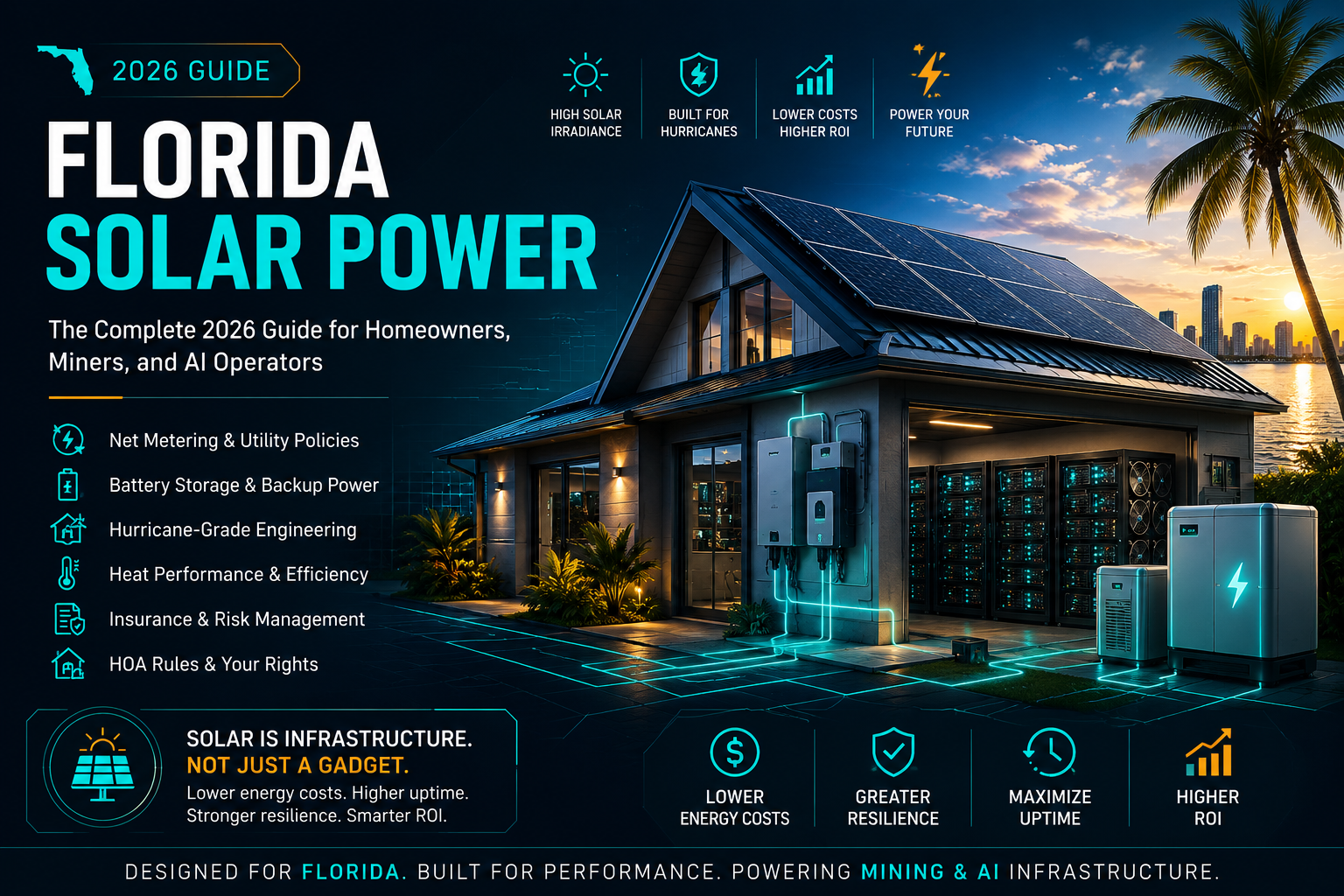
This 2026 guide explains how to evaluate solar power in Florida from a practical, investor-minded perspective. We will walk through six critical factors that shape real-world performance and returns: net metering policies, battery storage, hurricane-grade engineering, high-temperature performance, insurance considerations, and homeowners association (HOA) rules. Along the way, we will connect these topics to the realities of mining, AI workloads, and always-on infrastructure.
The objective is not to promote solar blindly, but to help you design a system that actually works under Florida’s environmental, regulatory, and economic conditions.
Solar Strategy for High-Load Users (Florida 2026)
| Scenario | Best Setup | ROI Potential | Risk Level |
|---|---|---|---|
| Strong Net Metering | Solar Only (Grid-Tied) | High | Low |
| Weak Net Metering | Solar + Battery | High | Medium |
| Frequent Outages | Solar + Large Battery | Medium | Medium |
| Mining / AI 24/7 Load | Hybrid + Smart Load Management | Very High | Medium |
Why Florida Is a Unique Solar Market
Florida combines three features that make solar especially relevant in 2026: strong and consistent solar irradiation, very high cooling demand, and a grid that is increasingly stressed during heat waves and storm seasons. For typical households, this already makes solar financially attractive. For miners and AI operators, the case is even stronger because power consumption is continuous, predictable, and often large.
However, Florida also introduces specific risks: hurricanes, extreme rooftop temperatures, evolving utility compensation rules, and a fragile insurance market. Ignoring these factors can turn a good-looking solar proposal into a long-term underperforming asset. Treating solar as infrastructure—rather than as a gadget—leads to much better results.
Florida’s solar potential is not unique globally; several regions operate under similar irradiation conditions, but with very different economics and infrastructure outcomes.
Global Regions with Solar Irradiance Comparable to Florida
| Region | Country | Avg Solar Irradiance (kWh/m²/day) | Climate Type | Relevance for Mining / AI |
|---|---|---|---|---|
| Florida | USA | 4.5 – 5.2 | Humid subtropical | Baseline reference |
| Southern Spain | Spain | 4.8 – 5.5 | Mediterranean | High efficiency, lower humidity |
| Northern Mexico | Mexico | 5.0 – 5.8 | Semi-arid | Better output, higher heat stress |
| South China (Guangdong) | China | 4.2 – 5.0 | Humid subtropical | Very similar to Florida |
| Brazil (São Paulo) | Brazil | 4.5 – 5.3 | Tropical | Stable solar + growing infrastructure |
| India (Mumbai region) | India | 4.5 – 5.5 | Tropical monsoon | Seasonal variability (monsoon impact) |
| Australia (Queensland) | Australia | 5.0 – 6.0 | Subtropical | Higher yield than Florida |
Regions with similar solar irradiance (≈4–6 kWh/m²/day) offer comparable baseline production potential, but real-world performance depends heavily on temperature, humidity, and grid conditions.
1: Net Metering: The Backbone of Solar Economics
Net metering defines how your utility values the electricity your system exports to the grid. When your panels produce more power than you consume, the excess is sent to the grid and credited to your account. Later, when production drops (at night or during cloudy periods), you draw power back using those credits.
One-for-One vs. Reduced Compensation
Some Florida utilities still offer true one-for-one net metering in 2026. In these areas, every kilowatt-hour you export can be taken back later as one kilowatt-hour, making it possible to size a system that nearly balances out over the year.
Other utilities have moved to reduced compensation models. Under these rules, you may need to export significantly more energy than you can later reclaim. This changes the financial logic of solar, especially for operations that run 24/7, such as mining rigs or AI servers.
What This Means for High-Load Users
If you are on a fair, one-for-one plan, a grid-tied system without batteries can still deliver strong returns. Your daytime overproduction effectively offsets your nighttime consumption. If you are not, then the grid becomes an expensive battery, and storing your own energy starts to make more sense. Before committing to any system, you should confirm your exact net metering terms, because this single variable can dominate your project’s economics.
2: Battery Storage: Cost Optimization and Resilience
In Florida, batteries serve two main purposes: improving the financial performance of solar when net metering is weak, and providing backup power during outages.
Batteries as an Economic Tool
When utilities pay poorly for exported energy, storing your own excess production and using it later on-site is often more profitable. This is particularly relevant for mining and AI workloads that continue into the evening and overnight. Instead of selling power cheaply and buying it back at full price, you shift more of your consumption to your own stored energy.
Batteries as a Reliability Layer
Florida’s weather makes grid outages a realistic risk, not a theoretical one. Standard grid-tied solar systems shut down when the grid goes offline, even in full sunlight. With batteries and proper system design, your installation can operate in island mode: solar powers loads during the day, charges the batteries, and the batteries carry critical systems through the night.
For high-load homes and small compute operations, this is not just about comfort. It is about protecting equipment, maintaining uptime, and avoiding forced shutdowns during prolonged outages.
Sizing for Real Needs
True whole-home or whole-operation backup requires both sufficient power output and enough stored energy. In Florida, air conditioning alone is a major load and a necessity for humidity control and building protection. Any serious design should prioritize essential cooling and networking first, then add compute or mining loads based on realistic expectations.
3: Hurricane-Grade Engineering and Wind Ratings
Florida’s building codes, especially in coastal regions, require structures to withstand much higher wind speeds than in most of the country. Solar installations must meet these same standards.
Structural Reality
A properly engineered system is designed to handle wind speeds that can exceed 130 mph in many areas. This affects the racking system, attachment methods, and overall layout. When done correctly, the solar array should remain in place as long as the roof itself remains intact.
Failures usually come from poor design or rushed installation, not from the concept of rooftop solar itself. For investors and operators, this means choosing installers who work with certified engineering plans and local code requirements, not just low-cost quotes.
4: Heat, Temperature Coefficients, and Real-World Output
Solar panels are tested under standard laboratory conditions, roughly equivalent to a mild indoor temperature. Florida rooftops in summer can reach extreme temperatures far above those conditions, and performance drops as heat increases.
Understanding Temperature Coefficients
The temperature coefficient tells you how much a panel’s output decreases for each degree above the standard test temperature. Panels with better (lower) temperature coefficients lose less performance in hot conditions, which translates into higher annual energy production and better long-term returns.
Why This Matters for Mining and AI
High temperatures often coincide with peak cooling demand. If your panels underperform exactly when your loads are highest, you end up buying more expensive grid power. Choosing panels and system designs that handle heat better reduces this mismatch and makes your energy costs more predictable throughout the year.
5: Insurance: A Critical but Overlooked Factor
Florida’s insurance market has become more sensitive to construction quality and risk exposure. Past waves of low-quality installations caused roof leaks and, in rare cases, electrical issues, which made some insurers cautious about solar-equipped homes.
Practical Steps
Before installing, speak with your insurance provider. Confirm whether solar panels and batteries affect your coverage, your premium, or your documentation requirements. In some cases, switching to a more solar-friendly insurer is the simplest solution.
For mining and AI setups, where equipment value can be substantial, proper insurance alignment is not optional—it is part of basic risk management.
6: HOA Rules and Florida’s Solar Access Rights
Florida law protects homeowners’ rights to install solar. Homeowners associations generally cannot ban solar systems outright, although they can set reasonable guidelines about placement and appearance.
What This Means in Practice
You usually have the right to install solar, but you may need to coordinate placement details. Importantly, aesthetic rules should not be allowed to significantly reduce system performance. Understanding this legal framework can prevent delays and avoid design compromises that hurt long-term output.
Solar as Infrastructure for Mining and AI
For ASIC miners, GPU farms, and AI operators, solar is not about marketing or image. It is about controlling energy costs, reducing exposure to grid instability, and improving operational resilience. A well-designed system can lower your effective cost per kilowatt-hour and stabilize your long-term operating expenses.
At the same time, solar is capital-intensive and long-lived. Mistakes in design, component choice, or regulatory assumptions can lock in mediocre performance for decades. The right approach is to model cash flows, stress-test assumptions, and design for real-world conditions—not just brochure numbers.
Conclusion
In 2026, Florida remains one of the strongest environments in the U.S. for solar power, especially for high-consumption users such as miners and AI operators. But success depends on getting the fundamentals right: understanding net metering, deciding on battery storage, engineering for hurricanes, accounting for heat-related performance losses, aligning with insurance requirements, and navigating HOA rules.
Solar in Florida is not a one-size-fits-all product. It is an infrastructure investment. When designed with technical and economic realism, it can deliver lower energy costs, higher resilience, and long-term stability. When designed poorly, it becomes an expensive lesson in overlooked details.
FAQ
Q1: Is solar still profitable in Florida in 2026?
In many areas, yes—especially where fair net metering still exists. Profitability depends on your utility rules, system cost, and consumption profile.
Q2: Do I need batteries with my solar system?
Not always. If net metering is favorable, batteries may not be necessary for financial reasons. If you want backup power or your utility pays poorly for exports, batteries become much more valuable.
Q3: Can solar panels survive hurricanes?
If properly engineered and installed to local building codes, solar systems are designed to withstand the same wind loads as the roof itself.
Q4: How much does heat reduce solar output in Florida?
High temperatures can significantly reduce output. Choosing panels with good temperature coefficients helps minimize these losses.
Q5: Will solar affect my home insurance?
It can. Some insurers require additional documentation or adjust premiums. Always check before installing.
Q6: Can my HOA stop me from installing solar?
In Florida, HOAs generally cannot ban solar outright, though they can set reasonable placement guidelines that do not severely impact performance.