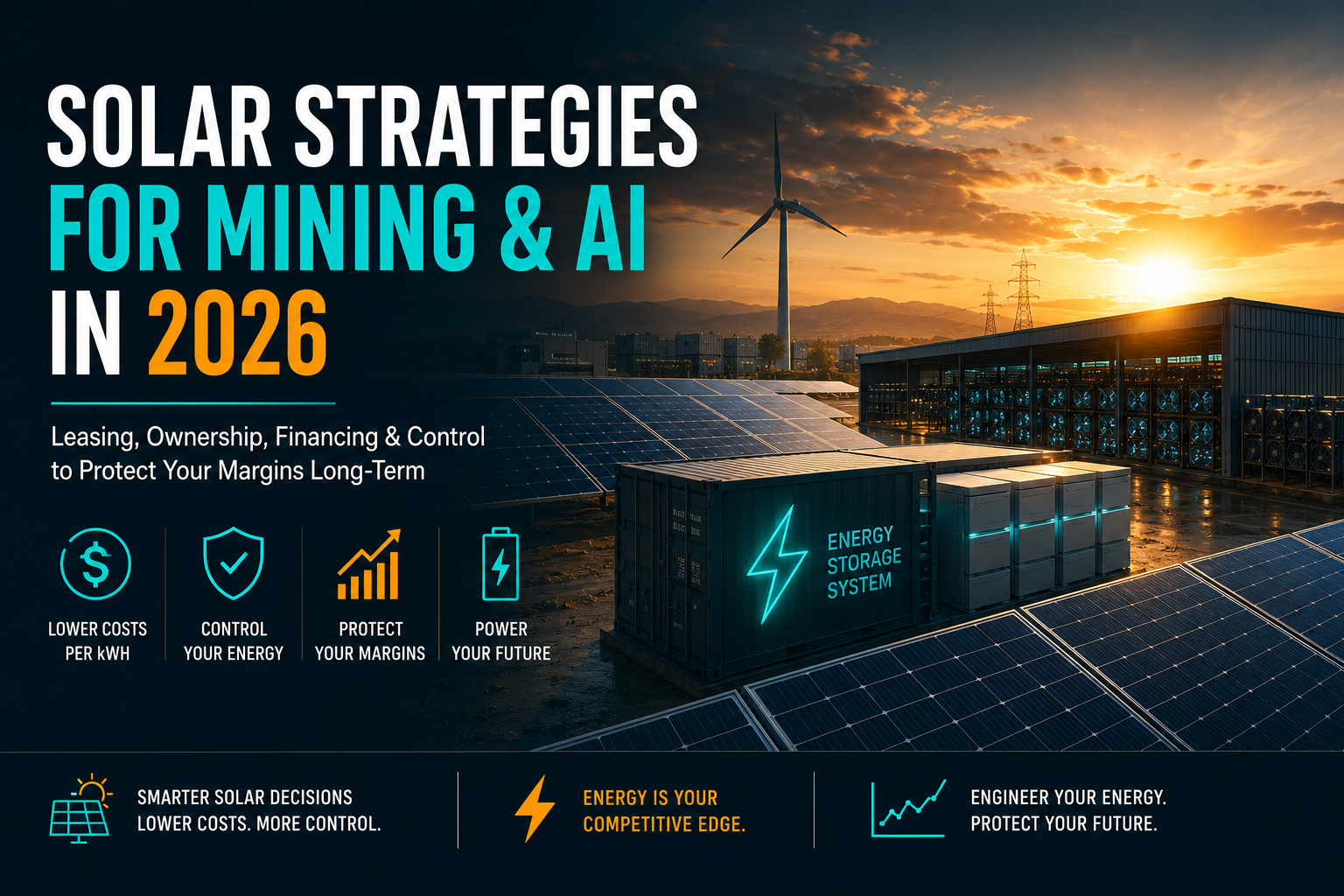
Introduction
In 2026, most mining operations don’t fail because of bad hardware — they fail because of bad energy decisions.
You can have the most efficient ASICs, the latest GPUs, and perfectly optimized firmware… but if your cost per kWh is wrong, none of it matters. Your margins collapse quietly, and by the time you notice, it’s already too late.
This is why solar is no longer a “green upgrade.” It’s a survival tool.
But here’s where most operators get it wrong: cheaper solar doesn’t automatically mean better economics. The real game isn’t panel prices — it’s structure. Ownership, leasing, financing, and control now matter more than the hardware itself.
In 2026, the solar market is shifting fast. Prices are dropping, incentives are changing, and new models like TPO and hybrid ownership are redefining how energy is deployed.
👉 The question is no longer “Is solar cheaper?” It’s: “Which solar strategy actually protects your margins long-term?”
In this guide, we break down what’s really driving solar costs down, how the end of the personal tax credit changes the equation, and which strategies make sense for crypto mining farms and AI compute infrastructure — without the hype, and without expensive mistakes.
Why Solar Installation Prices Are Falling in 2026
Two major forces are reshaping the market.
First, manufacturing is moving onshore. More panel, inverter, and battery suppliers are assembling products in the U.S. or completing final stages of production locally. This reduces logistics costs, shortens supply chains, and—more importantly—allows projects to qualify for domestic content incentives at the corporate level.
Second, the sales layer is being compressed. For years, residential and small commercial solar was burdened by high commissions, dealer fees, and complex financing markups. As competition increases and buyers become more informed, those margins are being pushed down. The result is a lower all-in installed price, even before considering incentives.
For mining and AI operators, this matters because energy projects are no longer “boutique” purchases. They are becoming infrastructure decisions, similar to cooling systems or network equipment—where efficiency and long-term cost matter more than branding.
The End of the Personal 30% Tax Credit: What Changed?
For nearly 20 years, U.S. homeowners and small businesses could rely on a 30% personal tax credit to reduce the cost of a solar installation. If you had sufficient tax liability, a large part of the system cost effectively came back to you.
That personal credit is now gone. This does not mean solar is suddenly uneconomic—but it does mean the structure of deals has changed.
Without that personal incentive, buying a system directly with cash or a loan often looks more expensive on paper than it did a few years ago. This policy shift is one of the main reasons third-party ownership (TPO) models have become more prominent in 2026.
Understanding Third-Party Ownership (TPO)
What TPO Actually Means
In a TPO structure, you do not own the solar system. Instead, a third party owns it and you either:
-
Pay a fixed monthly lease for the equipment, or
-
Sign a power purchase agreement (PPA) and pay per kilowatt-hour for the energy it produces.
In both cases, the system owner—not you—claims the available corporate tax incentives.
Why TPO Can Be Cheaper in 2026
While individuals lost the 30% tax credit, companies can still claim:
-
A 30% corporate investment tax credit, and
-
An additional 10% bonus if the system meets domestic content requirements.
In practice, this means a TPO provider can recover up to 40% of the system cost through tax incentives. In theory, that savings is partially passed on to the customer through lower monthly payments or a lower energy price.
For operators who care primarily about cash flow and predictable energy costs, this can be attractive—especially when no large upfront payment is required.
The Trade-Offs of Leasing vs. Owning
The Main Advantage: Lower Barrier to Entry
The biggest strength of TPO is simple: you can deploy solar with little or no upfront capital. For mining farms or AI compute sites that prefer to allocate capital to hardware, this can make sense.
You also avoid direct responsibility for:
-
Claiming tax credits
-
Some aspects of maintenance (depending on the contract)
-
Performance risk tied to equipment warranties
The Main Risk: You Don’t Control the Asset
With a leased or PPA system:
-
You cannot freely modify the installation
-
Adding batteries, upgrading inverters, or changing the layout usually requires approval
-
You are exposed to counterparty risk if the TPO provider faces financial trouble
Recent years have already shown that large solar leasing companies can fail. If that happens, contracts may be sold to another investor, and obligations often continue. In other words, a TPO system is not “free solar” if a company disappears—it simply shifts the relationship to a new owner.
For industrial users, this matters. Mining and AI facilities often need to reconfigure power infrastructure as loads change. Lack of control can become a real operational constraint.
Cash and Loan Purchases: Full Control, Higher Upfront Cost
If you buy a system with cash or finance it with a loan, you own the asset outright. This gives you:
-
Full freedom to choose equipment (including non-domestic brands)
-
Full control over upgrades, batteries, or system expansion
-
No dependency on a third-party owner’s financial health
The downside in 2026 is clear: you no longer get the 30% personal tax credit. That makes the initial price look higher than in previous years.
However, for energy-intensive operations, ownership can still make sense because:
-
The system becomes a long-term hedge against electricity price volatility
-
The levelized cost of energy (LCOE) over 10–20 years can be very competitive
-
You can optimize the system specifically for your load profile (mining or AI)
In other words, ownership is more capital-intensive, but often more strategic.
Domestic Content, FIOC, and Equipment Choice
Another new layer in 2026 is the distinction between domestic content equipment and products from so-called foreign entities of concern (FIOC), a category that often includes Chinese-owned manufacturers.
TPO providers usually must use domestic-content-compliant equipment to unlock the full tax benefits.
If you want to use FIOC-labeled equipment, you are typically limited to cash or loan purchases.
For mining and AI operators, this is not just a political issue—it’s a supply chain and pricing issue. Some of the most cost-effective and well-tested hardware still comes from Asian manufacturers. Depending on your priorities, that may push you toward direct ownership rather than leasing.
The Prepaid Lease: A Hybrid Approach
One structure gaining attention is the prepaid lease.
The idea is simple:
You sign a lease so the TPO provider can monetize the tax credits.
You prepay most or all of the lease payments upfront (often using a loan).
At the end of the term, you can usually buy the system for a nominal amount.
In theory, this gives you:
-
A lower effective system price thanks to the tax credits captured by the lessor
-
Eventual ownership of the asset
-
More flexibility later to add batteries or modify the system
This model is not risk-free—contract terms matter a lot—but for some investors it can be a way to arbitrage policy incentives while still ending up with a controlled asset.
Self-Directed Installations: The DIY-Industrial Middle Ground
As equipment becomes more modular and standardized, self-directed installations are becoming more realistic.
This does not mean ignoring safety or codes. It means:
-
Buying panels, inverters, and racking directly
-
Managing part of the installation process yourself
-
Hiring licensed electricians or roofers only for critical steps
For technically competent operators—especially in industrial or semi-industrial settings—this can cut soft costs significantly. In mining and AI environments, where teams already manage complex electrical systems, this approach can be practical.
The trade-off is responsibility: you take on project management, permitting, and performance risk. But in return, you often get the lowest possible cost per installed watt.
Which Solar Model Wins in 2026? (Mining & AI Energy Strategy Comparison)
| Factor | Leasing / TPO | Ownership (Cash / Loan) |
|---|---|---|
| Upfront Cost | Low / None | High |
| Control Over System | Limited | Full Control |
| Flexibility | Restricted (requires approval) | Fully customizable |
| Maintenance Responsibility | Handled by provider | Owner responsibility |
| Long-Term Cost (LCOE) | Higher over time | Lower over time |
| Energy Independence | Low | High |
| Best For | Low capital / passive operators | Long-term strategic operators |
There is no “best” solar model — only the one that matches your cost structure, risk tolerance, and control requirements.
Final Verdict: Solar Strategy Is the New Mining Edge
Solar in 2026 is no longer about being “green.” It’s about staying alive in a market where energy costs decide everything.
The real divide is simple: operators who control their energy… and operators who are controlled by it.
Leasing gives you access with low upfront cost. Ownership gives you control and long-term stability. Hybrid models sit in between—offering leverage if structured correctly.
But none of these options are “safe” by default.
Every model comes with trade-offs:
-
Less capital means less control.
-
More control means more responsibility.
-
Chasing the lowest price often hides the highest long-term risk.
The only metric that matters is your true cost per kWh over time — and how much control you have over it. Because in mining and AI, margins don’t disappear suddenly. They erode… slowly, silently, and permanently. The operators who win in the next cycle won’t be the ones with the best hardware. They will be the ones who engineered their energy like a system — not a bill. And one final truth:
You don’t scale compute without mastering power.
FAQ
Q1: Is solar still profitable for mining and AI compute without the personal tax credit?
Yes. Profitability now depends more on system price, financing structure, and utilization rate. Many projects still achieve competitive long-term energy costs, especially when paired with high, stable loads.
Q2: Is leasing always cheaper than owning in 2026?
Not always. Leasing can lower upfront costs, but ownership can deliver a lower lifetime cost per kWh and more operational flexibility.
Q3: What is the biggest risk of a TPO or PPA contract?
The main risks are limited control over the system and counterparty risk if the provider faces financial trouble.
Q4: Can mining farms benefit from self-directed installations?
Yes, especially if they already have technical teams. It can significantly reduce soft costs, but it requires strong project management and compliance with regulations.
Q5: Should I prioritize domestic-content equipment?
Only if you are using a structure that benefits from those incentives. For direct ownership, the best choice is usually the equipment with the best balance of price, reliability, and performance.