

The Evolution of Crypto Wealth: From Nakamoto Consensus to Global Infrastructure
When Bitcoin went live in early 2009, it flipped traditional finance on its head by showing that value could move globally without waiting on a central bank or middleman to clear the wire. Built right in the shadow of the 2008 financial crash, it offered a hard-capped digital alternative to a banking system that had just proved how fragile it really was.
Satoshi Nakamoto published the white paper in October 2008 and booted up the network in January 2009. The architecture relied on Proof of Work (PoW)—using raw computing power and energy to lock down transactions on an open, immutable blockchain with a hard ceiling of 21 million coins.
What started with Bitcoin quickly turned into an entire tech industry. Ethereum brought smart contracts and eventually switched to Proof of Stake (PoS) in 2022, stablecoins like USDT provided the liquidity backbone for daily trading, and mining evolved from desktop hobbyists into massive ASIC data centers drawing megawatts off the grid.
Getting here hasn't been smooth sailing. The industry has had to drag itself through darknet scandals, high-profile ransomware sagas, and non-stop political fire over sanctions enforcement in places like Iran, Russia, and Venezuela—where local realities dictate vastly different uses for crypto. At the same time, stablecoin giants still catch heat over what's actually backing their reserves and whether holding the power to freeze funds on-chain goes against the whole point of decentralization.
Yet, through all the chaos, crypto carved out its place in global markets. It expanded from a fringe experiment into a massive industry driving trading venues, industrial infrastructure, and corporate balance sheets.
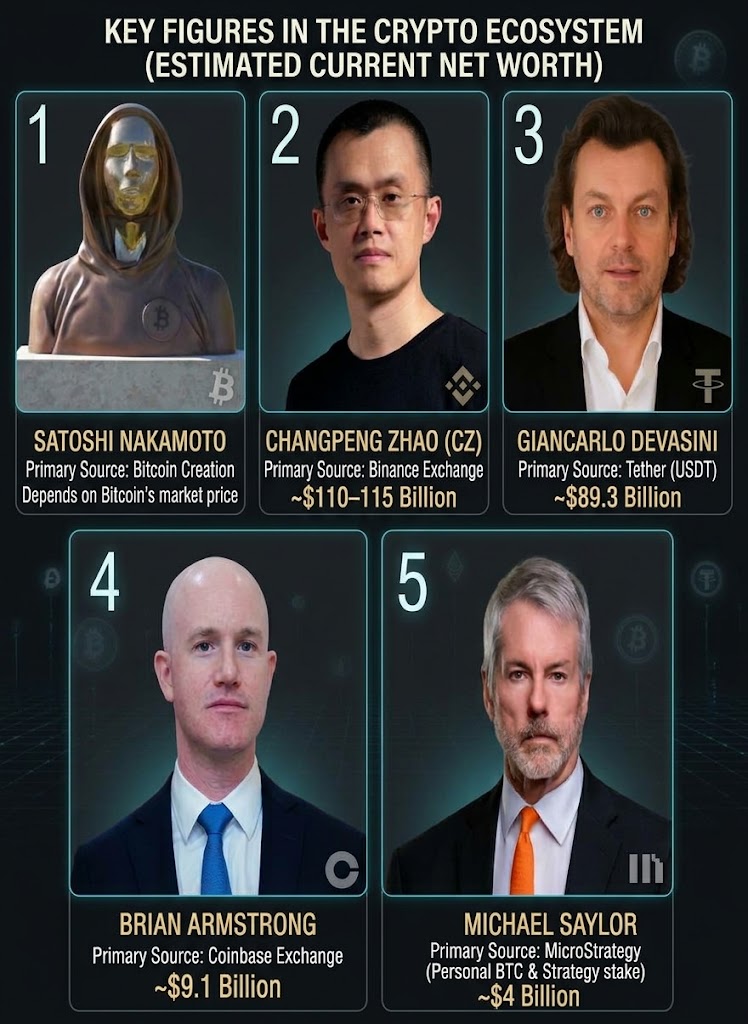
Below is a look at five people who captured immense value during this shift—mapping out where their money actually comes from, when they made their moves, and how their wealth measures up today.
| Name | Main project or source of wealth | Project start | Highest estimated net worth | Estimated current net worth |
|---|---|---|---|---|
| Satoshi Nakamoto | Bitcoin creation and estimated early mining holdings | 2008 / 2009 | Not independently established | Depends on Bitcoin's market price |
| Changpeng Zhao (CZ) | Binance exchange and BNB-related holdings | 2017 | Historical peak estimates | ~$110–115 billion |
| Giancarlo Devasini | Tether (USDT) and Bitfinex | 2012 / 2014 | Historical peak estimates | ~$89.3 billion |
| Brian Armstrong | Coinbase cryptocurrency exchange | 2012 | Historical peak estimates | ~$9.1 billion |
| Michael Saylor | Personal BTC & Strategy stake | 1989 / 2020 | ~$7.4 billion | ~$4 billion |
Methodology & Caveats: Interpreting Crypto Net Worth Estimates
These figures demand a degree of practical skepticism. On-paper wealth in crypto shifts rapidly alongside token spot prices, private company valuations, and changing equity structures.
Satoshi Nakamoto’s estimated net worth remains entirely speculative—the creator’s identity is unconfirmed, and those early mined blocks have remained motionless on-chain for over fifteen years. Likewise, MicroStrategy’s treasury reserves belong directly to MSTR shareholders, not to Michael Saylor as personal assets.
What these figures actually highlight are the distinct tracks for value creation within the digital asset ecosystem. Bitcoin established the foundational protocol, Binance and Coinbase captured transactional order flow, Tether provided market-wide liquidity rails through stablecoins, and MicroStrategy demonstrated corporate balance sheet leverage.
Ultimately, these fortunes prove that crypto has evolved far beyond raw mining operations and retail price speculation—it is now a mature ecosystem of financial infrastructure, institutional software, and capital markets.
Frequently Asked Questions (FAQ)
1. How did Bitcoin actually get started, and why isn't it just like normal money?
Answer: Bitcoin was launched right after the 2008 banking collapse by an anonymous creator using the name Satoshi Nakamoto. They dropped the white paper in late 2008 and got the network up and running in January 2009. What makes it totally different from regular fiat currency is that there’s no central bank or bank teller approving your transfers—it runs on an open, decentralized ledger secured by Proof of Work compute, and there will only ever be 21 million coins in existence.
2. Is Satoshi Nakamoto really the richest person in crypto?
Answer: Nobody knows for sure, and any net worth figure you see attached to Satoshi is purely theoretical. We know the creator’s wallet addresses hold around 1.1 million early-mined Bitcoins, but those coins haven't moved an inch on-chain in over 15 years. Since we don't know who Satoshi is—or if they even still have access to those private keys—that paper fortune fluctuates with Bitcoin’s market price, but remains completely inactive.
3. Does Michael Saylor personally own all those Bitcoins MicroStrategy holds?
Answer: No, that's a common misconception. MicroStrategy’s massive Bitcoin stack belongs to the corporate balance sheet and its public shareholders, not to Saylor himself. His personal net worth is tied to his individual Bitcoin holdings and his equity stake as the founder and executive chairman of MicroStrategy.
4. How are people making serious money in crypto these days if not just mining?
Answer: The days of making billions solely from home mining rigs or spot trading are mostly behind us. Wealth today is concentrated around high-margin infrastructure: core protocol development, exchange platforms that collect fees on every trade (like Binance and Coinbase), stablecoin issuers that earn massive interest on USD reserves (like Tether), and institutional treasury plays (like MicroStrategy).
5. Why are stablecoins like USDT constantly under fire?
Answer: The heat usually boils down to two things: reserve backing and control. Critics and regulators regularly demand proof that every issued dollar-backed stablecoin is fully backed 1-to-1 with liquid liquid cash and treasury bills. On top of that, there’s an ongoing debate over protocol ethics—because centralized issuers hold the power to freeze wallet addresses on-chain, which directly clashes with crypto's censorship-resistant ethos.