

How Crypto Mining Heat Reuse Creates Sustainable Heating for Farms and Greenhouses
We start with a story that perhaps you have heard before—it is a groundbreaking and unconventional one. During the long nights of Finland, when the cold has become not only a phenomenon but a manner of living, there was a question that lingered for many decades across the land: How can we warm our cities without burning the future?
For many years, Finns relied on conventional methods to heat their cities—fossil fuels and power plants with a large carbon footprint—resulting in high energy bills that hit citizens every January.
However, the answer did not lie in mines or fields, but in those quiet places where people rarely venture: data centers. Thousands of computers operate uninterrupted inside these facilities, processing text, video, financial transactions, and AI algorithms. What they produce is one massive resource: waste heat.
In most parts of the world, this heat is treated as a problem and wasted by being cooled and vented into the atmosphere. In Finland, this mindset underwent a paradigm shift, and a simple question was asked: What’s the point of wasting something when we could use it for something else?
Thus, the vision of connecting data centers to district heating systems was born, allowing heat from servers to travel through pipes and warm homes, schools, and hospitals. Every search query or streamed video now contributes to warming a Finnish home.
Is it possible for an individual such as myself to undertake a sustainable initiative by combining crypto mining with farming to combat carbon emissions and energy consumption? Below is an easy-to-follow approach that combines both worlds.
Using ASIC & GPU Mining Heat for Poultry Farm and Greenhouse Heating
In a world facing increasing economic and environmental challenges, new solutions that combine cutting-edge technology with traditional agricultural practices are being developed at a rapid pace. One such solution is the use of ASIC and GPU miners to provide the thermal energy required by chicken farms and greenhouses during winter months.
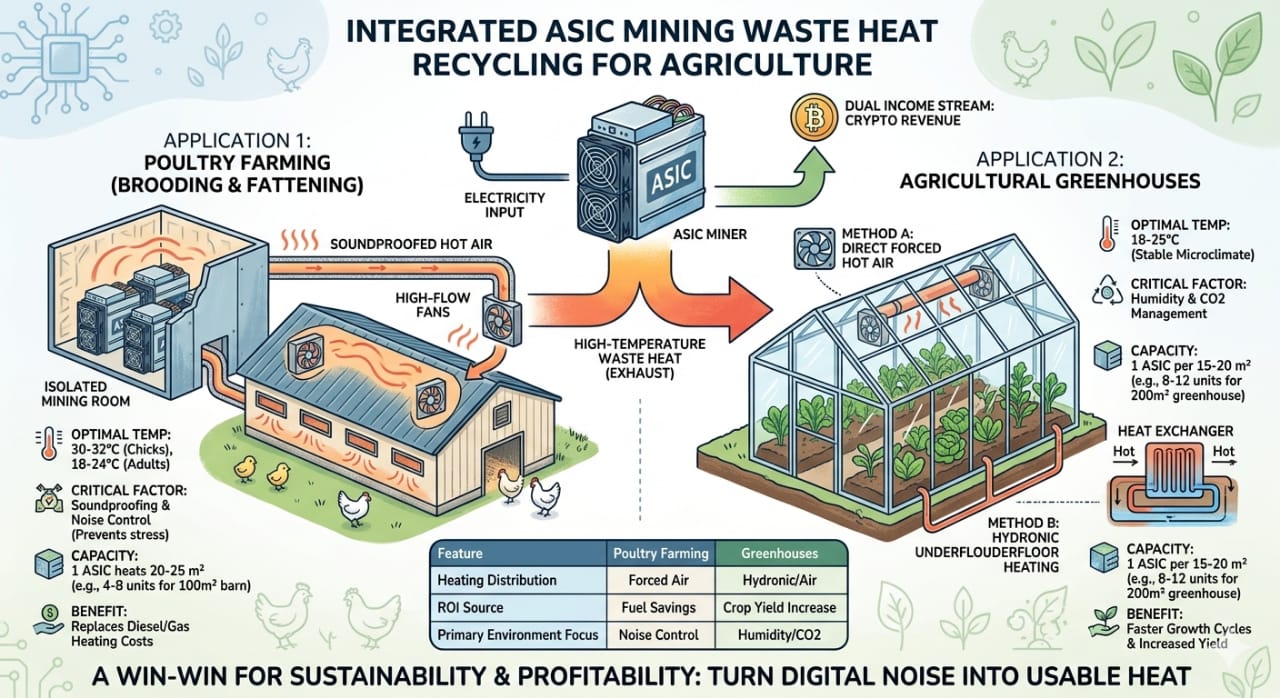
How to Reuse Bitcoin Mining Heat for Poultry Farm Heating: Step-by-Step Guide
Engineering Practical Setups to Heat Poultry Houses Using High-Performance Mining Servers
Mining units run continuously and generate constant heat. To reduce noise levels—which could stress birds and affect feed conversion rates—the units can be placed in a soundproof iron box or a soundproof room adjacent to the poultry house. The heated air is then transferred into the facility through iron pipes or high-flow fans.
Optimizing Thermal Requirements for Poultry Health Through Continuous Mining Heat Exhaust
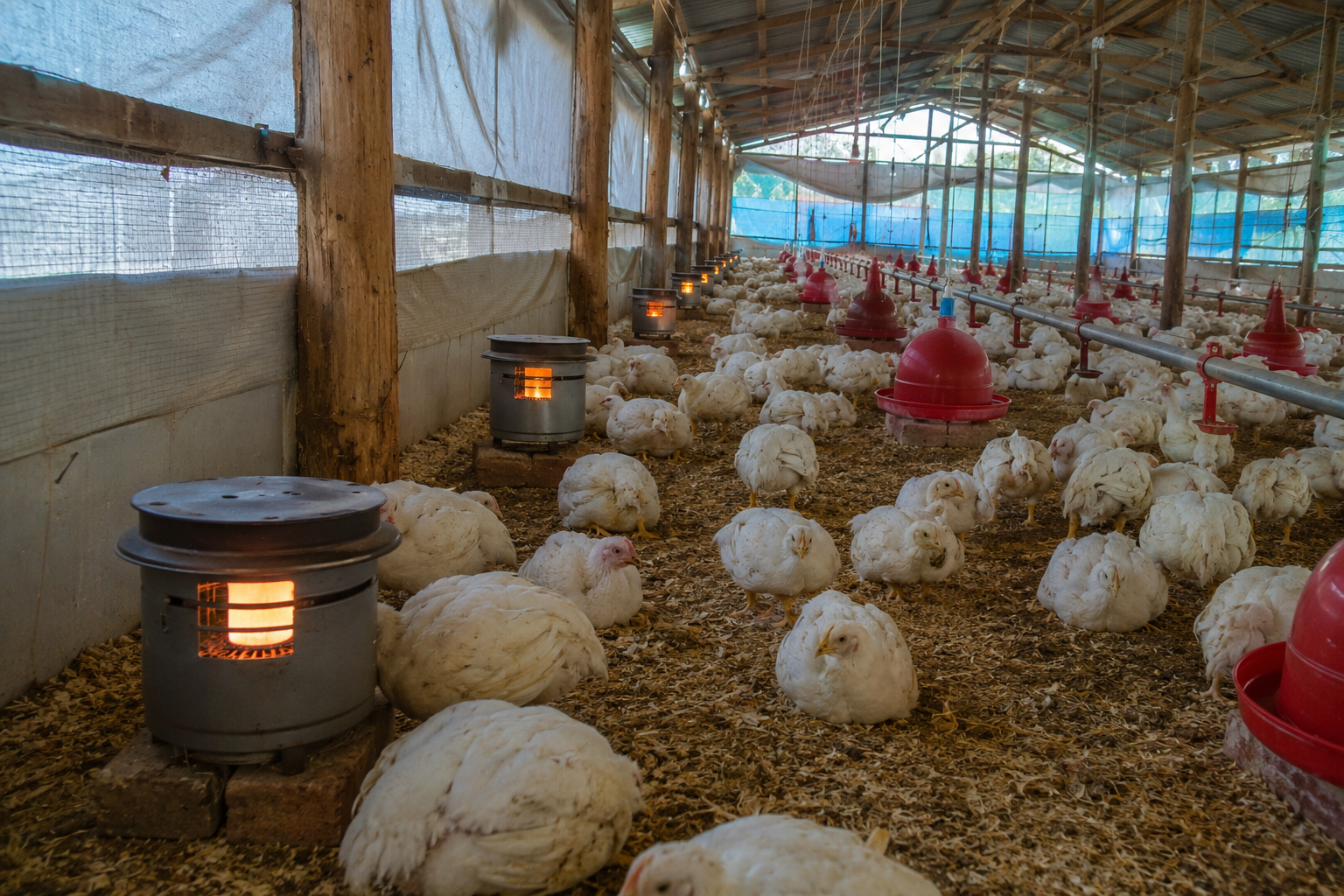
Thermal Needs:
-
Chicks (early stage): require temperatures ranging from 30–32°C.
-
Adult chickens: require a temperature range of 18–24°C.
Capacity: One ASIC miner can heat an area of 20–25 m² during winter months. For a medium-sized barn (approximately 100 m²), 4 to 8 units are required for space heating.
Financial and Operational Advantages of Replacing Fossil Fuels with Crypto Mining Thermal Energy
Benefits:
-
Reduction or complete elimination of gas, diesel fuel, or conventional electric heaters.
-
Stable heat supply for optimal poultry growth and health.
-
Dual income generation: mining revenue plus significant savings from reduced heating costs.
-
Agricultural electricity tariffs are generally lower than those for industrial and commercial use.
Using Crypto Mining Waste Heat to Heat Greenhouses and Increase Crop Yields
Technical Methods for Deploying ASIC Miners as Smart Greenhouse Climate Control Systems
How to Use: Heat can be applied directly as hot air or converted into hot water using a heat exchanger, then transported through underfloor piping systems. Heat controllers help maintain a stable microclimate for optimal plant growth.
Managing Greenhouse Microclimates and Heat Demands Using Scalable Bitcoin Mining Operations
Heat Requirements:
-
During winter, most plants require temperatures between 18–25°C.
-
A typical greenhouse of approximately 200 m² requires 8–12 ASIC units, depending on insulation quality.
Key Benefits of Repurposing Mining Computations for Sustainable Greenhouse Heating Solutions
Benefits:
-
Faster growth cycles and increased crop production yields.
-
Reduced reliance on conventional fuels and high-cost heating equipment.
-
Dual purpose: electricity is first used for mining computations and then fully repurposed for thermal heating.
Benefits of Crypto Mining Heat Recovery for Sustainable Agriculture and Farming
-
Economically: For every kilowatt used in mining, free heating is obtained by reusing the same energy.
-
Operationally: Waste heat is fully utilized instead of being expelled into the environment as a byproduct.
-
Environmentally: Carbon emissions are reduced by replacing fossil fuel-based heating systems with digital thermal energy.
-
Strategic location: Mining operations are usually located in agricultural or remote areas, making noise far less problematic for neighbors.
| 📊 Feature | 🍗 Poultry Farming (Brooding) | 🌿 Agricultural Greenhouses |
|---|---|---|
| 🌡️ Optimal Temperature | 🟠 18°C – 32°C (Variable) | 🔵 18°C – 25°C (Stable) |
| ⚡ Heating Capacity | 🟢 1 ASIC per 20–25 m² | 🟢 1 ASIC per 15–20 m² |
| 🛠️ Heat Distribution | 💨 Forced Hot Air (Soundproofed) | 💧 Hydronic Underfloor / Fans |
| ⚠️ Critical Factor | 🔇 Noise Control & Stress | 🌫️ Humidity & CO2 Levels |
| 💰 Primary ROI | 📉 Replacing Diesel/Gas Costs | 📈 Faster Crop Growth Cycles |
| 🌍 Sustainability | 🌱 Zero-Emission Heating | ♻️ Energy Repurposing |
Final Verdict: Is Crypto Mining Heat Reuse the Future of Sustainable Agriculture?
Mining hardware is no longer just a tool for cryptocurrency production; it has evolved into a smart industrial heating solution. In poultry farms and greenhouses, this technology offers a practical way to survive harsh winter seasons in Northern Europe and North America.
As Finland has demonstrated, all that is required is a change in perspective: turning digital noise into usable heat—and transforming that heat into a sustainable harvest.