Introduction
As GPU mining yields remain tight and network difficulty shifts across major Proof-of-Work (PoW) coins, operators are looking for smarter ways to deploy capital. While Application-Specific Integrated Circuits (ASICs) dominate established networks, Field-Programmable Gate Arrays (FPGAs) offer a compelling middle ground: specialized hashing efficiency combined with hardware reconfigurability.
The release of a dedicated Quantis (QTC) bitstream for the Osprey E300-VU35P gives owners of compatible Xilinx UltraScale+ hardware a fresh opportunity to monetize their equipment without dropping cash on a brand-new rig.
Quantis (QTC) Network Mechanics: Quantum-Resistant PoW Mining
Quantis "QTC" is a proof-of-work cryptocurrency built around quantum-resistant security and privacy features. With a fixed supply cap of 21 million coins, it’s catching the eye of miners looking to diversify away from the usual mega-cap assets.
Of course, like any proof-of-work coin, mining Quantis isn't a guaranteed payday. Profitability rises and falls with market price, network difficulty, hardware efficiency, and your local power rates. A sudden price spike looks great on paper, but it doesn't guarantee long-term margins.
Still, if you already own compatible hardware, adding support for a new algorithm is a great way to test the waters on an emerging chain without having to drop cash on a brand-new rig.
Osprey E300-VU35P Configuration: Loading the Quantis Bitstream
The Osprey E300-VU35P is an FPGA platform built for specialized compute jobs. Unlike a standard GPU rig running off graphics cards, an FPGA relies on programmable logic gates that can be reconfigured for different algorithms on the fly.
With a compatible Quantis bitstream now available, E300 owners can flash the required hashing logic directly onto the board. That’s the real selling point of FPGA hardware: when devs add support for a new algorithm, you can pivot to another coin without dropping a dime on new equipment.
Getting started involves a few basic steps:
-
Verify algorithm compatibility. Confirm that the available Quantis bitstream supports your exact Osprey E300 variant.
-
Access the miner's interface. Connect the device to your network and open its web dashboard using its local IP address.
-
Configure the mining pool. Enter the appropriate pool address, wallet address or account identifier, and worker name.
-
Adjust the operating parameters. Set the FPGA voltage and core clock according to the recommendations for the specific device and bitstream.
-
Monitor mining performance. Check the hashrate, accepted shares, temperature, stability, and power consumption after mining starts.
Depending on what’s currently running on your board, you may need to update the controller firmware or bitstream tools before loading the new algorithm. Always check your current software revision before flashing to avoid compatibility hiccups.
Optimal E300-VU35P Parameters: 680mV Voltage & 510MHz Clock
When setting up the Osprey E300-VU35P for Quantis, 680 mV core voltage and a 510 MHz core clock give you a solid operational baseline.
Treat these figures as a starting benchmark rather than a fixed rule across every setup. Because silicon quality varies from board to board and bitstream updates tweak underlying timing constraints, always cross-reference the dev team’s specific recommendations for your exact hardware batch before hitting save.
Your voltage and clock dials dictate your power draw, thermals, board stability, and final hash output. Bumping up clock speeds can yield higher throughput, but it ramps up core thermals quickly and risks invalid shares or sudden system drops. On the flip side, pulling voltage too low starves the FPGA logic, causing the board to fault mid-job.
Ultimately, the goal is locking in your board’s efficiency sweet spot—a stable, low-error profile that delivers a steady stream of accepted shares without blowing out your daily power costs.
FPGA vs. ASIC Hardware Architecture: Bitstream Flexibility vs. Efficiency
FPGA and ASICs miners both handle specialized computing workloads, but their underlying silicon architectures take completely different approaches.
An FPGA (Field-Programmable Gate Array) is Built around reconfigurable logic blocks. In crypto mining, developers write specialized bitstreams that reprogram the hardware at the gate level, allowing the device to adapt and mine entirely different algorithms over time.
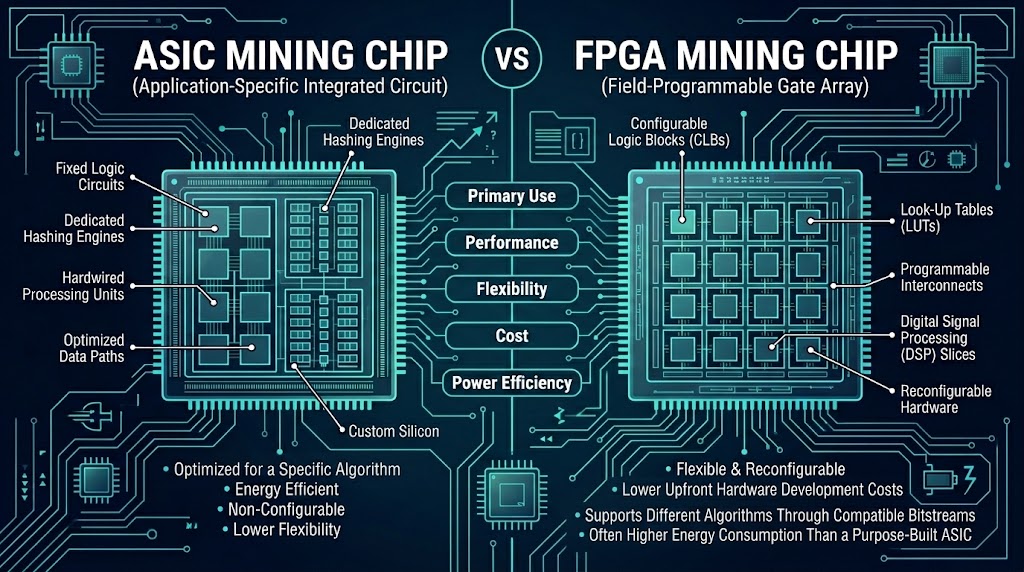
FPGA vs. ASIC: FPGA chips use reconfigurable logic, while ASICs use dedicated circuits optimized for specific algorithms.
An ASIC (Application-Specific Integrated Circuit) is manufactured with a single hashing algorithm permanently etched into the silicon. Because the hardware is hardwired exclusively for that task, an ASIC delivers far higher hashing density and energy efficiency than any reconfigurable chip ever could.
For operators who value agility and like testing new coins, FPGA hardware provides essential flexibility. ASICs, on the other hand, remain the gold standard when the sole priority is squeezing maximum performance out of a single algorithm.
FPGA vs. ASIC Mining Comparison
| Feature | FPGA Miner | ASIC Miner |
|---|---|---|
| Hardware design | Programmable logic | Custom-designed chip |
| Algorithm flexibility | Supports different algorithms through compatible bitstreams | Usually designed for a specific algorithm or algorithm family |
| Switching coins | Possible when compatible implementations are available | Depends on algorithm compatibility |
| Performance | Depends on the FPGA, bitstream, and configuration | Often extremely high for its target algorithm |
| Energy efficiency | Varies by algorithm and implementation | Generally optimized for its intended workload |
| Configuration | May require voltage, clock, and bitstream adjustments | Usually simpler, with model-specific settings |
| Development | Requires compatible hardware designs and bitstream support | Requires specialized chip design and manufacturing |
| Best suited for | Experimentation and adaptable mining setups | Focused mining on supported algorithms |
FPGA Profitability Matrix: Power Consumption, Dev Fees & TCO
At its core, the main advantage of "FPGA mining" is sheer adaptability. Instead of being locked into a single coin or algorithm, you can pivot your hardware whenever developers release a new, compatible bitstream. That flexibility is what keeps older rigs out of the scrap heap when profitability shifts.
Of course, flexibility doesn't automatically guarantee a positive return. Power rates, shifting network difficulty, developer fees, and coin prices all dictate whether an experiment actually pencils out. Running the numbers on your local electricity cost before flashing a new algorithm remains non-negotiable.
For Osprey E300-VU35P owners, Quantis is a great test case for what FPGAs do best. While ASICs will always rule the roost when it comes to raw, fixed-algorithm efficiency, FPGA hardware remains the go-to choice for miners who like to tinker, adapt, and stay flexible as market conditions change.