Introduction
Mining hardware has one problem that never goes away: heat.
An ASIC miner can run for hours, days, and months without stopping, and most of the electricity it uses eventually becomes heat. With conventional air cooling, fans pull air through the machine and push that heat away. It is a simple system, but it depends heavily on the air around the miner.
That can become a problem in very hot places.
In parts of the Gulf, desert regions, and the southern United States, summer temperatures can become extremely high. During severe heat, outdoor temperatures can approach or exceed 46°C (115°F) in some locations. When the air entering a mining facility is already that hot, cooling an ASIC becomes much harder than it would be in a cooler climate.
Dust makes things even more difficult. A miner running in a dusty environment is constantly pulling particles into its cooling system. Filters need cleaning, heatsinks can become dirty, and restricted airflow can eventually affect cooling performance.
This is where oil immersion cooling offers a different approach.
How Liquid Immersion Cooling Operates in ASIC Mining
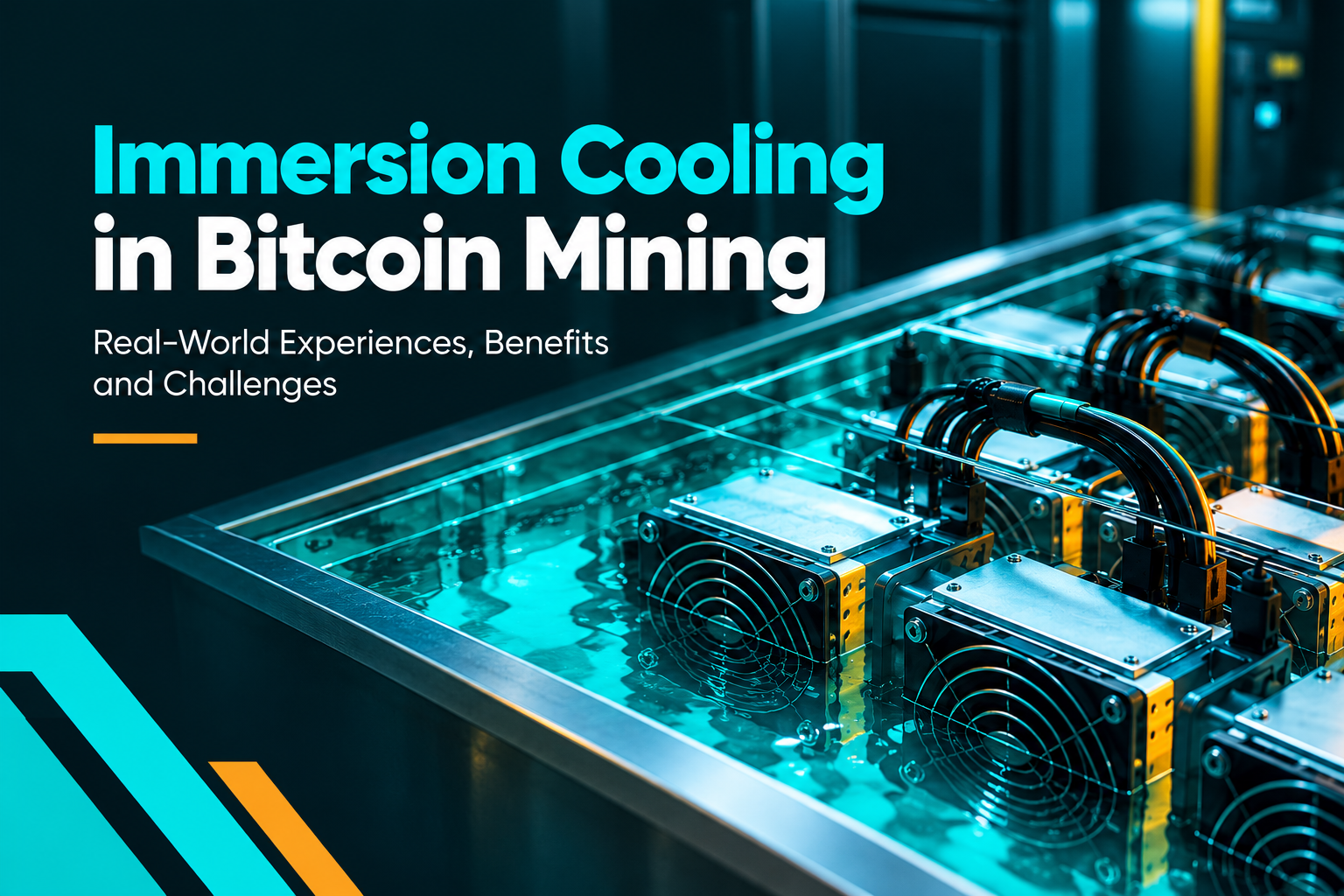
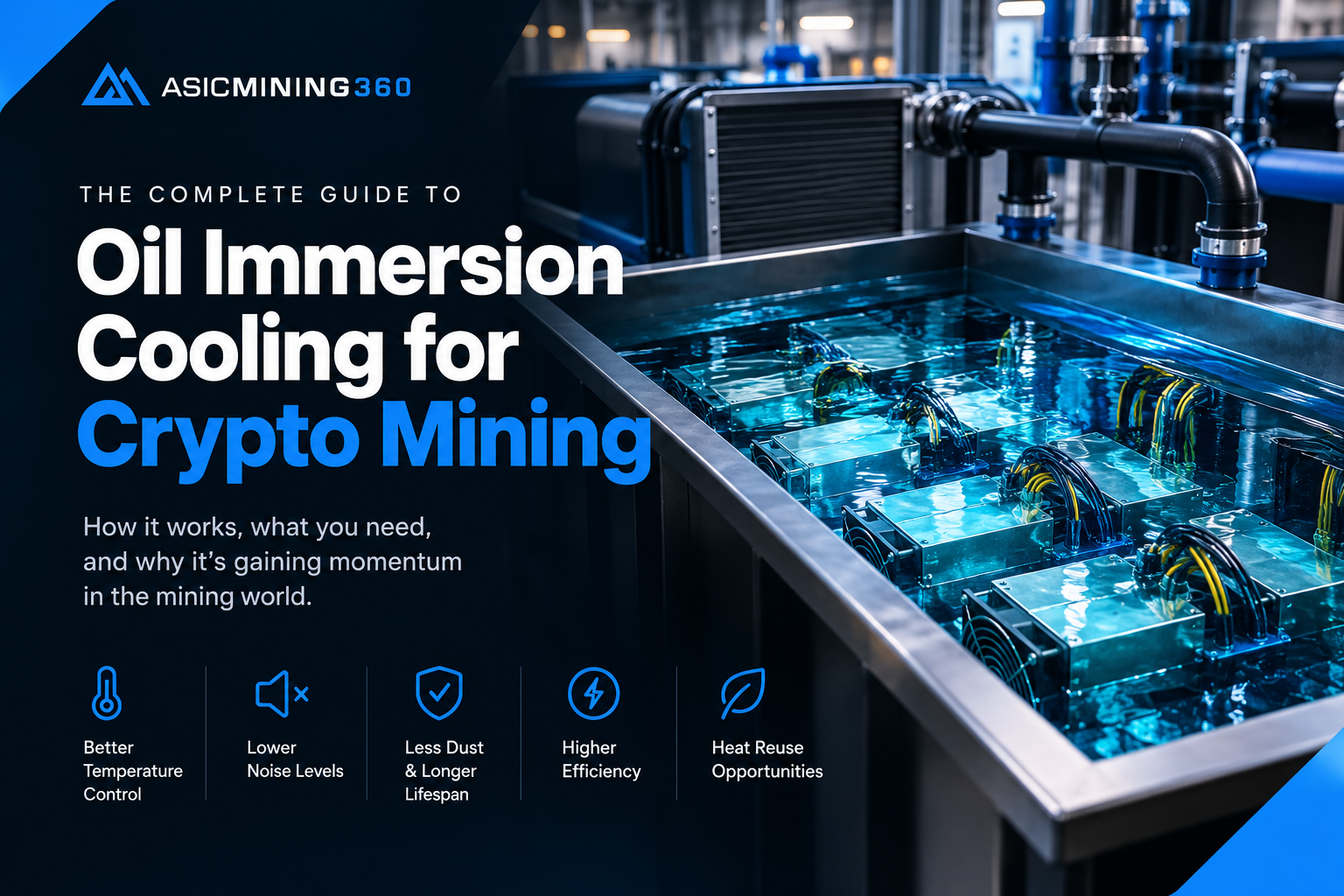
Instead of using air as the main medium for removing heat, immersion cooling places the mining hardware inside a specially selected electrically non-conductive fluid.
The idea is quite simple. The ASIC produces heat, the fluid absorbs that heat, and a circulation system carries the heated fluid away from the miner.
The hot fluid is pumped through a heat exchanger. On the other side of the exchanger, a separate water circuit carries the heat away. The water can then be sent to a cooling tower or another heat-rejection system before returning to the cooling loop.
So the basic cycle looks like this:
ASIC miner → cooling fluid → pump → heat exchanger → water circuit → heat rejection → cooled fluid → ASIC miner
The miner is still producing exactly the same heat. The difference is how that heat is collected and moved.
Core Components of an Industrial Immersion Mining System
An immersion installation is more than just a tank filled with oil. Several components work together to keep the miners at an acceptable temperature.
Immersion Tanks & Drawer-Based ASIC Racks
At its core, the tank holds both the miners and the dielectric fluid. How those machines are arranged inside comes down to the design—some setups use fixed racks or shelves, while others go with sliding drawers.
That drawer design is a real game-changer for maintenance. Instead of awkwardly fishing around in a deep tank full of fluid, a technician can just slide the miner right out to inspect or service it without the hassle.
Dielectric Fluid Circulation Pumps
Think of the pump as the heartbeat of the entire setup—it keeps the dielectric fluid constantly moving.
As the ASICs run hot, the fluid around them absorbs that heat. The pump pushes that warm fluid out toward a heat exchanger, where the thermal energy gets dumped into a secondary cooling loop.
Without steady flow, heat would just trap around the hashboards, and the whole system would quickly lose control of its temperatures.
Fluid Filtration Systems & Contaminant Removal
The fluid also needs to be kept clean.
A filtration system can remove contaminants from the cooling circuit and help maintain the condition of the fluid. This becomes particularly relevant in large installations that operate continuously and contain a substantial volume of cooling liquid.
Plate Heat Exchangers & Secondary Cooling Loops
The heat exchanger is where the two cooling circuits meet without actually mixing.
Hot dielectric fluid travels through one side while cooler water moves through the other. Heat passes through the exchanger material from the hotter fluid to the cooler water.
The heated water then moves toward the heat-rejection system, while the cooled mining fluid returns toward the miners.
The size and design of the heat exchanger matter because the entire system depends on being able to move enough heat away from the mining hardware.
External Cooling Towers & Outdoor Heat Rejection
Once the water has absorbed heat, that heat still has to go somewhere.
A cooling tower can release the heat into the surrounding environment before the water is sent back through the system.
This is worth keeping in mind when looking at immersion cooling. It does not eliminate the need for heat rejection. It simply changes the way heat is collected and transported.
High-Ambient & Desert ASIC Mining Thermal Efficiency
Air cooling works by moving air across the hot components. The cooler that air is, the more useful it can be for removing heat.
In a desert environment, that advantage becomes smaller when the incoming air is already extremely warm.
With immersion cooling, the ASIC is surrounded by the cooling fluid rather than depending on large quantities of outside air flowing directly through its heatsinks.
That can be useful in places where summer temperatures are very high.
It can also help in dusty locations. An air-cooled miner may continuously pull dust and other particles through its cooling path. An immersion-cooled system does not need to use the same constant airflow through the mining hardware.
This does not mean that an immersion system is completely unaffected by the climate. The cooling tower, radiators, chillers, or other heat-rejection equipment still have to deal with the outside environment. The difference is that the mining chips are no longer being cooled directly by the hot and dusty air.
Acoustic Noise Reduction in High-Density Mining
Anyone who has spent time around a large group of ASIC miners knows how loud they can be.
High-speed fans are a major source of that noise. They need to move a large amount of air through the machines, particularly when the hardware is working hard.
Immersion cooling changes the situation because the miners no longer depend on those large amounts of air moving directly through their cooling systems.
The result can be a much quieter mining environment.
It is not necessarily silent. Pumps, cooling towers, fans in other parts of the installation, and electrical equipment can still produce noise. But removing the constant high-speed airflow from the ASICs themselves can make a noticeable difference.
ASIC Waste Heat Recovery & Recycling Systems
There is another interesting side to immersion cooling: heat recovery.
A mining farm produces heat whether it uses air or liquid cooling. Instead of simply releasing that heat outside, an immersion system can be connected to a heat-recovery circuit.
Depending on the temperatures involved, the recovered heat could potentially be used for buildings, greenhouses, industrial processes, or other applications that need heat.
For example, a mining installation in a cold European climate could potentially send useful heat into a building instead of treating all of the mining heat as waste.
The idea is not limited to cold countries, either. The important question is whether there is a nearby application that can actually use the available heat at the temperature the system can provide.
Can ASIC Miners Be Used With Immersion Cooling?
Yes, but the answer is not simply a matter of putting any miner into any liquid.
The mining hardware and the cooling fluid have to be compatible. Electrical connections, materials, seals, power supplies, operating temperatures, and the characteristics of the fluid all matter.
Some ASIC models are specifically sold as immersion versions. Other miners can be installed in immersion systems designed to accommodate them.
The market already includes immersion-oriented machines from manufacturers such as Bitmain and models from MicroBT that are used in high-density mining environments.
For example, the data in the supplied miner list includes the Bitmain Antminer S23 Immersion at 442 TH/s and 5,304 W, as well as the Antminer S21 XP Immersion at 300 TH/s and 4,050 W. The same list includes the MicroBT WhatsMiner M78S at 472 TH/s and 6,550 W and the WhatsMiner M76S+ at 390 TH/s and 5,200 W.
There are also older and lower-hashrate examples in the list, including the Obelisk SC1 Immersion and several MicroBT models.
These machines show how quickly the thermal requirements can grow as mining hardware becomes more powerful. A 400-plus-TH/s ASIC consuming several kilowatts cannot simply be treated like a small electronic device when designing its cooling system.
The Fluid Is Just as Important as the Tank
Calling the cooling medium "oil" can make immersion cooling sound simpler than it really is.
Not every oil is suitable for putting electronic mining equipment into.
The fluid needs to be electrically non-conductive and must have properties that work with the temperatures, materials, seals, cables, and other components in the system. Its thermal characteristics also affect how efficiently heat can be moved away from the miners.
Different immersion systems can therefore use different types of fluids, including mineral-oil-based products and purpose-built dielectric fluids.
The choice affects more than cooling performance. It can influence the purchase price, maintenance, filtration, material compatibility, fluid lifetime, and what can be done with the equipment after it has been immersed.
This is also one area where cutting costs in the wrong place can become expensive later. Using an unsuitable fluid is not the same thing as finding a cheaper version of a suitable cooling fluid.
Is Immersion Cooling Worth Considering for Mining?
Immersion cooling is not automatically the right solution for every mining operation.
A small home miner may find the additional tank, pumps, heat exchanger, fluid, plumbing, and heat-rejection equipment difficult to justify. A large mining operation, however, has a different set of requirements.
The technology becomes more interesting when several problems appear at the same time: high ambient temperatures, dust, high ASIC density, noise restrictions, or a useful application for the heat produced by the miners.
The choice also depends on the cost of electricity, the price of the cooling equipment, the type of ASIC hardware being used, and the local climate.
For a conventional air-cooled installation, the cooling system is largely built around moving air.
With immersion cooling, the entire thermal path changes. The miner transfers heat into a dielectric fluid, the fluid carries that heat to a heat exchanger, and another circuit takes the heat away.
That extra equipment comes with a cost, but it can also open possibilities that are difficult to achieve with conventional fan cooling, particularly in hot, dusty, or noise-sensitive mining environments.
The next part is the hardware itself: which ASIC miners are available for immersion cooling, what their power consumption and hashrate look like, and how they compare with conventional air-cooled machines.
ASIC Miners Used With Immersion Cooling
Immersion cooling is not limited to one generation of mining hardware. Several ASIC models are available in immersion-oriented versions, while other machines can be installed in specially designed immersion systems.
The following examples show the range of ASIC hardware associated with immersion cooling, from newer high-hashrate Bitcoin miners to older models.
| Manufacturer | Miner | Hashrate | Power | Algorithm | Release |
|---|---|---|---|---|---|
| Bitmain | Antminer S23 Immersion | 442 TH/s | 5,304 W | SHA-256 | Jan 2026 |
| MicroBT | WhatsMiner M78S | 472 TH/s | 6,550 W | SHA-256 | Dec 2025 |
| MicroBT | WhatsMiner M76S+ | 390 TH/s | 5,200 W | SHA-256 | Dec 2025 |
| Bitmain | Antminer S21 XP Immersion | 300 TH/s | 4,050 W | SHA-256 | Oct 2024 |
| MicroBT | WhatsMiner M76S | 362 TH/s | 5,200 W | SHA-256 | Dec 2025 |
| MicroBT | WhatsMiner M76 | 336 TH/s | 5,200 W | SHA-256 | Dec 2025 |
| Bitmain | Antminer S21 Immersion | 301 TH/s | 5,569 W | SHA-256 | Dec 2024 |
| Auradine | Teraflux AI3680 | 360 TH/s | 6,840 W | SHA-256 | Dec 2024 |
| Obelisk | SC1 Immersion | 2.2 TH/s | 1,600 W | Blake2B | Mar 2019 |
| Canaan | Avalon Miner A1366I | 119 TH/s | 3,570 W | SHA-256 | Jun 2024 |
| MicroBT | WhatsMiner M56S | 212 TH/s | 5,550 W | SHA-256 | Jan 2023 |
| MicroBT | WhatsMiner M56 | 194 TH/s | 5,550 W | SHA-256 | Jan 2023 |
The specifications above come from the supplied miner list.
What About GPU Mining?
ASICs aren’t the only hardware getting the dip—GPUs can be submerged in dielectric fluid too, though the setup looks quite different.
Unlike purpose-built immersion ASICs, GPU setups usually rely on dedicated tanks or custom-designed enclosures tailored to hold the fluid and cards.
That custom approach is essential for GPU mining. Since card counts and layouts vary from rig to rig, the enclosure needs to fit the exact form factor. Plus, you’re not just dunking graphics cards—you have to design around the motherboard, PSUs, PCIe risers, cabling, and all the connectors that keep the rig running.
In other words, GPU immersion cooling does not necessarily require an ASIC-style immersion miner. A GPU mining rig can be placed inside a purpose-built immersion box or tank, provided that the fluid and the hardware are compatible.
This distinction is important because the cooling technology is similar, but the hardware arrangement can be very different.
For ASICs, some manufacturers now offer machines specifically associated with immersion cooling. For GPUs, the solution is more often based on a separate immersion enclosure or tank designed to accommodate the complete mining rig.
Immersion Cooling Does Not Mean Every Miner Can Be Submerged
A miner should not be placed into oil simply because the fluid is described as non-conductive.
The cooling fluid, electrical components, seals, plastics, cables, connectors, and other materials all need to be suitable for the application. The way the fluid circulates also matters, particularly in larger installations.
For that reason, compatibility should be checked before converting an air-cooled ASIC or GPU rig to immersion cooling.