Why Bitcoin Mining Is Driving Demand for New Energy Infrastructure
The digital world is getting hungrier. Between the explosion of generative AI, massive cloud expansions, and the relentless march of Bitcoin mining, global electricity demand is hitting levels we’ve never seen. For Bitcoin miners, power isn’t just a utility—it’s the entire business. When you’re running operations that suck up hundreds of megawatts, the price of a kilowatt-hour is the difference between a thriving farm and a shuttered warehouse.
This search for cheap and steady power has led the industry to an unexpected doorstep: the military’s work on mobile nuclear microreactors. What was originally designed to keep remote bases running without a vulnerable fuel supply chain might just be the "plug-and-play" energy solution the crypto world has been dreaming of. One project stands at the center of this: Project Pele. Managed by the U.S. Department of Defense, it’s a mission to build a transportable, safe, and tiny nuclear reactor that can go anywhere the grid can’t.
What Exactly Is a Nuclear Microreactor?
Think of a microreactor as a nuclear battery rather than a traditional power plant. These belong to the Generation IV family of nuclear tech. Unlike the massive, concrete-domed facilities we usually picture, microreactors are factory-built, compact, and designed to be moved by truck or plane.
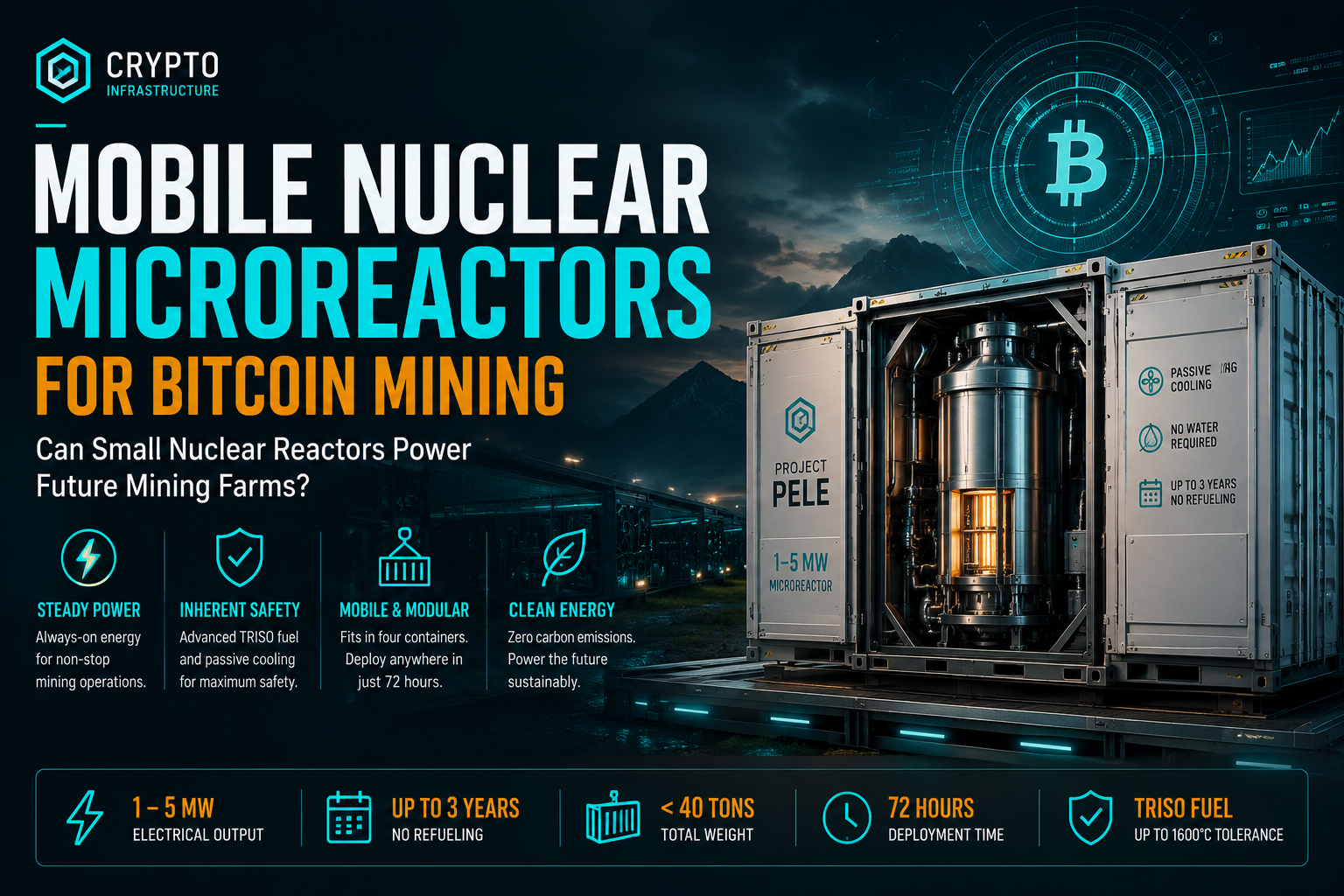
The Project Pele prototype is aiming for an output of 1 to 5 megawatts (MW). While that sounds small compared to a gigawatt-scale city plant, it’s a massive amount of "always-on" energy for a remote site. Perhaps the biggest selling point? It can run for three years straight without needing a single fuel delivery.
Technical Specifications of the Project Pele Mobile Nuclear Microreactor
| Specification | Project Pele Microreactor |
|---|---|
| Reactor Type | High-Temperature Gas-Cooled Reactor (HTGR) |
| Electrical Output | 1 – 5 MW (Prototype ~1.5 MW) |
| Fuel Type | TRISO Fuel Particles |
| Coolant | Helium Gas |
| Maximum Fuel Temperature Tolerance | Over 1600°C |
| Operational Duration | Up to 3 Years Without Refueling |
| Cooling System | Passive Cooling / No Water Required |
| Total System Weight | Less Than 40 Tons |
| Transport Format | Fits Into Four 20-Foot Shipping Containers |
| Deployment Time | Approximately 72 Hours |
| Decommission / Removal Time | About One Week |
| Developer | BWXT Advanced Technologies |
| Testing Location | Idaho National Laboratory (INL) |
| Expected Demonstration | Around 2028 |
High Temperature Gas-Cooled Reactors and TRISO Nuclear Fuel Technology
The microreactor being developed under Project Pele relies on high temperature gas cooled reactor technology. Instead of water, the system uses helium gas as a coolant, allowing the reactor to operate at very high temperatures while maintaining strong safety characteristics.
One of the key safety features of this design is the use of TRISO nuclear fuel. TRISO particles consist of tiny uranium kernels encapsulated within multiple layers of protective ceramic and carbon coatings. These layers act as miniature containment systems capable of retaining radioactive materials even under extreme temperatures.
TRISO fuel particles can withstand temperatures exceeding 1600 degrees Celsius, which significantly reduces the risk of fuel damage or meltdown scenarios. Because of these properties, many advanced nuclear developers consider TRISO-based reactors among the safest designs in modern nuclear engineering.
Another major advantage of this reactor design is its passive safety characteristics. The system is engineered to remain stable even under worst-case conditions without requiring complex active cooling systems.
Mobile Nuclear Reactors and Rapid Deployment in Remote Locations
One of the defining features of microreactors is their mobility. The Project Pele reactor is designed to weigh less than 40 tons and fit inside four standard 20-foot shipping containers.
This design allows the reactor to be transported using cargo aircraft, rail transport, or heavy-duty trucks. Once delivered to a location, the system can be deployed in roughly 72 hours, providing immediate electricity in environments where building traditional power plants would take years.
The reactor also does not require water-based cooling, which makes it suitable for desert regions, Arctic environments, remote islands, and disaster zones where water resources may be limited. After its operational cycle, the reactor can be disassembled and removed within about a week, restoring the deployment site.
Energy Consumption of Large Bitcoin Mining Farms
Bitcoin mining farms operate continuously, performing trillions of cryptographic calculations every second. Unlike many other industrial processes, mining hardware cannot easily pause or operate intermittently without losing profitability. As a result, mining operators require stable baseload electricity available twenty-four hours a day.
Large mining farms often consume tens to hundreds of megawatts of power depending on their size. The largest industrial mining facilities today operate at scales comparable to medium-sized power plants.
The global Bitcoin mining network is estimated to consume more than 15 gigawatts of electricity worldwide.
Electricity prices are therefore the most critical variable in mining economics. Even small differences in electricity cost can determine whether a mining farm remains profitable. Mining operators currently obtain electricity from hydroelectric dams, natural gas power plants, coal power plants, wind and solar farms, or stranded energy sources such as flared natural gas.
However, each of these energy sources has limitations. Renewable energy sources like wind and solar are intermittent, fossil fuel power plants face increasing environmental regulation, and hydropower availability depends heavily on geography and water resources. These challenges have prompted interest in alternative energy systems capable of delivering reliable power for extended periods.
Could Micro Nuclear Reactors Power Bitcoin Mining Infrastructure?
At first glance, nuclear microreactors appear well suited for powering digital infrastructure that requires uninterrupted electricity. A microreactor producing around 1.5 megawatts could potentially power a small modular mining operation consisting of roughly two hundred to three hundred modern ASIC mining machines, depending on the efficiency of the hardware used.
Estimated Number of Bitcoin Miners Powered by a Micro Nuclear Reactor
| Miner Model | Power Consumption | Units Powered by 1.5 MW Reactor | Units Powered by 5 MW Reactor |
|---|---|---|---|
| Bitmain Antminer S23 Hyd 3U | 11,020 W | 136 Units | 453 Units |
| MicroBT WhatsMiner M79 | 14,500 W | 103 Units | 344 Units |
| Bitmain Antminer S21e XP Hyd 3U | 11,180 W | 134 Units | 447 Units |
| Bitmain Antminer S23e Hyd 3U | 8,650 W | 173 Units | 578 Units |
Actual deployment would also depend on cooling infrastructure, power distribution systems, and facility overhead loads which typically consume a portion of total available electricity.
Larger reactors in the five megawatt range could support significantly larger mining clusters. One possible future architecture could involve containerized mining farms paired with containerized microreactors, creating fully independent power generation and computing units capable of operating almost anywhere in the world.
Such systems could theoretically be deployed in remote regions with cold climates suitable for hardware cooling, access to fiber internet infrastructure, and limited or nonexistent electrical grids. This concept could transform how mining farms are built, shifting from large centralized facilities toward modular and mobile mining infrastructure.
Estimated Costs of Nuclear Microreactors and Electricity Production
When we talk about the bottom line, cost is everything. Right now, these advanced microreactors aren't exactly "budget-friendly" because we are still in the early prototype phase. Industry analysts expect the first generation of these units to carry a heavy price tag—anywhere from $10 million to $40 million depending on their capacity.
The real question for miners is the cost per kilowatt-hour. While the numbers are still projections, the goal is to hit a sweet spot between 5 and 10 cents per kWh once mass production kicks in. Now, if you have access to cheap hydropower, that might not sound like a bargain. But if you’re operating in a remote area where the only other option is shipping in diesel at 25 to 50 cents per kWh, suddenly, going nuclear becomes a massive competitive advantage.
Legal and Regulatory Challenges for Mobile Nuclear Reactors
Despite all the potential, the biggest hurdles aren't technical—they’re legal. In the United States, any civilian reactor has to go through the Nuclear Regulatory Commission (NRC), a process that usually takes years of intense safety reviews.
While Project Pele has the advantage of starting under military and Department of Energy oversight, private companies like Westinghouse (with the eVinci) and Oklo (with the Aurora) are facing a much steeper climb. We are essentially asking the government to build a brand-new regulatory playbook for portable nuclear power. On top of that, taking this tech international adds even more layers of red tape, from export controls to global safety agreements.
The Future of Nuclear Powered Digital Infrastructure
We are still in the early innings of this technology, but it represents a fascinating intersection between advanced energy and the digital economy. As AI, high-performance computing, and Bitcoin mining continue to demand massive amounts of electricity, we simply can't rely on the old way of doing things.
Microreactors might not replace the giant power plants that run our cities, but they are carving out a niche as a specialized solution for remote industrial sites and isolated digital hubs. For Bitcoin miners, the message is clear: the future belongs to whoever can secure a stable, long-term power source. Whether that comes from a containerized nuclear reactor remains to be seen, but the technology is clearly reshaping how we think about the infrastructure of the future.
FAQ: Micro Nuclear Reactors and Bitcoin Mining
Q1: Can nuclear microreactors power Bitcoin mining farms?
Yes, microreactors could technically power Bitcoin mining farms, especially small or modular operations. A reactor producing around 1 to 5 megawatts can support hundreds of ASIC mining machines. Because microreactors provide stable baseload electricity, they may be suitable for remote mining facilities where grid power is unavailable.
Q2: How much electricity does a Bitcoin mining farm need?
The electricity demand of a mining farm depends on its size. Small operations may require one to five megawatts, while large industrial mining farms often consume fifty to several hundred megawatts. Electricity costs are the most important factor affecting mining profitability.
Q3: Are nuclear microreactors safe?
Modern microreactors use advanced technologies such as TRISO nuclear fuel and passive safety systems. These designs are engineered to prevent fuel damage even under extreme conditions. Many Generation IV reactor concepts focus on inherent safety to reduce the risk of accidents.
Q4: How much could electricity from microreactors cost?
Early estimates suggest electricity from microreactors could eventually cost between five and ten cents per kilowatt hour once the technology is produced at scale. However, first-generation reactors may be more expensive until manufacturing and regulatory processes become more efficient.
Q5: When could nuclear microreactors become commercially available?
Several prototypes are currently under development and testing. Demonstration projects such as Project Pele are expected to operate later this decade. Commercial deployment will depend on regulatory approval, manufacturing capacity, and long-term operational testing.