Introduction
In the priority of solar and wind, we sometimes forget another powerful low-carbon energy source: nuclear. The topic can be divisive. When the word nuclear appears, many people immediately think of mushroom clouds, wars, and disasters. Yet, nuclear energy has also been one of the most reliable ways to produce electricity without carbon emissions.
The world has been producing nuclear energy since the first nuclear power plant connected to the Soviet power grid in 1954. For decades, it has been considered a stable, carbon-friendly energy source capable of supporting intermittent renewables such as wind and solar. Countries like France, Slovakia, Ukraine, and Hungary still rely heavily on nuclear electricity.
But the global picture has changed.
In 1996, nuclear energy accounted for about 17.7% of global electricity generation. By 2019, that number had fallen to roughly 10.3%. Meanwhile, renewable capacity expanded rapidly. In the same year, the world installed about 98 gigawatts of solar and 59 gigawatts of wind, while nuclear capacity grew only slightly.
Why did nuclear slow down so much?
Part of the answer is history. Major events such as the Three Mile Island accident, the Chernobyl disaster, and the Fukushima nuclear disaster shaped public perception and made governments and investors cautious. Safety concerns and nuclear waste became major political issues.
But there is another reason.
Traditional nuclear plants are large, complex, and expensive. Building a new nuclear facility can take six years or more, and costs can exceed $5,900 per kilowatt of installed capacity. Natural gas plants are much cheaper and faster to build. Solar and wind have also become increasingly competitive, with levelized costs often around $40 per megawatt hour.
So while nuclear is stable, it is also difficult to scale quickly.
The nuclear industry needed an escape route.
Small Modular Reactors (SMRs): The New Generation of Nuclear Energy
One of the most interesting alternatives to massive nuclear power plants is the Small Modular Reactor, often called an SMR. Compared with conventional reactors that produce gigawatts of electricity, SMRs are much smaller. According to the World Nuclear Association, these reactors typically generate 300 megawatts or less and are designed with modularity in mind.
Instead of building every component on site, SMRs can be manufactured in factories using standardized designs. This approach allows reactors to be transported to their installation site and assembled more quickly. It also reduces construction delays and financial risks.
Some designs are even smaller.
Very small modular reactors and microreactors can generate only a few megawatts of electricity, yet they can be deployed in places where traditional power plants would never be built.
Small. Compact. Portable.
This is where the technology becomes particularly interesting for digital infrastructure.
Energy Challenges for Crypto Mining Farms and AI Data Centers
Cryptocurrency mining farms and AI data centers require enormous amounts of electricity. These facilities operate continuously, 24 hours a day, seven days a week.
Electricity prices therefore determine profitability.
In Europe and North America, many mining farms depend entirely on large utility companies. Electricity prices can fluctuate significantly depending on market conditions, fuel supply disruptions, or grid demand. In some European regions, electricity costs have exceeded $0.15 or even $0.20 per kWh, creating serious challenges for energy-intensive industries.
Solar energy is often suggested as a solution. But it does not work everywhere.
Northern Europe receives limited sunlight for much of the year. Dense urban areas may lack sufficient land for large solar installations. Mountain regions, industrial zones, and colder climates make solar deployment difficult or inefficient.
Wind power faces similar limitations. It depends on geographic conditions, regulatory approvals, and grid integration.
For high-performance computing infrastructure, intermittent power is a problem. Data centers cannot stop. Mining farms cannot pause operations every time clouds pass overhead.
They need constant power. Reliable power. Baseload power.
This is where micro nuclear reactors enter the conversation.
Micro Nuclear Reactors: Portable Nuclear Power
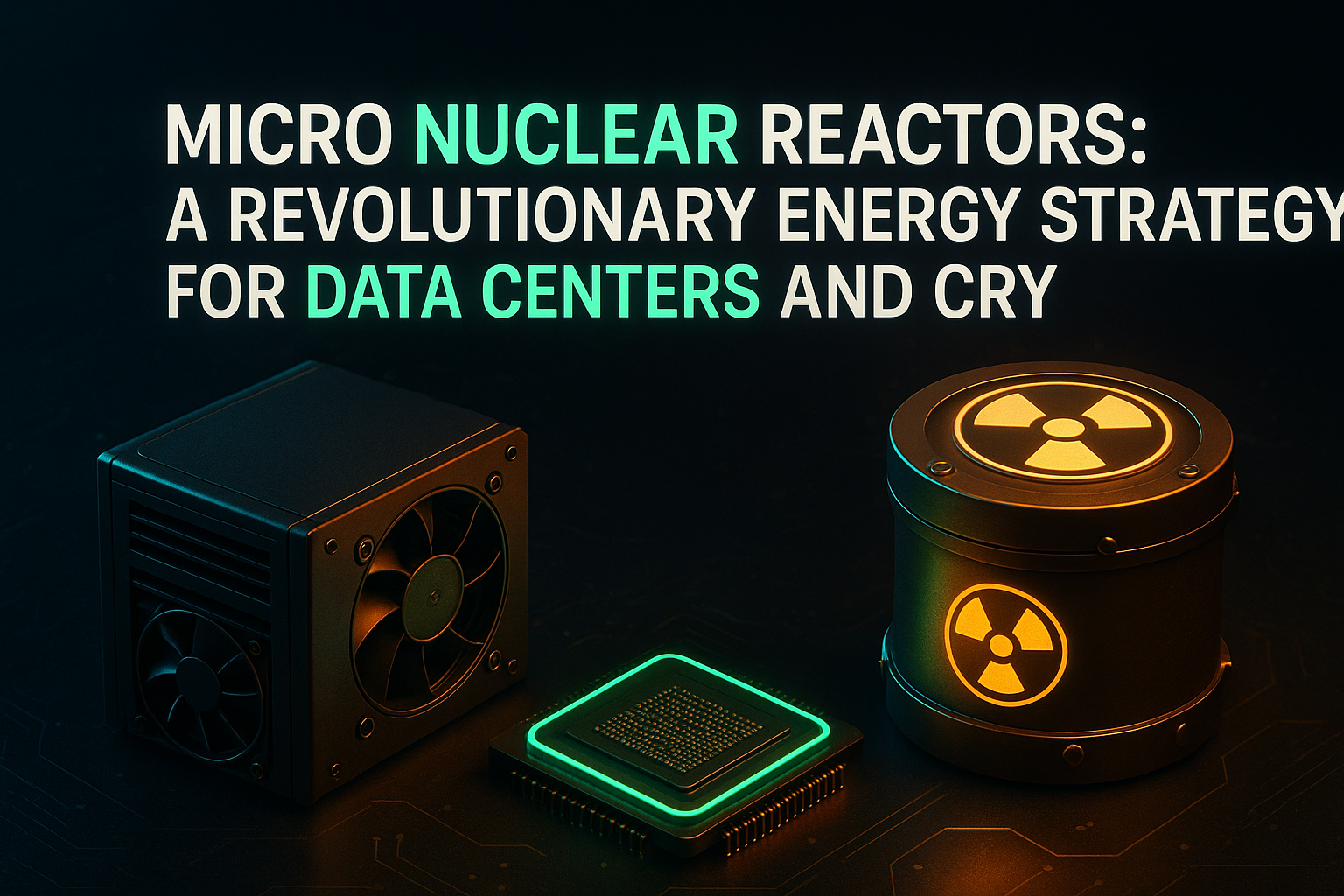
Micro nuclear reactors are the smallest class of nuclear power systems currently under development. Some designs produce only 1 to 2 megawatts of electricity. That may sound small compared with traditional nuclear plants, but it is surprisingly powerful for localized infrastructure.
A typical high-performance cryptocurrency mining machine consumes about 6 kilowatts of power. A 2-megawatt reactor produces roughly 2,000 kilowatts.
Simple math.
That amount of energy could theoretically power more than 300 mining machines, even after accounting for cooling systems, networking hardware, and operational overhead.
And the reactor itself can be compact. Some designs fit inside shipping-container sized modules. Others can be transported by truck and installed on site.
Small reactor. Big impact.
Instead of relying entirely on utility companies, mining operators and data center developers could generate electricity locally.
Energy independence becomes possible.
TRISO Fuel and the Oak Ridge Legacy
One of the key technologies enabling these next-generation reactors is TRISO nuclear fuel, a design that emerged from decades of research at Oak Ridge National Laboratory in Tennessee.
Oak Ridge played a critical role in the Manhattan Project, where uranium enrichment helped produce the first atomic weapons. But in the decades that followed, the laboratory evolved into one of the most important nuclear research centers in the United States.
TRISO fuel stands for tristructural isotropic fuel.
Instead of traditional fuel rods, TRISO uses extremely small fuel particles. Each particle contains a tiny uranium kernel surrounded by multiple layers of carbon and ceramic materials. These coatings act like miniature containment systems, sealing fission products inside each particle.
Tiny particles. Multiple protective layers. Extreme resilience.
The result is a fuel design that is extremely robust and highly resistant to overheating. Even under severe conditions, the particles retain radioactive materials inside their protective shells.
This makes TRISO fuel particularly suitable for small modular and micro modular reactors. The fuel allows reactors to operate with passive safety systems, meaning that cooling can occur naturally without relying heavily on pumps, generators, or complex mechanical systems.
In simple terms, the physics works.
Comparing Energy Strategies
Energy Sources Comparison for Data Centers and Mining Infrastructure
| Energy Source | Typical Cost (kWh) | Reliability | Infrastructure Needs | Suitability for Mining / Data Centers |
|---|---|---|---|---|
| Solar Power | $0.03 – $0.06 | Intermittent (daylight only) | Large land area + batteries | Medium (requires storage) |
| Wind Power | $0.03 – $0.05 | Variable | Wind farms + grid integration | Medium |
| Natural Gas | $0.07 – $0.10 | High | Gas supply infrastructure | High |
| Traditional Nuclear | $0.12 – $0.15 | Very High | Large nuclear plant | Very High |
| Micro Nuclear Reactor (1–2 MW) | $0.08 – $0.12 | Continuous Baseload | Compact modular reactor | Very High |
Micro Nuclear Reactor vs Solar Farm for 1–2 MW Continuous Power
| Factor | Micro Nuclear Reactor (1–2 MW) | Solar Farm Equivalent |
|---|---|---|
| Power Output | 1–2 MW continuous baseload | Requires 6–8 MW solar capacity to produce similar daily energy |
| Number of Units | 1 compact modular reactor | 10,000 – 14,000 solar panels |
| Land Requirement | Small industrial footprint | 15 – 25 acres solar farm |
| Installation Cost | $10M – $50M depending on design | $6M – $10M solar farm infrastructure |
| Battery Storage | Not required for continuous output | Large battery system required for night operation |
| Battery Cost | None | $5M – $15M depending on storage capacity |
| Operational Profile | 24/7 constant electricity | Intermittent without storage |
| Suitability for Mining / Data Centers | Very High | Medium (requires large storage systems) |
Estimated Electricity Cost per kWh for Continuous Power
| Energy Source | Estimated Cost per kWh | Notes |
|---|---|---|
| Micro Nuclear Reactor (1–2 MW) | $0.08 – $0.12 | Stable baseload electricity |
| Solar Farm + Battery Storage | $0.10 – $0.18 | Includes storage for night operation |
Land Area Required to Generate 1–2 MW of Continuous Power
| Factor | Micro Nuclear Reactor | Solar Farm + Battery Storage |
|---|---|---|
| Continuous Power Target | 1–2 MW constant output | 6–8 MW solar capacity to reach similar daily energy |
| Typical Land Requirement | 0.1 – 0.5 acres | 15 – 25 acres |
| Number of Solar Panels | Not applicable | 10,000 – 14,000 panels |
| Energy Storage Area | Not required | Additional battery container area |
| Suitability for Dense Industrial Sites | Very High | Limited by land availability |
Leading Small Modular Reactor (SMR) Companies and Projects
| Company | Reactor Model | Output | Key Partnership / Focus |
|---|---|---|---|
| Oklo Inc. | Aurora Powerhouse | 15 MWe | Partnered with Equinix for data center power; uses TRISO fuel. |
| NuScale Power | VOYGR™ SMR | 77 MWe | First SMR design to receive U.S. NRC certification. |
| X-energy | Xe-100 / Mobile | 80 MWe | Partnered with Amazon to power future AWS data centers. |
| TerraPower | Natrium™ / MCFR | 345 MWe | Founded by Bill Gates; advanced liquid sodium cooling. |
| Last Energy | PWR-20 | 20 MWe | Micro-modular units for industrial sites in Europe. |
| Rolls-Royce SMR | UK SMR | 470 MWe | Focus on national grid stability and AI clusters in the UK. |
As computing infrastructure expands, operators must evaluate different energy strategies.
Solar energy offers low generation costs but requires large land areas and battery storage systems. Wind energy can produce substantial power but depends on location and weather conditions. Natural gas plants provide reliable electricity but depend on continuous fuel supply and produce carbon emissions.
Traditional nuclear plants offer extremely stable power output but require massive capital investments and long construction timelines.
Micro nuclear reactors sit somewhere in between. They provide continuous baseload power like traditional nuclear plants, but with a compact design that allows deployment near industrial facilities, remote installations, or high-density computing infrastructure.
Localized power generation changes the equation.
Instead of relying entirely on centralized electricity markets, companies can deploy energy systems exactly where electricity is needed.
A New Infrastructure Model for the Digital Economy
Artificial intelligence computing clusters, cryptocurrency mining farms, and hyperscale data centers are transforming the global demand for electricity. These systems require enormous power, but they also require reliability.
Intermittent energy alone cannot support this new digital infrastructure.
Micro modular reactors could offer a new model: compact nuclear systems capable of delivering stable megawatts of power for decades. Transportable. Scalable. Independent from volatile electricity markets.
The technology is still emerging, and regulatory frameworks will play a major role in determining how quickly it spreads.
But the concept is clear.
For regions where solar energy is limited and electricity prices are high, micro nuclear reactors may become one of the most practical solutions for powering the digital economy.
Small reactors. Continuous energy. Local control.
And possibly a new chapter in the history of nuclear power.
FAQ: Micro Nuclear Reactors for Data Centers and Crypto Mining
Q1: What is a micro nuclear reactor?
A micro nuclear reactor is a very small nuclear power system typically producing between 1 and 20 megawatts of electricity. These compact reactors are designed for modular deployment and can provide continuous baseload power for remote sites, industrial facilities, data centers, or cryptocurrency mining farms.
Q2: How much electricity can a micro nuclear reactor produce?
Micro nuclear reactors can produce anywhere from about 1 MW to 20 MW depending on the design. A 2 MW reactor can generate roughly 2,000 kilowatts of continuous electricity, enough to power hundreds of high-performance cryptocurrency mining machines or small data center clusters.
Q3: Why are micro nuclear reactors attractive for data centers and mining farms?
Data centers and cryptocurrency mining operations require constant electricity 24 hours a day. Micro nuclear reactors provide stable baseload power independent of weather conditions, unlike solar or wind energy. Their compact size also allows deployment close to computing infrastructure, reducing reliance on external electricity markets.
Q4: What is TRISO fuel and why is it important?
TRISO fuel is an advanced nuclear fuel design consisting of tiny uranium particles coated with multiple layers of carbon and ceramic materials. These protective layers contain radioactive materials even under extreme conditions, improving reactor safety and making TRISO suitable for small modular and micro nuclear reactors.
Q5: Are micro nuclear reactors safer than traditional nuclear plants?
Many micro reactor designs use passive safety systems and advanced fuels such as TRISO. These systems allow reactors to cool naturally without relying on complex mechanical systems. While all nuclear technology requires strict regulation, these new designs aim to significantly reduce the risk of overheating or large-scale accidents.
Q6: Can micro nuclear reactors replace renewable energy for data centers?
Micro nuclear reactors are not necessarily intended to replace renewable energy. Instead, they can complement solar and wind power by providing stable baseload electricity when renewable generation is intermittent. For energy-intensive infrastructure like AI computing clusters and mining farms, combining multiple energy sources may provide the most reliable solution.
Q7: How long can micro nuclear reactors operate?
Depending on the design, many micro nuclear reactors are intended to operate for 8 to 20 years before refueling. Some designs are built as sealed units that operate for long periods without onsite fuel handling, which simplifies operations for remote industrial installations.