Introduction: Bitcoin as a Financial Lifeline Under Sanctions
In a world where global banking systems hold the reins of financial power, economic sanctions have evolved into one of the most potent geopolitical weapons. When a nation is severed from international interbank messaging networks, it faces a suffocating reality: restricted trade, frozen capital, and a total loss of access to the global marketplace.
However, a new form of economic resilience is emerging.
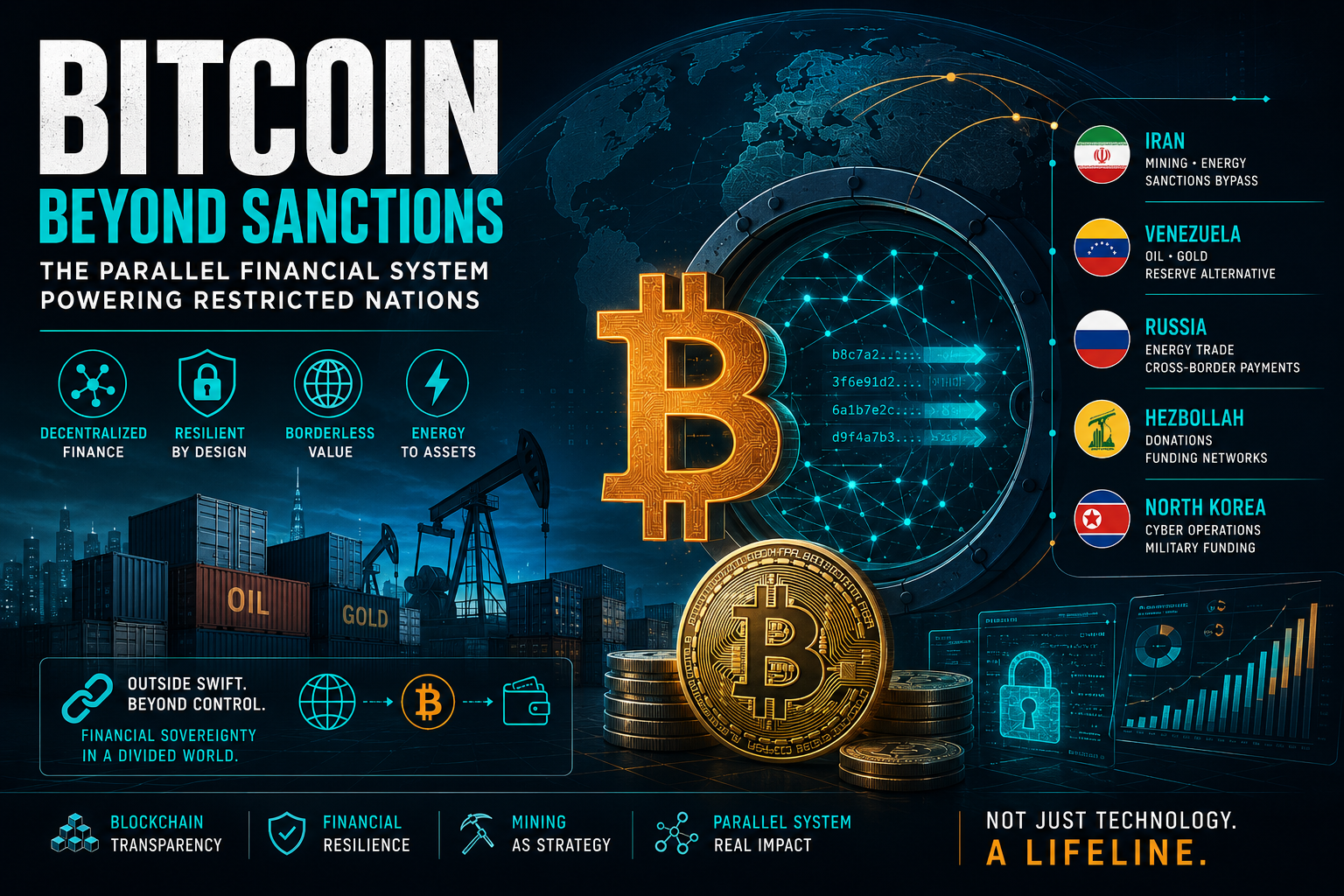
Over the last few years, cryptocurrencies—led by Bitcoin—have surfaced as a decentralized financial layer operating entirely outside the reach of traditional oversight. For sanctioned economies, this shift isn't necessarily about replacing the established order, but rather about building a parallel "relief valve" that allows vital economic activity to persist despite external pressure.
In some instances, states have even turned to large-scale Bitcoin mining as a strategic move. By converting domestic energy resources into globally liquid digital value, these nations can bypass traditional blockades. With production costs in energy-rich regions often sitting at a fraction of the market price, this creates a unique financial arbitrage that exists far beyond the walls of regulated finance.
Blockchain analysis further confirms this trend, reporting that crypto-related flows linked to sanctioned regions now reach several billions of dollars annually. These flows frequently spike during periods of heightened geopolitical friction, signaling that digital assets are no longer just speculative tools—they have become a flexible, essential lifeline for navigating financial isolation.
| Country / Entity | Estimated BTC (Intelligence) | Estimated Value | Primary Source | Strategic Use | Source / Report |
|---|---|---|---|---|---|
 | ~10,000 – 50,000 BTC / year | $700M – $3.5B | State mining | Sanctions bypass | Cambridge, Elliptic, Chainalysis |
 | ~100,000 – 600,000 BTC (speculative) | $7B – $40B+ | Oil & gold conversion | Reserve alternative | Intelligence estimates |
 | ~50,000 – 200,000 BTC (flow exposure) | $3B – $15B | Energy trade | Cross-border payments | Chainalysis, Reuters |
 | ~500 – 5,000 BTC | $30M – $350M | Donations | Funding networks | Elliptic, US Treasury |
 | ~10,000 – 20,000 BTC | $700M – $1.5B+ | Cyber attacks | Military funding | Chainalysis, Elliptic |
The estimates presented above are derived from intelligence reports, blockchain analytics, and investigative research. Due to the covert nature of these activities and the use of offshore wallets and intermediaries, these figures remain highly speculative and should not be considered exact or fully verifiable.
Conclusion
When heavily sanctioned countries turn to Bitcoin, it’s about a lot more than just adopting new tech—it’s a clear sign that global trust in our traditional financial systems is fracturing. Seeing nations locked out of SWIFT or having their sovereign assets frozen has been a massive wake-up call. It proves to governments worldwide that access to the mainstream banking network isn’t a guarantee anymore, and it certainly isn't politically neutral.
Because of this, even countries that aren't under sanctions right now—but still have tension with the United States—are starting to play it safe. They are looking closely at decentralized networks like Bitcoin as an insurance policy against being cut off in the future.
At the same time, when you squeeze a country's economy tight enough, they often resort to the shadows to survive. We've seen this with reports of North Korea's cyber operations; total financial isolation basically forces these actors to find creative, and often illegal, ways to keep their money flowing.
At the end of the day, Bitcoin isn't going to completely replace the global banking system. But it has created a parallel financial lane—one that gives nations a way to keep their funds moving and hold onto their financial independence in a deeply divided world.
FAQ: Bitcoin, Sanctions, and Financial Systems Outside SWIFT
Q1: How do sanctioned countries use Bitcoin to bypass SWIFT?
Sanctioned countries use Bitcoin as an alternative financial rail that does not rely on traditional banking systems like SWIFT. By leveraging mining, peer-to-peer transactions, and crypto exchanges, they can move value across borders without direct involvement from regulated financial institutions.
Q2: Is Bitcoin really effective for evading economic sanctions?
Bitcoin provides partial effectiveness rather than a complete solution. While it enables transactions outside traditional systems, blockchain transparency, liquidity limits, and regulatory monitoring still impose constraints. However, it remains a useful tool for reducing the impact of financial isolation.
Q3: Why do energy-rich countries focus on Bitcoin mining?
Energy-rich countries use Bitcoin mining to convert excess or stranded energy into a globally tradable digital asset. This allows them to generate revenue independently of export restrictions, especially when traditional energy trade channels are limited by sanctions.
Q4: Which countries are most associated with crypto usage under sanctions?
Countries commonly associated with crypto use under sanctions include Iran, Venezuela, Russia, and North Korea. Some non-state entities have also used cryptocurrencies for funding purposes, according to blockchain analysis and intelligence reports.
Q5: Are the Bitcoin holdings of sanctioned nations accurate?
No, these estimates are highly uncertain. Due to the use of offshore wallets, intermediaries, and covert operations, most figures are based on intelligence assessments and blockchain analytics rather than verified official disclosures.
Q6: Can cryptocurrencies replace the global financial system?
Cryptocurrencies are unlikely to fully replace the global financial system in the near term. Instead, they function as a parallel system that offers flexibility and resilience, particularly for actors facing restrictions within traditional financial networks.