INTRODUCTION
While Bitcoin has matured from a speculative asset into a global powerhouse of specialized computing, the landscape for miners varies wildly by geography. Kuwait presents a fascinating—if complicated—case study. On paper, it’s a miner’s paradise: high per-capita income, abundant fossil fuels, and government-subsidized electricity that is among the cheapest in the Gulf.
However, the reality on the ground in 2026 is a balancing act between high-tech profitability and strict legal prohibitions.

The Legal Reality: Is Mining Actually Allowed?
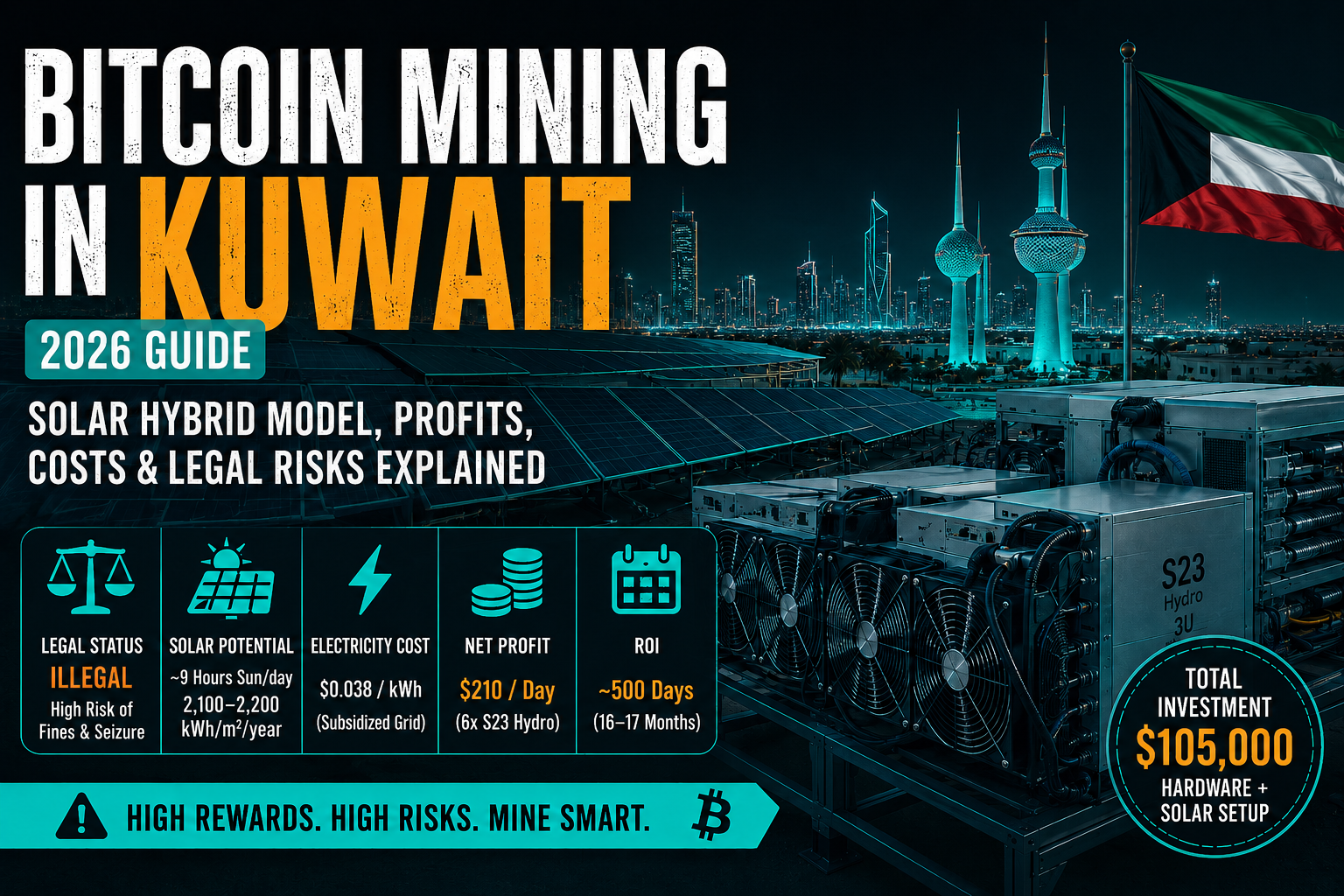
As of 2026, Bitcoin mining remains illegal in Kuwait. The government does not view it as a legitimate business but rather as unauthorized electricity consumption. Authorities have become increasingly vigilant, particularly in residential hubs like Al-Wafra and Al-Sabah Al-Ahmad. Unusually high power loads often trigger investigations, and while jail time is rare, the consequences are still heavy:
-
Equipment Seizure: Confiscation of expensive hardware is the standard enforcement.
-
Fines: Operators typically face penalties of around 1,000 KWD.
-
Grid Pressure: The main concern for regulators is the "abnormal pressure" mining puts on the national infrastructure.
The Solar Solution: Leveraging Kuwait’s Climate
Technically, Kuwait is one of the best places on Earth for solar-assisted mining. With roughly nine hours of effective sunlight daily and an annual yield of 2,100–2,200 kWh/m², miners can significantly offset their dependence on the grid. By using a Hybrid Model, miners can run their rigs on solar power during the day and switch to the national grid at night, slashing operating costs while theoretically reducing their daytime electrical footprint to avoid detection.
The Hybrid Model: Costs & Revenue Analysis
To understand the economics, let’s look at a setup using six S23 Hydro 3U units.
-
Daily Power Demand: These units pull roughly 1,584 kWh over 24 hours.
-
The Split: 50% from solar (792 kWh) and 50% from the grid (792 kWh).
-
Monthly Electricity Bill: Even with half the power coming from the sun, the subsidized grid cost (~$0.038/kWh) results in a monthly bill of about $900.
-
Profitability: If each device generates $40/day, the total daily revenue is $240. After paying for power, you’re looking at a net daily profit of $210.
Infrastructure: What Does the Setup Require?
Running six high-powered miners on solar for 12 hours a day requires a massive footprint. To generate the necessary 66 kW per hour, you would need:
-
Panels: 160 to 170 units (550W each).
-
Space: Between 416 and 442 square meters to allow for proper tilt, spacing, and ventilation.
This makes the setup more practical for farms or open rural areas than for standard residential rooftops.
Investment vs. Payback (ROI)
The initial "buy-in" for this project is significant:
-
Mining Hardware: ~$66,000 for six units.
-
Solar System: ~$39,000 (panels, inverters, and mounting).
-
Total Capital Outlay: $105,000.
At a net profit of $210/day, it takes approximately 500 days (16–17 months) to break even. After that, the system moves into pure profit territory, minus a small 2% allocation for ongoing maintenance.
Risk Management: The "Stealth" Approach
Despite the high ROI, the legal risks are the elephant in the room. To mitigate the chance of detection by utility monitors, some operators distribute their nighttime load across two or three separate meters. Additionally, mining in rural areas like farms helps manage heat and noise, which are often dead giveaways in crowded residential neighborhoods.
The Verdict: Is it Worth It?
Technically and economically, Bitcoin mining in Kuwait is a goldmine. The combination of cheap subsidized power and extreme solar potential creates a financial model that is hard to beat.
However, the legal risk remains the primary barrier. Until Kuwait establishes a formal regulatory framework for digital assets, home mining remains a high-stakes gamble. For those in countries with similar climates but friendlier laws—such as Algeria, Egypt, or Iraq—this hybrid solar model represents the future of sustainable, high-margin crypto extraction.