
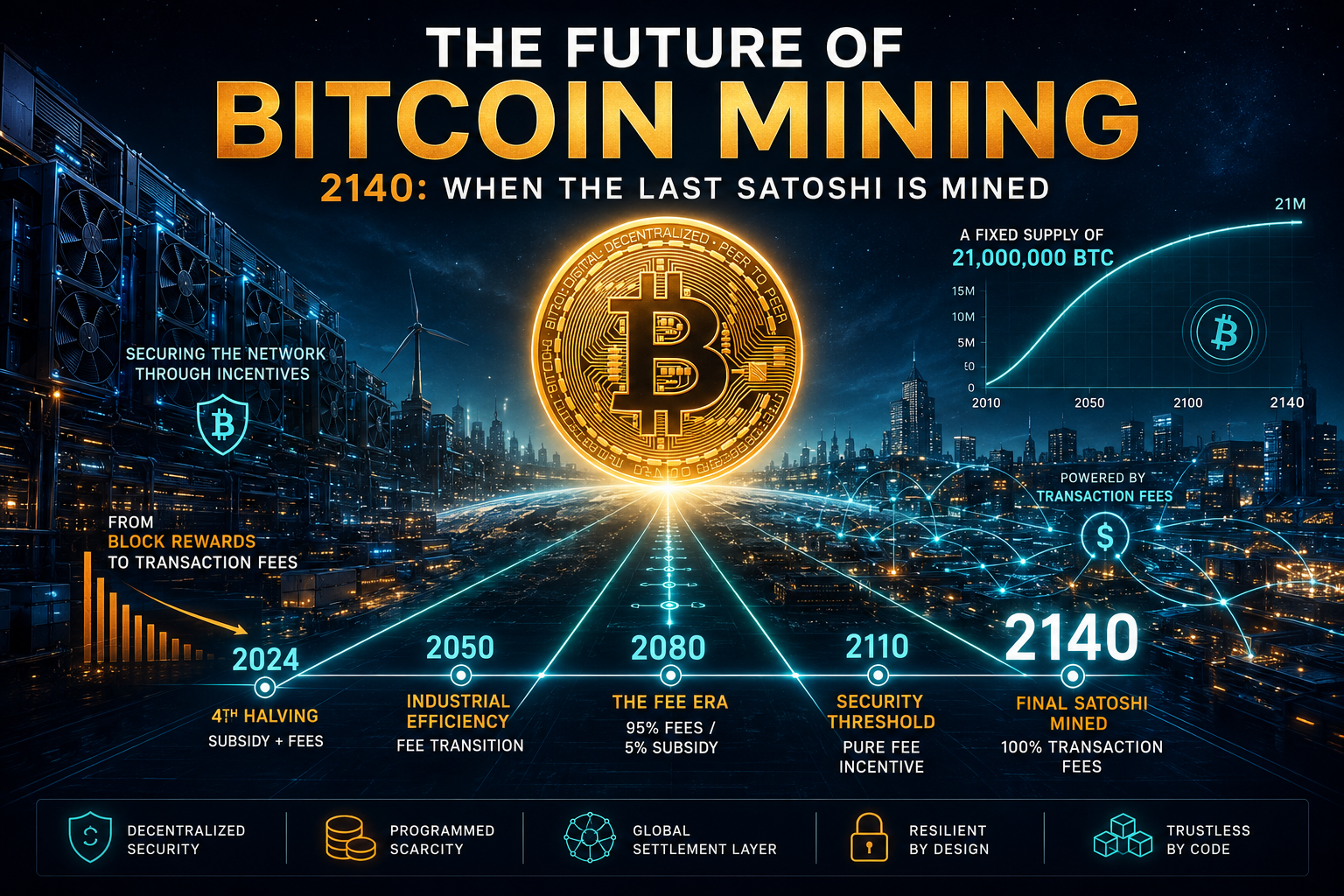
INTRODUCTION
No one alive today will witness the exact moment the final Bitcoin is mined. By the year 2140, neither we nor the immediate descendants of most people reading this will be around. Yet, that specific year serves as a profound mental anchor for the cryptocurrency community—it marks the absolute end of a monetary issuance schedule embedded into Bitcoin's core code back in 2009.
We are presented with a unique financial paradox: attempting to value a digital asset on a timeline that drastically exceeds a standard human lifespan. When analyzing a traditional stock index, economists can project 50 to 100 years into the future based on historical dividends, cash flows, and macroeconomic productivity. Bitcoin operates on an entirely different paradigm. Its long-term valuation is dictated by a complex intersection of programmed scarcity, decentralized trust, network security, and monetary utility—factors that are nearly impossible to hold constant over a century.
While highly optimistic advocates project six- or seven-figure valuations, skeptical economists warn that the asset could plummet to zero if genuine monetary utility fails to materialize and speculative interest dries up. The objective truth is that no one can predict the exact future price of Bitcoin. However, we can systematically analyze the underlying forces that will either sustain the network or cause it to collapse.
By stepping forward through specific chronological milestones—2050, 2080, 2110, and 2140—we can unpack the shifting dynamics of remaining supply, mining economics, transaction fees, and technological threats.
Bitcoin’s Strategic Evolution Roadmap (2024 – 2140)
| Timeline | Core Milestone | % Mined | Revenue Model |
|---|---|---|---|
| 2024 | 4th Halving Event | 93.75% | Subsidy + Fees |
| 2050 | Industrial Efficiency | 99.81% | Fee Transition |
| 2080 | The Fee Era | 99.99% | 95% Fees / 5% Subsidy |
| 2110 | Security Threshold | 99.999% | Pure Fee Incentive |
| 2140 | Final Satoshi Mined | 100.00% | 100% Transaction Fees |
The Significance of 2140: Understanding Bitcoin's Hard Cap
The year 2140 is largely symbolic. It marks the theoretical point where the creation of new Bitcoin slows to a halt. In practice, the network won't experience a single, dramatic finale. The issuance of new coins tapers off at a microscopic rate as block rewards continually shrink.
How Halvings Shape the Transition from Subsidies to Transaction Fees
Bitcoin is governed by a hard-coded mathematical limit: a maximum supply of 21 million coins. The journey toward this cap is regulated by halvings—events occurring roughly every four years that slice the block reward in half, reducing the rate at which new Bitcoin enters circulation.
This deflationary mechanism triggers two critical shifts:
- Mechanical Scarcity: The pipeline of newly minted supply continuously tightens.
- Mining Business Model Evolution: Miners will eventually lose the safety net of block subsidies and must transition to a revenue model sustained purely by transaction fees.
Ultimately, this transition from subsidy-based security to fee-based security is the most critical hurdle Bitcoin faces—even more so than its celebrated scarcity.
Bitcoin in 2050: Surviving the Scarcity Squeeze
By the mid-21st century, the Bitcoin network will be four decades old. With over 99% of the total supply already mined, the amount of Bitcoin left to be created will be mathematically insignificant compared to the circulating supply.
The Evolution of Mining Economics
In 2050, the block reward will be a tiny fraction of what it is today. While mining operations won't shut down, the economic reality will demand ruthless optimization:
- Extreme Efficiency: Miners will need unprecedented advancements in power consumption, hardware architecture, and cooling systems.
- Market Consolidation: Bear markets will relentlessly flush out smaller, less efficient players.
- Industrialization: The industry will be entirely dominated by massive, highly professional data-center operations.
Bull vs. Bear: Institutional Adoption versus CBDC Competition
The narrative surrounding Bitcoin's success in 2050 hinges on the race between global adoption and state-sponsored alternatives.
The Bull Case (The Institutional Standard):
If Bitcoin successfully cements itself as a premier reserve asset for corporations, institutions, and sovereign wealth funds, the price floor could rise dramatically. Furthermore, the "borrow against Bitcoin" strategy could mature. In this model, investors use Bitcoin as top-tier collateral to access fiat liquidity without creating sell pressure. Note: This requires robust, highly regulated, and transparent financial infrastructure to mitigate counterparty risk.
The Bear Case (The Utility Problem):
Economists argue that an asset lacking cash flows must develop broad, undeniable utility. By 2050, two major headwinds could emerge:
1. Central Bank Digital Currencies (CBDCs): State-backed digital money could offer seamless, integrated payments, providing a less volatile alternative for the average consumer.
2. The Energy Paradox: If global energy becomes cheap and abundant, mining doesn't necessarily become easier. Instead, competition skyrockets, network difficulty adjusts upward, and profit margins compress even further.
Bitcoin in 2080: Transitioning to a Transaction Fee-Driven Network
By 2080, Bitcoin will be an established 70-year-old financial network. The defining characteristic of this era will be the network's total reliance on transaction fees to incentivize miners and secure the blockchain.
The Security Dilemma: Can Fees Sustain the Blockchain?
As the block subsidy approaches zero, network security must be funded by either:
- Consistently high transaction fees.
- A massive volume of transactions.
- A calculated balance of both.
This represents a delicate economic tightrope. If base-layer fees become exorbitantly high, everyday users will be priced out. If fees are too low, miners will unplug their machines, leaving the network vulnerable to 51% attacks. For the network to remain resilient, the cumulative economic value of the hashpower must make it prohibitively expensive for a bad actor to attack the chain.
The Role of Layer 2 Solutions like the Lightning Network
To prevent Layer 1 (the main blockchain) from becoming a congested, expensive bottleneck, everyday commerce will likely rely on Layer 2 scaling solutions like the Lightning Network. Layer 1 would function strictly as a high-value global settlement layer.
However, mass Layer 2 adoption introduces its own hurdles:
-
Requires flawless UX, deep liquidity, and efficient routing.
-
Relies heavily on node operators and channel managers, which risks reintroducing centralization into a decentralized ecosystem.
Bitcoin in 2110: Navigating the Post-Subsidy Era
Approaching the 22nd century, the Bitcoin network will be in its final issuance stages. The block reward will be virtually nonexistent, and the "post-subsidy" era will be in full effect.
Economic, Quantum, and Governance Risks on the Horizon
At this stage, attempting to predict a nominal fiat price (e.g., $500 million per coin) is futile, as the purchasing power of modern fiat currencies over an 80-year horizon is entirely unpredictable. Valuation will be measured purely in global purchasing power. To survive this era, Bitcoin must navigate three existential threats:
1. The Deflationary Spending Risk: Critics argue that a perpetually appreciating currency discourages spending, stalling economic velocity. Proponents counter that essential spending always occurs, and robust credit markets can be built on top of pristine collateral.
2. The Quantum Computing Threat: If quantum computers successfully break modern cryptographic primitives, Bitcoin's core security could be compromised. The community would need to execute a flawless, network-wide migration to quantum-resistant algorithms without fracturing the user base.
3. Governance and Forking Risks: As generations pass, social cohesion could fracture. Disagreements over fundamental rules (like the 21 million cap) could result in catastrophic network forks, splitting liquidity and damaging institutional trust.
The Year 2140: Reaching the 21 Million Bitcoin Supply Limit
In 2140, the absolute cap is reached. The algorithm halts issuance permanently. From this point forward, the Bitcoin ecosystem operates entirely on a closed-loop fee market, relying solely on network demand and unshakeable trust in its immutable code.
Strategic Takeaways for Modern Crypto Investors and Miners
Looking a century ahead reveals that Bitcoin's ultimate survival isn't about speculative price targets—it is about functional resilience. We are likely heading toward one of two extremes, or a hybrid middle ground:
- Global Digital Gold: Bitcoin successfully becomes the base-layer settlement network for global finance. Mining evolves into heavily subsidized, strategic infrastructure (similar to modern telecommunications or energy grids).
- Technological Obsolescence: Bitcoin fails to scale, loses the UX battle to newer technologies, fees collapse, security degrades, and the network slowly dies out.
- The Realistic Middle-Ground: Bitcoin survives as a highly secure, niche store of value and settlement layer alongside a diverse basket of CBDCs and other digital assets.
Final Thoughts: Looking Beyond Long-Term Price Speculation
Fixating on what Bitcoin's exact dollar value will be in 2140 is a distraction. The numbers are easy to hypothesize but impossible to guarantee. Instead, investors, miners, and developers must focus on the operational levers that will dictate Bitcoin's longevity today:
expanding real-world utility, stress-testing the fee-based security model, preparing for cryptographic upgrades, and maintaining social consensus. The ultimate question is not how much a single Bitcoin will be worth in 2140, but whether the network itself will remain a credible, impenetrable fortress of decentralized trust.
The 2140 Countdown: Frequently Asked Questions
Q1: If no more Bitcoins are created, why would miners keep working?
It’s a common worry, but the system is designed to pivot. Even without new coins being born , every transaction made on the network carries a small fee. By 2140, these fees will be the miners' entire paycheck. As long as people value and move Bitcoin, there will always be a financial incentive to keep the "digital auditors" (miners) online.
Q2: Could the 21 million limit ever be increased?
Technically, anything in code can be changed, but in practice, it’s nearly impossible. This limit is Bitcoin's social contract. To change it, the entire global community—miners, developers, and users—would have to agree to devalue their own holdings. It’s like trying to change the rules of a game when everyone playing benefits from the rules staying exactly as they are.
Q3: Will Bitcoin become too expensive to actually use?
On the main network (Layer 1), fees might indeed become very high, making it a rich man's settlement layer. However, that’s where technologies like the Lightning Network come in. Think of Layer 1 as a massive cargo ship for global settlements, while Layer 2 acts like a fleet of fast delivery bikes for your daily coffee and small purchases.
Q4: What if a "Black Swan" event, like Quantum Computing, kills Bitcoin?
Bitcoin isn't a static rock; it's software that evolves. If a threat like Quantum Computing becomes real, the network would undergo an upgrade to new, post-quantum cryptography. The real challenge isn't the tech itself, but the human coordination needed to move everyone to the new, safer standard in time.