
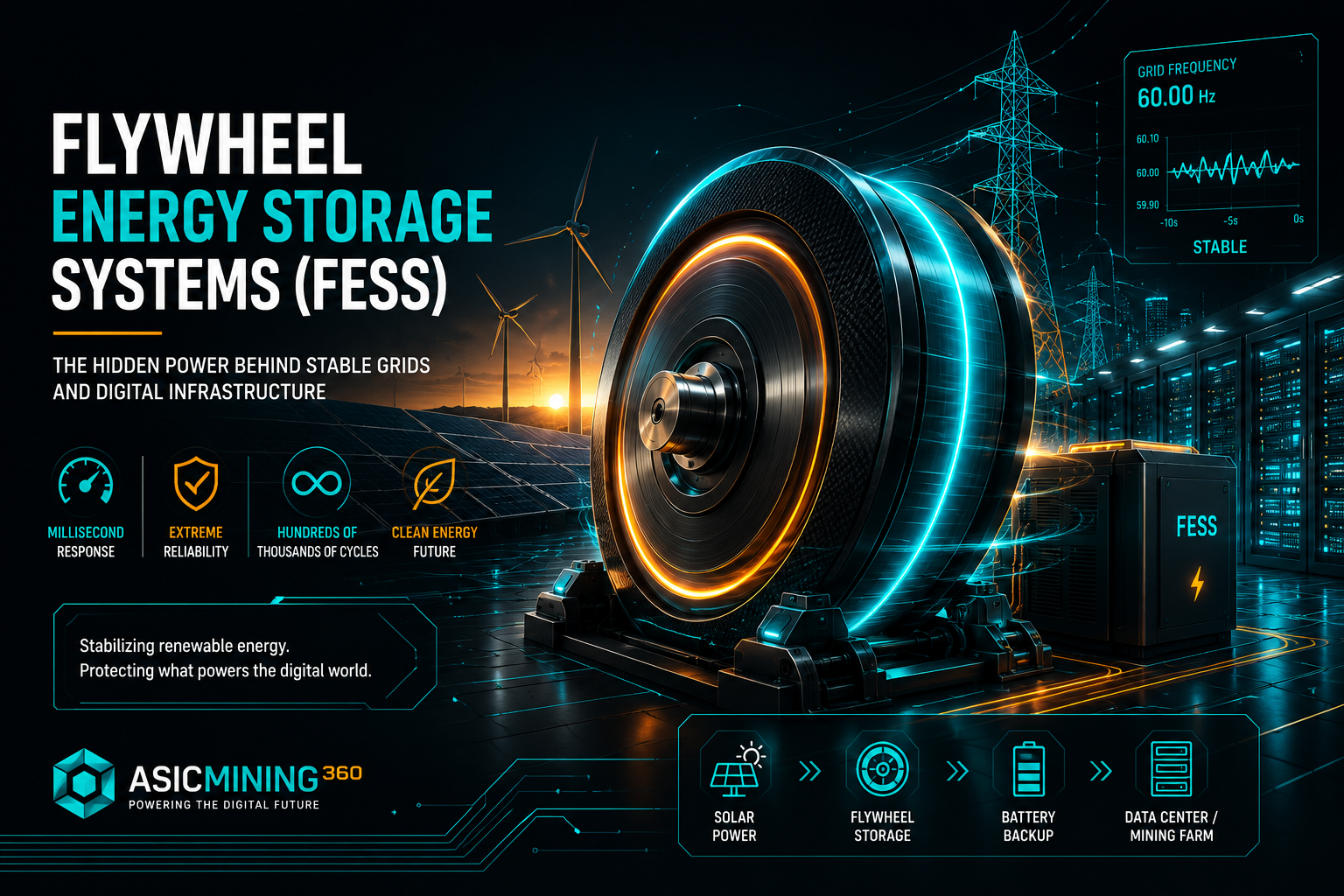
Why Flywheel Energy Storage Systems (FESS) Are Critical for Renewable Energy and Data Centers
Our entire digital existence—from the massive server banks that keep the cloud afloat to the specialized rigs mining Bitcoin—rests on a single, silent assumption: the power will never flicker. But as we move away from fossil fuels toward a cleaner future of solar and wind, maintaining that rock-solid stability is becoming a massive engineering headache.
The sun is a fantastic resource, but it’s also incredibly fickle. Solar production doesn't just dip at night; even a passing cloud can cause a sudden, sharp drop in power. For a grid that demands perfect frequency and voltage to stay alive, these fluctuations aren't just a nuisance—they’re a direct threat to the hardware we rely on.
To solve this, engineers are actually looking backward to move forward. They’re dusting off a mechanical concept once tucked away in high-end aerospace labs: Flywheel Energy Storage Systems (FESS). It’s a bit of a retro-future solution, using high-speed rotational motion to act as the ultimate shock absorber for the modern energy grid.
Unlike a typical battery that stores power through chemical reactions, a flywheel stores electricity as pure motion. Refined by pioneers like Quintec, these systems are emerging as the "shock absorbers" of the modern grid, protecting the sensitive hardware of the digital economy from the inherent instability of renewable energy.
Why Renewable Energy Needs Flywheel Energy Storage for Grid Stability
The electricity grid is a delicate machine. In most parts of the world, it must hum at a near-perfect 50 Hz or 60 Hz. If that frequency wavers even slightly, safety protocols kick in, potentially triggering massive shutdowns of power plants and industrial hubs.
In the past, we relied on grid inertia to keep things steady. Massive, heavy turbines in coal and nuclear plants acted like giant mechanical anchors; their sheer momentum absorbed sudden shocks to the system. But as we retire these spinning giants in favor of static solar panels, that natural buffer is disappearing.
We saw the consequences of this in April 2025. A grid disturbance in Spain caused 15 gigawatts of power to vanish in an instant, plunging parts of Spain and Portugal into darkness. The solar panels weren't broken; they just didn't have the mechanical "weight" to stabilize the oscillation.
This isn't an isolated incident. The UK alone has already funneled over £300 million into flywheel systems and synchronous compensators. They aren't just buying energy; they’re buying resilience.
How Flywheel Energy Storage Systems (FESS) Work: Technology Explained
Conceptually, a flywheel is elegantly simple. Think of it as a high-tech potter’s wheel.
When there’s excess electricity on the grid, it powers a motor that spins a heavy rotor to incredible speeds. That energy is now stored as rotational kinetic energy. When the grid needs a boost, the process reverses: the spinning rotor drives a generator, converting that motion back into electricity.
The physics behind it is straightforward:
In this equation, I represents the moment of inertia and ω is the angular velocity. Because the velocity is squared, doubling the speed doesn't just double the energy—it quadruples it. This is why modern flywheels use ultra-tough carbon fiber rotors that can spin at speeds approaching Mach 3, with edges moving at nearly 1,000 meters per second.
Flywheel Energy Storage Technology: Key Components and Engineering Design
To keep a rotor spinning at those speeds without it tearing itself apart or slowing down, engineers use three critical layers of technology:
Magnetic Bearings and Frictionless Rotation
Magnetic Bearings: Traditional bearings would melt under this kind of friction. Instead, the rotor "floats" using magnetic levitation. While some early designs used expensive superconducting materials (like YBCO) cooled by liquid nitrogen, many modern commercial systems use active electromagnetic bearings. They are easier to maintain and far more cost-effective.
Vacuum Chambers to Eliminate Air Resistance
Vacuum Chambers: Even thin air acts like a brake at Mach 3. By sealing the rotor in a vacuum, aerodynamic drag is virtually eliminated, allowing the system to hold its energy for much longer.
Reversible Motor-Generators for Instant Power Flow
Reversible Motor-Generators: A seamless "shift" between charging (motor mode) and discharging (generator mode) allows energy to flow back and forth with almost zero delay.
Flywheel Energy Storage vs. Lithium Batteries: Which Energy Storage System Is Better?
Flywheels aren't trying to be "better" than lithium batteries; they are trying to do what batteries can't.
The Advantages:
-
Blink-of-an-eye response: They react in milliseconds.
-
Indestructible: They can be charged and emptied hundreds of thousands of times without wearing out.
-
Safety: There’s no risk of the "thermal runaway" fires associated with lithium-ion.
The Limitations:
-
Short Bursts: They are great for providing power for seconds or minutes, but they can't power a city overnight.
-
Lower Density: They take up more space for the amount of energy they store compared to chemical batteries.
Flywheel Energy Storage vs Lithium Battery Storage
The following table highlights the key differences between flywheel energy storage systems and lithium-ion battery storage technologies commonly used in modern energy infrastructure.
| Feature | Flywheel Energy Storage | Lithium Battery Storage |
|---|---|---|
| Energy Storage Method | Mechanical kinetic energy (rotating mass) | Electrochemical reactions |
| Response Time | Milliseconds | Seconds |
| Cycle Life | Hundreds of thousands of cycles | 3,000 – 10,000 cycles |
| Energy Duration | Seconds to minutes | Minutes to hours |
| Safety Risk | Very low (no thermal runaway) | Thermal runaway risk |
| Maintenance | Low maintenance | Battery degradation over time |
| Typical Applications | Grid stabilization, data centers, industrial power conditioning | Energy storage, solar backup, electric vehicles |
How Flywheel Energy Storage Improves Solar Power Plant Performance
Solar farms are great, but they are "noisy." Every time a cloud passes or an inverter adjusts, the output stutters. Flywheels act as a buffer, soaking up spikes and filling in the gaps instantly.
In a typical setup, a flywheel might only handle 1% to 5% of a solar plant's capacity, but that small amount provides the "inertia" the grid needs to stay upright. In fact, just two large flywheel units in the UK currently provide roughly 1% of the total grid inertia for England, Scotland, and Wales combined.
In addition to solar grid stabilization, several companies and research organizations are actively developing and deploying flywheel energy storage technologies worldwide.
Top Flywheel Energy Storage Companies, Projects & Real-World Applications
Several companies and infrastructure projects around the world are already deploying flywheel energy storage systems to stabilize power grids, support renewable energy, and protect sensitive digital infrastructure such as data centers and industrial facilities.
| Company / Project | Country | Technology Focus | Main Application | Estimated Capacity |
|---|---|---|---|---|
| Beacon Power | United States | Grid-scale flywheel frequency regulation | Electric grid stabilization | 20 MW per facility |
| Amber Kinetics | United States | Long-duration steel flywheel systems | Renewable energy storage | 4–32 kWh per unit |
| Quintec Power | Germany | High-speed carbon fiber flywheels | Industrial power conditioning | High-speed kinetic storage |
| Active Power | United States | Flywheel UPS systems | Data centers and mission-critical facilities | Up to 2 MW per system |
| Temporal Power | Canada | Grid inertia flywheel technology | Frequency regulation for utilities | 2–4 MW systems |
| Stornetic (EnWheel) | Germany | Modular flywheel storage units | Renewable grid balancing | 100 kW modules |
| NASA Flywheel Research Program | United States | Spacecraft flywheel energy storage | Satellite power and attitude control | Experimental systems |
Why Data Centers and Crypto Mining Operations Need Flywheel Energy Storage Systems
For data centers and crypto miners, power stability isn't just a preference—it's a requirement.
In a crypto mining rig, ASIC devices are running at full tilt 24/7. A sudden voltage drop doesn't just stop the work; it can brick expensive hardware. This is where a "layered" energy approach comes in:
-
Solar Panels generate the bulk power.
-
Flywheels smooth out the micro-fluctuations and "clean" the power.
-
Batteries provide the long-term backup for when the sun goes down.
The Future of Flywheel Energy Storage in Renewable Energy and Smart Grids
The tech we’re seeing today has its roots in the Cold War and NASA research. Spacecraft have long used flywheels for two jobs at once: storing energy and controlling the ship’s "attitude" (orientation). By spinning an internal wheel faster or slower, a satellite can turn itself without using a drop of fuel.
The same vacuum seals and magnetic bearings that keep a satellite functioning in the void of space are now being used to keep our terrestrial data centers online.
Final Verdict: Is Flywheel Energy Storage the Future of Renewable Energy?
As the world leans harder into renewable energy, the "spinning mass" that once kept our grids stable is disappearing. Flywheels are the mechanical answer to this digital-age problem.
They may not replace batteries for long-term storage, but they are the essential "shock absorbers" that allow solar farms and data centers to coexist. As AI and cryptocurrency continue to drive up our demand for high-quality, stable power, these high-speed mechanical systems will be the silent force keeping our digital lives running smoothly.
FAQ: Flywheel Energy Storage Systems (FESS), Solar Energy & Crypto Mining
Q1: What is a flywheel energy storage system (FESS)?
A flywheel energy storage system stores electricity as rotational kinetic energy. Excess electricity spins a heavy rotor at extremely high speeds inside a vacuum chamber. When power is needed, the spinning rotor drives a generator to convert that motion back into electricity. This technology delivers extremely fast response times and is ideal for stabilizing power grids and sensitive digital infrastructure.
Q2: Why are flywheels important for solar and wind energy grids?
Solar and wind energy production fluctuates due to weather conditions. Flywheel systems react within milliseconds to absorb sudden spikes or drops in power output. This helps maintain grid frequency stability and prevents voltage disturbances that could trigger shutdowns of power plants, data centers, or industrial systems.
Q3: Can flywheel storage replace lithium batteries?
Flywheels are not designed to replace lithium batteries. Instead, they complement them. Flywheels provide extremely fast bursts of power for seconds or minutes, while batteries handle longer energy storage for hours. Together, they create a layered energy system that stabilizes renewable energy and ensures continuous electricity supply.
Q4: How do flywheels protect crypto mining hardware?
Crypto mining hardware such as ASIC machines runs continuously and is sensitive to power fluctuations. Even small voltage drops can damage equipment or interrupt mining operations. Flywheel systems act as a buffer that instantly stabilizes the electrical supply, preventing downtime and protecting expensive mining hardware.
Q5: How long can a flywheel store energy?
Modern flywheel systems can store energy for several hours thanks to vacuum chambers and magnetic bearings that minimize friction. However, their primary purpose is delivering short bursts of power—typically seconds to minutes—to stabilize electricity networks and maintain grid frequency.
Q6: Are flywheel energy systems used in real power grids today?
Yes. Several countries already deploy flywheel energy storage for grid stabilization. The United Kingdom, for example, has invested hundreds of millions of pounds in flywheel facilities and synchronous compensators to maintain grid inertia as renewable energy replaces traditional fossil-fuel power plants.