Introduction
Mining today isn't the gold rush it used to be; it’s a game of inches. By 2026, the margins have become so tight that you’re no longer just fighting for blocks—you’re fighting your electricity bill. One small slip in efficiency and your investment quickly turns into a very expensive space heater.
That’s why ASICs have evolved into something much more surgical. It’s a delicate dance between performance and power draw. When I set up the Fluminer T3, I wasn't just looking for better numbers on a screen. I was looking for proof: can a machine actually survive in a world where being smart is now more important than just being fast?
Fluminer T3 Hardware Architecture: A Deep Dive Into Its Next-Gen Cooling and Design Philosophy
The first thing you notice when unboxing the T3 is the weight. It feels denser than the previous L1 models, and for good reason. Stripping the side panel reveals a cooling solution that is, frankly, overkill—but in a way that gives a professional operator peace of mind.
The Heatsink Mass
We’re looking at a single, massive, continuous heatsink block. In industrial environments, thermal "creep"—where heat builds up in specific pockets of a hashboard—is the silent killer of chips. By using a unified block, Fluminer is betting on thermal mass to bridge the gap between their fans.
Airflow and Layout
The T3 uses a 6-fan "push-pull" configuration. Interestingly, they’ve positioned the Power Supply Unit (PSU) at the top of the chassis. Many of my colleagues prefer this because it prevents PSU heat from rising through the hashboards—a common flaw in older vertical designs. However, the trade-off is noise. Unlike the near-silent Canaan Avalon Q (which can purr at 43 dB), this machine is loud. We clocked it at 70 dB in its highest mode. In a data center, that’s fine; in a residential garage, your neighbors will know you're mining within the hour.
Fluminer T3 Technical Performance Breakdown: Real-World Hashrate, Power Usage, and Efficiency Results
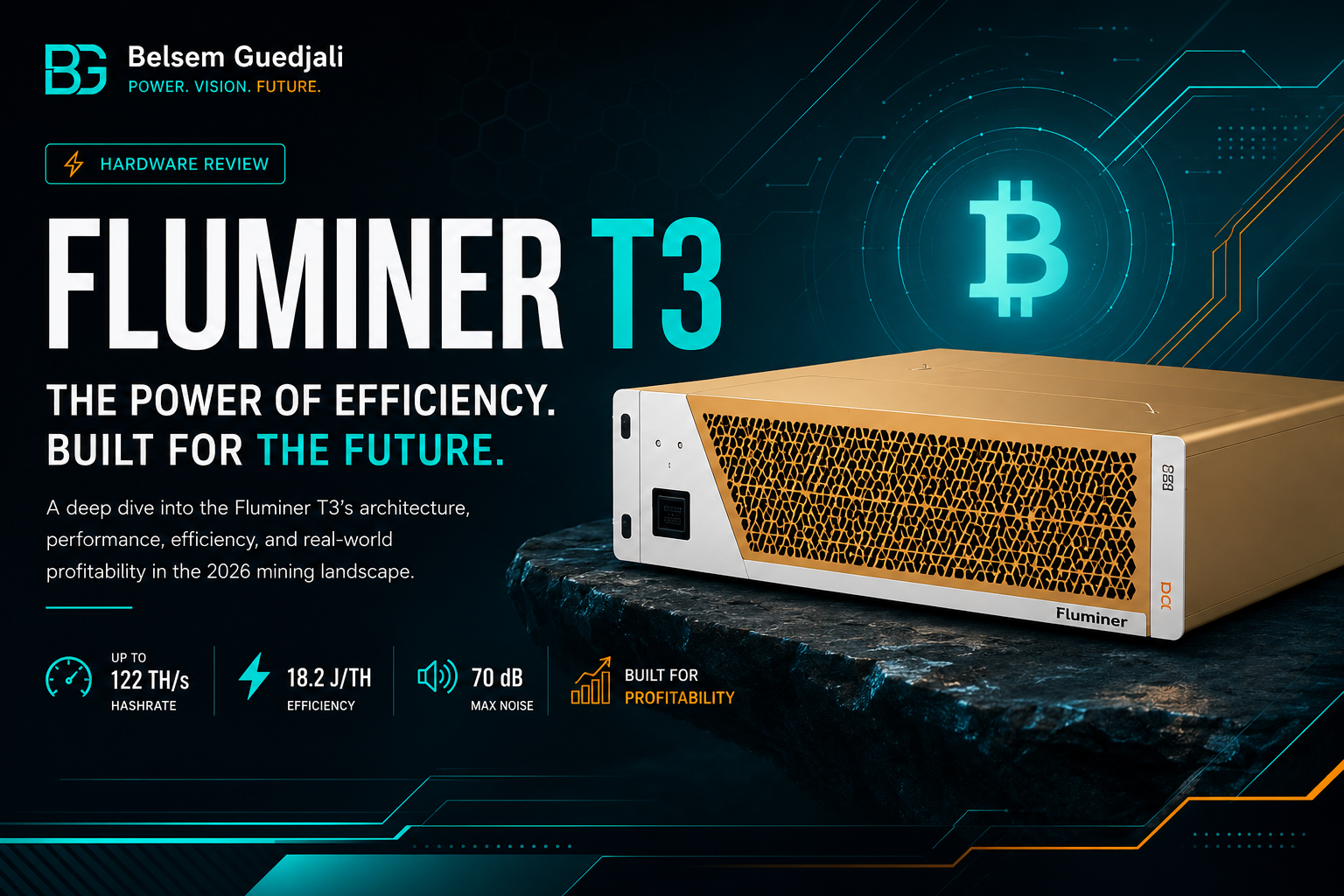
I don’t trust manufacturer stickers. The T3 is rated for 110-115 TH/s, but as any operator knows, the "real" numbers happen at the wall and in the pool.
We tested the T3 across three firmware-locked modes. Here is the operational data from my 240V, 30A circuit:
| Operating Mode | Hashrate (TH/s) | Power (Watts) | Efficiency (J/TH) | Noise (dB) |
|---|---|---|---|---|
| Silent | 91.23 | 1,667 | 18.27 | 60 |
| Normal | 110.10 | 2,013 | 18.28 | 66 |
| Efficient | 122.35 | 2,226 | 18.20 | 70 |
The Efficiency Paradox in the Fluminer T3: How Increased Power Leads to Better J/TH Performance
The real kicker with Efficient Mode isn’t just the J/TH on the spec sheet—it’s how it actually holds up when the heat is on. Most miners look great for the first ten minutes and then start choking, but the T3 stays rock-solid even after days of grinding. It’s the difference between a 'lab queen' and a machine that’s actually built for the trenches of a real mining farm.
Operational Realities and Constraints
As a professional, I look at more than just hashrate. I look at failure points.
- Connectivity: The T3 comes with a wireless dongle, but I cannot stress this enough: do not mine on Wi-Fi. Packet loss and latency in a high-RF environment like a mining farm lead to "stale shares," which is essentially burning money. Stick to the Ethernet port.
- The Cable Trap: The T3 uses a C19/C20 interface. The first units shipped with European plugs or standard NEMA 5-15P cables. If you are running at 240V on a PDU (which you should be for efficiency), you’ll need a dedicated C20-to-C19 pigtail. Don't be the guy who has $2,100 of hardware sitting idle because you're missing a $20 cable.
- Maintenance: Because the heatsink is one massive block, cleaning it is easier than the fin-stack designs of the past. However, if you have a single chip failure in the middle of that board, repasting and repairing is going to require a long-reach driver and some serious patience.
Fluminer T3 2026 Profitability Modeling: Real-World ROI Based on Electricity Costs and Mining Difficulty
Mining in 2026 is a game of electricity tiers. If you are paying "standard" residential rates, you aren't mining—you’re gambling.
- Scenario A: The Industrial Operator ($0.04/kWh)
At 4 cents, the T3 in "Efficient Mode" generates a healthy daily margin. Even with hashprice at historic lows, the 122 TH/s output keeps you well above the break-even line. You’re looking at a machine that pays for its own power and contributes significantly to CapEx recovery.
- Scenario B: The Home/Small Operator ($0.07/kWh)
This is the current "danger zone." At 7 cents, your daily profit after power is thin. You are highly sensitive to the 11.1% difficulty adjustments we’ve been seeing lately. Here, you should run the T3 in Silent Mode. You sacrifice 30 TH/s, but you drop your power draw by 550W, preserving your margin and extending the life of your hardware.
- Scenario C: The Residential "Hobbyist" ($0.12/kWh)
If you’re paying 12 cents or more, the T3 is essentially a heater that occasionally spits out Satoshis. Unless you are "spec-mining" (holding the coin in hopes of a massive price spike), your operational cost is likely higher than the cost of just buying BTC on an exchange.
Fluminer T3 vs Antminer S19k Pro Comparison: Efficiency, Hashrate, and Power Consumption in 2026 Mining
To put the T3's performance in perspective, look at the legacy workhorse, the Antminer S19k Pro. To get 122 TH/s out of an S19k Pro, you’d be pulling nearly 3,100W. The T3 does the same work at 2,226W. That ~900W difference is the margin that keeps a business alive during a bear market.
Final Judgment: Professional Advisory
The Fluminer T3 represents the commoditization of high-end ASIC mining. It’s a no-frills, high-efficiency brick.
Strengths:
-
Leading Efficiency: 18.2 J/TH is world-class for air-cooled hardware in 2026.
-
Thermal Headroom: The massive heatsink and 6-fan setup handle the "Efficient" mode without hitting thermal throttle limits.
-
Software Stability: Testing on ViaBTC showed 100% stability, though I’d avoid smaller, unoptimized pools where I saw some rejected share spikes.
Weaknesses:
-
Noise: This is a loud machine. It is not suitable for an office or a bedroom.
-
UI Simplicity: Removing the front-facing screen was a cost-saving measure that makes local troubleshooting slightly more annoying.
Final Verdict: Is the Fluminer T3 Worth It in 2026?
Let’s be honest: the Fluminer T3 isn’t here to win any beauty contests or impress you with marketing hype—it’s built purely to survive. Mining in 2026 isn't a game of chasing big numbers or flashy specs anymore. It’s a game of endurance, where electricity costs and razor-thin margins decide who stays in business as the difficulty keeps climbing.
The T3 doesn’t sell you a dream or promise easy money. It’s a cold, industrial workhorse designed for one brutal task: staying online and grinding out value while less efficient setups are forced to unplug.
If your power is cheap and your setup is professional, the T3 becomes a silent profit engine that holds its ground when the market gets ugly. But if you’re paying too much for power or running a casual rig, this machine won’t ‘help’ you—it will ruthlessly expose every flaw in your plan and turn them into losses you can’t ignore.
The bottom line is simple: either you’re running a serious, efficiency-first operation… or the Fluminer T3 will prove, quite painfully, that you’re simply out of your league.
Fluminer T3 FAQ 2026: Mining Performance, Efficiency, Profitability & Setup Guide
Q1: Can I actually run the T3 in my house, or will my neighbors think I’m running a jet engine?
Let’s be real: at 70 dB in its "Efficient" mode, this isn’t a machine you tuck away in the guest bedroom. It’s loud. If you have a dedicated, sound-insulated garage or a basement with a heavy door, you might get away with it—especially in "Silent Mode" (60 dB). But if you’re in a thin-walled apartment, your neighbors will definitely know you’re mining within the hour. It’s a professional-grade brick, not a consumer appliance.
Q2: Why does the "Efficient Mode" pull more power? Isn't that the opposite of what "efficient" means?
It sounds like a paradox, but here’s the deal: in the T3, pushing more juice to the chips actually lets them scale their hashrate faster than they consume power. While you're pulling 2,226W (which is a lot), you’re getting 122 TH/s in return. This brings your efficiency down to 18.2 J/TH. So, while your electric bill goes up, the amount of Bitcoin you’re mining per dollar spent on power actually improves. It’s about working harder and smarter.
Q3: The T3 comes with a Wi-Fi dongle—is it safe to use that for my connection?
Just because you can doesn't mean you should. In the high-interference environment of a mining rig, Wi-Fi is notorious for packet loss and latency. Even a few "stale shares" (shares that reach the pool too late) is basically the same as flushing money down the toilet. Do yourself a favor: ignore the dongle, buy a solid Ethernet cable, and plug it directly into the wall. Reliability beats convenience every time in this game.
Q4: I’m paying about $0.10/kWh for electricity. Is the T3 a good investment for me?
At 10 cents per kilowatt-hour, you’re living in the "danger zone." In the 2026 market, the T3 will likely cover its own power costs, but your profit margins will be razor-thin after you factor in the cost of the hardware itself. At that rate, you’re basically "spec-mining"—betting that the price of Bitcoin will moon later. If you’re looking for a steady, low-risk income stream at that power price, the T3 might just feel like a very expensive, very loud space heater.