
Introduction
The search for new renewable electricity sources is no longer just about adding more solar panels or building bigger wind farms. As electricity demand rises across digital industries—especially artificial intelligence, cloud infrastructure, and crypto mining—the energy sector is under pressure to find power sources that are not only low-carbon, but also continuous and predictable.
One option attracting growing attention is osmotic power, sometimes called salinity gradient energy. The idea is simple in principle: when freshwater and seawater mix, the difference in salt concentration contains usable energy. That exchange happens naturally every day at estuaries, coastal outlets, and industrial water facilities. The challenge is not whether the energy exists, but whether it can be captured efficiently enough to matter.
That question is becoming more relevant as membrane technologies improve and desalination expands worldwide. What once looked like a niche scientific concept is now being tested as a possible complement to the modern power system.
Why Salinity Gradients Matter in Energy Infrastructure
Freshwater and seawater do not carry the same chemical potential. When they meet, nature pushes them toward equilibrium. That balancing process releases energy, and at global scale the theoretical resource is enormous.
Researchers often estimate the annual global potential from freshwater-seawater mixing at around 14,500 terawatt-hours, which places it among the larger untapped renewable resources on Earth. Practical deployment would of course be far smaller than the theoretical maximum, but even conservative scenarios suggest osmotic power could make a meaningful contribution in selected locations.
Instead of viewing estuaries only as ecological zones, energy planners are beginning to see them as places where hydrology and power engineering overlap. The same is true for desalination plants, wastewater treatment systems, and industrial brine streams.
| Energy Indicator | Estimated Value | Explanation |
|---|---|---|
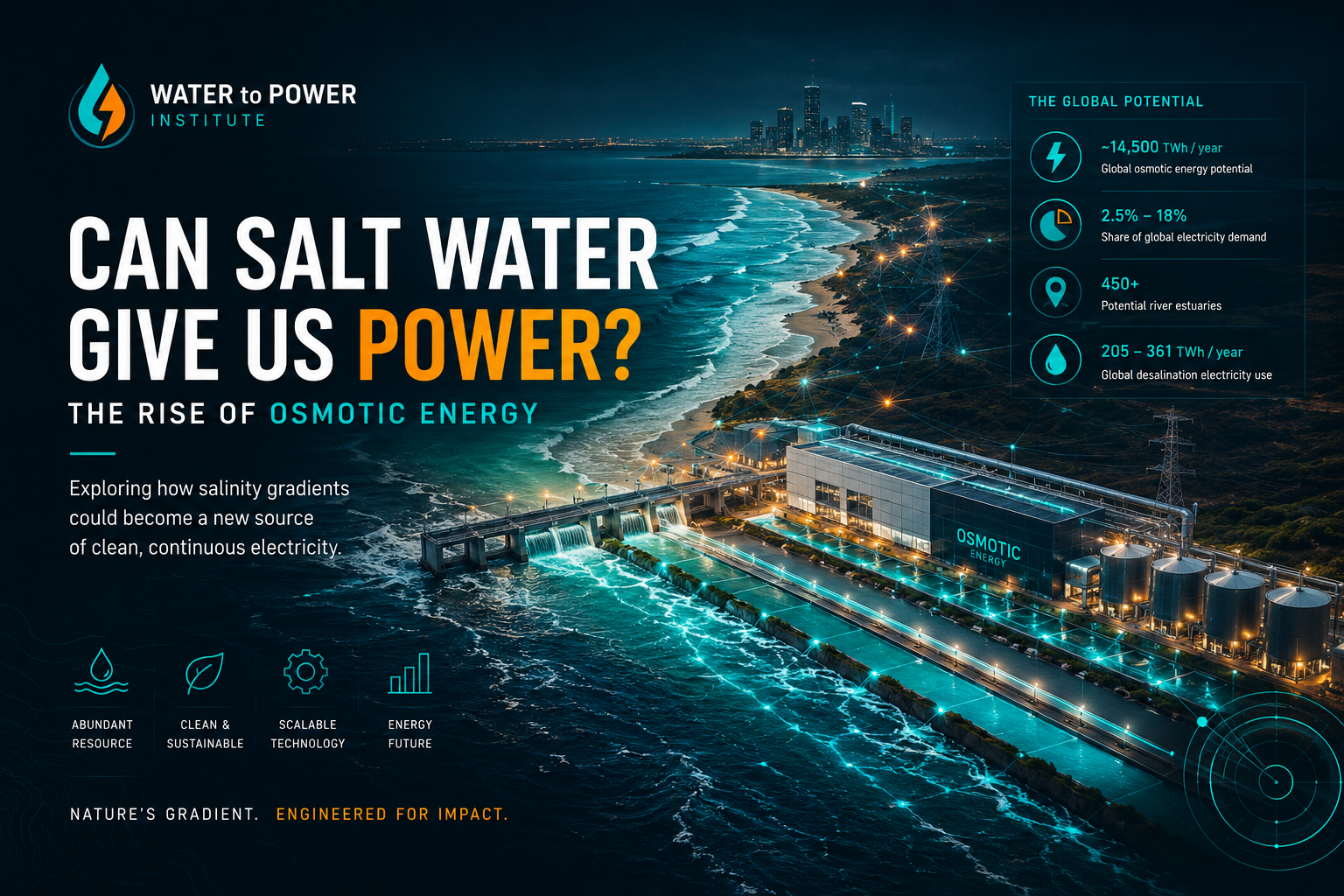
| Global Osmotic Energy Potential | ~14,500 TWh / year | Estimated energy released annually when freshwater mixes with seawater in river estuaries around the world. |
| Share of Global Electricity Demand | 2.5% – 18% | Range of estimates for how much osmotic power could contribute to global electricity supply. |
| Potential River Estuaries | 450+ | Number of river mouths identified worldwide as promising sites for osmotic power generation. |
| Global Desalination Electricity Use | 205 – 361 TWh / year | Estimated electricity consumed each year by desalination plants worldwide. |
These figures highlight the enormous theoretical potential of salinity-gradient energy. However, real-world deployment depends heavily on local hydrology, infrastructure integration, and economic feasibility.
Osmotic Power Is Not Just About Rivers
A common mistake is to think osmotic energy only belongs at river mouths. In reality, some of the most promising applications may come from engineered water systems, not natural estuaries.
Desalination plants are a strong example. They consume large amounts of electricity to separate freshwater from seawater, and in the process they produce concentrated brine. That brine is typically a waste stream, but energetically it still has value. If paired with lower-salinity water—such as treated municipal wastewater—it can form the basis of an osmotic energy recovery system.
This matters because desalination is expanding in regions already struggling with water stress and expensive power. If part of that lost salinity energy can be recovered on-site, the plant’s total electricity demand falls, operating costs improve, and the environmental burden becomes easier to manage.
The Two Main Engineering Paths
Today, osmotic power development is moving in two main directions. One route converts salinity into pressure, and the other converts it more directly into electrical potential.
Pressure-Retarded Osmosis (PRO)
PRO is the more familiar approach. Freshwater and saltwater are separated by a membrane that lets water pass but retains most dissolved salts. Water naturally migrates into the more saline side, increasing pressure there. That pressure can then drive a turbine and generator, creating electricity in a way that resembles miniature hydropower.
The strength of PRO is that its logic is easy to understand from a power engineering perspective: pressure becomes mechanical motion, and motion becomes electricity. Its weakness has historically been membrane cost, fouling, and efficiency under real operating conditions.
Still, it has moved well beyond theory. Demonstrations in several countries showed that the concept works, even if early economics were not attractive enough for rapid commercial rollout.
Membrane-Based Voltage Generation
A second path avoids turbines altogether. Instead of using osmotic flow mainly to build hydraulic pressure, these systems exploit ion movement across specialized membranes to create voltage directly.
That is the logic behind Ionic Nano Osmotic Diffusion (INOD). In this design, nanostructured membranes guide positively and negatively charged ions differently. As ions separate and move, an electrical potential forms across the membrane stack. In effect, the salinity difference becomes a continuous source of electrochemical driving force.
This approach is especially interesting because it may simplify certain plant designs and reduce dependence on pressurized hydraulic loops. It also aligns well with the broader trend in energy technology toward compact, modular, membrane-based systems.
The table below summarizes the main technologies currently being developed to convert salinity gradients into electricity.
| Technology | Core Principle | Electricity Generation | Main Advantage |
|---|---|---|---|
| Pressure-Retarded Osmosis (PRO) | Freshwater flows through a semi-permeable membrane into saltwater, increasing hydraulic pressure. | The pressurized water drives a turbine connected to an electricity generator. | Compatible with traditional turbine-based power systems |
| Ion-Selective Membrane Systems (INOD) | Nanostructured membranes selectively guide positive and negative ions. | Ion separation generates electrical voltage that drives electrons through a circuit. | Direct electricity generation without turbines |
| Hybrid Water-Energy Recovery Systems | Industrial brine and treated freshwater create strong salinity gradients. | Energy is recovered using pressure turbines or electrochemical membrane systems. | Improves efficiency of desalination and wastewater infrastructure |
Where the Technology Is Showing Promise
Recent projects show that osmotic energy is slowly moving from concept to infrastructure.
In Japan, a plant linked to desalination and wastewater streams has demonstrated how osmotic recovery can support the energy balance of water treatment itself. Instead of treating brine purely as a disposal problem, the system uses it as part of an energy loop.
In Europe, industrial brine applications have also shown promise because very high salinity can improve performance. These sites may not generate utility-scale electricity on their own, but they prove something important: osmotic systems can run continuously and serve real industrial loads.
On the membrane side, French developers are pushing direct electrical generation technologies that aim to compete with other firm low-carbon power options. Laboratory performance is always stronger than field results, but that is normal in energy engineering. What matters is whether field performance keeps improving enough to justify scale-up.
Why Digital Industries Should Pay Attention
For AI data centers, cloud campuses, and mining operations, the appeal of osmotic power is not only that it is renewable. The bigger attraction is operational profile.
These industries do not simply need clean energy. They need: reliable supply, stable output, predictable operating hours, and low exposure to fuel price volatility.
That is why baseload and near-baseload resources remain strategically valuable. Solar and wind are important, but they often require storage, overbuilding, or flexible backup. Osmotic systems, by contrast, have the potential to provide continuous generation wherever a strong and steady salinity gradient exists.
This does not mean osmotic power will replace dominant renewables. More realistically, it could become a site-specific infrastructure advantage for coastal digital facilities, especially where desalination is already part of urban or industrial life.
The Real Constraints
Osmotic power still has serious hurdles to clear.
Membranes must become cheaper, tougher, and more resistant to fouling. Water pretreatment adds cost. Site conditions vary widely. Environmental integration also matters, especially in sensitive estuarine ecosystems. And like many emerging energy technologies, good technical performance alone does not guarantee competitive project economics.
In other words, the resource is large, but the commercially accessible resource is much smaller. That distinction matters.
Why Coastal Data Centers Are the Perfect Fit for Osmotic Power
As our digital world continues to explode, tech giants are increasingly eyeing the coastlines for their massive hyperscale data centers and computing hubs. And honestly, it makes perfect sense. Think about it: these coastal spots offer direct access to subsea internet cables, an endless supply of ocean water for cooling, and they are often right next door to major desalination or wastewater treatment plants.
This is exactly where osmotic power could step in as a game-changer. By piggybacking these salinity-gradient systems onto the water infrastructure that's already sitting there, coastal data centers could tap into a rock-solid, 24/7 supplementary power source. Sure, a single osmotic setup isn't going to out-muscle a massive traditional power plant anytime soon. But for high-density computing facilities, having a predictable, always-on, and low-carbon energy stream is a massive win for keeping operations resilient and online.
Looking ahead, if we keep seeing leaps in membrane efficiency and a drop in installation costs, osmotic energy is perfectly positioned to become a highly valuable, specialized energy layer for coastal tech hubs. It’s an especially exciting prospect for regions where massive desalination efforts and heavy-duty computing are already sharing the exact same shoreline.
Conclusion
Osmotic power is no longer just an interesting scientific idea about mixing river water and seawater. It is becoming a real engineering discussion about how to recover energy from salinity gradients inside both natural and industrial systems.
Its strongest near-term role may not be replacing major power plants, but improving the efficiency of coastal infrastructure—especially desalination and water treatment assets that already handle large saline flows. Over time, if membrane performance keeps improving, osmotic energy could earn a valuable place in the renewable mix as a steady, location-specific source of low-carbon electricity.
For a future shaped by AI, high-density computing, and energy-hungry digital infrastructure, that kind of dependable power could matter more than many people realize.
FAQ
Q1: What makes osmotic power different from solar and wind?
Osmotic power is based on salinity differences rather than weather conditions, so it has the potential to generate more continuously than solar or wind in suitable locations.
Q2: Is osmotic power mainly useful at river estuaries?
No. Estuaries are important, but desalination plants, wastewater systems, and industrial brine streams may be among the most practical places to deploy it.
Q3: Why is desalination closely linked to osmotic energy?
Because desalination creates concentrated brine, which contains recoverable salinity-gradient energy when paired with lower-salinity water sources.
Q4: Can osmotic systems help data centers and crypto mining?
Potentially yes, especially in coastal regions where stable local power and water infrastructure already overlap.
Q5: What is the biggest obstacle to wider adoption?
The main barriers are membrane cost, real-world efficiency, fouling, and the economics of scaling projects beyond pilots.