

Liquid-to-Core: How Biomimetic Microfluidics Will Salvage the Future of GPUs and ASICs
Walk into any modern crypto mining facility or AI data center, and the first thing that hits you isn’t the flashing LEDs or the endless rows of server racks. It’s the noise. It sounds like a hurricane trapped inside a warehouse. Millions of high-RPM fans scream 24/7, desperately trying to push chilled air across blistering heatsinks.
We are currently fighting a war against thermodynamics, and to be entirely honest, we are losing.
The relentless explosion of AI workloads and the brutal competitive intensity of crypto mining have pushed our silicon to its absolute physical limits. Today, the real bottleneck isn't how many transistors we can cram onto a die—it’s how we stop those transistors from melting themselves into slag. Traditional cooling methods, like massive aluminum blocks and industrial air conditioners, are just treating the symptoms. To unlock the next era of computing, we have to rethink architecture entirely. The answer? Bring the cooling directly inside the silicon, using a blueprint stolen straight from Mother Nature: Biomimetic In-Chip Microfluidic Cooling.
1. The Thermal Crisis: The Real Threat to Mining and AI Infrastructure
If you look at the electricity bill of any high-performance data center, the power split is staggering. You aren't just paying to compute; you're paying a massive premium just to keep the computers alive.
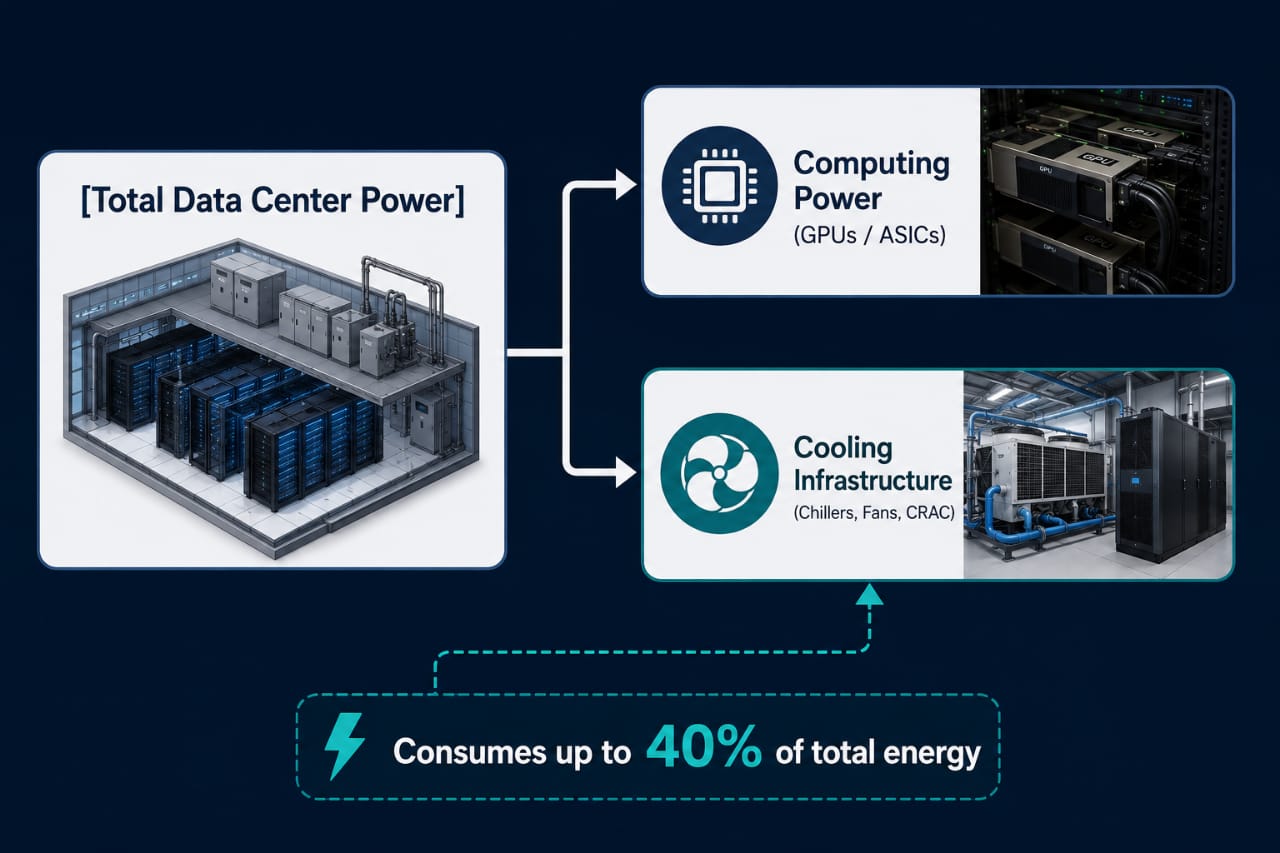
In standard facilities, cooling can eat up 30% to 40% of the total energy cost. That massive overhead directly slaughters mining profit margins and drastically inflates the operating expenses (OpEx) of AI cloud providers.
But heat isn't just expensive; it’s a silent killer of hardware. There’s a dangerous myth that as long as your ASIC or GPU stays below its throttling threshold (around 80°C to 85°C), you're perfectly safe. Physics tells a much darker story.
The Physics of Heat and Chip Degradation
As chipmakers shrink manufacturing processes down to 3-nanometer scales, the microscopic walls holding electrons back become unimaginably thin. When a chip runs under sustained extreme heat, two destructive things happen:
-
Electromigration: Imagine a rushing river tearing rocks from its banks. That’s what high-density electron flow does to the metal traces inside a chip at high temperatures. The electrons physically dislodge atoms over time, causing microscopic breaks or shorts. Once that happens, your expensive GPU is permanently dead.
-
Leakage Current: As temperatures rise, electrons get highly energized and start "jumping the fences" across transistor gates, even when they are supposed to be switched off. This unwanted leakage creates a vicious cycle known as thermal runaway—the leaked electrons generate more heat, which causes even more leakage.
For a mining farm running hundreds of Antminers 24/7, or an AI cluster training massive LLMs, a reduction in chip lifespan from 5 years down to 2 years is a catastrophic capital loss.
2. Scientific Breakdown: How In-Chip Biomimetic Microfluidics Works
If pasting a block of copper on top of a chip isn't enough anymore, the logical next step is radical: eliminate the physical barrier entirely. Instead of pulling heat through layers of thermal paste and metal, In-Chip Microfluidic Cooling carves microscopic rivers directly into the backside of the silicon wafer itself.
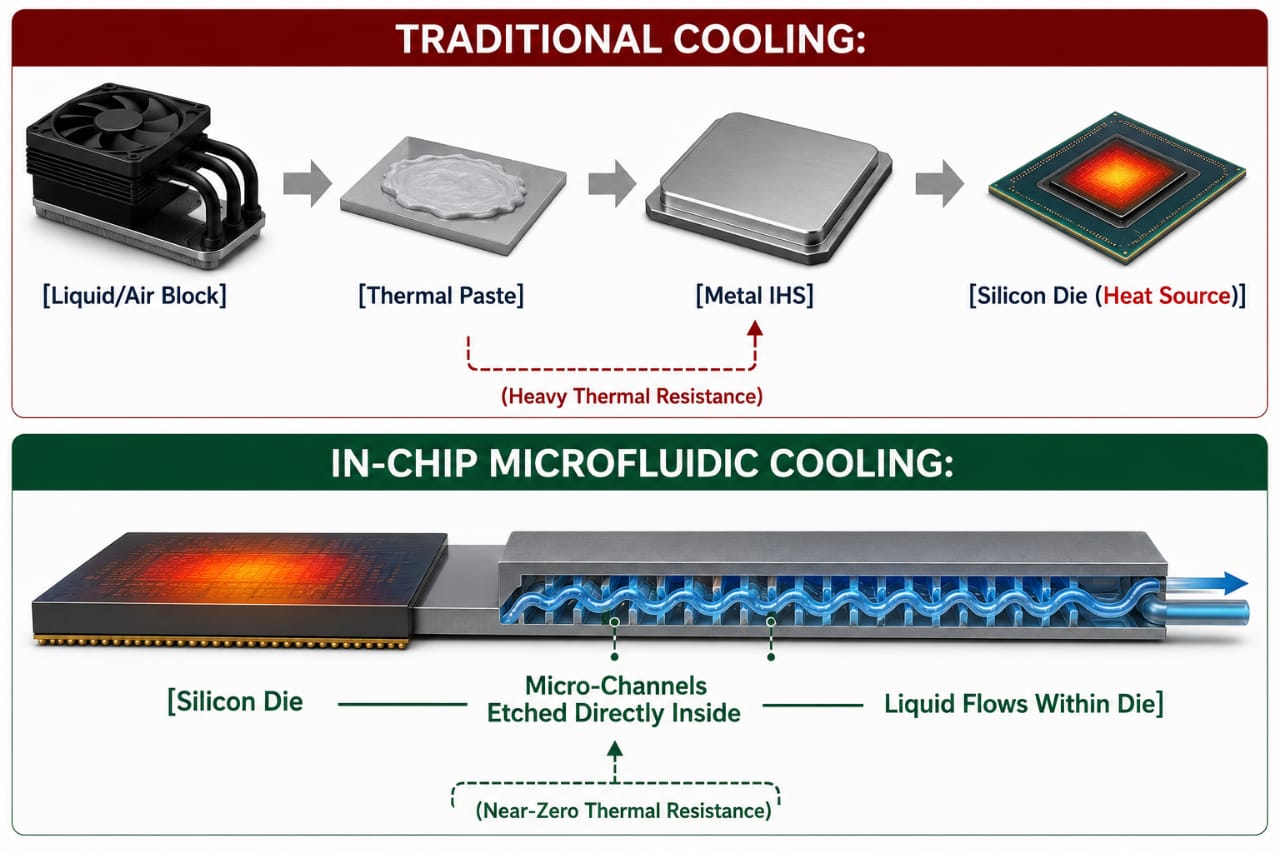
By pumping a non-conductive dielectric fluid or purified water right through the heart of the processor, thermal resistance drops to practically zero. Heat is absorbed the exact millisecond it’s generated.
The Biomimetic Edge
But there’s a catch. If you just carve straight, microscopic lines into silicon, you run into a massive fluid dynamics problem. Forcing liquid through thousands of tiny, straight tunnels requires incredibly powerful pumps. The friction is immense, and by the time the liquid reaches the other side of the chip, it’s boiling.
To solve this, scientists looked at how nature handles fluids—like the vascular networks of human lungs or the veins in leaves. Nature doesn't use straight grids. It uses biomimetic fractal structures.
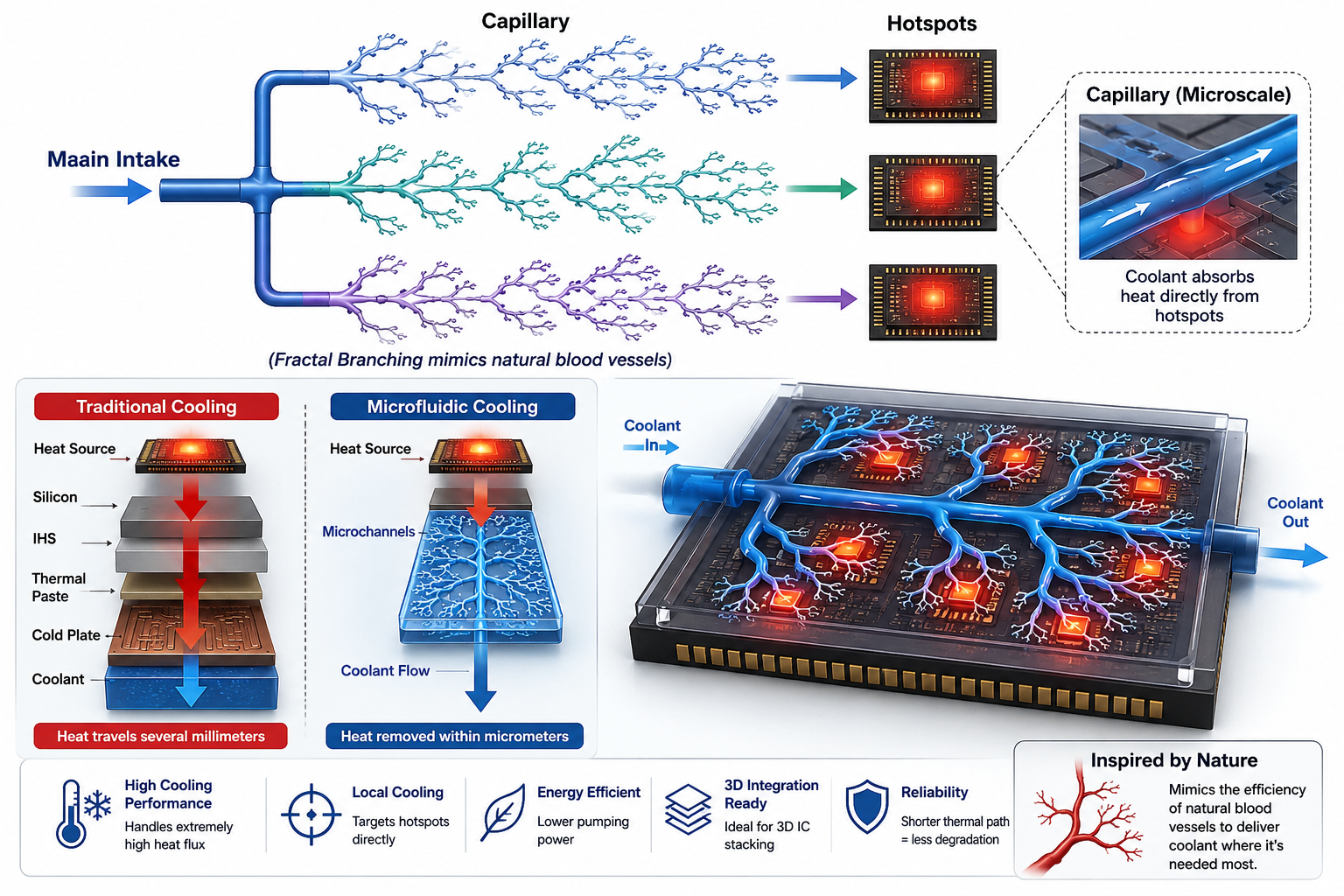
By etching these organic, branching patterns into the silicon, engineers achieved two massive breakthroughs:
-
Uniform Temperature Distribution: The fractal geometry ensures that localized "hotspots" (like HBM memory stacks or tensor cores) receive fresh, cold fluid at the exact same time.
-
Low Pressure Drop: The natural fluid dynamics practically eliminate resistance. You get superior cooling across the entire die using very little pump energy. It’s an engineering masterpiece, entirely plagiarized from biology.
3. Economic Impact: Power Reductions and the Cost of Innovation
The economic ripple effects of this technology are profound. It presents unique upfront challenges, but the long-term savings are astronomical.
Deep Power Savings and Spatial Optimization
By ditching energy-guzzling chillers and massive air conditioning systems for ultra-low-power biomimetic loops, data centers can push their Power Usage Effectiveness (PUE) down to a near-perfect 1.0. The electricity you save on cooling can immediately be used to power more GPUs and ASICs, vastly increasing your hash rate or compute output without drawing an extra watt from the grid.
Furthermore, this changes the physical shape of computing. Traditional servers are bulky because they need empty space for airflow. In-chip liquid cooling allows system architects to stack chips vertically in dense 3D configurations without fear of melting the middle layers. You can achieve a 5x to 10x increase in computational density per square foot, drastically reducing the land and real estate costs for data centers.
Will It Raise Manufacturing Costs?
Yes, initially. Etching complex, microscopic fractal channels into monocrystalline silicon requires highly advanced, precise techniques like Deep Reactive-Ion Etching (DRIE).
| Metric | Traditional Cooling Systems | Biomimetic In-Chip Microfluidics |
|---|---|---|
| Initial Manufacturing Cost (CapEx) | Low to Moderate | High (Requires advanced silicon etching) |
| Long-Term Operational Cost (OpEx) | High (Massive power draws for fans/chillers) | Very Low (Highly efficient fluid dynamics) |
| Chip Lifespan & Reliability | Reduced due to thermal degradation | Maximized (Maintains uniform, optimal temps) |
| Hardware Computational Density | Limited by physical space for airflow | Extremely High (Enables dense 3D stacking) |
While the purchase price of these next-gen chips will carry a premium, the ROI for enterprise operations is a no-brainer. The hardware lasts years longer, never suffers from thermal throttling, and slashes power costs so aggressively that it easily pays for the upfront premium within the first year.
4. Key Industrial Players and the Near-Future Roadmap
This isn't just science fiction confined to academic papers anymore; the race to commercialize is already well underway.
-
TSMC (Taiwan Semiconductor Manufacturing Company): The world’s undisputed foundry king has been aggressively showcasing prototypes of on-chip water cooling. They are integrating these fluid channels directly into their advanced packaging tech (like CoWoS) to brace for the next generation of AI super-chips.
-
Academic Pioneer Labs (EPFL): Researchers at Switzerland’s École Polytechnique Fédérale de Lausanne have successfully built integrated microfluidics into functional silicon, proving that the heat dissipation capabilities are off the charts.
-
CoolIT Systems & JetCool: Veteran liquid cooling companies are moving closer to the bare silicon, partnering with server makers to design the high-efficiency fluid delivery manifolds that will connect these futuristic chips to the racks.
With NVIDIA's Blackwell architecture and future GPUs pushing well past 1000W to 1200W per card, and Bitcoin miners demanding sub-15 J/TH efficiencies, the transition to integrated microfluidics is inevitable.
5. Conclusion: Redefining Geopolitics and Data Center Geography
If biomimetic in-chip cooling scales commercially, its biggest legacy won't just be better hardware—it will completely redraw the global map of computing.
Historically, mega-mining farms and data centers chased the cold. They built facilities in Iceland, the Nordics, or damp coastal areas to exploit freezing ambient air and ocean water. But building on coastlines and seismically active islands (like Japan) carries massive geographical and geopolitical risks. From catastrophic tsunamis and rising sea levels to targeted attacks on maritime infrastructure, coastal hubs are vulnerable.
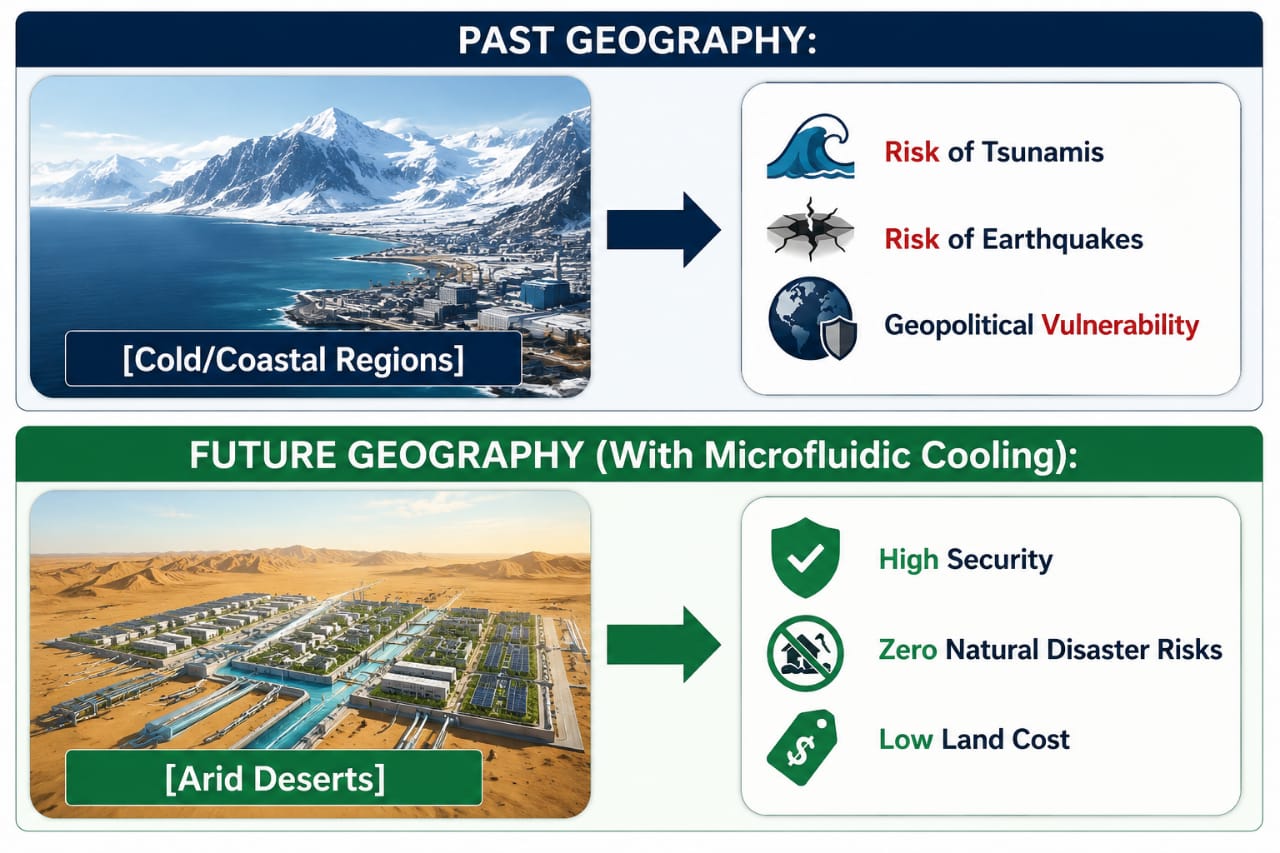
With biomimetic in-chip cooling, we no longer need the outside air to be cold. Because the system rejects heat flawlessly even in scorching environments—without evaporating millions of gallons of water—we can move the beating heart of our global infrastructure to the safest, most stable places on Earth: the great deserts.
Regions like the Sahara, the Mojave, the Atacama, and the deep interior of China are incredibly secure. They offer endless expanses of cheap land and are completely immune to tsunamis, volcanic eruptions, and dense civilian conflicts. The only thing that ever stopped us from building massive AI and crypto vaults in the desert was the impossible task of keeping the servers cool under the blazing sun. By curing the thermal crisis at the microscopic level inside the silicon, biomimetic microfluidics finally unlocks the deserts as the ultimate, secure home for the future of human computing.
Frequently Asked Questions (FAQ)
Q1. Why can't we just keep using bigger fans or standard water blocks for new GPUs and ASICs?
Standard cooling methods only treat the symptoms. When you use fans or water blocks, you're trying to pull heat through layers of thermal paste and metal heat spreaders, which creates a lot of thermal resistance. With modern chips pushing past 1000 watts, standard cooling simply can't extract the heat fast enough, leading to hardware degradation. We have to cool the silicon from the inside out.
Q2. What exactly makes this new cooling technology "biomimetic"?
"Biomimetic" basically means stealing brilliant designs from nature. Instead of carving straight, rigid channels into the silicon (which causes huge fluid friction and requires massive pumps), engineers are etching fractal, branching patterns into the chips. It works exactly like the blood vessels in your lungs or the veins in a leaf, distributing the cooling fluid evenly and efficiently across the entire chip with almost zero pressure resistance.
Q3. Is it true that running my mining rigs or AI servers at 80°C will permanently damage them?
Yes, it is. There’s a widespread myth that staying just below the thermal throttling limit is totally safe. In reality, sustained high heat causes "electromigration" (where electrons literally chip away at the metal pathways) and "leakage current" (which creates thermal runaway). This continuous thermal stress can easily cut the lifespan of an expensive ASIC or GPU from 5 years down to just 2 years.
Q4. How will in-chip cooling actually lower my electricity bill?
Right now, in a standard data center, up to 40% of the electricity you pay for doesn't even go toward computing—it goes entirely to running the massive chillers, CRAC units, and fans. Biomimetic microfluidics use ultra-low-power pumps that practically eliminate the need for external air conditioning. This drops your cooling overhead to near zero, allowing you to use that saved electricity to power more hashing or AI workloads.
Q5. Won't these microfluidic chips be much more expensive to manufacture?
Yes, initially they will carry a premium. Etching microscopic, organic rivers directly into a silicon wafer requires advanced and expensive manufacturing techniques like Deep Reactive-Ion Etching (DRIE). However, the return on investment is incredibly fast. The money you save on your power bill, combined with the fact that your hardware will last years longer, easily absorbs the upfront cost.
Q6. Why would this technology make us move data centers to the desert?
Historically, we had to build mega-farms in freezing or coastal climates to use the cold air and ocean water for cooling, which leaves them vulnerable to tsunamis, earthquakes, and geopolitical risks. With in-chip microfluidics, the outside ambient temperature no longer matters. We can finally build highly secure, massive infrastructure in the deep deserts—where land is cheap and natural disasters are practically non-existent—without worrying about the servers melting under the sun.
Q7. Is this just academic theory, or are companies actually building these chips?
This is very real and happening right now. The world's largest foundry, TSMC, is actively integrating fluid channels into their advanced packaging technologies. Academic pioneers at EPFL have already built working prototypes, and major liquid cooling companies are designing the server racks to support them. It’s the inevitable next step for the industry.