The Energy Storage Paradox: Why Cheap Solar and Wind Power Still Fail Without Storage
The future of computing is no longer limited by processing power, but by energy availability and storage efficiency.
We’ve managed to do the seemingly impossible by making solar and wind power the cheapest electricity on the planet, yet the grid is still stumbling over a fundamental physical hurdle: catching that energy and keeping it. It’s the great paradox of the modern energy transition. We can generate massive amounts of clean power when the sun is out or the wind is howling, but the moment the weather turns, that supply vanishes. For the average consumer, this intermittency is an annoyance. But for hyperscale AI data centers and Bitcoin mining farms—operations that demand an incredibly dense, unrelenting stream of power 24 hours a day—a grid that fluctuates is a fast track to financial hemorrhage.
Why Grid Instability Is a Major Risk for AI Data Centers and Bitcoin Mining
The stakes are entirely unforgiving. A momentary lapse in power translates immediately to dropped hash rates and interrupted server processing, which is why operators are acutely aware of the systemic vulnerabilities exposed by events like the rolling blackouts in California a few years ago. Despite having gigawatts of solar capacity baking in the afternoon sun, the state's grid simply buckled when evening hit and air conditioning demand spiked, proving that sheer generation capacity means nothing if you can't bank it. The bottleneck is no longer how we make power, but how we store it, and the industries eating up the most electricity are desperate for a solution that doesn't rely on an unpredictable grid.
Pumped Hydro Storage: Traditional Large-Scale Energy Storage Explained
Historically, the heavy lifting of energy storage has been handled by pumped hydro. It’s an elegant, brute-force concept where surplus power is used to pump water up a mountain, turning vast reservoirs into colossal, landscape-sized batteries that can flush water back down through turbines when demand peaks. While incredibly effective—capable of matching the output of a nuclear reactor—pumped hydro is severely handicapped by geography. If you are deploying modular crypto mining rigs in the arid expanses of the Middle East or looking at cheap, sun-drenched land in Algeria, a storage system that strictly requires a mountain and a massive water supply is entirely useless. Furthermore, you simply can't wait the decade or more it takes to get one of these mega-projects off the ground.
Gravity Battery Storage Systems: A Scalable Mechanical Energy Solution
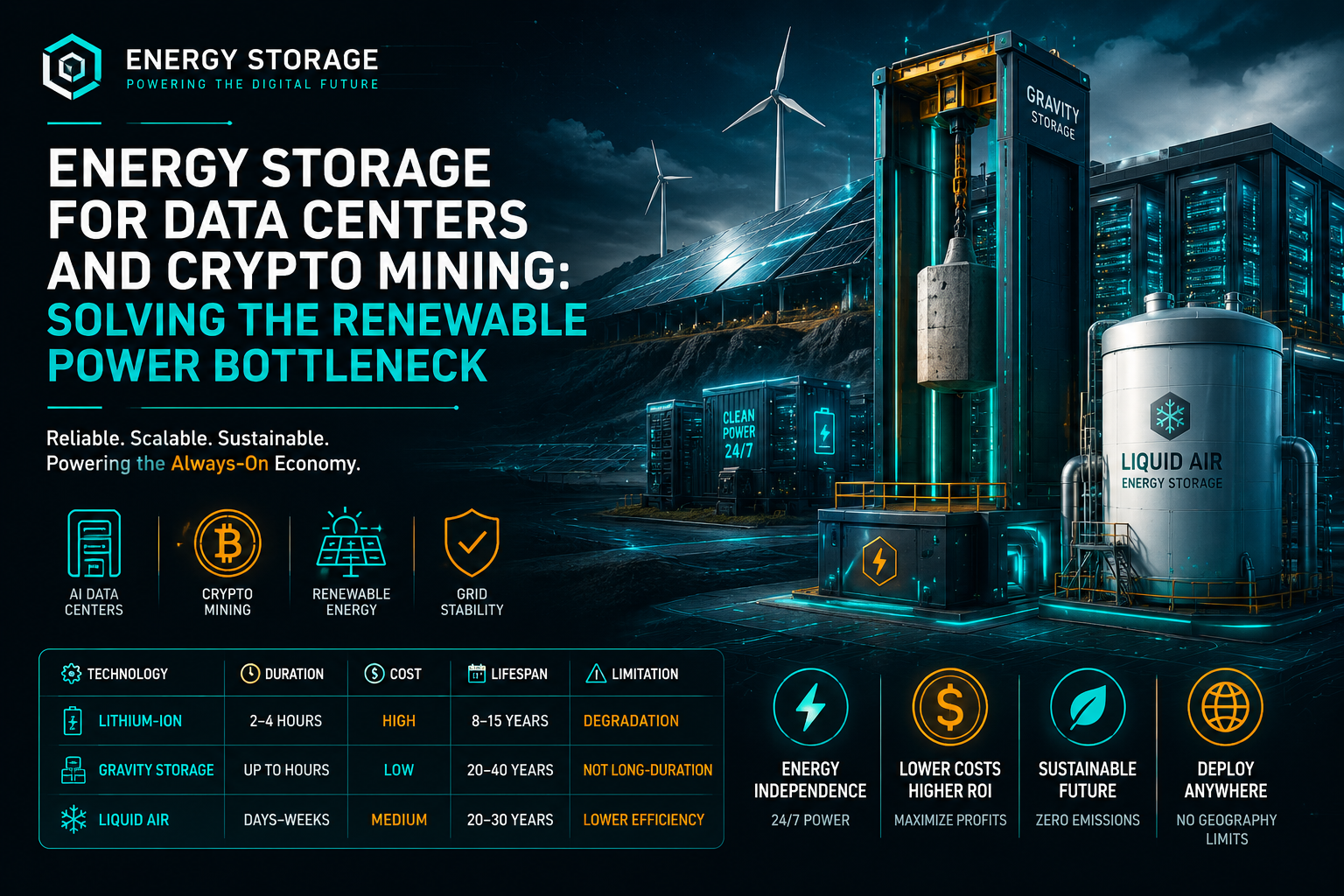
That geographical friction has forced engineers to look sideways for solutions, leading to the industrialization of an ancient concept: the gravity battery. Imagine the mechanics of a weight-driven grandfather clock, but scaled up to the size of a skyscraper or buried deep within abandoned mine shafts. These systems use excess renewable energy to winch tens of thousands of tons of composite mass into the air. When the grid needs a surge of power, the brakes are released, and gravity pulls the mass down, spinning generators with immense torque.
AI-Controlled Stability: The Key Innovation
What makes this viable today isn't just the mechanics, but the software. Suspending a 40-ton block naturally invites pendular swinging and chaotic vibrations that would ordinarily ruin the steady output of electricity. By weaving advanced, real-time AI into the control systems to predict and counter these microscopic movements instantly, operators can achieve flawlessly smooth energy release in under a second. Better yet, because they use cheap, locally pressed earth blocks rather than specialized concrete, these towering systems can be erected almost anywhere on flat land.
Liquid Air Energy Storage (LAES): The Long-Duration Solution
| Technology | Duration | Cost | Lifespan | Limitation |
|---|---|---|---|---|
| Lithium-ion | 2–4 hours | High | 8–15 years | Degradation |
| Gravity Storage | Up to hours | Low | 20–40 years | Not long-duration |
| Liquid Air | Days–Weeks | Medium | 20–30 years | Lower efficiency |
But mechanical gravity systems are mostly a sprint; they handle the short-term dips perfectly. To weather a multi-day storm or power an AI cluster through a week of heavy cloud cover, the industry is turning to Liquid Air Energy Storage (LAES). This is essentially a massive deep freeze for electricity. Surplus power cools ambient air down to a bitter -196°C until it turns liquid, shrinking its volume so drastically that massive amounts of potential energy can be held in insulated tanks for weeks. The moment the grid goes hungry, the liquid air is exposed to ambient heat, violently expanding back into a gas to drive a turbine. Unlike lithium-ion batteries that tap out after a few hours and degrade over time, liquid air systems offer the kind of relentless, multi-day endurance that could completely eliminate a data center's need for diesel backup generators.
The Cost Revolution: Toward Energy Independence
| Technology | Response Time | Storage Duration | Efficiency | Best Use Case |
|---|---|---|---|---|
| Pumped Hydro | Slow (minutes) | Hours to Days | 70–85% | National Grid |
| Gravity Storage | < 1 second | Minutes to Hours | 75–90% | Mining Farms |
| Gravity Towers (AI) | < 1 second | Hours | ~80% | Decentralized Energy |
| Liquid Air (LAES) | Minutes | Days to Weeks | 50–70% | Data Centers |
What this all points to is a very imminent collapse in the cost of doing business. As the levelized cost of these advanced storage systems relentlessly drops toward the critical 3 to 4 cents per kilowatt-hour mark, pairing them with ultra-cheap solar generation actually undercuts the cost of fossil fuels. For mining operations and tech giants, this represents total energy emancipation. You no longer need to tether your infrastructure to legacy grids in expensive, highly regulated regions. Instead, the smartest money is moving toward vast, high-irradiance deserts where land is cheap, solar is abundant, and next-generation storage can finally turn unpredictable weather into a permanent, hyper-profitable baseline of power.
| Energy Type | Cost (per kWh) | Trend |
|---|---|---|
| Solar / Wind | 1–3 cents | Decreasing |
| Gravity Storage | 3–4 cents | Rapidly decreasing |
| Liquid Air | 5–8 cents | Improving |
| Lithium-ion | 8–15 cents | Stable |
| Fossil Fuels | 6–12+ cents | Volatile |
What This Means for Crypto Mining and AI Infrastructure
Not all energy storage technologies are equally suitable for every application. The table below highlights the most efficient solutions depending on the specific use case.
| Use Case | Best Technology | Why | Ideal Locations |
|---|---|---|---|
| Crypto Mining | Gravity Storage | Fast + Cheap + Off-grid | Algeria, Middle East, Texas |
| AI Data Centers | Liquid Air + Hybrid | Long-duration + Stable | Industrial Zones |
| National Grid | Pumped Hydro | Massive capacity | Mountain Regions |
The Future of Energy Storage: Why Power Is No Longer a Limiting Factor
Ultimately, we’ve moved past the era where the primary hurdle was simply "making" clean energy. The cost curves for solar and wind have already plummeted, winning the economic argument decisively; the real battle now lies in the mastery of control. For the high-stakes, always-on world of data centers and crypto mining, renewable energy is only as good as its reliability. Without a way to bank that power for a rainy day—or a windless night—green energy remains a volatile asset rather than a foundation for growth.
What’s increasingly evident is that we aren't looking for a single "magic bullet" technology to save the day. The future of the grid will be a sophisticated, hybridized ecosystem: lightning-fast gravity systems will handle the immediate flickers in demand, while liquid air setups provide the deep, multi-day endurance that keeps the lights on during a week-long storm. When we weave these together, we aren't just stabilizing the grid; we are transforming unpredictable weather into a hyper-reliable, low-cost commodity that finally undercuts the old guard of fossil fuels.
For the people building the next generation of digital infrastructure, this shift is transformative. Energy is graduating from a mere line-item expense to a massive strategic lever. The operators who move first—those who stop treating power as something they just "buy from the grid" and start treating storage as a core part of their tech stack—will be the ones who define the next decade of profitable, self-sustaining infrastructure.
FAQ: Energy Storage for Data Centers and Crypto Mining
Q1: What is the biggest problem with renewable energy for crypto mining?
The main issue is intermittency. Solar and wind do not produce constant power, which creates instability for mining operations that require 24/7 electricity. Without proper storage systems, miners face downtime, reduced hash rates, and financial losses.
Q2: Which energy storage technology is best for crypto mining?
Gravity storage is currently one of the best options for crypto mining because it offers fast response times, low costs, and can operate off-grid. It is especially effective in regions with strong solar potential like deserts.
Q3: Why is energy storage important for AI data centers?
AI data centers require continuous, stable power to process workloads. Energy storage ensures uninterrupted operation during grid instability or renewable energy fluctuations, preventing costly downtime and system interruptions.
Q4: How does Liquid Air Energy Storage (LAES) work?
LAES stores energy by cooling air into a liquid at extremely low temperatures. When energy is needed, the liquid air expands rapidly into gas, driving turbines to generate electricity. It is ideal for long-duration storage lasting days or weeks.
Q5: Is lithium-ion battery storage still relevant for large-scale infrastructure?
Yes, but mainly for short-duration use cases. Lithium-ion batteries are effective for quick bursts of energy but are limited by degradation, cost, and storage duration compared to newer technologies like gravity storage and LAES.
Q6: Can energy storage reduce electricity costs for mining farms?
Absolutely. Combining cheap solar energy with efficient storage systems can reduce electricity costs to as low as 3–4 cents per kWh, making operations more profitable and less dependent on traditional power grids.
Q7: Where are the best locations for solar-powered mining with storage?
High-irradiance regions like Algeria, the Middle East, and parts of Texas are ideal. These areas offer abundant sunlight, low land costs, and are well-suited for deploying off-grid mining infrastructure with advanced storage systems.