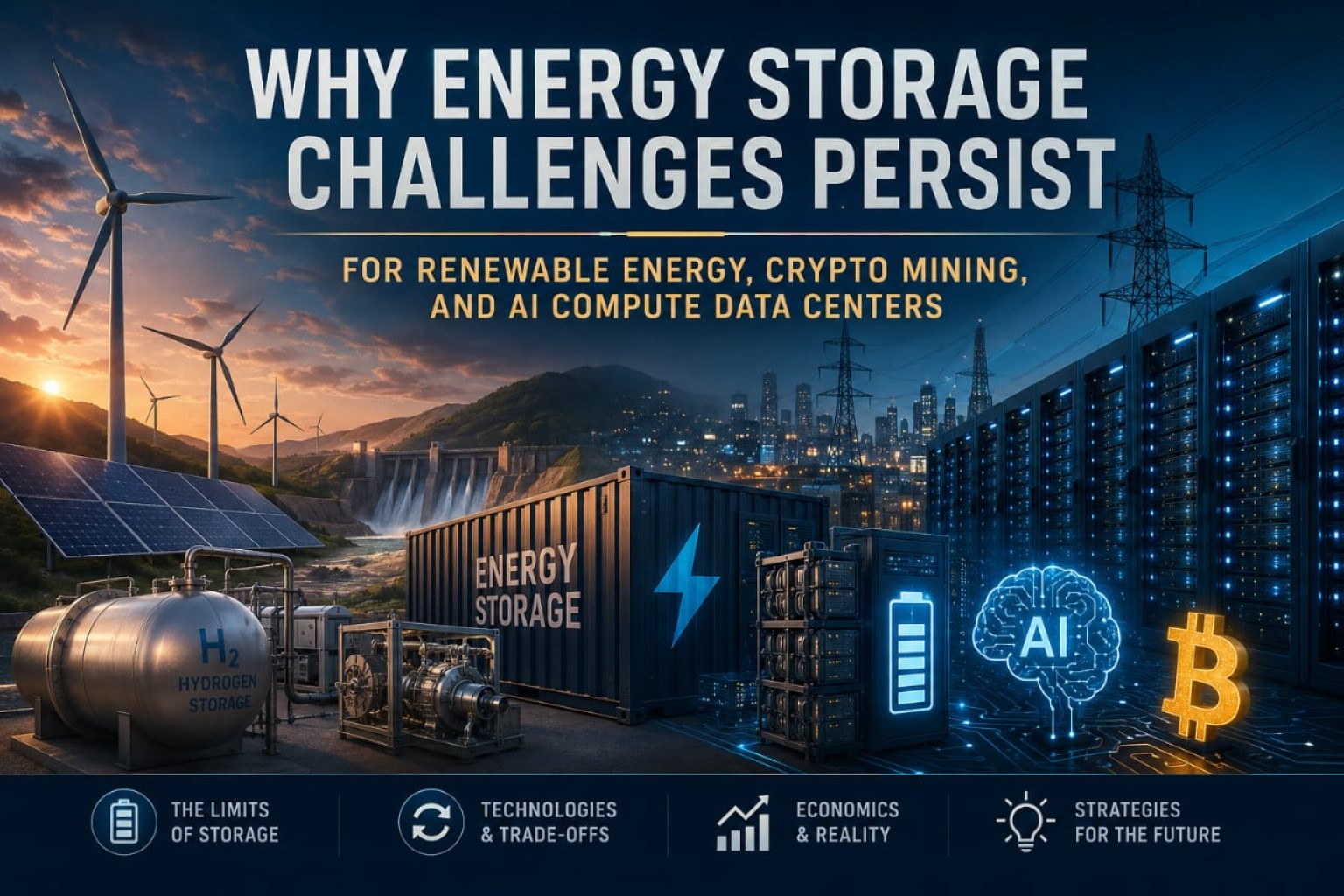
The Global Energy Grid Dilemma: High Power Generation Versus Low Storage Flexibility
Electricity is everywhere—and yet, we still don’t truly know how to hold it. We can generate massive amounts of energy from the sun, wind, water, and even atoms, but the moment production stops, the system becomes vulnerable. This contradiction sits at the core of modern civilization: energy is abundant in generation, but fragile in storage.
For industries like crypto mining, AI compute clusters, and large-scale data centers, this is not a theoretical problem—it is the difference between profit and loss, stability and shutdown. Megawatts can be generated in seconds, but storing them for hours, days, or seasons remains one of the hardest engineering and economic challenges ever faced.
Every grid in the world is built on a delicate balance between supply and demand, a balance that must be maintained in real time. When it breaks, prices spike, systems fail, and operators are forced into expensive compromises. This is why energy storage has become the silent bottleneck of the renewable transition and the hidden constraint behind the next generation of computing infrastructure.
In this article, we break down why storing energy is fundamentally difficult, what technologies exist today, where they fail, and what this means for the future of high-performance energy-dependent industries.
Understanding the Fundamental Nature of Electricity for Industrial Power Consumption
Why Storing Electrical Energy Directly is Physically Impossible
At a basic level, electricity is not a substance. It is movement—the flow of charged particles through a conductor. The moment that movement stops, electricity as such no longer exists.
This is why “storing electricity” is a misleading phrase. In practice, we do not store electricity itself. We convert it into another form of energy that can be stored and later converted back. Most commonly, that form is chemical energy (in batteries), gravitational potential energy (in pumped hydro), mechanical energy (in flywheels), or thermal energy (in heat storage systems).
Every conversion step comes with losses. Heat escapes. Friction occurs. Chemical reactions are not perfectly reversible. The laws of thermodynamics guarantee that you never get 100% of your energy back.
For grid operators—and for energy-intensive industries—this inefficiency is not just a technical detail. When scaled to city-sized or country-sized systems, small percentage losses become massive absolute costs.
The Rise of Battery Technology and Its Current Limitations in High-Energy Industries
How Lithium-Ion Battery Technology Transformed Mobile Devices and Grid Systems
Lithium-ion batteries are one of the most important technological breakthroughs of the last few decades. They made smartphones, laptops, and electric vehicles practical. They also enabled the first serious attempts at grid-scale battery storage.
Inside these batteries, electrical energy is stored via chemical reactions and released when needed. Compared to older battery technologies, lithium-ion offers better energy density, higher efficiency, and longer cycle life.
Key Structural Limitations and Degradation Issues in Modern Battery Systems
Despite their success, lithium-ion batteries have clear limitations:
• Degradation over time: Every charge and discharge cycle slightly reduces capacity.
• Material constraints: Key materials like lithium, cobalt, and nickel are expensive and geographically concentrated.
• Energy density gap: Even the best batteries store far less energy per kilogram than liquid fuels like gasoline or diesel.
• Cost at scale: Storing city-scale or grid-scale energy requires enormous installations, with high upfront capital costs and long payback periods.
For a mining farm or AI data center, batteries are useful for short-term backup and power smoothing, but they are rarely a full solution for multi-hour or multi-day energy storage.
The Complex Challenges of Scaling Energy Storage from Consumer Devices to Smart Cities
Why Implementing Grid-Scale Renewable Energy Storage is a Unique Engineering Challenge
A single city consumes enormous amounts of electricity every hour. Storing enough energy to cover just one night of solar downtime would require massive battery arrays, occupying large areas and costing hundreds of millions (or billions) of dollars.
These systems do exist, and they are improving. But today, they are still limited, expensive, and highly site-specific.
Wind power adds another layer of complexity. Wind is not constant. Some days are calm; others are stormy. When turbines produce excess electricity, that energy must be used immediately or stored. Without storage, renewable energy output often has to be curtailed—meaning clean power is simply thrown away. This is why energy storage is often called the missing piece of the renewable transition.
Exploring Alternative Large-Scale Energy Storage Technologies Beyond Traditional Batteries
⚡ Key Insight
No energy storage technology is universally optimal. Each system is a trade-off between efficiency, cost, and scalability. This is why modern power infrastructure relies on hybrid solutions instead of a single storage method. Energy Strategy • AI • Mining • Grid Systems
The Role of Pumped Hydroelectric Storage in Utility-Scale Power Management
Pumped hydro is one of the oldest and most efficient large-scale storage methods. When excess electricity is available, water is pumped uphill into a reservoir. When power is needed, the water flows back down through turbines, generating electricity.
Pros:
• High efficiency
• Long lifetime
• Proven at massive scale
Cons:
• Requires suitable geography (hills, valleys, water availability)
• Large environmental and infrastructure footprint
• Limited to specific locations
Globally, pumped hydro still represents the majority of grid-scale energy storage capacity.
| Technology | Efficiency | Duration | Scalability | Cost Level | Key Limitation |
|---|---|---|---|---|---|
| Lithium-ion Batteries | 85–95% | 1–8 hours | Medium | High | Degradation & cost |
| Pumped Hydro | 70–85% | Days | Very High | Medium | Geography dependent |
| Compressed Air (CAES) | 40–70% | Hours–Days | High | Medium | Low efficiency |
| Flywheels | 85–95% | Seconds–Minutes | Low | Medium | Not for long storage |
| Thermal Storage | 50–80% | Hours–Days | Medium | Low | Conversion losses |
| Hydrogen Storage | 25–45% | Weeks–Months | Very High | High | Very low efficiency |
How Compressed Air Energy Storage (CAES) Solutions Work for Power Grids
These systems use excess electricity to compress air and store it in underground caverns or tanks. Later, the air is released to drive turbines.
Pros:
• Potential for large-scale storage • Long discharge times
Cons:
• Lower overall efficiency • Requires suitable geological formations • Complex engineering and integration
Using Flywheels and Mechanical Energy Storage for Rapid Grid Stabilization
Flywheels store energy as rotational motion. They are excellent for very fast response and short-duration storage.
Pros:
• Extremely fast response times
• High cycle life
• Useful for grid stabilization
Cons:
• Not suitable for long-duration storage
• Limited total energy capacity
The Applications of Thermal Energy Storage in Concentrated Solar Power Systems
Thermal systems store energy as heat, often in molten salts or other high-temperature materials. This approach is commonly used in concentrated solar power plants.
Pros:
• Relatively low material cost
• Good for specific industrial and solar applications
Cons:
• Conversion back to electricity adds losses • Not flexible for all grid uses Each of these technologies works. None is a perfect, universal solution.
The Thermodynamics of Energy Conversion: Why Power Storage Losses Are Physically Unavoidable
Every energy storage system is a conversion machine. Electricity becomes chemical, mechanical, gravitational, or thermal energy—and then becomes electricity again. At each step:
• Some energy turns into waste heat
• Some is lost to friction or resistance
• Some is lost to imperfect reactions or mechanical limits
This is not a design flaw. It is fundamental physics. Even the best systems have round-trip efficiencies well below 100%. On a small scale, this might seem acceptable. On a national grid—or a large mining operation consuming megawatts—these losses translate directly into higher operating costs.
Managing the Time Mismatch Between Renewable Energy Production and Peak Grid Demand
Navigating Daily and Seasonal Power Fluctuations in Renewable Energy Infrastructure
Energy demand is not constant. It rises in the morning, peaks in the evening, and changes with seasons, weather, and economic activity. Renewable production does not naturally follow these patterns:
• Solar peaks during the day
• Wind may peak at night or during storms
• Demand often peaks in the evening
Without storage, grids must rely on backup power sources, usually fossil fuels, to fill the gaps. This creates a paradox: we can generate clean energy, but without storage, we cannot fully depend on it. For mining and AI compute operators, this mismatch often shows up as:
- Variable electricity prices
• Curtailment events
• Grid congestion charges
• Interruptible power contracts
The Future of Experimental Energy Storage: Green Hydrogen and Advanced Battery Chemistries
Evaluating Hydrogen as a Long-Term Energy Carrier for Industrial Applications
One promising idea is to use excess electricity to split water into hydrogen and oxygen. The hydrogen can then be stored and later used to generate electricity or heat.
Challenges:
- Low overall efficiency
- Difficult and expensive storage (compression or liquefaction)
- Limited infrastructure
- Lower energy density than many liquid fuels
Hydrogen may make sense for seasonal storage or specific industrial uses, but it is not a simple replacement for batteries.
The Potential Impact of Solid-State and Sodium-Ion Next-Generation Batteries
Researchers are working on:
• Solid-state batteries
• Sodium-ion batteries
• Flow batteries
• Alternative chemistries with cheaper or more abundant materials These technologies promise improvements in safety, cost, and scalability. But moving from lab success to reliable, mass-produced systems usually takes many years.
The Economic Reality and Hidden Costs of Implementing Large-Scale Energy Storage
Even when a storage technology works technically, it still has to make sense financially.
Key economic factors include:
• Upfront capital cost
• Lifetime and degradation
• Maintenance and replacement cycles
• Financing and insurance
• Regulatory and grid integration costs
For investors in mining and AI compute, this means energy storage is often best viewed as:
• A risk management tool (for outages and price spikes)
• A grid services tool (for peak shaving and demand response)
• Not a magic solution that eliminates energy costs
Strategic Energy Management and Power Optimization Strategies for Crypto Mining and AI Operations
1. Storage Is About Optimization, Not Independence
Most operations will not become fully off-grid with storage alone. The realistic goal is to:
• Reduce peak demand charges
• Smooth power fluctuations
• Improve uptime and reliability
• Take advantage of variable pricing
2. Location Still Matters More Than Technology
Cheap, stable power near hydro, nuclear, or large renewable hubs often beats expensive storage-heavy setups in poor locations.
3. Hybrid Strategies Work Best
The most cost-effective setups often combine:
• Grid power
• On-site solar or wind
• Limited battery storage
• Smart load management (shifting compute to cheap hours)
4. Flexibility Is a Competitive Advantage Operations that can pause, scale, or shift workloads based on power availability and price will consistently outperform rigid, always-on designs.
The Future of Energy Storage: Navigating Trade-Offs in AI and Crypto Infrastructure
Energy storage isn't lagging because we’re waiting for some "miracle tech"—it’s struggling because we’re bumping up against the hard walls of physics and economics. Whether it’s batteries or pumped hydro, every option we have is essentially just a trade-off. You’re always sacrificing scale for cost, or efficiency for geography. There is no perfect "set-it-and-forget-it" solution.
For energy-heavy sectors like AI and crypto, this is a massive wake-up call. Success isn't about finding a way to make energy problems disappear; it’s about learning to build around them. That means using storage only where it actually makes financial sense, setting up shop where power is naturally cheap, and staying flexible enough to adapt when the grid fluctuates.
Ultimately, energy isn't a puzzle we’re going to "solve" once and move on. It’s a constant, shifting variable. The real winners won't be the ones waiting for a perfect energy system to arrive—they’ll be the ones who figured out how to thrive in an imperfect one.