Introduction
The explosive growth of artificial intelligence, cloud computing, and hyperscale data centers has triggered an insatiable appetite for electricity. Today’s modern AI clusters swallow up as much power as entire small cities. When tech giants scout for new locations to build their digital infrastructure, they usually prioritize fast network speeds, political stability, and getting close to their end users.
But there's a massive blind spot in this strategy: energy independence.
Building sprawling data centers in countries that don't produce their own energy is a huge gamble. This vulnerability becomes painfully obvious the moment a geopolitical crisis or supply chain hiccup shakes the global energy market.
Just look at the fallout from the Russia-Ukraine war. When major supply lines were disrupted, Europe was hit with crippling natural gas shortages, and electricity prices shot up by more than 20% almost overnight. That kind of sudden spike puts a crushing financial strain on any business that needs round-the-clock, heavy-duty power.
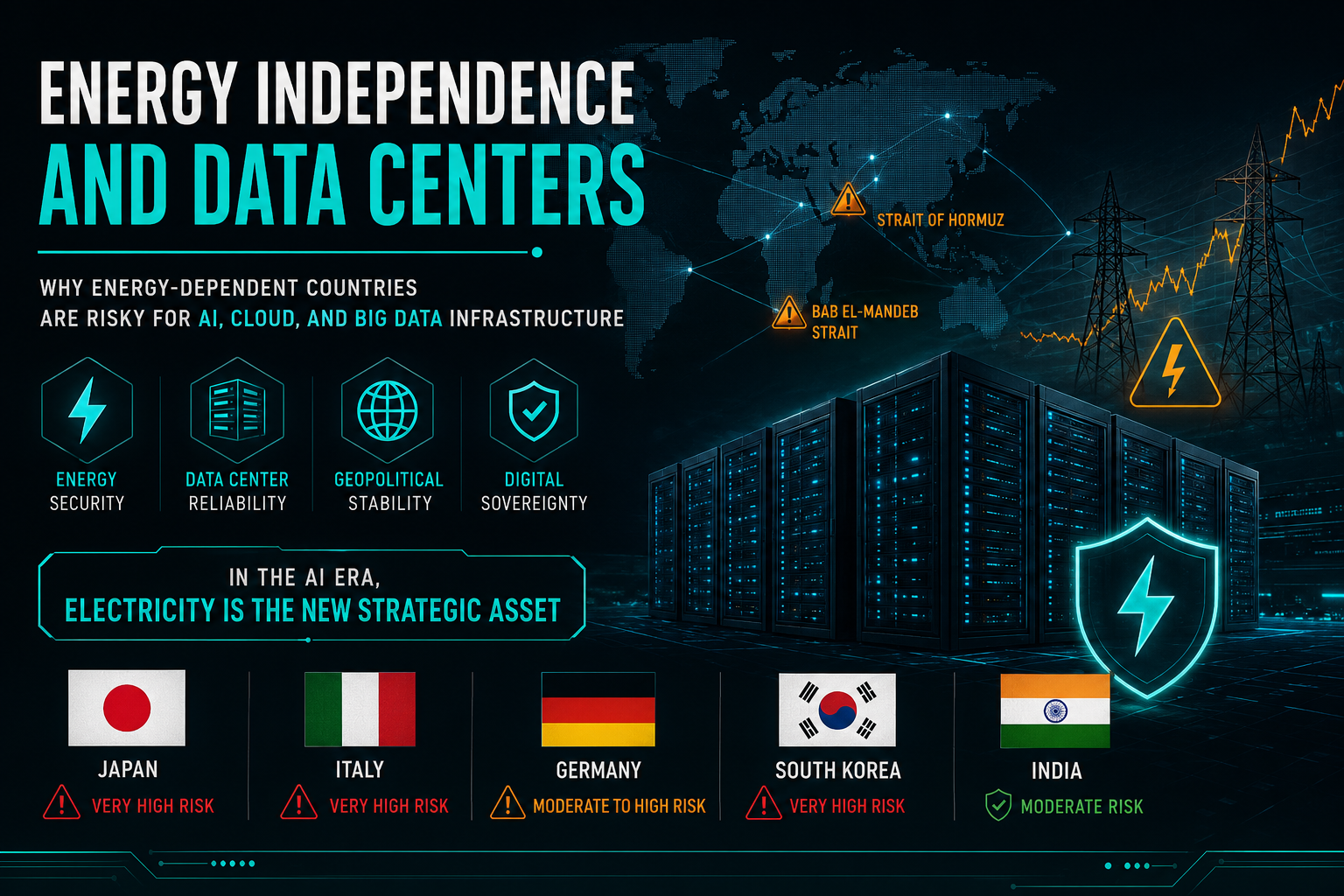
Future conflicts could easily trigger a sequel. Imagine a disruption in critical shipping lanes like the Strait of Hormuz or the Bab el-Mandeb strait. A massive chunk of the world's oil and liquefied natural gas (LNG) passes through these bottlenecks, and any blockage would devastate countries relying on those imports.
While crypto miners have historically chased the absolute cheapest electricity on the planet, high-end AI and cloud facilities tend to set up shop in highly developed economies. The irony? Many of these tech-forward nations are fundamentally dependent on imported fuel, leaving their power grids dangerously exposed to global shocks.
Here is a look at how this dynamic plays out across several major economies.
Energy Production and Import Dependence
The table below summarizes electricity production levels, energy sources, and import dependence for major economies hosting advanced digital infrastructure.
| Country | Annual Electricity Production | Main Energy Sources | Energy Import Dependence | Risk for Data Centers |
|---|---|---|---|---|
| Japan | ~850 TWh | Natural Gas, Coal, Renewables, Nuclear | Very High | High exposure to global energy shocks |
| Italy | ~290 TWh | Natural Gas, Renewables | Very High | Electricity price volatility |
| Germany | ~500 TWh | Renewables, Coal, Gas | Moderate to High | Price spikes during supply crises |
| South Korea | ~600 TWh | Coal, Natural Gas, Nuclear | Very High | Energy island – no grid imports |
| India | ~1,700 TWh | Coal, Renewables, Gas | Moderate | More resilient but still exposed |
Japan 
Energy Dependence: A Major Risk for Data Centers and Digital Infrastructure
Japan is undeniably a global leader in tech, hosting critical infrastructure for global finance and cloud networks. Yet, it has one of the worst energy self-sufficiency rates in the developed world.
Before the Fukushima disaster in 2011, nuclear energy comfortably supplied about 30% of Japan’s power. Following the accident, the country shuttered its reactors for safety checks, effectively wiping out its nuclear capacity. To keep the lights on, Japan had to pivot hard to imported fossil fuels.
Today, Japan generates roughly 850 terawatt-hours (TWh) of electricity a year. Its current energy mix looks like this:
- Natural gas: ~30%
- Coal: ~30%
- Renewables: ~27%
- Nuclear: ~10% (as reactors slowly come back online)
Geography makes this even tougher. As an island nation, Japan has no international power lines to draw electricity from neighbors during a crunch. Furthermore, it imports about 95% of its oil from the Middle East—most of it sailing right through the vulnerable Strait of Hormuz.
Italy 
Imported Energy Problem and Its Impact on Data Center Stability
Italy is another prime example of a country with cutting-edge digital infrastructure but a surprisingly fragile energy backbone.
The Italian grid relies heavily on natural gas, which makes up roughly 45% of its electricity generation. Almost all of this fuel is imported. On top of that, Italy physically imports about 14–16% of the actual electricity it consumes from neighboring countries like France, Switzerland, and Austria.
How did it get here? A major factor was a 2011 national referendum where Italians voted against reintroducing nuclear power after the Fukushima disaster. As a result, Italy remains one of Europe’s biggest electricity importers.
When the Russia-Ukraine war sent shockwaves through the market, Italy’s wholesale electricity prices skyrocketed, peaking at an eye-watering 127 euros per megawatt-hour in 2023. For data centers requiring steady, predictable overhead, that kind of volatility is a major risk.
Germany 
Energy Transition and the Electricity Price Shock
As Europe’s industrial engine, Germany needs a colossal and reliable flow of electricity to power its automotive, chemical, and engineering sectors.
Before the war in Ukraine, Germany was heavily reliant on cheap Russian gas flowing through the Nord Stream pipelines. In 2021, gas-fired plants generated roughly 90 TWh of electricity, accounting for about 15% of the country’s total supply.
When those pipelines were cut off—and later destroyed—Germany faced a historic energy crisis. You can see the magnitude of the shock in the roller-coaster of their wholesale electricity prices:
- 2021: ~97 €/MWh
- 2022: ~235 €/MWh (war in Ukraine)
- 2023: ~95 €/MWh
- 2024: ~78 €/MWh
While prices eventually cooled off, the economic damage was done. The massive spike forced energy-heavy industries to seriously consider moving their operations abroad.
Despite aggressive investments in renewables and importing power from neighbors like France and Denmark, Germany's economy remains deeply sensitive to global energy swings.
South Korea 
Energy Island Problem and Data Center Power Risks
South Korea is a powerhouse in semiconductor manufacturing and high-performance computing. But much like Japan, it is essentially an "energy island" with severely limited domestic resources.
Producing about 600 TWh of electricity annually, South Korea’s energy mix breaks down like this:
- Coal and Natural Gas: ~58%
- Nuclear: ~31%
- Renewables: ~8–9%
Because it operates an isolated grid without international connections, South Korea can't simply buy electricity from a neighbor if supplies run low.
Expanding renewables is also incredibly difficult due to the country’s dense population and lack of available land. Consequently, South Korea leans heavily on Middle Eastern oil and LNG imports, leaving its tech sector exposed to the exact same maritime transit risks as Japan.
India 
Coal-Based Power System and Its Hidden Energy Import Risk
India's situation is quite different from the others on this list. Unlike Japan or Italy, India sits on massive domestic coal reserves, providing a robust buffer for its power grid.
Coal currently fuels roughly 75% of the nation's electricity, giving it a relatively stable baseline.
However, the country is far from fully insulated. India relies heavily on imports for its other critical energy needs—specifically crude oil and LNG. Over half of its oil, along with a massive chunk of its LNG, comes from Middle Eastern producers like Qatar and the UAE.
While its raw electricity generation is more secure than that of South Korea or Japan, any geopolitical flare-ups in the Persian Gulf would still inflict serious economic pain, driving up fuel and transportation costs that ripple through the industrial sector.
The Sovereignty Trap: Why Energy Fragility is a Digital Death Sentence
It’s time to stop looking at energy as just a "utility bill" and start seeing it for what it truly is: the oxygen of the digital age. For energy-fragile nations like Japan, Italy, or South Korea, the ambition to lead in AI is hitting a hard, physical wall. These countries are caught in a Sovereignty Trap. They are building world-class digital economies on a foundation of imported molecules. This creates a dangerous paradox: you can have the most advanced AI algorithms in the world, but if the natural gas tankers stop arriving or a strategic strait is blockaded, your "sovereign AI" goes dark.
In these vulnerable hubs, we are seeing a shift from economic risk to existential risk. When a power grid is pushed to the brink, governments face a brutal choice: keep the hospitals running or keep the data centers humming. In a crisis, the "Cloud" is the first thing to be rationed.
This fragility is already triggering a Digital Migration. Smart capital and AI startups aren't just looking for fast fiber anymore; they are fleeing volatile grids. They are moving to Energy Safe Havens—places like Canada, Norway, or even Texas—where power is homegrown, stable, and decoupled from global geopolitical drama. The harsh reality for the next decade is simple: Digital sovereignty is an illusion without energy independence. If you don't own your electrons, you don't truly own your data.
Why Energy Independence Is Critical for AI Data Centers and Hyperscale Infrastructure
The rapid rollout of AI supercomputers, hyperscale cloud networks, and high-density data centers is radically changing global power demand. A single AI training cluster can chew through hundreds of megawatts, with some facilities drawing as much power as tens of thousands of homes combined.
Because of this, predictable electricity pricing and bulletproof supply security are no longer just strategic bonuses—they are essential.
Building in energy-dependent countries brings severe risks:
- Sudden, crippling electricity price hikes during global crises.
- Supply blackouts tied to distant geopolitical conflicts.
- Ballooning long-term operational costs that can ruin the financial viability of a project.
As the European energy crisis proved, operating costs for power-intensive facilities can multiply in a matter of months.
We are entering an era where electricity has become the single most valuable resource in the digital economy. As geopolitical tensions continue to reshape global energy markets, the defining question for tech investors over the next decade isn't just where to build the next massive data center—it’s where the power to run it will stay secure, reliable, and affordable.
FAQ: Energy Independence, Data Centers, and Global Power Risks
Q1: Why is energy independence important for data centers?
Energy independence ensures stable electricity supply and predictable power prices. Data centers consume massive amounts of electricity, and reliance on imported energy exposes operators to geopolitical disruptions, fuel price spikes, and supply shortages that can dramatically increase operational costs or cause outages.
Q2: Which countries are most vulnerable to energy supply disruptions?
Countries that rely heavily on imported fuels—such as Japan, Italy, and South Korea—are particularly vulnerable. Their electricity systems depend on oil, gas, or LNG imports, often transported through strategic maritime chokepoints like the Strait of Hormuz, making them sensitive to geopolitical conflicts.
Q3: How did the Russia-Ukraine war affect electricity prices in Europe?
The war disrupted natural gas supplies from Russia to Europe, triggering severe shortages. Electricity prices surged dramatically, in some cases rising by more than 20% in a short period. Countries heavily dependent on imported gas experienced the most volatility.
Q4: Why do AI data centers consume so much electricity?
Modern AI training clusters require thousands of GPUs running continuously for weeks or months. These systems process enormous datasets and complex models, consuming hundreds of megawatts of power—similar to the electricity demand of small cities.
Q5: What are the safest locations for building hyperscale data centers?
The most stable locations typically combine domestic energy resources, diversified power generation, strong electrical grids, and political stability. Countries with abundant hydroelectric, nuclear, or renewable energy resources and strong grid infrastructure offer the lowest long-term risk.
Q6: How do geopolitical conflicts affect global energy markets?
Conflicts can disrupt fuel production, pipelines, and shipping routes. When supply chains break down, energy prices rise rapidly. This volatility directly affects electricity costs, which can significantly impact industries like AI computing, cloud infrastructure, and cryptocurrency mining.