A New Class of Home Energy Systems
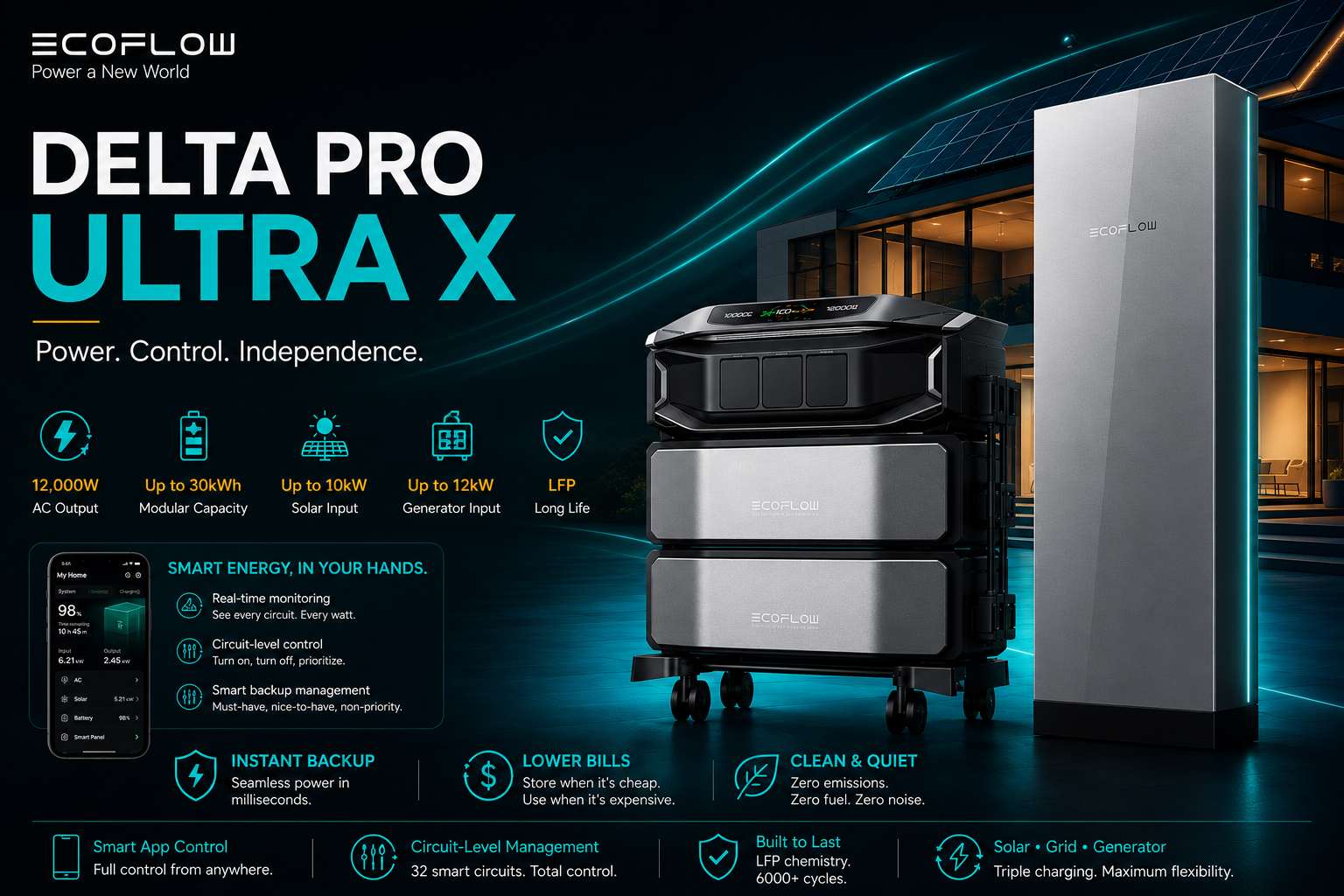
The EcoFlow Delta Pro Ultra X (DPUX) represents a shift in how advanced battery systems are designed and deployed. Instead of treating backup power as a niche product, EcoFlow has built a modular, high-output platform that can function as a full home energy hub: battery storage, inverter, solar input, and smart load management in one ecosystem.
Recent real-world installations in Saudi Arabia, Algeria, and Texas highlight why systems like this are gaining attention. In all three regions, electricity prices, grid reliability, and extreme weather create a strong case for on-site energy storage—not just for emergencies, but for daily cost optimization and power stability.
At its core, the Delta Pro Ultra X is designed to replace or complement traditional generators and classic grid-tied solar inverters. It is not a small portable power station. It is a whole-home capable inverter-battery system that can scale from a single stack to multi-inverter configurations.
Hardware Overview: What the Delta Pro Ultra X Actually Is
High-Power Inverter with Modular Storage
The Delta Pro Ultra X delivers up to 12,000 watts of continuous AC output, a major step up from earlier generations that were closer to the 7 kW range. This puts it in the same practical category as many standby generators, but without fuel, noise, or exhaust.
Battery capacity is modular. Each battery module is roughly 6 kWh, and stacks can be built up to around 24–30 kWh per inverter in a single vertical tower. For most homes, 24 kWh already represents a serious amount of storage, enough to run essential loads for many hours or even days depending on consumption.
The chemistry used is LFP (lithium iron phosphate), which is widely favored in stationary storage because of its longer cycle life, better thermal stability, and lower degradation compared to older lithium-ion chemistries.
AC and 240V Integration
While the front panel still includes a few standard 120V outlets for convenience, the real strength of the DPUX is its 240V output. It can connect:
-
Directly to a generator inlet (like a standby generator would)
-
Or to EcoFlow’s Smart Home Panel 3 for full circuit-level integration
This means the system can power large loads such as HVAC systems, well pumps, or high-power equipment without artificial throttling, as long as total demand stays within the inverter’s limits.
Smart Home Panel 3: Turning Batteries into a Real Energy Management System
A Full 200A Smart Electrical Panel
The Smart Home Panel 3 is not just a transfer switch. It is designed to replace a standard 200-amp electrical panel entirely. It supports up to 32 smart-controlled circuits, each of which can be monitored and controlled individually through EcoFlow’s app.
This puts the system in the same category as advanced smart panels like Span, but tightly integrated with EcoFlow’s battery and inverter ecosystem.
Circuit-Level Monitoring and Control
From the app, users can:
-
See real-time power consumption per circuit
-
Review historical usage (daily, weekly, etc.)
-
Turn circuits on or off remotely
-
Set priority levels for backup operation
This is not just a convenience feature. It fundamentally changes how backup power is used. Instead of guessing which loads are draining the battery, you can see exactly where energy is going—and act on it.
Priority Logic: Must-Have, Nice-to-Have, Non-Priority
During a grid outage, circuits can be grouped into categories:
-
Must-have: Always powered (internet, lighting, refrigeration, servers, etc.)
-
Nice-to-have: Powered only above a certain battery state of charge
-
Non-priority: Automatically отключed during outages
For example, an air conditioner or electric water heater can be set to shut off once the battery drops below, say, 73%–80%. This extends runtime for critical loads and prevents a single appliance from draining the entire system overnight.
Solar, Generator, and Grid: Three Ways to Feed the System
Up to 10 kW of Solar Input
One of the biggest upgrades in the Ultra X generation is solar input. The system supports up to around 10 kW of solar, nearly double what earlier versions could handle.
This makes it realistic to:
-
Power most of a home’s daytime consumption directly from solar
-
Recharge large battery stacks quickly
-
Use the system for self-consumption rather than just backup
In regions like Saudi Arabia and Texas, where solar potential is extremely high, 10 kW of panels can cover a significant share of annual household or small-facility energy needs.
Fast Generator Charging
The DPUX can also accept up to ~12 kW of AC input from a fuel-based generator. In practical terms, this means:
-
You can recharge large battery stacks very quickly
-
You don’t need to run a generator all night
-
Fuel can be used efficiently as a battery charger, not as a continuous power source
In a prolonged outage scenario, this hybrid approach—solar when available, generator when needed—offers much better fuel economy and less wear on equipment.
Grid Charging and Grid Arbitrage
Even without solar, the system can be used for grid arbitrage in regions with time-of-use pricing. The idea is simple:
-
Charge the batteries when electricity is cheap (off-peak)
-
Use battery power when electricity is expensive (peak)
This is especially relevant in places like Texas or parts of Saudi Arabia with evolving tariff structures, and in Algeria where grid stability and cost optimization are becoming more important for businesses and high-consumption users.
Real-World Use: What Happens During an Outage?
In practice, when the grid fails, the system switches to battery power in milliseconds—fast enough that most electronics don’t even reset. The home continues running, but now entirely from stored energy.
With around 25 kWh of storage and a moderate load (for example, 600–800 watts), runtime can easily reach a full day or more. With smart load management—turning off non-essential circuits—that runtime can be extended significantly.
Scalability: From One Inverter to a Small Power Plant
EcoFlow also offers a Smart Inlet Box that allows multiple Delta Pro Ultra X inverters to be connected in parallel:
-
2 inverters: ~25 kW continuous output
-
3 inverters: ~37 kW continuous output
At this point, the system is no longer just a home backup solution. It becomes suitable for:
-
Large homes or villas
-
Small commercial sites
-
Workshops, labs, or compute rooms
-
High-density equipment setups
This scalability is one of the most interesting aspects of the platform, because it allows users to start small and expand later without replacing the entire system.
The Broader Energy Context: Why Batteries Are Replacing Old Solar Models
For many years, the dominant model was simple grid-tied solar: produce power, export excess to the grid, and rely on net metering. That model is slowly disappearing in many regions.
Today, utilities increasingly:
-
Reduce export compensation
-
Introduce time-of-use pricing
-
Add grid fees and demand charges
As a result, battery-backed solar is becoming the more rational design. Instead of selling cheap power to the grid and buying it back later at a higher price, users can store and self-consume more of their own energy.
The Delta Pro Ultra X fits squarely into this new reality: it is not just about backup anymore—it is about control over when and how energy is used.
What This Means for ASIC, GPU, and AI Compute Users
High-performance computing—whether for ASIC mining, GPU rendering, or AI inference/training—has one thing in common: power is the main operating cost and the main risk.
Systems like the DPUX can play several roles here:
- Power Stability: Sudden outages can corrupt data, crash rigs, or damage hardware. A fast-switching battery system acts like a large-scale UPS for entire rooms or small facilities.
- Peak Shaving and Cost Control: In time-of-use markets, batteries can reduce exposure to expensive peak tariffs, lowering the effective cost per kWh for compute workloads.
- Hybrid Solar + Storage for Remote or Constrained Sites: In regions of Algeria or remote parts of Saudi Arabia, where grid capacity may be limited, a hybrid solar-battery system can support small compute clusters without expensive grid upgrades.
- Scalable Infrastructure: The ability to parallel multiple inverters means operators can grow capacity gradually, aligning energy infrastructure with compute expansion.
That said, it is important to be realistic: a single DPUX stack is not meant to run a large industrial mining farm. But for home labs, edge compute nodes, small GPU clusters, or a handful of ASICs, it can be a very practical building block.
Factory Specifications
| Specification | EcoFlow Delta Pro Ultra X (DPUX) |
|---|---|
| System Type | Modular inverter + battery storage platform for whole-home backup and self-consumption |
| Battery Chemistry | LFP (Lithium Iron Phosphate) |
| Continuous AC Output | Up to 12,000 W |
| Solar Input Capacity | Up to 10 kW |
| AC Charging (Generator/Grid Input) | Up to 12 kW (for fast recharge) |
| 240V Output Options | 240V output suitable for generator-inlet style integration (e.g., 30A / 50A inlet use cases) |
| Typical Battery Module Size | ~6 kWh per module (modular stack) |
| Example Installed Storage (Shown) | 24 kWh total storage (stacked modules) |
| Max Storage per Single Stack (Mentioned) | Up to ~30 kWh in one stack (with one inverter) |
| Smart Panel Compatibility | Works with EcoFlow Smart Home Panel 3 for whole-home circuit management |
| Smart Home Panel 3 Capacity | 200A panel replacement with up to 32 smart-controlled circuits |
| Parallel Expansion (with Smart Inlet Box) | Up to ~24 kW (2 inverters) or ~36 kW (3 inverters) continuous output |
Conclusion
The EcoFlow Delta Pro Ultra X is not just a bigger battery—it is a modular energy platform that bridges the gap between consumer backup systems and light commercial power infrastructure.
With high output power, scalable LFP storage, deep smart-panel integration, and flexible input options (solar, grid, generator), it fits perfectly into the modern reality of self-consumption, grid uncertainty, and rising energy costs.
For homeowners, it offers resilience and control. For professionals running compute-heavy workloads, it provides a way to stabilize power, manage costs, and build a more flexible energy foundation—especially in regions like Saudi Arabia, Algeria, and Texas, where energy strategy is becoming as important as hardware strategy.
FAQ
Q1: Can the Delta Pro Ultra X really replace a traditional generator?
For many use cases, yes. It can provide similar power levels, instant switching, and silent operation. However, for very long outages, it works best when combined with solar or a fuel generator for recharging.
Q2: How much solar can it handle?
The system supports up to about 10 kW of solar input, which is enough for most residential or small commercial installations.
Q3: Is LFP battery chemistry better for this kind of system?
Yes. LFP batteries generally offer longer cycle life, better thermal stability, and improved safety compared to older lithium-ion chemistries.
Q4: Can it be used for mining or AI workloads?
It can support small to medium compute setups, home labs, or edge nodes. It is not designed for large industrial farms, but it is very useful for stability, backup, and cost optimization.
Q5: What is the advantage of the Smart Home Panel 3?
It enables circuit-level monitoring, remote control, and priority management, which significantly improves how battery power is used during outages or peak pricing periods.
Q6: Can the system be expanded later?
Yes. You can add more battery modules or even parallel multiple inverters to increase both storage and output power as your needs grow.
NOTE
This article is not an advertisement and is not sponsored. It is only a review and general information about the product.