
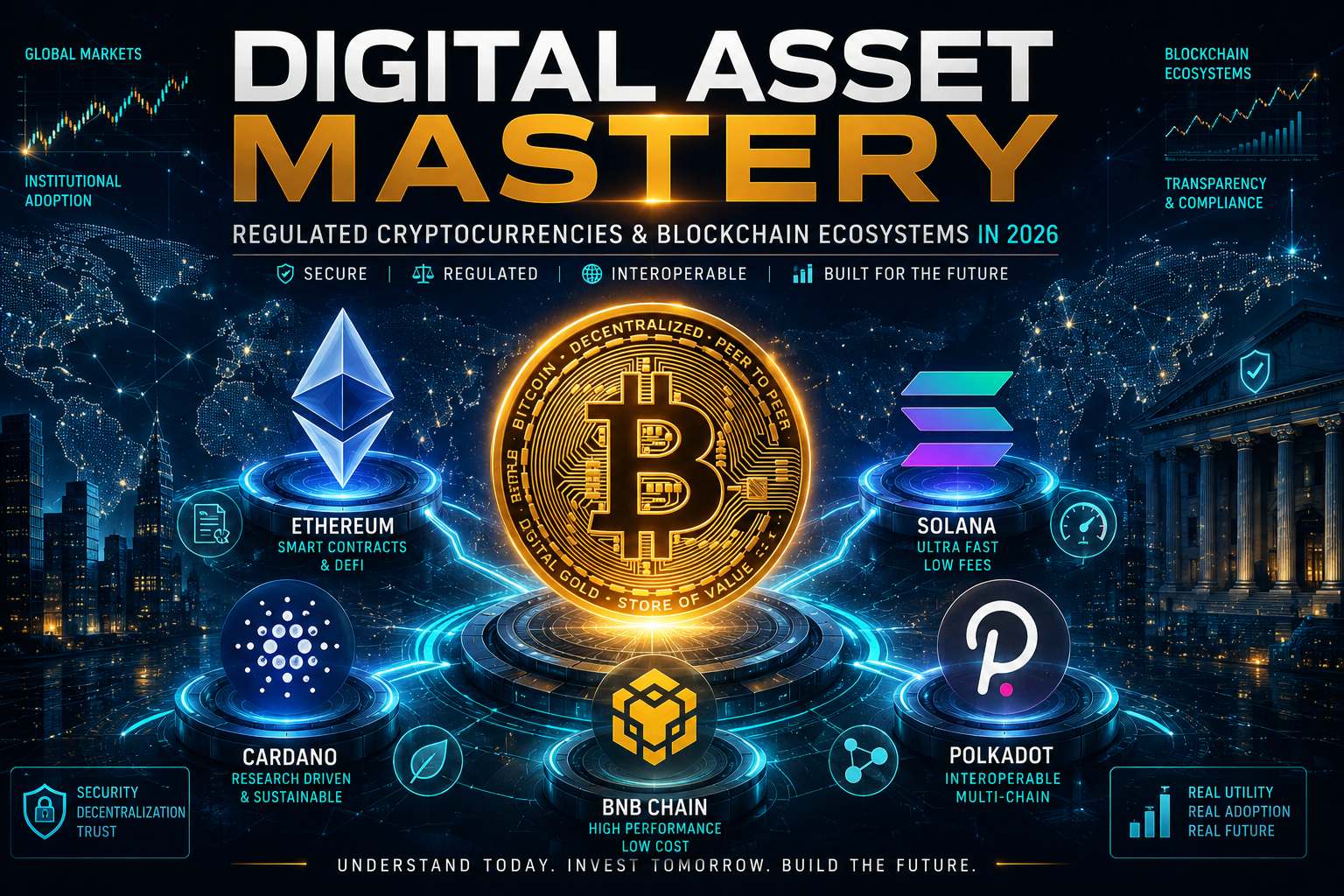
Navigating the Global Landscape of Regulated Digital Markets and Investor Security
The digital currency landscape is a vast and rapidly evolving domain. While thousands of assets exist, a critical distinction lies between those integrated into regulated cryptocurrency markets and those operating in unofficial, peer-to-peer environments.
This analysis, authored by Belsem Guedjali, focuses exclusively on the foundational assets that have achieved institutional stature. These Blue Chip cryptocurrencies are actively traded on licensed, globally recognized platforms like Binance, Kraken, and Coinbase. Understanding these legitimate frameworks is the first step for any participant looking to navigate the risks and legalities of modern digital finance.
1. Bitcoin (BTC): The Gold Standard of Proof-of-Work and Decentralized Value
How Did Bitcoin’s Proof-of-Work System Establish the Core Foundation for Decentralized Digital Money?
Launched in 2009 by the pseudonymous Satoshi Nakamoto, Bitcoin stands as the world’s first successful decentralized blockchain. Its journey is legendary: ascending from a negligible $0.003 to historic peaks exceeding $120,000. Today, over 119 countries officially recognize or license its usage and mining.
-
The Mission: To enable direct, peer-to-peer financial transfers without bureaucratic banking intermediaries.
-
The Security: Bitcoin relies on the interaction between a Public Key (your address) and a Private Key (your secret digital signature).
-
The Mechanism: Transactions are validated via Proof of Work (PoW). This requires specialized miners to solve complex mathematical puzzles using powerful ASIC hardware.
-
The Result: By using the SHA-256 algorithm, Bitcoin ensures that every block is chronologically linked and immutable. While it may be slower than newer networks, its immense market value and battle-tested security make it the undisputed Digital Gold.
2. Ethereum (ETH): Transforming Blockchain Through Smart Contracts and DeFi
How Have Ethereum's Programmable Smart Contracts Revolutionized Blockchain Technology Beyond Simple Payments?
If Bitcoin is digital money, Ethereum is a global, decentralized computer. Launched in 2015 by Vitalik Buterin, it introduced Smart Contracts—self-executing agreements that trigger automatically when conditions are met, removing the need for banks or legal middlemen.
-
The Ecosystem: Ethereum is the backbone of Decentralized Finance (DeFi) and NFTs.
-
The Evolution: In 2022, the network completed a historic transition from Proof of Work to Proof of Stake (PoS). This move replaced energy-hungry miners with Validators who "stake" their ETH to secure the network, reducing energy consumption by over 99%.
-
The Future: Despite occasional high fees (gas), the community is actively scaling the network through Rollups and Sharding to ensure it remains the premier home for decentralized applications (dApps).
3. BNB Chain (BNB): Optimizing Speed and Cost with Proof of Staked Authority
How Does the BNB Chain Achieve High-Performance Transactions and Low Fees for Global Users?
Born from the Binance ecosystem in 2017, the BNB Chain was designed for one thing: efficiency. It trades some decentralization for blistering speed and incredibly low transaction costs.
-
The Model: It utilizes Proof of Staked Authority (PoSA). In this system, a limited group of validators is chosen based on their BNB holdings and reputation.
-
The Advantage: This structure allows for very short block times and high throughput, making it a favorite for developers building high-traffic decentralized exchanges (DEXs).
-
The Trade-off: With a validator set capped at a specific number (currently 26 in 2026), it is more centralized than Bitcoin or Ethereum but offers a user experience that mimics traditional web speeds.
4. Solana (SOL): Breaking Throughput Barriers with Proof of History
What Innovation Allows Solana to Process Thousands of Transactions Per Second with Near-Zero Fees?
Solana entered the scene in 2020 with an ambitious goal: to be the fastest blockchain in existence. It is capable of handling tens of thousands of transactions every second.
-
The Innovation: Its secret weapon is Proof of History (PoH)—a cryptographic clock that timestamps transactions. This allows validators to agree on the order of events almost instantly without waiting for network-wide confirmation.
-
The Experience: With sub-second confirmation times and fees that are virtually zero, Solana is the go-to platform for high-frequency trading, gaming, and mass-market NFT launches.
-
The Challenge: Such extreme speed comes with technical hurdles; the network has faced occasional outages, highlighting the difficulty of maintaining a high-performance distributed system.
5. Cardano (ADA): A Research-Driven Path to Scalability and Sustainability
How Does Cardano’s Multi-Layered Architecture Improve Security and Global Blockchain Sustainability?
Led by Ethereum co-founder Charles Hoskinson, Cardano (2017) is famous for its "measure twice, cut once" philosophy. Every update is backed by peer-reviewed academic research.
-
The Architecture: It separates the network into two layers: the Settlement Layer (for moving value) and the Computation Layer (for executing smart contracts). This improves both security and scalability.
-
The Ouroboros Algorithm: This advanced Proof of Stake model is highly energy-efficient and organizes time into "Epochs" and "Slots."
-
The Roadmap: Cardano’s development follows five distinct eras, moving from basic decentralization (Shelley) and smart contracts (Goguen) to the current focus on community governance (Voltaire).
6. Polkadot (DOT): Building the Interoperable Web of the Future
How Does Polkadot Enable Seamless Interoperability Between Multiple Specialized Blockchain Networks?
Founded by Gavin Wood, Polkadot (2020) views the future not as a single blockchain, but as an internet of blockchains. Its mission is interoperability.
-
The Design: The central Relay Chain provides security, while specialized Parachains connect to it to perform specific tasks (like identity or finance)
-
The Governance: Projects compete for "slots" on the network through community auctions. DOT holders participate via Nominated Proof of Stake (NPoS) to choose validators.
-
The Flexibility: Polkadot is designed to be upgraded without "hard forks," allowing the network to evolve gracefully as technology changes.
Side-by-Side Comparison of Top Blockchain Networks in 2026
| Blockchain | Consensus | Strength | Weakness | Use Case |
|---|---|---|---|---|
| Bitcoin (BTC) | PoW | Maximum Security | Slow & Energy Heavy | Store of Value |
| Ethereum (ETH) | PoS | Smart Contracts | High Fees | DeFi & dApps |
| BNB Chain | PoSA | Low Fees | Centralization | Trading Ecosystem |
| Solana (SOL) | PoH | Ultra Fast | Stability Issues | Gaming & NFTs |
| Cardano (ADA) | Ouroboros | Energy Efficient | Slow Development | Secure dApps |
| Polkadot (DOT) | NPoS | Interoperability | Complex | Multi-chain |
The Real Truth About Bitcoin, Ethereum, and the Future of Regulated Crypto Markets
At the end of the day, most people think they’re investing in crypto —but in reality, they’re choosing between completely different economic philosophies.
Bitcoin isn’t trying to be fast or flexible—it’s trying to be untouchable.
Ethereum isn’t just money—it’s an entire financial system being rebuilt from scratch.
Solana is chasing speed like a tech startup.
Cardano is moving slowly, but with the discipline of academic research.
Polkadot is betting on a future where blockchains don’t compete—they connect.
And that’s the part most investors miss.
This market isn’t about picking “the best coin.”
It’s about understanding what problem each network is solving—and whether that problem will still matter in 5 or 10 years.
Because in a world that’s becoming more regulated, more transparent, and more competitive…
Only the networks with real utility, strong design, and proven resilience will survive.
Everything else?
It disappears quietly.