Introduction
In 2026, the stakes for digital asset custody have never been higher. As institutional adoption has matured, so have the adversaries. We are no longer just fighting basic one-click phishing links; we are navigating a landscape of sophisticated AI-driven social engineering, supply chain compromises, and the looming shadow of quantum-assisted decryption.
If you’ve crossed the threshold of holding meaningful capital—typically anything north of $1,000—relying on an exchange or a mobile hot wallet is a systemic risk you shouldn't be taking. In my years responding to security incidents, I’ve seen that the difference between a total loss and a minor inconvenience often comes down to a single physical air-gap.
Understanding Cold Wallet Security Architecture and How Private Keys Stay Offline
At its core, a cold wallet is not a storage device for your coins; it is an isolated execution environment for your private keys. Your assets live on the blockchain; the wallet simply holds the "digital signature" required to move them.
The primary goal of a hardware wallet is to ensure that your private key never touches an internet-connected device. Even if your computer is riddled with malware, a properly designed cold wallet requires physical interaction—a button press or a screen tap—to authorize a transaction. This What You See Is What You Sign (WYSIWYS) protocol is the bedrock of self-custody.
Generating Secure Entropy and Managing Your Recovery Seed Phrase
Security begins with randomness (entropy). In 2026, high-end wallets like the Trezor Safe 7 or Ledger Stax use dedicated Secure Element (SE) chips to generate keys. These chips use hardware-based true random number generators (TRNGs) to ensure your 24-word seed phrase isn't predictable. A common mistake I see beginners make is using "brain seeds" or software-generated phrases. If the randomness is flawed, the most expensive hardware in the world won't save you.
Comparing Top-Rated Hardware Wallets 2026 for Security and Ease of Use
When choosing a device, you are balancing three factors: Security Surface, Convenience, and Trust Assumptions.
| Device | Security Standard | Connectivity | Audit Status | MSRP |
|---|---|---|---|---|
| Trezor Safe 7 | EAL6+ / Quantum-Ready | USB-C / Bluetooth | Open Source | $249 |
| Ledger Flex | EAL6+ Secure Element | NFC / Bluetooth | Proprietary | $249 |
| Tangem Card | EAL6+ (Seedless) | NFC | Audited | $69 |
| SafePal X1 | EAL5+ | Bluetooth | Mixed | $49 |
Deep Dive Comparison: Ledger Stax vs Trezor Safe 7 vs Tangem Wallet Features
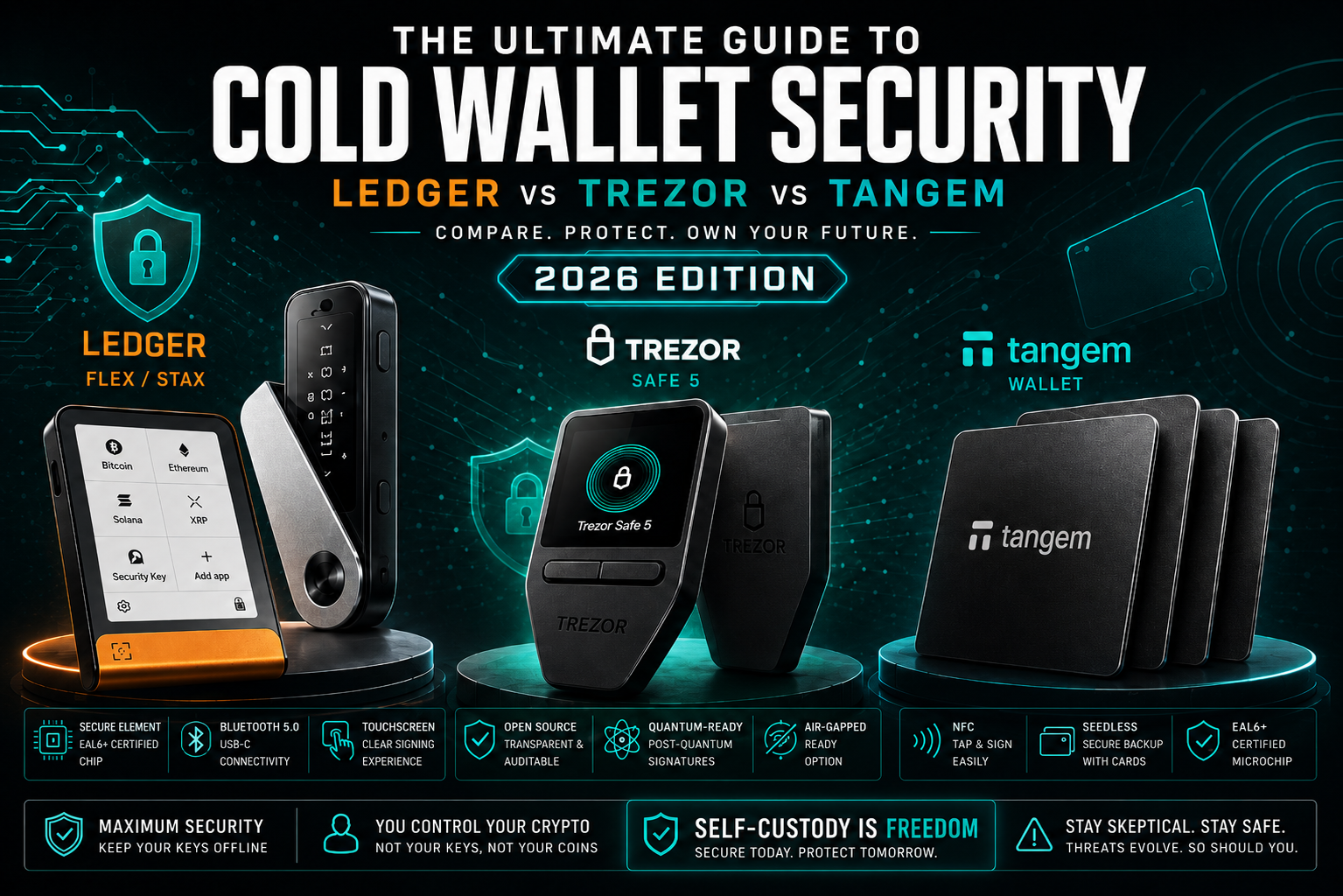
| Feature | Ledger Series (Stax/Flex) | Trezor Safe 7 | Tangem Wallet |
|---|---|---|---|
| Security Chip | Proprietary EAL6+ Secure Element | Dual Chip (Open Source + SE) | EAL6+ Certified Microchip |
| Connectivity | Bluetooth 5.0 / USB-C | Bluetooth / Air-gapped Ready | NFC (Card-to-Phone) |
| Source Code | Partially Open (App Layer) | Fully Open Source | Fully Open Source |
| Quantum Defense | Standard ECC (Elliptic Curve) | Post-Quantum Signatures | Standard ECC (Elliptic Curve) |
| User Experience | High (Premium Touchscreen) | High (Shatter-resistant Touch) | Ultra-High (No Charging/Seedless) |
| Best Use Case | Daily Web3 & NFT Interaction | Maximum Security & Future-Proofing | Beginners & Secure Mobile Use |
Reviewing the Ledger Ecosystem: Why Secure Element Chips Matter for Crypto Safety
Ledger remains the industry giant, largely due to their use of EAL6+ certified chips. These are essentially the same security standards used in passports and credit cards.
The Nano X & Flex are the workhorses. The newer Ledger Flex ($249) offers a much-needed touchscreen, which is more than just a luxury—it makes verifying addresses significantly easier, reducing the "human error" risk of misreading a tiny monochrome screen.
The Trust Factor is that Ledger is not fully open-source. You are trusting their firmware developers. While Ledger has never had a remote device hack, they have suffered database leaks in the past (leaking customer home addresses). If your threat model includes physical privacy, consider using a P.O. Box for delivery.
Why Trezor Safe 7 Open Source Firmware and Quantum-Ready Tech is the Future
Trezor’s advantage is transparency. Their code is auditable by anyone.
The Trezor Safe 7 ($249) is the flagship for 2026. It introduces dual-chip architecture—one for the open-source firmware and an EAL6+ secure element for sensitive data. Crucially, it is "quantum-ready," utilizing post-quantum cryptographic signatures in its bootloader to protect against future decryption threats.
Is Tangem Seedless NFC Cold Storage Right for Your Mobile Crypto Security?
Tangem ($55–$70) has gained massive traction by challenging the "seed phrase" dogma. Instead of writing down 24 words, you use 2 or 3 NFC cards as physical backups of each other.
The "No-Firmware-Update" Advantage is that Tangem cards have non-updatable firmware. In a world where a malicious firmware update could technically exfiltrate keys (the "backdoor" risk), Tangem's rigid architecture offers a unique kind of peace of mind.
Common Crypto Security Threats in 2026 and How to Prevent Wallet Hacks
In my experience, "hacking" the device itself is rare. Losing funds usually happens through operational failures:
-
Supply Chain Attacks: Never buy a wallet from Amazon, eBay, or a third-party reseller. Attackers have been known to "pre-configure" wallets with their own seed phrases, then repackage them to look new. Only buy direct from the manufacturer.
-
Seed Phrase Phishing: This remains the #1 killer. No legitimate support team, "emergency update" site, or NFT gallery will ever ask for your 24 words. If you type your seed into a keyboard, it’s no longer a cold wallet—it’s a hot wallet.
-
The "Wrench Attack": Physical coercion. If someone knows you have millions in a Ledger, they don't need to hack the chip; they just need a $5 wrench. Use the Passphrase (25th word) feature. This creates a "hidden" wallet. Keep a small amount in the main wallet as "decoy" funds and the bulk of your wealth in the passphrase-protected one.
Implementing Advanced Multisig Cold Storage Strategies for Generational Wealth Protection
For those securing generational wealth, a single hardware wallet is a single point of failure. If you lose the device and the seed, you’re done.
Multisig (Multi-signature): A "2-of-3" setup requires two different devices (e.g., a Ledger and a Trezor) to sign a single transaction. This mitigates the risk of a single manufacturer backdoor or a single device theft.
Institutional vs. Personal: Large funds often use MPC (Multi-Party Computation) or institutional custodians like BitGo. For the individual, a 2-of-3 Multisig using a platform like Unchained or Sparrow remains the gold standard for Bitcoin-heavy portfolios.
Mastering 2026 Crypto OpSec: Steel Backups and Inheritance Planning Best Practices
Backup Strategy: Paper burns. Ink fades. For 2026, stainless steel or titanium backups (like Billfodl or Trezor Keep) are mandatory. They survive fires, floods, and time.
Inheritance Planning: If you disappear tomorrow, does your family have a "Dead Man’s Switch" or a technical instruction manual? Don’t leave your seed in a safe without explaining how to use the device.
Firmware Hygiene: Update your device regularly, but wait 48–72 hours after a new release to ensure the community hasn't flagged any bugs.
Final Expert Verdict on Selecting the Best Hardware Wallet for Your Portfolio Size
Security is a spectrum, not a binary. If you’re just starting, a Tangem or Trezor Safe 3 is a massive upgrade over an exchange. If you’re managing a retirement-sized portfolio, you should be looking at a Trezor Safe 7 with a Passphrase and a Steel Backup stored in a geographically separate location.
The most important tool in your security stack isn't the hardware—it's your skepticism. In 2026, if a transaction feels urgent or a support agent is too helpful, your alarm bells should be ringing. The cold wallet provides the shield; you provide the strategy.
FAQ: Navigating the 2026 Self-Custody Landscape
Q1. Wait, if my wallet has Bluetooth or NFC, can’t a hacker just 'sniff' my keys out of the air?
It’s a valid concern, but here’s the reality: Your private keys never actually travel over Bluetooth or NFC. The wireless connection only sends the unsigned transaction to the device and brings back the signed one. It's like passing a contract through a window for a signature—the person inside never leaves the room, and neither does your key. In 2026, the encryption on these signals is so robust that sniffing them is effectively a waste of a hacker's time.
Q2. What happens to my crypto if the wallet manufacturer (like Ledger or Trezor) goes bankrupt or disappears?
This is the beauty of the BIP-39 standard. Your crypto isn't "inside" the company; it’s on the blockchain. As long as you have your 24-word seed phrase, you can take that phrase to almost any other hardware or software wallet in the world and recover your funds instantly. You aren't married to the brand; you're married to your seed phrase.
Q3. Be honest: Is a $250 premium wallet actually 'safer' than a $50 entry-level one?
In terms of raw math? Not necessarily. Both use high-level encryption. The extra $200 usually buys you "Human-Error Insurance." Large touchscreens help you catch a malicious address change that you might miss on a tiny screen. Better build quality prevents the device from dying when you need it most. If you're moving $500, the $50 wallet is fine. If you're moving $50,000, you want the screen that makes everything crystal clear.
Q4. Should I really trust a 'seedless' wallet? It feels like I'm breaking the first rule of crypto.
It feels weird, right? But for many, the "seed phrase" is actually their biggest security hole—people lose the paper, take a photo of it (never do this!), or type it into a fake website. Seedless wallets like Tangem replace that human vulnerability with physical redundancy (multiple cards). It’s not less safe; it’s a different philosophy. If you’re great at hiding physical cards but bad at managing secret words, seedless is actually a smarter move for you.
Q5. Why can't I just use an old, factory-reset iPhone as a 'cold wallet' instead of buying a dedicated device?
It’s tempting to save the money, but a phone is a general-purpose device. It has thousands of points of entry, a complex operating system, and chips designed for TikTok, not high-stakes cryptography. A hardware wallet is a "minimalist" device—it does one thing and one thing only. By stripping away the cameras, browsers, and app stores, you're removing 99% of the ways a hacker can get in. You wouldn't use a screen door to protect a vault; don't use a smartphone to protect your life savings.