INTRODUCTION
The reality of choosing an ASIC: why most beginners fail before they even start. Let’s be real: buying an ASIC miner is a gamble. It’s not a "set it and forget it" passive income machine, no matter what the YouTube influencers tell you. In this industry, you are competing against massive mining farms with cheap electricity and the latest tech. If you walk into this blindly, you’re not investing—you’re just buying an overpriced, noisy space heater for your garage.
The difference between the guys who make a killing and those who go broke in six months comes down to one thing: math. A fraction of a cent in power costs or a slight change in network difficulty can instantly turn a profitable machine into a liability. You have to think like an engineer and act like a CFO. You need to account for noise, heat, the inevitable halving events, and the fact that today’s top-tier rig might be obsolete by next year.
If you’re serious about making crypto mining a business rather than a hobby, you need a strategy that survives both bull and bear markets. In this guide, we’re cutting through the marketing fluff to give you a 5-step framework for choosing hardware that actually pays for itself.
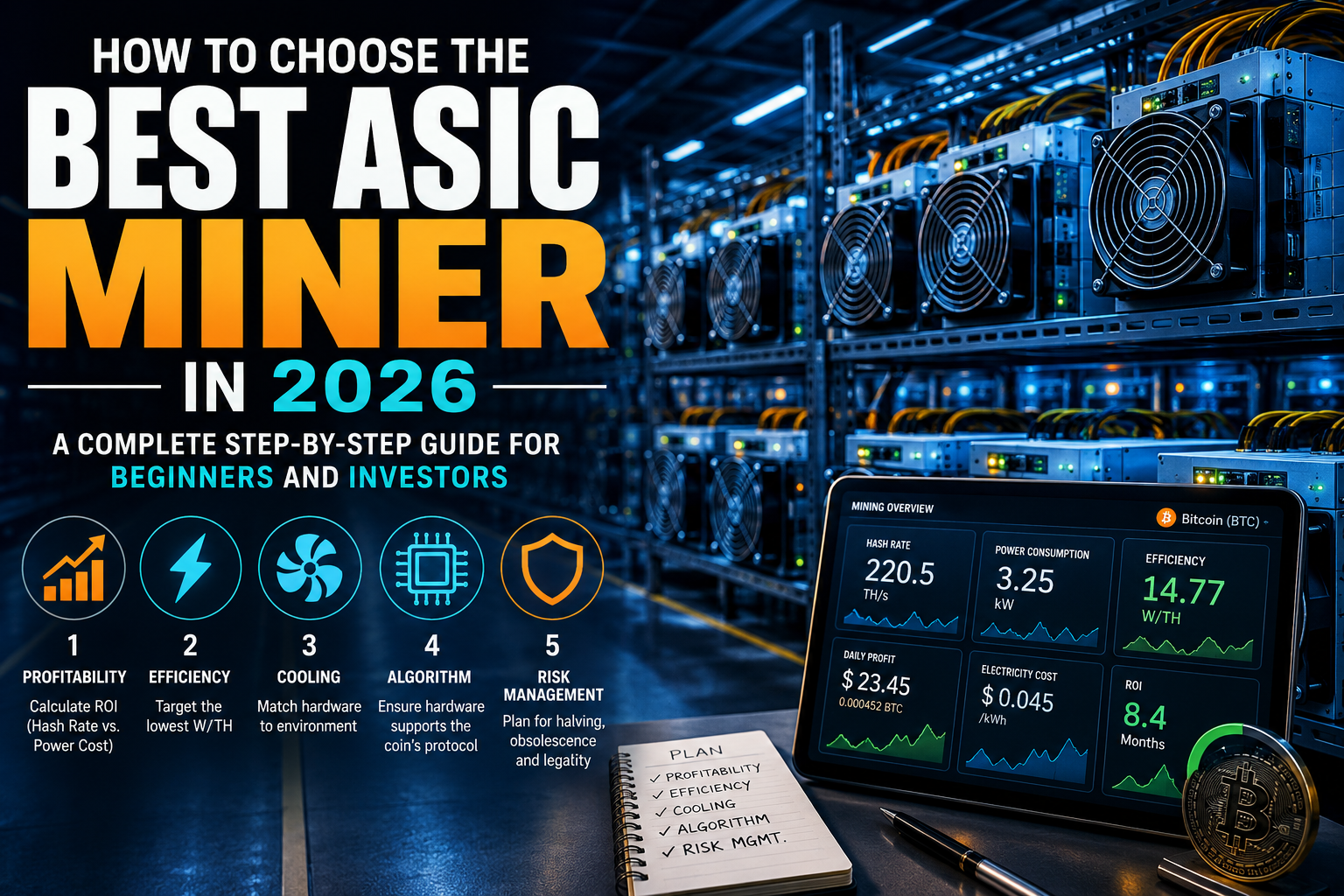
| Step | Focus Area | Key Metric / Goal |
|---|---|---|
| 1 | Profitability | Calculate ROI (Hash Rate vs. Power Cost) |
| 2 | Hardware Efficiency | Target the lowest W/TH |
| 3 | Cooling Systems | Match hardware to environment (Air/Hydro) |
| 4 | Algorithm Match | Ensure hardware supports the coin's protocol |
| 5 | Risk Management | Plan for Halving, Tech Obsolescence, and Legality |
Step 1: Evaluate ASIC Mining Profitability and Financial Returns
Key Factors That Determine ASIC Miner Profitability
When you're looking at an ASIC, profitability is the only North Star that matters. But it isn't just one number—it’s a constant tug-of-war between three critical variables:
- Hash Rate (The Muscle): Think of this as your machine’s raw horsepower. Measured in TH/s, a higher hash rate means you’re processing more data and grabbing a bigger slice of the mining rewards.
- Electricity (The Burn): These machines are absolute power hogs. Your "cost to play" depends entirely on your local utility rates. If your electricity is expensive, it doesn't matter how fast your miner is—the power company will eat your margins before you do.
- Coin Price (The Wildcard): This is the ultimate roller coaster. You can have the most efficient setup in the world, but if the market dips, your revenue follows. It’s the one factor you can’t control, which makes it the most important one to watch.
How to Calculate ASIC Mining Return on Investment (ROI)
Stop guessing and start calculating. To figure out if a deal actually makes sense, you need to use a real-world tool like ASIC Miner Value. It does the heavy lifting for you—factoring in hash rate, power draw, and your specific electricity rates to give you a reality check on your daily margins.
The number you’re really hunting for is ROI (Return on Investment). Essentially: how fast does this machine pay for itself? While the goal is to break even as quickly as possible, you have to be realistic. Your 'payback date' isn't set in stone—it shifts constantly based on market swings and your day-to-day operating costs.
Step 2: Analyze ASIC Miner Efficiency and Hardware Performance
Power Consumption and Energy Efficiency (W/TH)
Efficiency isn't just a technical spec—it’s your insurance policy. If you want to stay profitable when the market gets tough, you have to look past raw power and focus on W/TH (Watts per Terahash).
Think of it like gas mileage for a car: you want the most distance (hash rate) for the least amount of fuel (electricity). The lower that W/TH number, the more efficient the machine. This is where cutting-edge chips really pay off; they squeeze out more performance without blowing up your power bill. Especially if you live somewhere with high electricity costs, a highly efficient rig is often the only thing standing between a profit and a loss.
Step 3: Understand Different Types of ASIC Miners and Cooling Systems
Home vs Professional ASIC Miners
The types of ASIC miners vary to meet diverse operational needs: we find Home Miners characterized by being compact, quiet, and suitable for residential setups, representing an ideal choice for hobbyists and beginners despite potentially offering lower hash rates. In contrast, Professional Miners emerge as larger, high-performance machines specifically designed for industrial-scale mining operations, often requiring dedicated facilities and robust cooling systems.
Advanced Cooling Technologies for Industrial Mining
Within the industrial category, advanced cooling technologies stand out:
- Hydro Miners (Water-Cooled): Generally quieter and more efficient than traditional air-cooled models, ideal for high-temperature environments.
- Immersion Miners: These machines are cooled by submerging them in a dielectric fluid, improving efficiency, reducing noise, and extending lifespan.
Real-World Pro Tip: Your Environment is Your Silent Partner
Forget the "air vs. hydro" debate for a second. Your real performance depends on three things: temperature, dust, and power stability. Mining in heat is a profit-killer, and dust is a silent assassin that suffocates your hardware. Without stable electricity, you’re just waiting for a fried motherboard. A clean, steady setup isn't a luxury—it’s the foundation that prevents your rig from becoming an expensive liability.
Step 4: Ensure ASIC Miner Compatibility with Mining Algorithms
Before you drop a single dollar on hardware, you have to make sure you’re buying the right 'key' for the 'lock.' Every cryptocurrency runs on a specific mining algorithm—think of it as the language the network speaks. Bitcoin uses SHA-256, while Litecoin uses Scrypt. If you buy a Bitcoin miner to mine Litecoin, you’ve just bought a very expensive paperweight; they simply won't talk to each other.
Most ASICs are specialists—they do one algorithm, and they do it exceptionally well. While some 'multi-algo' machines exist, they are rare. The rule of thumb is simple: pick the coin you want to mine first, then find the machine built specifically for that algorithm. If the tech doesn't match the coin, the party is over before it starts.
Step 5: Assess Mining Risks and Develop a Long-Term Strategy
Major Risks in Cryptocurrency Mining
Mining isn’t a guaranteed win; it’s a high-stakes game with real risks that can knock you out if you aren't prepared. You have to look at the 'threats' before you look at the 'gains':
- The Market Rollercoaster: Crypto prices can crash overnight. If your plan only works when Bitcoin is at an all-time high, you’re in trouble. You need a strategy that survives the 'crypto winters.'
- The Tech Race: Today’s top-of-the-line rig is tomorrow’s paperweight. Hardware goes obsolete fast as newer, faster models hit the market, making your current gear less competitive by the day.
- Red Tape: Governments change their minds. Depending on where you live, new regulations or sudden bans can shut you down overnight, so staying legal is non-negotiable.
- Heat & Noise: These machines sound like jet engines and run hot enough to heat a house. If you don't invest in serious cooling and soundproofing, you’ll likely deal with hardware failure—or very angry neighbors.
The bottom line: Successful mining isn't just about plugging in a machine; it’s about managing these risks so you’re the last one standing when things get tough.
Building a Sustainable Long-Term Mining Strategy
All these points underscore the necessity of having a Long-Term Strategy that considers scalability, future resale value, and the potential shift towards using renewable energy or more efficient miners to ensure the sustainability of operations.
The Bottom Line: Don't Just Buy a Rig—Build a Business
In the world of crypto mining, the math is cold and it doesn’t care about your feelings. Choosing an ASIC miner isn't just a shopping trip; it’s a high-stakes strategic move. It’s the difference between owning a "money printer" or a "glorified space heater" that eats your savings via the power grid.
To ensure your investment is a winner, stick to this triple-threat strategy:
- Efficiency is King: Never get blinded by raw Hash Rate. A high-output machine that drains power inefficiently will bleed you dry during a bear market. Always hunt for the lowest W/TH (Watts per Terahash). That is your true competitive edge.
- Infrastructure Over Hype: If you haven't solved the "Heat and Noise" riddle, you’re buying a headache, not an asset. Match the machine to your environment—don’t try to run an industrial beast in a bedroom unless you’re prepared for the consequences.
- The "Worst-Case" Mindset: Don't calculate your ROI based on Moon prices. Run your numbers against market dips and rising difficulty. The best miners are the ones that keep purring profitably while the amateurs are forced to unplug.
The Pro Tip: Mining isn't a sprint; it’s a marathon of endurance. The "best" miner isn't necessarily the most expensive one on the shelf—it’s the one that survives the volatility. Do your homework, because in this game, your profit is actually made the moment you buy, not just when you mine.