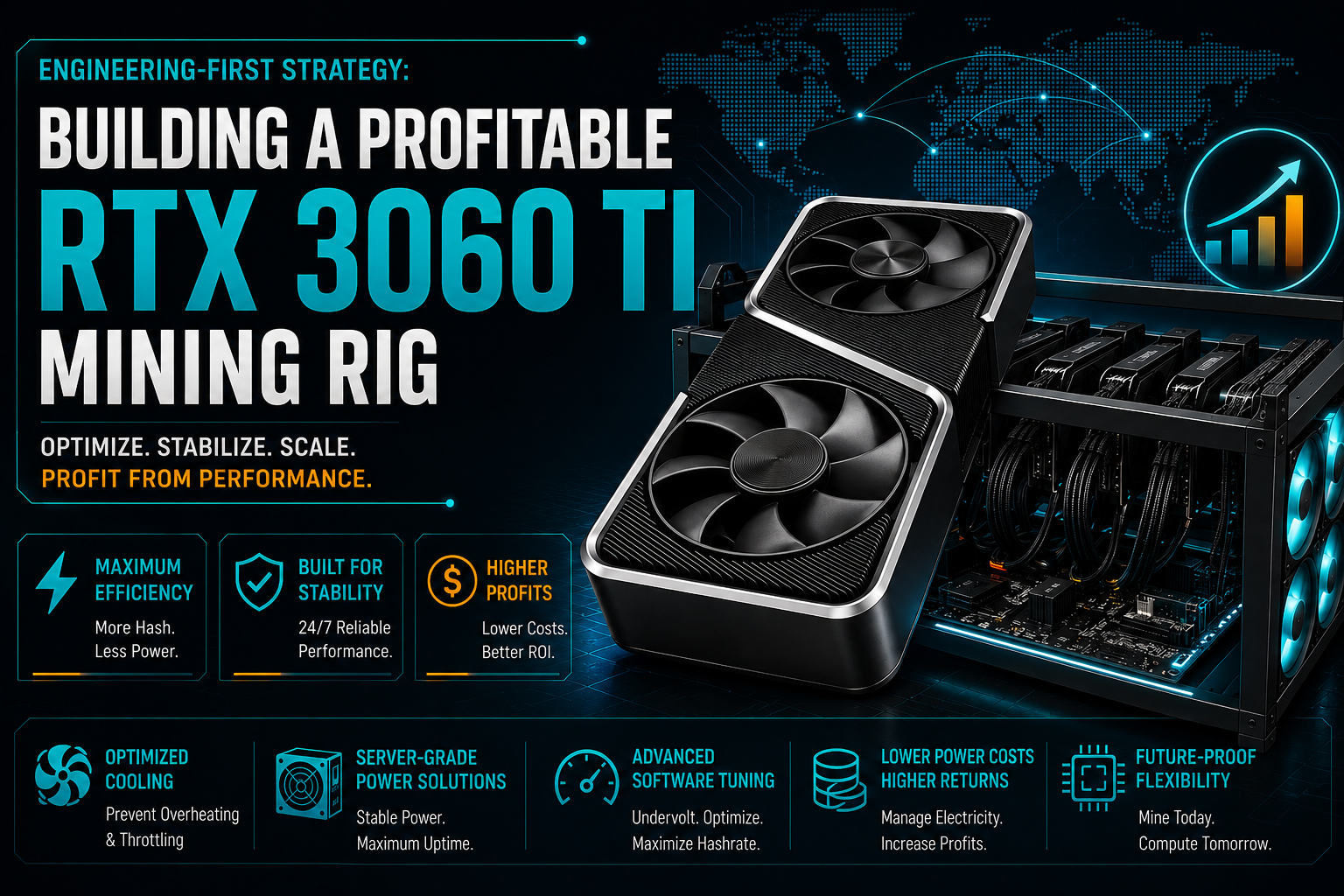
Engineering-First Strategy: Achieving Long-Term Profitability in 2026 GPU Mining
Let’s get one thing straight: GPU mining in 2026 isn't the speculative, hype-driven gold rush it used to be. Today, it’s a disciplined infrastructure play. Your profitability doesn't depend on luck; it depends on system reliability, thermal management, and smart resource allocation.
If you're looking to build a professional-grade, four-GPU mining rig, you need to think like an engineer. This means prioritizing long-term operational resilience over short-term gains. Here is a practical blueprint for deploying an RTX 3060 Ti rig that will run reliably for years, not just weeks.
The State of GPU Mining in 2026: Beyond the Post-Ethereum Ecosystem
Over the last few years, the mining industry has grown up. We've shifted away from the chaotic, plug-and-pray days into a mature ecosystem where technical execution is everything. When Ethereum moved to Proof-of-Stake, a lot of people called the death of GPU mining. The reality? A strong secondary market of GPU-minable networks—like Flux, Ravencoin, Ergo, and Neoxa—stepped up, providing enough liquidity to keep smart, efficient operators in the game.
Why the RTX 3060 Ti Remains the Best GPU for Mining Efficiency
The comparison below clearly shows why the RTX 3060 Ti dominates in efficiency and ROI:
| GPU Model | Hashrate (KawPoW) | Power (W) | Efficiency (MH/W) | Estimated ROI |
|---|---|---|---|---|
| RTX 3060 Ti | ~60 MH/s | 130W | 0.46 | ⭐ High |
| RTX 3070 | ~62 MH/s | 150W | 0.41 | Medium |
| RTX 3080 | ~90 MH/s | 220W | 0.40 | Medium |
The following comparison table highlights why the RTX 3060 Ti remains the most efficient choice in 2026:
You might be wondering why we are focusing on the 3060 Ti when newer, Blackwell-based powerhouses are on the market. It comes down to one metric: efficiency per dollar. The 3060 Ti holds a massive advantage when balancing power consumption, hash rate, and upfront cost.
Optimizing the KawPoW Algorithm for Maximum Hash-to-Watt Ratio
The KawPoW Advantage
On algorithms like KawPoW, it delivers an incredibly optimized hash-to-watt ratio. You get consistent performance without melting your hardware.
Evaluating VRM Durability for 24/7 Multi-GPU Operations
Built to Last
Its robust VRM design means it can handle the stress of being packed into tight, multi-GPU configurations running 24/7. Newer cards might boast higher raw numbers, but the 3060 Ti remains unmatched for operational predictability and ROI.
Mining Power Supply Solutions: Transitioning to Server-Grade Infrastructure
When you are building a headless compute server meant to run at 100% load around the clock, stability is your revenue stream. Every time your rig crashes, you lose money. The biggest rookie mistake is relying on standard ATX consumer power supplies. They simply aren't built for this kind of sustained abuse. Instead, professional setups require server-grade infrastructure:
Using Platinum Server PSUs and ZSX Breakout Boards for Reliable Power
Platinum Server PSUs: A 750W server power supply paired with a breakout board (like the ZSX) is the gold standard. It simplifies your wiring by giving you direct motherboard connections and plenty of safe PCIe outputs for your GPUs.
Configuring Dual-PSU Systems for Residential 120V Mining Circuits
Dual-PSU Setups for 120V: If you live in an area restricted to standard 120V residential circuits, syncing two server PSUs is essential. It distributes the load, prevents boot-cycle crashes, and ensures your GPUs are actually detected when you power on.
Professional Mining Rig Assembly: Avoiding Common Hardware Failures
The Build: Where Most Failures Begin
How you assemble the rig dictates how long it will last. Minor shortcuts taken on day one turn into nightmare troubleshooting sessions by month three.
Maximizing Airflow in a 12-GPU Chassis to Prevent Thermal Throttling
Space it Out: Even if you are only running four cards, put them on a 12-GPU chassis. The extra breathing room prevents "thermal recycling"—the dreaded scenario where one GPU is sucking in the exhaust heat from the card next to it.
Hardware Protection: Static Isolation and High Static-Pressure Cooling
Isolate and Cool: Use nylon standoffs to protect the motherboard from static discharge. More importantly, ditch cheap fans. You need high static-pressure fans that actually force air through dense GPU heatsinks, rather than just blowing it around the room.
Advanced Software Optimization and Mining OS Management
Software Optimization
In 2026, your software layer is just as critical as your hardware.
Replacing USB Drives with SSDs for Reliable HiveOS Performance
Use an SSD: Stop using cheap USB thumb drives for mining OS platforms like HiveOS. The constant read/write logs will fry a USB drive in weeks, taking your rig offline. Spend the extra few dollars on a dedicated SATA SSD.
GPU Undervolting Techniques to Reduce Power Costs by 30%
Master the Undervolt: This is where you make your money. By dropping the core voltage and tweaking the memory clocks, you can often slash power consumption by up to 30% while maintaining your hash rate.
Implementing Hardware Watchdogs for Automated System Recovery
Automate Your Uptime: Set up hardware watchdogs. If a card drops offline or spikes in temperature, the watchdog will automatically reboot the system, keeping your downtime to seconds instead of hours.
Economic Analysis of GPU Mining: Electricity Costs and Revenue Streams
The table below illustrates how electricity pricing directly impacts the profitability of a 4x RTX 3060 Ti mining rig in 2026:
| Electricity Cost ($/kWh) | Daily Cost (4x 3060 Ti) | Estimated Daily Revenue | Estimated Profit | Profitability Level |
|---|---|---|---|---|
| $0.05 | $0.84 | $3.50 | $2.66 | 🟢 High Profit |
| $0.08 | $1.34 | $3.50 | $2.16 | 🟢 Stable |
| $0.10 | $1.68 | $3.50 | $1.82 | 🟡 Moderate |
| $0.12 | $2.02 | $3.50 | $1.48 | 🟡 Low |
| $0.15 | $2.52 | $3.50 | $0.98 | 🔴 Risky |
The Reality of Mining Economics
At the end of the day, mining is a margin business. You are trading electricity for digital assets. If your power costs exceed $0.10 per kWh, your margins are going to be painfully thin. To combat this, smart operators use time-of-use strategies, pushing their hardware harder during off-peak hours when power is cheaper. However, building a rig with GPUs gives you two massive financial safety nets that ASIC miners don't have:
Asset Protection: Managing GPU Resale Value vs. ASIC Obsolescence
Resale Value: GPUs can always be sold to gamers or video editors if the market tanks.
The AI Pivot: Renting GPU Power to Decentralized Compute Networks
The AI Pivot: Decentralized compute networks are booming. When standard mining isn't cutting it, you can easily rent out your RTX 3060 Ti rig for AI training or rendering workloads to keep the cash flowing.
Conclusion: Scaling Your Professional RTX 3060 Ti Mining Operation
The Final Verdict
A four-GPU RTX 3060 Ti rig is arguably the smartest entry point into professional mining right now. It operates quietly enough for a home, runs efficiently on standard power circuits, and is highly profitable when tuned correctly. It forces you to stop thinking like a gambler and start thinking like an infrastructure manager. Would you like me to outline some specific starting overclock and undervolt parameters for the RTX 3060 Ti on popular algorithms like KawPoW or Autolykos?
FAQ: Professional GPU Mining & Infrastructure
Q1: Is GPU mining still profitable in 2026?
Yes, but profitability now depends on operational efficiency and coin selection rather than market speculation. By using efficient hardware like the RTX 3060 Ti and targeting networks like Flux or Neoxa, miners can maintain healthy margins. Success requires keeping electricity costs below $0.10/kWh and utilizing advanced undervolting to maximize the hash-to-watt ratio.
Q2: Why should I use server power supplies instead of ATX for a mining rig?
Consumer ATX power supplies are designed for variable gaming loads, not the 100% continuous duty cycle required for mining. Server-grade Platinum PSUs are engineered for 24/7 operation, offering superior efficiency and heat tolerance. When paired with breakout boards, they provide safer power distribution for multiple GPUs, significantly reducing the risk of cable meltdowns or system instability.
Q3: What are the best coins to mine with an RTX 3060 Ti right now?
The RTX 3060 Ti excels on memory-intensive and core-heavy algorithms alike. In 2026, the most profitable options typically include Ravencoin (KawPoW), Ergo (Autolykos2), and Flux (ZelHash). These networks provide the necessary liquidity and rewards to justify the hardware’s power draw, especially when the cards are properly undervolted to optimize their performance-per-watt.
Q4: Can I use my mining rig for AI tasks if mining profits drop?
Absolutely. One of the biggest advantages of a GPU rig over an ASIC is versatility. Through decentralized compute networks, you can rent out your RTX 3060 Ti's VRAM and processing power for AI model training, rendering, or complex simulations. This "AI Pivot" provides a critical alternative revenue stream that ensures your hardware remains a productive asset regardless of crypto market volatility.
Q5: What is the ROI timeline for a 4x RTX 3060 Ti mining rig in 2026?
The ROI timeline for a 4x RTX 3060 Ti mining rig in 2026 typically ranges between 10 to 16 months, depending on electricity costs, hardware price, and market conditions. At electricity rates around $0.05–$0.08 per kWh, miners can achieve faster break-even, especially with optimized undervolting and stable uptime. Additional revenue from AI workloads can further reduce the ROI period.