INTRODUCTION
At the end of the day, your choice comes down to your 'pain tolerance. The Bitmain L11 Pro is the high-end luxury sedan of the mining world. It’s expensive, and the 3nm tech is a masterpiece of efficiency, but it’s a nightmare to repair once that thermal adhesive sets in. You buy this if you have a professional cooling setup and a long-term contract for cheap power. It’s built for the marathon.
The VolcMiner D3, on the other hand, is the 'street fighter.' It might lose by a hair on pure efficiency, but its accessibility—especially those copper heatsinks and the quieter profile—makes it much more human-friendly for smaller setups or hybrid farms.
My take? If you’re building a 1MW facility in the desert, don’t overthink it: buy the Bitmain. But if you’re managing a mid-sized operation and you actually want to be able to fix your own gear without a PhD in micro-soldering, the VolcMiner D3 is the smartest money you’ll spend this year. The network doesn't care about brand loyalty; it only cares about uptime. Choose the machine that you can actually keep running.
🔴 3nm Explained
The “3nm” process does not refer to the real physical size of transistors.
It represents a generation of semiconductor manufacturing technology that improves:
- Transistor density
- Energy efficiency
- Overall performance
In modern chip manufacturing, nodes such as 3nm are mainly used as a label for technological advancement rather than an exact measurement of physical size.
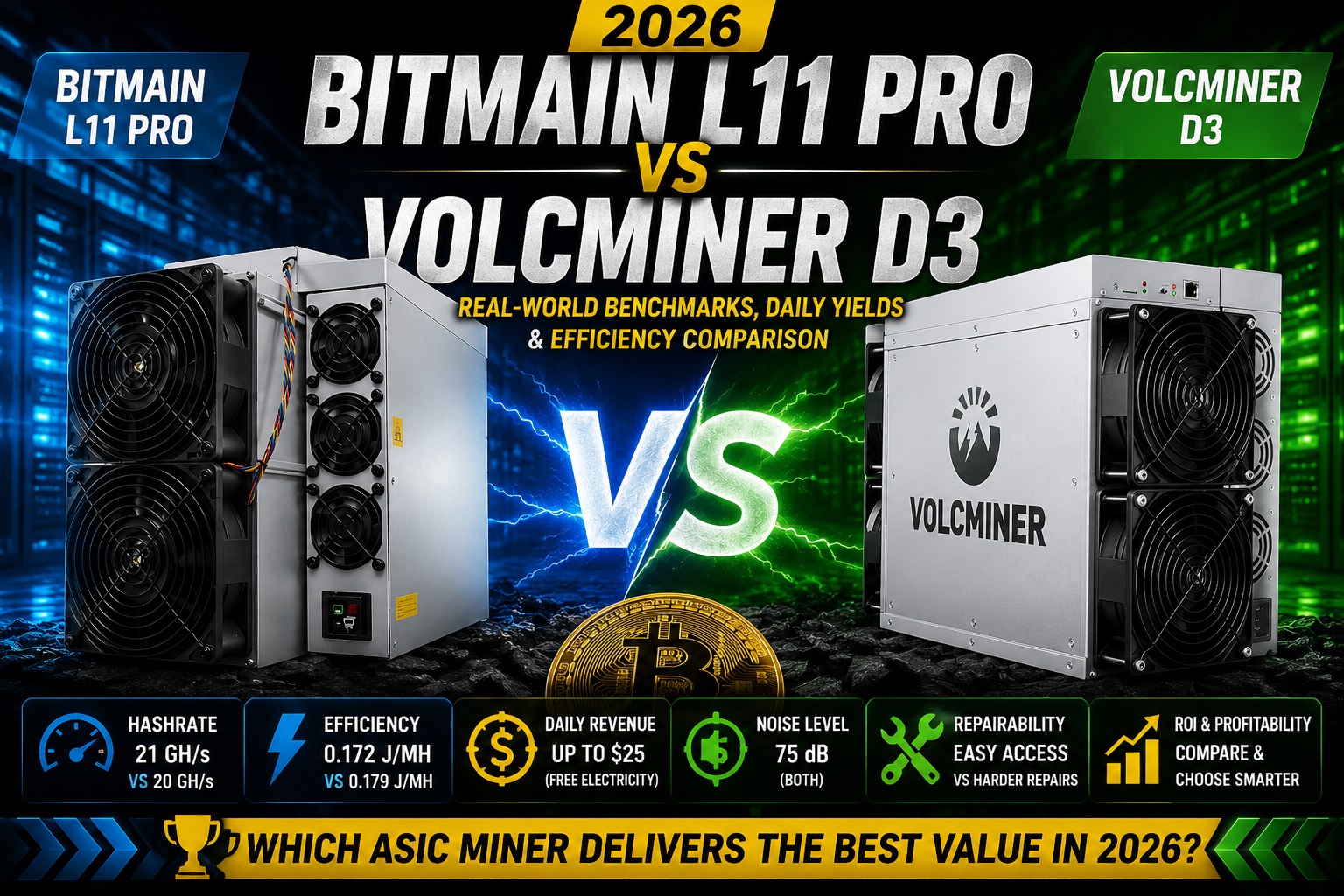
2026 Technical Showdown: Bitmain L11 Pro vs. VolcMiner D3 — Real-World Benchmarks, Daily Yields, and Efficiency Ratings
Bitcoin Miner Comparison: Bitmain L11 Pro vs VolcMiner D3
A comprehensive evaluation across 10 key performance metrics for industrial-grade mining operations.
| Criteria | Bitmain L11 Pro | VolcMiner D3 |
|---|---|---|
| Build Quality | Excellent ★★★★★ | Very Good ★★★★☆ |
| Hashrate | 21 GH/s ★★★☆☆ | 20 GH/s ★★★☆☆ |
| Efficiency (J/MH) | 0.172 ★★★★☆ | 0.179 ★★★★☆ |
| Size & Weight | 15.8 kg 195×290×379 mm ★★★★☆ | 22 kg 384×270×316 mm ★★★★☆ |
| Price | $10,000 ★★★☆☆ | $8,000 ★★★★☆ |
| Revenue (Free Elec.) | $25 / Day ★★★★☆ | $23.5 / Day ★★★★☆ |
| Noise Level | 75 dB ★★★☆☆ | 75 dB ★★★☆☆ |
| Rev @ $0.04/kWh | $22 / Day ★★★★☆ | $21 / Day ★★★★☆ |
| Rev @ $0.08/kWh | $18.5 / Day ★★★★☆ | $17.5 / Day ★★★★☆ |
| Generation | Gen 6 ★★★★☆ | Gen 6 ★★★★☆ |
| OVERALL RATING | ⭐⭐⭐⭐☆ (3.8 / 5) | ⭐⭐⭐☆☆ (3.6 / 5) |
Evaluating Manufacturing Quality and Industrial Reliability: A Deep Dive into Bitmain vs VolcMiner for 2025 and 2026
When looking at manufacturing quality and industrial reliability for 2025/2026, based on technical assessments and feedback from mining farm operators, here’s a closer look at Bitmain and VolcMiner.
Bitmain Antminer Series Review: Assessing Build Quality, Advanced ASIC Chip Technology, and Long-Term Durability
Overall, Bitmain gets a 9/10. Their internal component quality is rated at 9.5/10. They use advanced ASIC chips (3nm/5nm), and their hashboards are built for continuous 24/7 use over many years.
For cooling engineering, it's an 8.5/10. Their air-cooled units perform well, and they lead in hydro cooling. One point to note about air-cooled units is the noise level from their industrial fans. The assembly build scores 9/10, featuring precise automated assembly and a tough industrial aluminum chassis that helps keep internal parts safe from physical damage and environmental factors.
A key weakness, especially in 2026 models like the S21 series, is that manual repairs are harder because they use a lot of thermal adhesive instead of screws for heatsinks.
VolcMiner D1 and Mini Series Analysis: Quiet Mining Design, Cooling Efficiency, and Current Market Maturity
VolcMiner’s overall rating is 7.5/10. Internal component quality is 7/10. While their chips are great for Scrypt algorithm mining, they still have some ground to cover to match Bitmain's chip technology in terms of efficiency.
Their cooling engineering rates an 8.5/10. They are known for Quiet Mining solutions, using large copper heatsinks in their home models, which shows a level of detail often missing in Bitmain's home user offerings. The assembly build is 7.5/10. They have a clean, good-looking finish and solid construction.
A key weakness is their relative newness to the market; while the materials are high-quality, there isn't enough historical information (3-5 years) yet to confirm long-term material resilience compared to Bitmain.
The Bottom Line: Which One is Actually Worth Your Money?
Look, we can talk about Terahashes and J/T all day, but when you’re standing in your mining shed at 3 AM, the only thing that matters is which machine stays running and which one gives you a headache.
If you’ve got the budget and you want a set it and forget it workhorse, stick with Bitmain. They are the industry giants for a reason—their machines are built like tanks and they hold their resale value far better when you’re ready to upgrade. It's the safe bet for a reason.
But, if you’re tired of paying the Bitmain tax and want a machine that’s surprisingly quiet and gets you to your ROI months faster, VolcMiner is proving that they aren't just a budget knock-off anymore. They’ve actually listened to what smaller miners want.
My honest advice? If this is your first rig or you’re mining from home, grab the VolcMiner D3. The price-to-performance ratio is just too good to ignore. But if you’re building a legacy and need hardware that your grandkids might still find running in a decade, pay the extra for the L11 Pro. Either way, stop overthinking and get hashing—the network doesn't wait for anyone.
Source TSMC – 3nm Technology Overview https://www.tsmc.com/japanese/dedicatedFoundry/technology/logic/l_3nm