
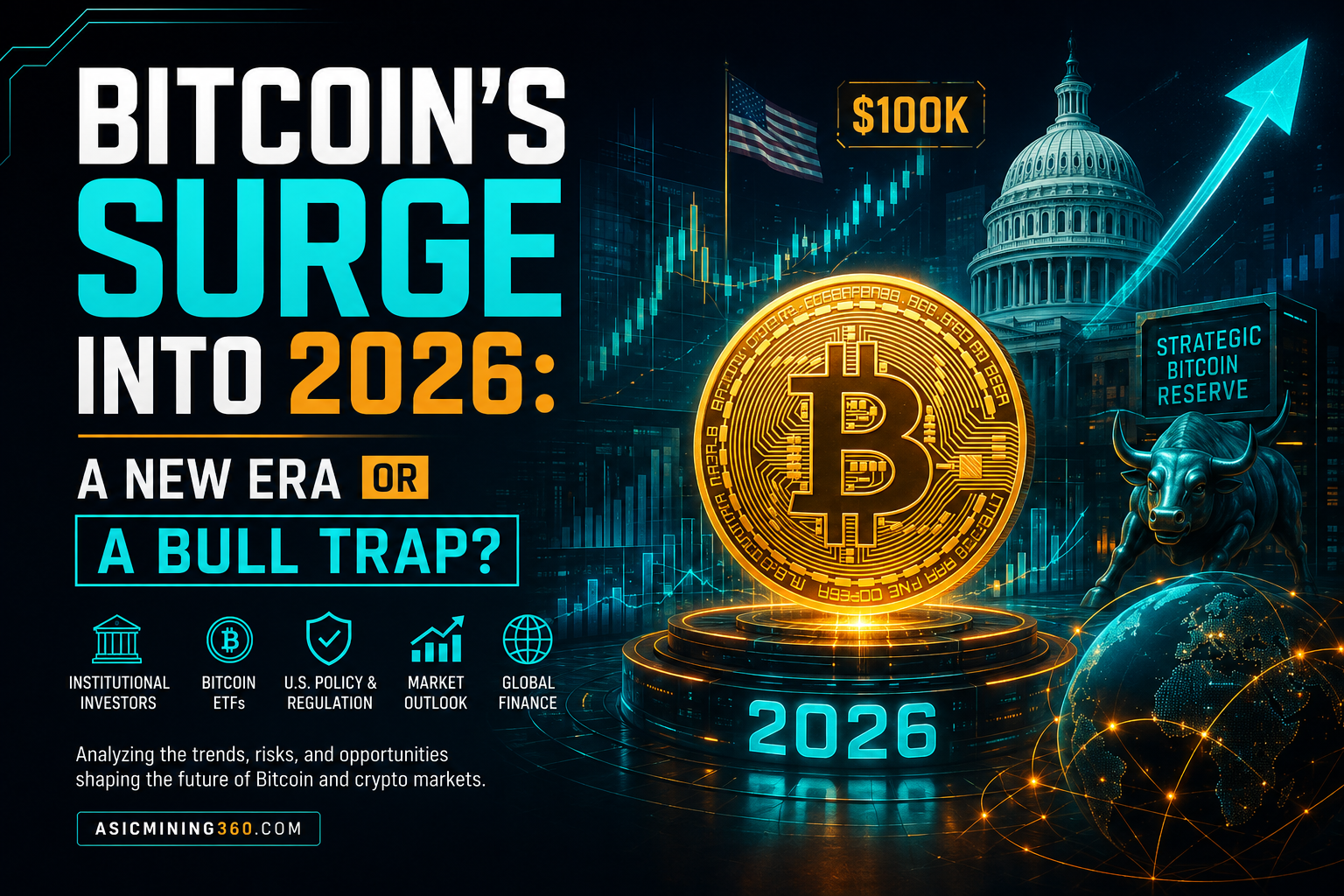
Bitcoin's Surge into 2026: A New Era or a Bull Trap?
Bitcoin didn't just walk into 2026; it sprinted. After a relatively quiet December at $86,000, we watched it tear through the $93,000 mark in early January. Now, the million-dollar question is echoing across every trading desk: Are we finally standing at the base of a massive new bull market, or is this just a "bull trap" before another gut-wrenching correction?
To get the real story, you have to look past the green candles. The market we’re seeing in 2026 isn't the same speculative wild west of 2021. It’s being driven by structural shifts—like the Strategic Bitcoin Reserve and new U.S. "Crypto Czars"—that make this trajectory feel fundamentally different.
Institutional Investors, Bitcoin ETFs, and Market Liquidity in 2026
If 2025 was the year institutional capital knocked on the door, 2026 is the year it moved in and started running the show. The explosion of Bitcoin ETFs has turned into a massive vacuum for supply, with cumulative trading volumes now crossing the $2 trillion mark.
This isn't just "hype" anymore; it’s corporate policy. We’re seeing a shift where Bitcoin is no longer a "trade" for these firms—it’s a permanent part of their balance sheets. The real mystery for 2026 is whether this slow-moving institutional money will keep its foot on the gas even if we hit a period of stagnation, or if they’ve already priced in the best news.
U.S. Regulation, Government Policy, and Their Impact on Bitcoin Prices
Let’s be honest: the biggest driver right now isn't code—it’s Washington. For the first time, we have an administration that isn't just "tolerating" crypto but actively integrating it. With the appointment of a national Crypto Czar and talk of the CLARITY Act passing the Senate, the "regulatory fog" that held the market back for years is finally lifting.
When the government treats Bitcoin as a strategic asset rather than a nuisance, the "big money" feels safe. This shift in policy is acting like a floor for the price; every time we dip, the expectation of pro-crypto legislation seems to bring the buyers back in.
Key Risks for the Crypto Market in 2026: Volatility, Regulation, and Speculation
But let’s keep our feet on the ground—this market can still bite. The biggest risk in 2026 is actually over-optimism. If the market prices in perfect regulatory outcomes and they don't deliver, the "sell the news" event could be brutal.
There's also the risk of the "junk" coming back. As Bitcoin nears $100K, we’re seeing a resurgence in speculative memecoins and unvetted projects that could suck liquidity away from the majors. If the retail "moon-boys" take over from the institutional "gray-suits," we might see the kind of unstable blow-off top that leads to a multi-year winter.
Interest Rates, Monetary Policy, and Their Effect on Crypto Markets
One of the quietest but most powerful winds at Bitcoin's back is the Federal Reserve. With interest rates finally drifting toward the 3% range, the "cash is king" mentality is fading. Investors are once again hunting for yield and growth, and Bitcoin—as a scarce digital asset—is the first place they look.
Historically, Bitcoin has been a liquidity sponge. If the Fed continues to pause its balance sheet reductions (Quantitative Tightening) in 2026, we could see a flood of capital that pushes Bitcoin well into six-figure territory.
Bitcoin Market Structure in 2026: Institutional vs Retail Dynamics
The "DNA" of this cycle is unique. In the past, Bitcoin was driven by retail FOMO and TikTok influencers. In 2026, the foundation is built on spot ETFs, corporate treasuries, and sovereign reserves.
This means the "four-year cycle" might actually be dead. Instead of a violent boom-and-bust, we’re seeing a more resilient capital base. Institutions don't panic-sell at 2:00 AM because of a tweet; they buy the dips to hit their quarterly allocation targets. This makes the market less erratic but much more sensitive to global macro trends.
Bitcoin Outlook 2026: Bull Run or Short-Term Rally?
So, is the $93K surge the real deal? If you look at the combination of falling interest rates, pro-crypto U.S. policy, and massive ETF inflows, it’s hard not to be bullish. However, for this to be a true, sustained bull run, Bitcoin needs to hold its current levels as a "new floor" rather than just a peak. If we can consolidate around $90K without a massive liquidation event, then $100K isn't just a target—it's inevitable.
The Future of Bitcoin: How Global Finance Is Reshaping Crypto Markets
By the end of 2026, we might stop calling it "crypto" and just call it "finance." With the tokenization of real-world assets and Bitcoin becoming a staple in retirement portfolios, the line between Wall Street and the blockchain has officially blurred. Bitcoin is no longer an experiment; it’s a global financial pillar that is now too big to ignore—and arguably, too integrated to fail.
Additional FAQ: Bitcoin Price Forecast, Risks, and Investment Strategy in 2026
Q1: Will Bitcoin reach $100,000 in 2026?
Bitcoin reaching $100,000 depends largely on continued institutional inflows, favorable macroeconomic conditions, and sustained demand through ETFs. While technically possible, it requires strong liquidity and stable regulation. Without these, price growth may face resistance and increased volatility near key psychological levels.
Q2: Is Bitcoin still a good investment in 2026?
Bitcoin remains attractive as a high-risk, high-reward asset. Its growing institutional adoption adds credibility, but volatility remains significant. Investors should consider diversification, risk tolerance, and macroeconomic conditions before allocating capital, rather than relying purely on short-term price movements.
Q3: What drives Bitcoin price the most in 2026?
The biggest drivers are institutional demand, interest rate policies, and regulatory clarity. Unlike previous cycles driven by retail hype, the 2026 market is heavily influenced by large capital flows, ETF activity, and global liquidity conditions tied to central bank decisions.
Q4: Can Bitcoin crash again after this rally?
Yes, corrections are always possible. Even in bullish environments, Bitcoin can experience sharp pullbacks due to macroeconomic shocks, regulatory news, or reduced institutional inflows. Volatility remains a core characteristic of the crypto market, regardless of long-term trends.
Q5: How do ETFs affect Bitcoin price stability?
Bitcoin ETFs can improve price stability by increasing liquidity and attracting long-term institutional investors. However, they can also amplify volatility during large inflows or outflows, as significant capital movements directly impact market supply and demand.
Q6: What is the biggest risk for crypto investors in 2026?
The biggest risks include sudden regulatory changes, shifts in monetary policy, and over-reliance on institutional demand. If any of these weaken, market sentiment can quickly reverse, leading to rapid price corrections and reduced investor confidence.