Introduction: The Price That Doesn’t Excite You—It Scares You
What will you feel the first time Bitcoin reaches a number that makes your stomach tighten instead of your heart race? Not excitement. Not celebration. Fear. A quiet, heavy question: Should I sell and run?
If we’re honest, most people who buy Bitcoin today will not arrive at 2030 with the same stack they hold now. Not because they’re careless or because the long-term thesis breaks. But because financial systems—and markets—are designed to test human behavior under stress. Volatility is visible. Psychology is the real battlefield.
Bitcoin is a scarce digital asset living inside a global system built on flexible money and expanding credit. That tension creates opportunity, but it also creates pressure. Humans think in straight lines: salary, rent, bills, emergencies. Bitcoin doesn’t move that way. It moves in cycles, in supply shocks, in events like halvings and sudden repricing that permanently reset expectations.
Today, most people still measure Bitcoin in dollars. They check the price before checking their plans. But over long periods, especially if adoption continues and fiat currencies keep losing purchasing power, that perspective can flip. You may start pricing parts of your life in satoshis instead. That mental shift is not about hype—it’s about how people adapt to scarce assets over time.
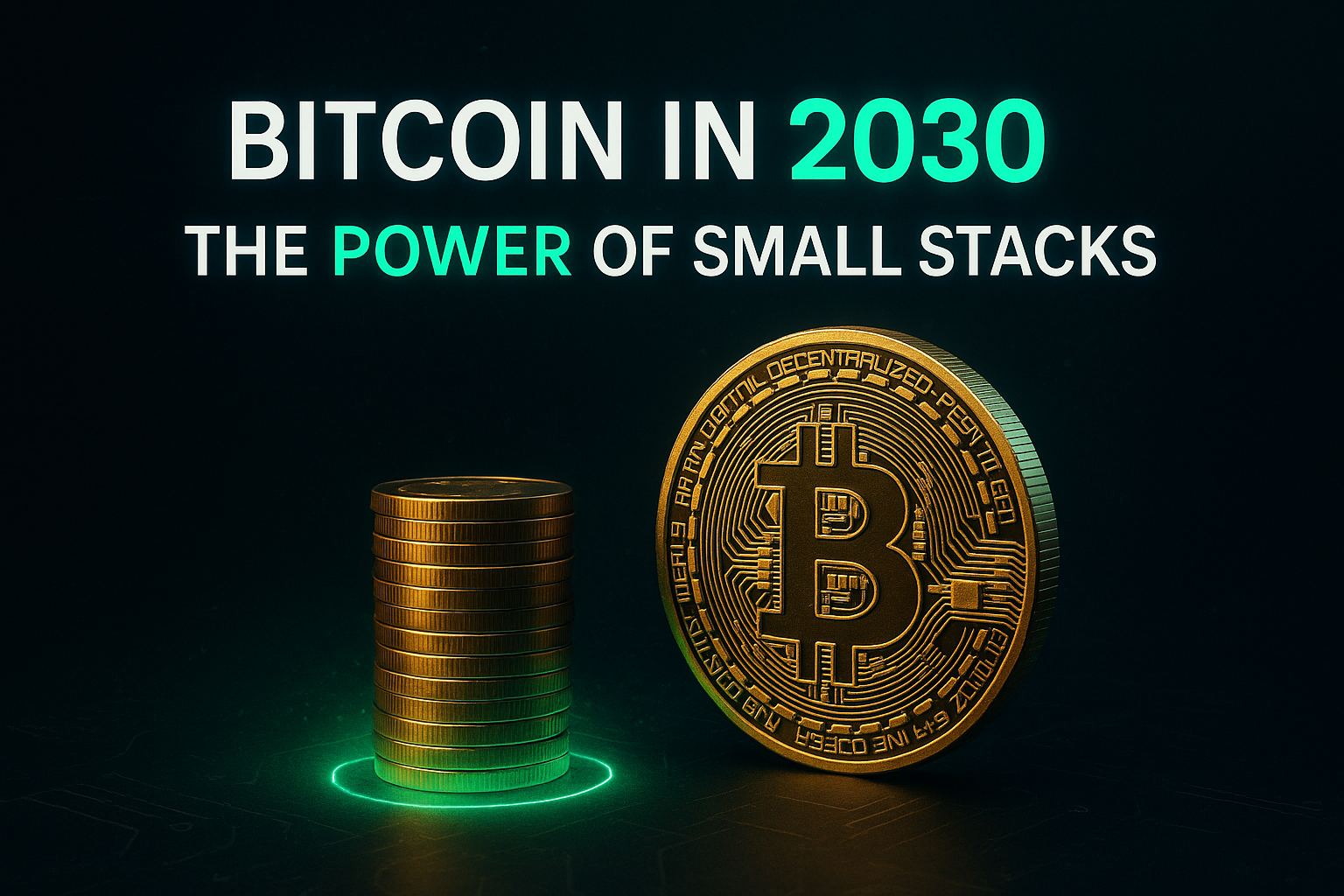
To keep things grounded, let’s use a conservative long-term scenario: $1 million per Bitcoin by 2030. Some models argue higher, some lower. The exact number matters less than the exercise itself. When the unit price rises, decimals stop feeling small. “Dust” starts looking like capital.
This article breaks down four stack sizes—not as promises of wealth, but as levels of financial resilience in a world of monetary uncertainty:
Why the Real Enemy Isn’t a Crash
Comfort, Not Volatility, Destroys Most Stacks
Market crashes are dramatic, but they’re not the main reason people lose their Bitcoin. The quieter enemy is comfort. Lifestyle creep. The internal voice that says, I deserve this now.
Historically, more Bitcoin has been sold to fund convenience than to escape panic.
In traditional finance, this shows up as people raiding savings accounts, refinancing future stability for present comfort. Bitcoin simply makes this trade-off more visible because the asset is volatile and the upside is asymmetric.
From a macro perspective, this is happening in a world where:
-
Debt levels keep rising
-
Currencies slowly lose purchasing power
-
Assets become harder to accumulate through wages alone
Bitcoin doesn’t fix human behavior. It just exposes it.
The real goal for most long-term holders isn’t perfect timing. It’s building a structure that prevents forced selling.
The Survival Stack: 0.001 Bitcoin (100,000 Satoshis)
Why “Small” Doesn’t Mean “Meaningless”
Today, 0.001 BTC might feel trivial. It’s a dinner out. A pair of shoes. A tank of gas. It’s easy to look at that balance and think, “Why even bother?”
That reaction is understandable—and often wrong.
In a $1 million Bitcoin scenario, 0.001 BTC equals $1,000. More importantly, it represents future purchasing power in a world where fiat continues to dilute.
From a real-world perspective, that could mean:
-
A month of basic expenses in a crisis
-
A plane ticket out of a bad situation
-
Temporary mobility when others are stuck
Globally, a huge portion of the population has no meaningful savings at all. Holding even a small, scarce digital asset can put you ahead of that curve.
The Real Risk: Forced Selling
Here’s where reality hits. Life is expensive. Cars break down. Medical bills appear. Something always needs fixing. When there’s no cash buffer, even a small Bitcoin stack becomes the emergency fund—and gets sold.
That’s not investing. That’s trading a fixed-supply asset for an endlessly expandable currency under pressure.
The lesson is simple but uncomfortable:
Before optimizing returns, optimize your personal financial stability. A basic fiat emergency fund can be the difference between holding and being forced to sell.
Think of 0.001 BTC not as spending money, but as your absolute floor. The break-glass reserve. If you can hold even that until 2030, you’re not starting from zero.
The New Standard: 0.01 Bitcoin (1,000,000 Satoshis)
Scarcity in a World of Eight Billion People
There will only ever be 21 million Bitcoin. If you divide that by 100, you get 2.1 billion units of 0.01 BTC. There are already over 8 billion people on Earth.
Even with perfect distribution—which will never happen—only about one in four people could own 0.01 BTC. In reality, supply is further tightened by:
-
Long-term holders
-
Institutional custody
-
ETFs and funds
-
Lost coins
Owning 0.01 BTC likely puts you in a small global minority.
At $1 million per coin, 0.01 BTC equals $10,000. In an inflationary world, that’s not luxury money. It’s stability money. Options money. A future emergency fund that doesn’t depend on a single banking system.
The Psychological Trap: Comparison and Overreach
This is where social media does real damage. You see people posting whole-coin balances. You feel behind. So you start “optimizing”:
-
Taking leverage
-
Chasing speculative assets
-
Trying to trade your way up faster
Most people who try to turn 0.01 into 0.1 through active trading end up with less, not more. The data across markets is brutal: overconfidence is expensive.
Holding 0.01 BTC for a decade requires accepting a simple truth:
> You are not competing in a trading tournament. You are saving in a scarce asset in a world that discourages saving.That’s not flashy. It’s effective.
The Freedom Buffer: 0.1 Bitcoin (10,000,000 Satoshis)
When Numbers Start Changing Real Life
At today’s prices, 0.1 BTC might look like a used car. But scarcity compounds over time. At $1 million per Bitcoin, 0.1 BTC equals $100,000.
That’s not just a number on a screen. That’s:
-
A house down payment
-
An education fund
-
One to two years of living expenses
-
The ability to leave a job you hate
This is what you could call freedom capital. Not retirement wealth, but meaningful leverage over your own time.
The Mid-Cycle Temptation
Now imagine this scenario: Bitcoin hits $250,000 in 2026. Your 0.1 BTC is worth $25,000. Suddenly, real problems could be solved:
-
Debt disappears
-
The roof gets fixed
-
You finally take that break you postponed
Friends tell you to “take profits.” Headlines talk about bubbles. You start thinking you can sell and buy back lower.
This is one of the most common long-term mistakes in markets.
Once you sell, the probability of rebuilding the same position drops sharply. While you wait for dips, large holders accumulate. Supply moves into long-term storage. Historically, when Bitcoin leaves retail hands, it doesn’t come back easily.
Holding 0.1 BTC through multiple cycles requires a mindset shift:
> You’re not holding a lottery ticket. You’re holding a share of a finite monetary network.The Sovereign Share: 0.21 Bitcoin
Owning One-Millionth of All Bitcoin
The number 0.21 is not random. With a total supply of 21 million coins, 0.21 BTC represents one-millionth of the entire network.
There are tens of millions of millionaires worldwide. There is not enough Bitcoin for each of them to own this amount.
From a pure supply-and-demand perspective, that’s significant.
In a mature Bitcoin market, 0.21 BTC could function less like a speculative asset and more like strategic capital—the kind you borrow against, protect, and pass on rather than sell casually.
The Cost: Patience and Boredom
Reaching 0.21 BTC usually doesn’t come from clever trading. It comes from:
-
Consistent accumulation
-
Ignoring short-term noise
-
Delayed gratification
-
Surviving multiple volatility cycles
The market will test this through:
-
Sharp corrections
-
Regulatory headlines
-
Long periods of sideways movement
-
Moments where selling feels “responsible”
If you have 0.1, aiming for 0.21 is a strategic choice. If you have 0.01, aiming for 0.1 is already meaningful progress. The window to do this easily doesn’t stay open forever.
Bitcoin, Cycles, and Realistic Expectations
From a market perspective, Bitcoin has always moved in cycles driven by:
-
Supply issuance (halvings)
-
Liquidity conditions
-
Risk appetite
-
Institutional participation
There will be booms and busts. There will be periods where holding feels smart and periods where it feels exhausting. None of that changes the core structural difference between a fixed-supply asset and expandable money systems.
The biggest risk for most people is not volatility. It’s behavior during volatility.
Conclusion: You’re Competing With Your Future Self
When the next unexpected expense hits, what will you reach for—short-term relief or long-term security?
FAQ
Q1: Is $1 million per Bitcoin by 2030 realistic?
No one can guarantee a price target. The figure is a conservative scenario used to illustrate how scarcity changes the impact of small amounts. The real value depends on adoption, macro conditions, and market structure.
Q2: Is it too late to start with a small amount of Bitcoin?
Not necessarily. Even small amounts can represent meaningful purchasing power in the future, especially compared to holding nothing in a depreciating currency.
Q3: Should I trade to increase my Bitcoin stack?
Most people underperform by trading due to fees, timing errors, and emotional decisions. For many, consistent accumulation and holding is a more reliable strategy.
Q4: Why is having a cash emergency fund important if I own Bitcoin?
Without a cash buffer, unexpected expenses can force you to sell Bitcoin at bad times. A small fiat reserve protects your long-term position.
Q5: What does “pricing life in satoshis” mean?
It means shifting your mental accounting from thinking in fiat terms to thinking in units of a scarce asset, especially if that asset becomes a long-term store of value.
Q6: Is 0.21 BTC really that special?
Mathematically, it represents one-millionth of total supply. In a world with many high-net-worth individuals, that level of scarcity could be strategically meaningful over the long term.
Q7: What’s the biggest risk for long-term holders?
Behavioral mistakes: panic selling, lifestyle-driven selling, overtrading, and abandoning a long-term plan during emotionally difficult market phases.