Introduction: The Brutal Math of Choosing a Pool in 2026
If you’re still trying to mine solo in 2026, you aren't just an optimist—you’re basically buying a lottery ticket with electricity. With the global hashrate now screaming past the Zettahash mark, the mathematical odds of a single farm—let alone a home setup—hitting a block are practically zero.
In this environment, joining a mining pool isn't a "choice." It’s your survival strategy.
But here is the problem: a lot of miners treat picking a pool like picking a movie on Netflix—they just go with whatever is popular. In 2026, that laziness will kill your ROI. When network difficulty is this high and margins are this thin, the difference between a 1% and a 2% fee, or a slight lag in your stratum connection, is the difference between paying your power bill and bleeding money.
You can’t just look at the hashrate anymore. To stay solvent, you have to get into the ugly details:
-
The Payout Trap: Are you chasing the steady "salary" of FPPS, or are you willing to gamble on PPLNS to save on fees?
-
The Latency War: If your pool’s server is halfway across the world, you’re losing shares to "stale" blocks before they even reach the chain. That’s invisible money down the drain.
-
The Threshold Squeeze: If a pool has a high minimum payout, your rewards are sitting in their wallet, not yours—earning them interest while you wait weeks to see a dime.
In this breakdown, we’re going to look at the four heavyweights dominating the racks in 2026. We’re cutting through the marketing fluff to see who actually delivers the most consistent sats to your wallet.
Whether you’re spinning up a new liquid-cooled fleet or just trying to keep your legacy air-cooled rigs profitable, this is the data you need to stop guessing and start earning.
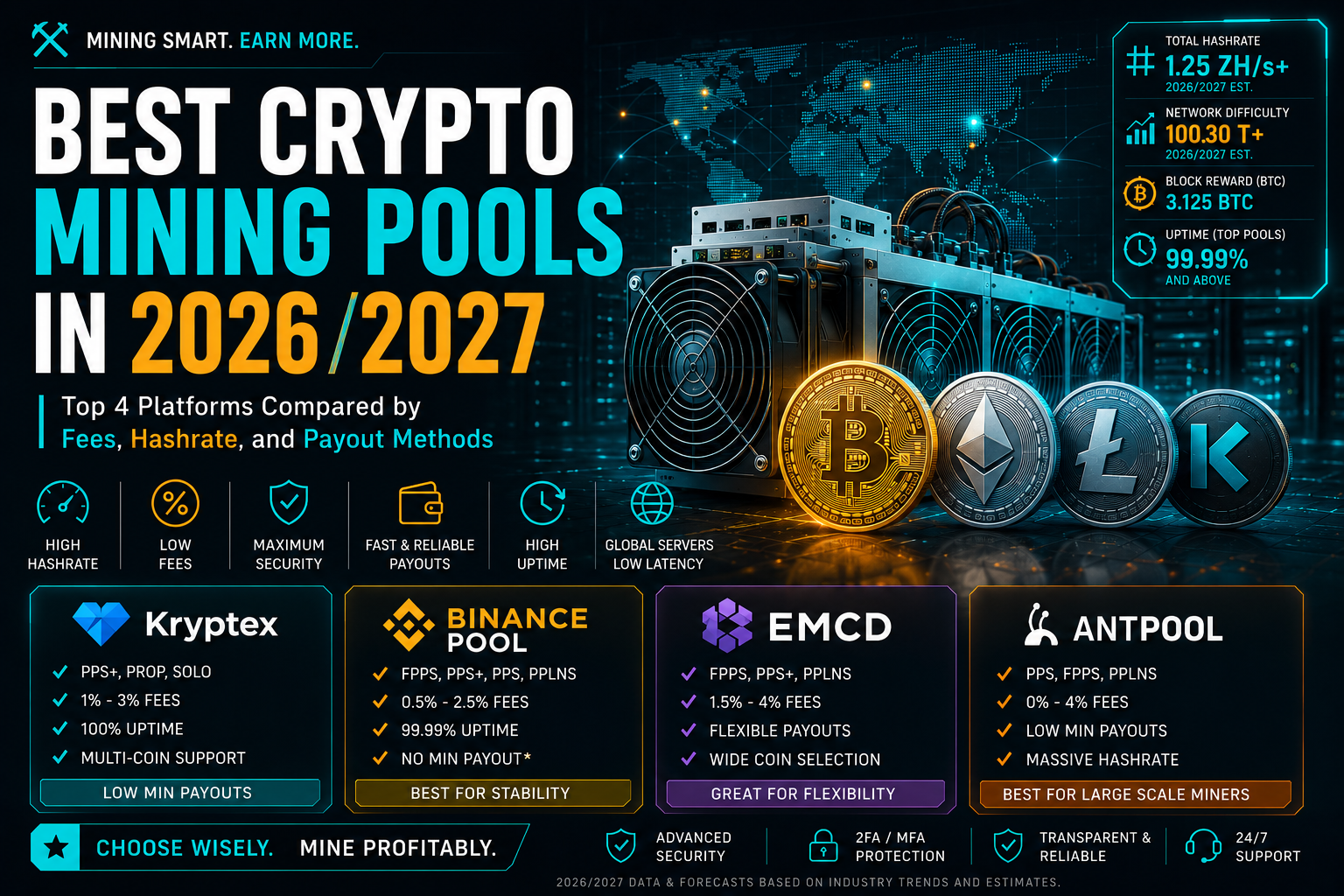
Top 4 Crypto Mining Pools in 2026 (Hashrate, Fees, Uptime & Payout Comparison)
| Mining Pool | Hashrate | Supported Coins | Fees | Payout Method | Uptime | Min Payout | Security | Rating |
|---|---|---|---|---|---|---|---|---|
| Kryptex | BTC 88.09 PH/s LTC 758.75 GH/s ETHW 659.79 GH/s | BTC, BCH, LTC, ETHW, XMR, RVN, KAS… | 1% - 3% | PPS+, PROP, SOLO | 100% | BTC 0.001 LTC 0.05 ETHW 0.1 | 2FA | 9/10 |
| Binance Pool | BTC 51.61 EH/s LTC 166.4 TH/s ETHW 650.21 GH/s | BTC, BCH, LTC, ETC, ETHW, RVN, KAS… | 0.5% - 2.5% | FPPS, PPS+, PPS, PPLNS | 99.99% | 100 KAS No min others | MFA | 8/10 |
| EMCD | BTC 19.79 EH/s LTC 53.67 TH/s KAS 10.79 PH/s | BTC, BCH, DASH, LTC, KAS, DOGE… | 1.5% - 4% | FPPS, PPS+, PPLNS | Not disclosed | BTC 0.001 LTC 0.05 KAS 50 | 2FA | 7/10 |
| Antpool | BTC 166 EH/s LTC 294 TH/s BCH 206 PH/s | BTC, BCH, LTC, DASH, ZEC, KAS… | 0% - 4% | PPS, FPPS, PPLNS | Not disclosed | BTC 0.0005 LTC 0.001 BCH 0.01 | 2FA | 9/10 |
💡 Tip: Always balance fees, uptime, and payout model—not just hashrate.
Estimated Mining Pool User Base in 2026 (Pool Size & Market Reach)
Estimated Mining Pool User Base in 2026
| Pool | Estimated Users |
|---|---|
| Kryptex | ~100K – 300K |
| Binance Pool | ~500K+ |
| EMCD | ~200K+ |
| Antpool | ~1M+ |
⚠️ Estimates based on ecosystem size and hashrate share.
1- Kryptex Mining Pool Review 2026: Fees, Uptime, and Payout Options
Kryptex is the ultimate "set-and-forget" powerhouse in 2026. Whether you're a veteran or just starting, its automatic profit-switching does the heavy lifting, pointing your rigs at whatever is most lucrative in real-time.
The math is transparent: fees stay between 1% and 3%, with PPS+, PROP, and SOLO payout options to fit your risk level. Most importantly, it has maintained a perfect 100% uptime over the last 90 days. When you factor in 2FA security, it’s easily one of the most stable environments for your hashrate.
The only real hurdle? Some niche coins have higher payout thresholds, so smaller miners might wait a bit longer to see their sats. But for a seamless, high-performance experience, Kryptex is hard to beat.
2- Binance Pool Review 2026: Low Fees, FPPS Rewards, and Near-Perfect Uptime
Binance Pool remains the "safe bet" for miners who value uptime over a massive list of experimental coins. With fees ranging from 0.5% to 2.5%—and a 0% fee hook for KAS—it’s built for those who prioritize their bottom line.
The real draw here is the flexibility. Whether you want the guaranteed daily "salary" of FPPS or the lower-fee gamble of PPLNS, they’ve got a payout model that fits your risk tolerance.
Combine that with a 99.99% uptime record, and it’s arguably the most reliable engine in the game today. It’s slightly more curated than a catch-all like Kryptex, but for the major chains, it’s a powerhouse of stability.
The Verdict: If you want a "set and forget" pool that won't eat your margins, Binance is hard to beat.
3- EMCD Mining Pool Review 2026: Fees, Uptime, and Payout Options
EMCD is the go-to "no-headache" entry point for 2026. If you want a clean, banking-style interface that just works, this is it. It supports the essentials with FPPS, PPS+, and PPLNS payout models to fit your risk level.
The math starts at a fair 1.5% fee, though it can climb toward 4% depending on the market. While 2FA security is standard, the pool isn't as transparent with live uptime data as its competitors.
The Verdict: Perfect for beginners who value a polished experience. However, if you're a veteran looking to micro-manage every watt and millisecond, the lack of granular data might feel a bit restrictive.
4- Antpool Review 2026: Large Hashrate, Market Share, and Daily Payouts
Antpool comes from Bitmain, so it has strong infrastructure and the largest market share for Bitcoin mining. It supports mining for over 15 cryptocurrencies, and payouts are made daily using three methods: PPS, FPPS, and PPLNS. Miners often find that a larger collective hashrate can lead to more consistent income.
Fees are between 0% and 4%, which is a bit higher than some other options. While specific uptime data isn't shared publicly, its reputation for scale, stability, and trustworthiness positions it as a leading option, particularly for dedicated Bitcoin miners.
The Takeaway: It’s Not About Power—It’s About the Math
In 2026, the biggest mistake you can make is chasing the highest hashrate and assuming the rewards will follow. If you’re in the trenches, you know that raw power is just one part of the equation. The smartest players on the racks aren't just "mining harder"; they’re auditing their pools like hawks.
A massive pool might look attractive, but if their fees are eating your margins or their uptime is flaky, your high-end ASICs are basically just expensive heaters. Survival in this market comes down to the "boring" stuff: consistent uptime, a payout model that matches your cash flow needs, and transparent fees that don't have hidden "taxes" tucked away in the fine print.
At the end of the day, your hashpower is a commodity. Where you point it determines whether you’re actually stacking sats or just subsidizing someone else’s infrastructure.
The Verdict for 2026: Don't just follow the crowd. Choose the pool that treats your hashrate like the high-value asset it is.
If you're serious about mining in 2026, don’t leave your hashrate on autopilot. Audit your pool, optimize your setup, and treat every percentage point like profit—because it is.
FAQ: Crypto Mining Pools in 2026
Q1: What is a crypto mining pool and how does it work?
A crypto mining pool is a group of miners who combine their computational power (hashrate) to increase the chances of solving blocks. When a block is mined, the reward is shared among participants based on their contribution. This model provides more consistent payouts compared to solo mining.
Q2: Which mining pool has the lowest fees in 2026?
In this comparison, Binance Pool offers some of the lowest fees, including zero pool fees for KAS mining and competitive rates for other coins. However, total profitability also depends on payout structure, uptime, and supported cryptocurrencies.
Q3: What is the best payout method for mining pools (PPS, FPPS, PPLNS)?
PPS and FPPS offer more predictable payouts because miners are paid per share submitted. PPLNS can provide higher rewards over time but comes with more variance. The best option depends on your risk tolerance and preference for stable versus potentially higher returns.
Q4: How important is uptime when choosing a mining pool?
Uptime is critical because downtime directly impacts your earnings. A pool with 99%–100% uptime ensures consistent mining activity and stable payouts. Frequent outages can significantly reduce profitability over time.
Q5: Can beginners join large mining pools like Antpool or Kryptex?
Yes, beginners can join large mining pools. Many platforms offer user-friendly dashboards and clear payout structures. However, new miners should carefully review minimum payout thresholds and fee structures before committing.
Q6: What factors should I compare before choosing a mining pool?
Key factors include hashrate size, fee percentage, reward distribution model, supported coins, minimum payout threshold, security features (like 2FA), and historical uptime. Comparing these elements helps you select a pool that matches your mining goals and hardware capacity.