INTRODUCTION
In 2026, the global energy landscape has decoupled into two distinct worlds: the high-margin, latency-sensitive world of AI, and the low-margin, high-efficiency world of Bitcoin mining. For the professional infrastructure expert, Bitcoin mining is no longer a crypto play; it is a pure-play energy arbitrage business.
As AI data centers continue to saturate traditional hubs like Northern Virginia and Dublin, Bitcoin miners are being pushed to the frontier of the grid. To succeed in this environment, one must understand that bad power and grid instability are the new normals. This article outlines the engineering and financial realities of mining in an era where electricity quality is declining and power strategy defines the bottom line.
1. Understanding the AI Displacement: Why Energy Quality is the New Frontier for Miners
In 2024, the primary concern was sheer energy volume. By 2026, the problem has evolved into power quality and grid congestion.
The Impact of Harmonic Distortion and Synchronous Demand from AI Data Centers
AI data centers, powered by dense GPU clusters (like the Blackwell B200 and subsequent iterations), create massive synchronous demand. When these centers cycle through training phases, they create harmonic distortions—deviations from the standard 60 Hz sine wave—that can exceed the 8% Total Harmonic Distortion (THD) threshold.
For Bitcoin miners, this creates a unique opportunity. While AI requires clean power and ultra-high uptime, Bitcoin miners can thrive on garbage energy: curtailed wind, stranded gas, and off-peak baseload. However, as AI drives up industrial rates in traditional clusters, miners must look toward energy-advantaged regions where they act as a "stabilizing sponge" for the grid.
2. Analyzing Electricity Cost Thresholds for 2026 Mining Profitability
In the current epoch, post-halving economics have made the margin for error razor-thin. Power cost is the only variable that truly scales.
Regional Industrial Rates and the Critical Five-Cent Profitability Rule
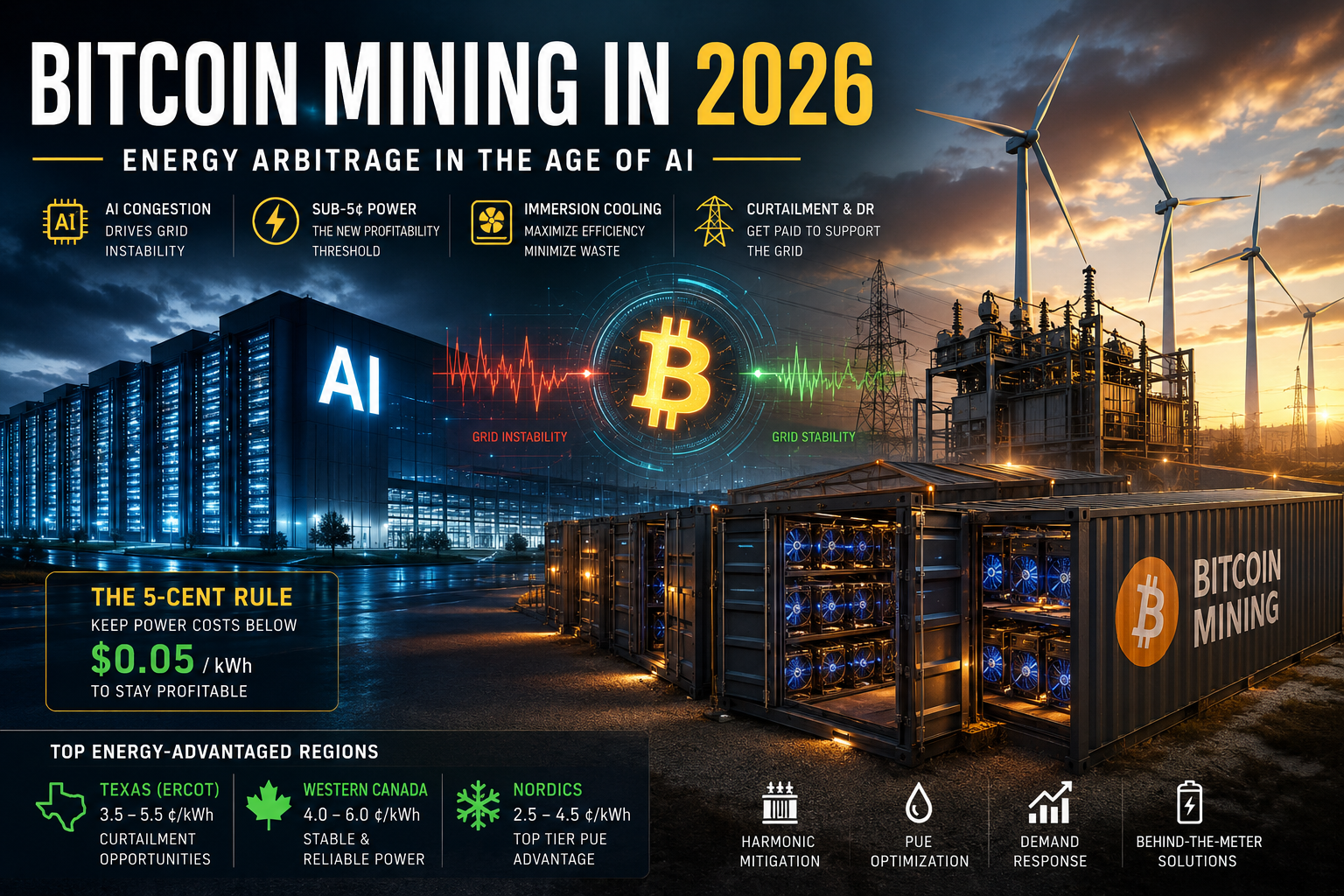
| Region | Avg. Rate (¢/kWh) | Mining Viability / Strategy |
|---|---|---|
| U.S. East Coast (PJM) | 9.5 – 12.0¢ | Unviable (AI Congested) |
| Texas (ERCOT - BTM) | 3.5 – 5.5¢ | Highly Profitable (Curtailment Required) |
| Western Canada (Hydro/Gas) | 4.0 – 6.0¢ | Stable / Moderate |
| Nordics (Renewables) | 2.5 – 4.5¢ | Top Tier (PUE Advantage) |
The Importance of Sub-5 Cent Power
For 2026-generation ASICs (averaging 15–18 J/TH), an all-in power cost exceeding $0.05/kWh places the operation at significant risk during price retracements. The most successful operators are now targeting sub-3 cent power through Demand Response (DR) programs.
3. Engineering High-Performance Infrastructure for Grid Instability and Heat Management
The physical layer of a 2026 mining site is an exercise in heat management and electrical resilience.
Transformer Sizing and Harmonic Mitigation Strategies
Because AI clusters are polluting the local grids with harmonics, mining infrastructure must now include robust filtering. We are seeing a shift toward K-Factor rated transformers, designed specifically to handle the heat generated by harmonic currents.
Engineering Note: Over-sizing transformers by 20% is no longer a luxury; it is a requirement to prevent premature failure in "dirty" grid environments.
Power Usage Effectiveness (PUE) Optimization and Cooling Technologies
In 2026, air-cooled "warehouses" are becoming obsolete in high-density regions:
-
Immersion Cooling: PUE of 1.03 - 1.05. High CAPEX, but allows for overclocking and eliminates fan noise.
-
Hydro-Cooling: Bridging the gap for industrial-scale deployments.
-
Standard Air: PUE of 1.15 - 1.25. Only viable in northern latitudes with free-air cooling.
4. Advanced Power Procurement Strategies: From Virtual Power Plants to Behind-the-Meter Solutions
The "Fixed Rate" contract is a dying breed. Grid operators now prefer miners who can act as a Virtual Power Plant (VPP).
Leveraging Curtailment Agreements and Demand Response
-
Curtailment Agreements: By agreeing to shut down within 10 seconds of a grid frequency deviation, miners can receive "credits" that effectively lower their net power cost by 30–50%.
-
Floating vs. Fixed: Large-scale operators use a "Hedged Floating" strategy—buying the floor on spot markets but using financial swaps to protect against price spikes.
-
Behind-the-Meter (BTM): The gold standard. Connecting directly to a 50MW solar farm or a natural gas wellhead bypasses transmission and distribution (T&D) charges, which now account for up to 40% of a utility bill.
5. Managing Mechanical and Regulatory Risks in an Unstable Energy Environment
As seen in recent global energy crises, frequency deviations are becoming more common. When 1,500 MW of load disappears instantly (due to AI data centers tripping into backup mode), the grid frequency can spike dangerously.
Protecting ASIC Lifespan Against Frequency Deviations and Zoning Restrictions
For a miner, this frequency instability is a mechanical risk. Constant tripping of breakers and power cycling of ASICs shortens the lifespan of the hashboards. 2026 mining rigs are more efficient but also more sensitive to undervoltage.
Regulatory Shifts: Jurisdictions like Loudoun County (U.S.) have shifted to "restrictive zoning." New 2026 developments must prove a Net Positive Grid Impact, often requiring on-site battery storage or participation in advanced frequency regulation services.
6. Advisory Conclusion: Building a Sustainable Energy Moat in the 2026 Bitcoin Landscape
Mining in 2026 is no longer about buying hardware; it is about securing an energy moat. If you are an investor or developer, your checklist must include:
-
Interconnection Grade: Do not build where the queue is longer than 3 years.
-
Harmonic Profile: Test the site's THD. If it's above 5%, budget for active filters.
-
PUE Strategy: If your PUE is above 1.1, you are leaving 10% of your margin on the table.
-
Curtailment Readiness: Your firmware and switchgear must be capable of automated, remote shutdowns to capture DR revenue.
Bitcoin mining remains the world's most efficient tool for balancing the grid, but only for those who treat the transformer as seriously as the hash rate.
Frequently Asked Questions (FAQ)
Q1: Why is AI congestion a problem for Bitcoin miners in 2026?
AI data centers and Bitcoin miners are competing for the same high-voltage substations. However, AI's massive and fluctuating power draw causes grid instability and harmonic noise, which can damage mining hardware if not properly mitigated.
Q2: What is the "5-Cent Rule" in 2026 mining?
The 5-Cent Rule states that for modern ASICs to remain profitable through market cycles, the total operational electricity cost must stay below $0.05 per kWh. Operators paying more are often forced to shut down during price pullbacks.
Q3: How does Bitcoin mining help stabilize the power grid?
Unlike AI data centers that need 99.9% uptime, Bitcoin miners are "interruptible." They can shut down instantly during peak demand, acting as a flexible load that prevents blackouts and balances the grid frequency.
Q4: Is air cooling still viable for industrial mining?
In 2026, air cooling is only viable in extremely cold climates. In temperate or warm regions, the high power density of new ASICs makes liquid or immersion cooling necessary to prevent thermal throttling and maintain efficiency.