Introduction
Bitcoin mining looks radically different depending on where you stand. In multi-megawatt data centers, corporate operators run thousands of high-powered ASICs focused strictly on aggregate hash rate and continuous revenue through massive mining pools. At home, however, a growing community of enthusiasts is turning to small, desktop-sized open-source devices like the Bitaxe Gamma 602 to participate in a completely different paradigm: Solo Mining, often called "Lottery Mining."
Understanding the divide between pool mining and solo mining is essential for anyone entering the home mining space.
Pool Mining vs. Solo Mining: Two Polar Opposite Approaches
With pool mining, your hardware doesn't have to tackle the massive block puzzle all by itself. Instead, it sends smaller, easier proofs of work—called 'shares'—to a central server. The pool pools together the hash rate from thousands of devices to find blocks much faster, then splits up the rewards based on how much work each miner contributed. This delivers steady, predictable returns—even if those returns amount to only a few cents per day on small hardware.
In Solo Mining, partial effort yields zero financial return. Your device works independently to generate a hash that satisfies the global network difficulty target.
-
If you miss: The device consumes electricity without generating any payout.
-
If you hit: You earn the entire block reward (currently 3.125 BTC on Bitcoin, plus transaction fees).
Because the statistical probability of finding a Bitcoin block with a single desktop unit is extremely low, enthusiasts view the operating cost as the price of a continuous, low-cost lottery ticket.
Buy Bitcoin or Buy a Miner? The Community Debates
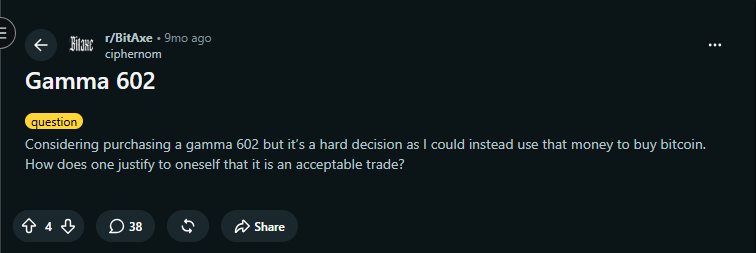
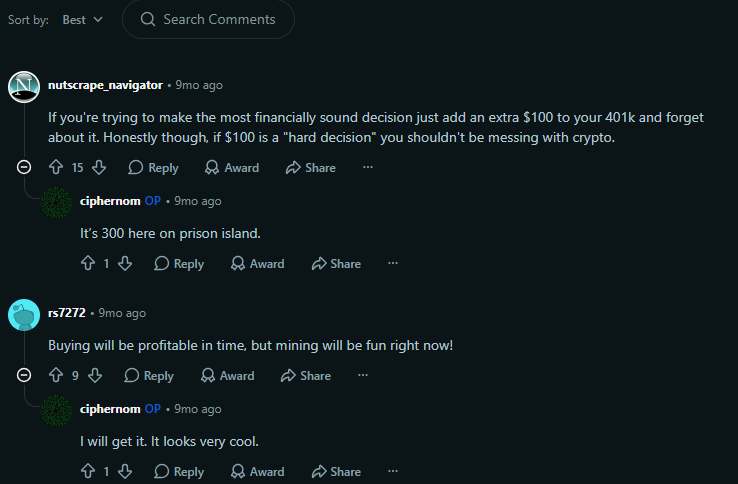
The decision to buy a home ASIC miner rarely stems from pure financial speculation. A viral thread on Reddit’s r/BitAxe community captures the core dilemma every prospective buyer faces:
In this post, user ciphernom poses a fundamental question:
"Considering purchasing a gamma 602 but it’s a hard decision as I could instead use that money to buy bitcoin. How does one justify to oneself that it is an acceptable trade?"
The community's response highlights the exact philosophy driving home mining:
As user rs7272 neatly summarizes in the discussion:
"Buying will be profitable in time, but mining will be fun right now!"
This exchange gets to the heart of home mining. Pure financial logic suggests buying spot Bitcoin directly. However, home miners pay for hardware to gain hands-on technical experience, run open-source software, support network decentralization, and secure a perpetual, low-power entry in the block reward lottery.
Bitaxe Gamma 602: Technical Specifications
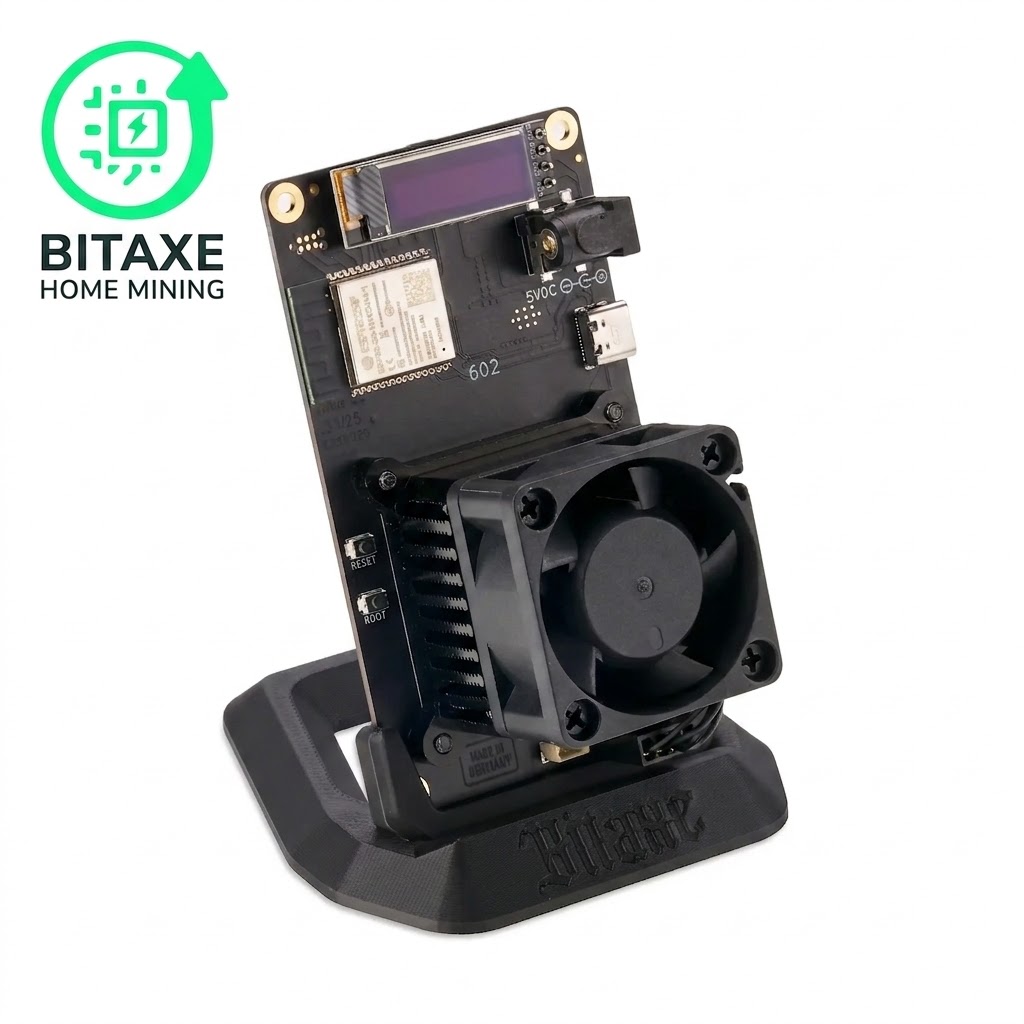
Developed by Open Source Miners United (OSMU), the Bitaxe Gamma is the fifth major generation of the open-source Bitaxe line. It features a single Bitmain BM1370 ASIC chip—the exact same chip architecture used inside industrial Antminer S21 Pro units.
| Specification | Details |
|---|---|
| Device Model | Bitaxe Gamma 602 |
| ASIC Chip | Bitmain BM1370 (Closed-source ASIC) |
| Mining Algorithm | SHA-256 |
| Stock Hash Rate | ~1.2 TH/s |
| Overclocked Hash Rate | Up to ~1.8 TH/s (depending on tuning & cooling) |
| Base Power Efficiency | ~15 J/TH |
| Stock Power Draw | ~18 W – 20 W |
| Overclocked Power Draw | Up to ~35 W |
| Connectivity | Wi-Fi 2.4 GHz |
| Onboard Controller | ESP32-S3 |
| Firmware Interface | AxeOS / ESP-Miner |
| Cooling System | Heatsink + 5V Active Cooling Fan |
| Power Input | 5V DC |
| Mining Modes | Solo Mining, Mining Pool, Lottery Mining |
| Project Nature | Open-source PCB design & software |
Note: Performance varies depending on board revision, power supply quality, and active thermal management. Overclocking increases sensitivity to heat and requires adequate airflow.
Solo Mining Math: Bitaxe Gamma 602 By The Numbers
To understand the "lottery ticket" analogy, here is the exact mathematical breakdown for a Bitaxe Gamma 602 operating at stock performance on the Bitcoin network.
(Note: Calculations assume a global network hash rate of ~700 EH/s, a block time of 10 minutes, and an electricity rate of $0.10/kWh).
- Hardware Hash Rate: 1.2 TH/s (1,200,000,000,000 hashes/sec)
- Power Draw: ~18 Watts (0.432 kWh / day)
- Reference Global Network Hash Rate: ~700 EH/s (700,000,000 TH/s)
The Probability Breakdown
| Metric | Mathematical Value | Real-World Context |
|---|---|---|
| Odds Per Single Block | 1 in 583,333,333 | Chance of hitting a block in any 10-minute window |
| Daily Winning Odds | ~0.0000247% | 1 in ~4.05 million chance per 24 hours |
| Annual Winning Odds | ~0.009% | 1 in ~11,100 chance per year |
| Expected Time to Block | ~11,100 Years | Statistical average duration for a single block hit |
| Daily Electricity Cost | ~$0.043 / day | Calculated at $0.10/kWh (~$1.30 per month) |
The Takeaway: At roughly $1.30 per month in electricity, running a Gamma 602 in solo mode isn't a financial investment strategy. It is a $0.04-per-day lottery entry combined with the educational value of running real, open-source Bitcoin infrastructure on your desk.
Real Proof from the Mining Pools: When Solo Mining Hits
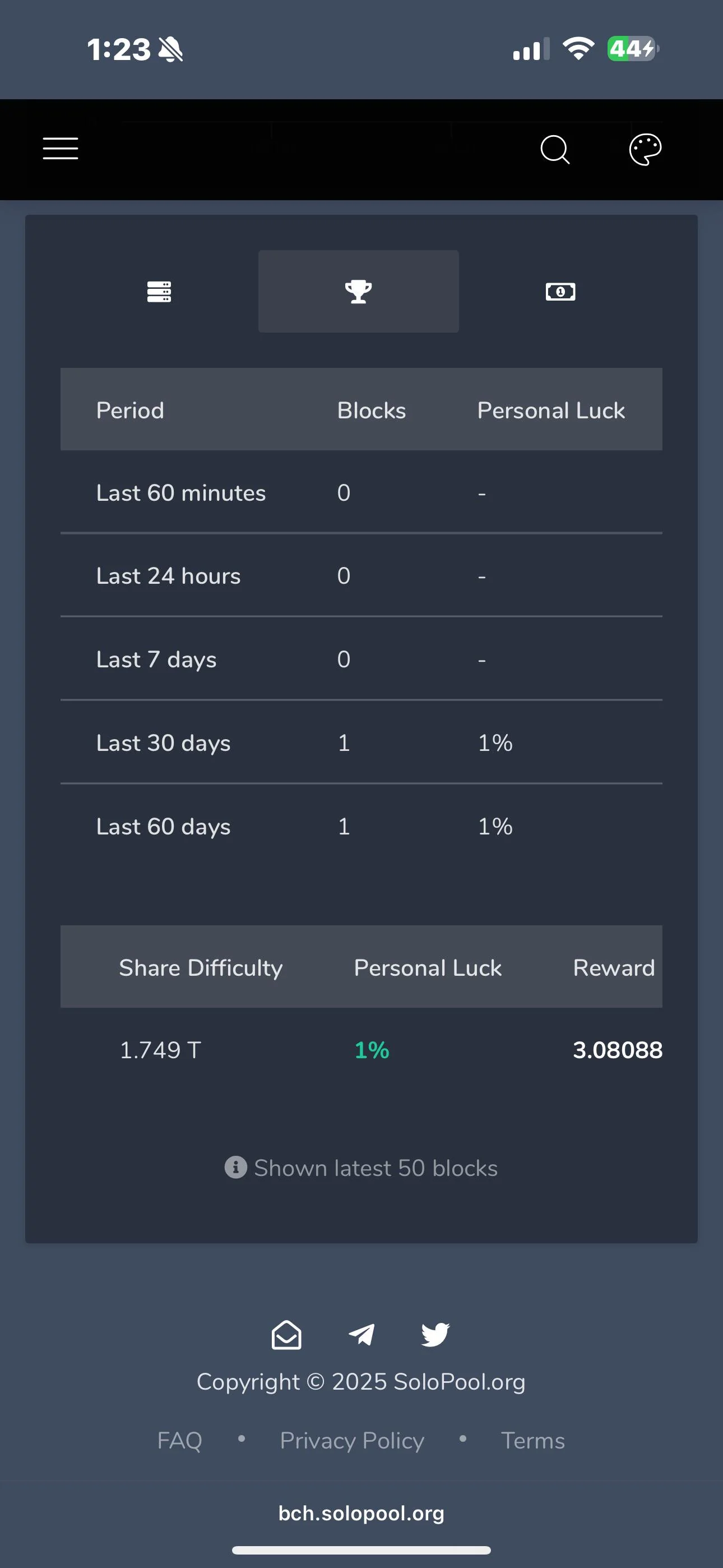
Yes, technically a single micro-miner can solve a block—it just comes down to pure luck. On Bitcoin, hitting a block with a tiny hash rate is like winning a high-stakes lottery because the global difficulty is so sky-high. That's why many micro-miners point their rigs toward lower-difficulty SHA-256 coins like Bitcoin Cash (BCH), where solo mining actually gives you a realistic shot at finding a block and proving your setup works.
Data from SoloPool shows what happens when a small unit hits the jackpot:
This pool dashboard records a solo mining event where a miner achieved a 1% Personal Luck score over a 30-day period, successfully submitting a share difficulty of 1.749 T to capture a full block reward of 3.08088 BCH.
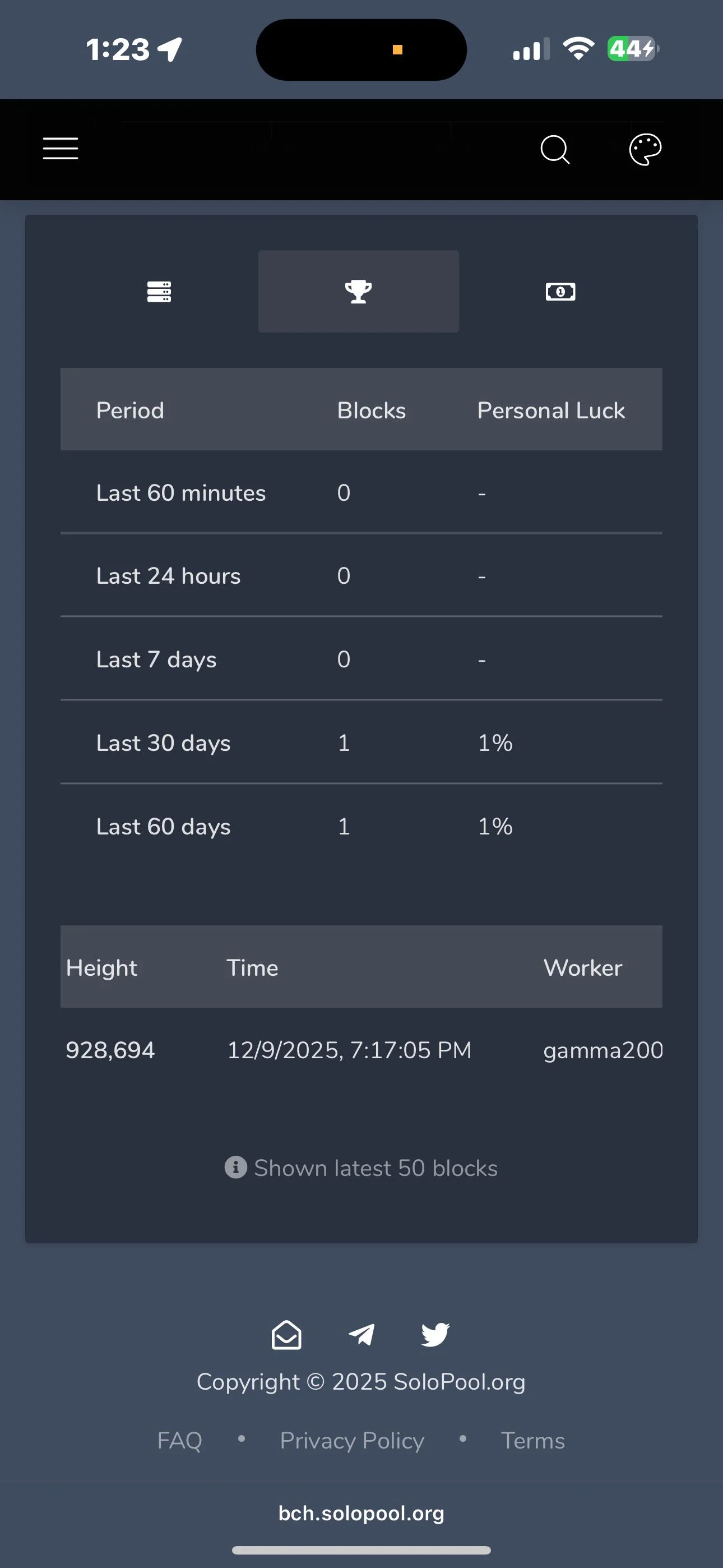
A closer look at the pool's block history logs reveals the exact worker responsible for this hit:
The worker details verify that worker gamma200—a single Bitaxe Gamma device—solved block #928,694 on the Bitcoin Cash network.
This real-world example demonstrates why hobbyists remain drawn to solo mining. Whether mining on Bitcoin directly for a multi-hundred-thousand-dollar block reward or targeting alternative SHA-256 chains for more frequent wins, small devices retain the theoretical ability to solve full blocks.
The Home Miner’s Advantage
The Bitcoin network operates on strict mathematical equality: every single hash computed has the exact same probability of satisfying the target difficulty as any other hash. The network does not grant preference to industrial farms over home hardware.
A multi-petahash farm increases its odds purely through volume, rolling the mathematical dice millions of times more per second. However, industrial farms face significant fixed overhead, high cooling demands, and commercial power contracts.
A home user running a Bitaxe Gamma 602 at 18 Watts isn't attempting to out-hash commercial farms. Instead, they operate with minimal overhead, maintaining a live node on the network and holding a continuous entry in the global block lottery for cents a day in electricity.
Why Home Micro-Mining Makes Sense
At its core, home micro-mining operates on a fundamentally different philosophy than industrial server farms and high-end commercial rigs built strictly for traditional ROI.
Investing $10,000 to $20,000 in a heavy commercial ASIC for a residential environment comes with staggering electricity bills, intense noise, and massive heat—all without any guarantee of ever hitting a solo block during the machine's operational lifespan.
In contrast, spending $160 to $200 on an ultra-low-power desktop miner completely flips the economic dynamic. With very low monthly wall power costs, a compact device offers a low-cost, affordable way to keep a continuous entry in the block lottery. You get a genuine shot at capturing a full block reward for minimal financial risk, while simultaneously gaining a front-row seat to the inner workings of the Bitcoin network.
Frequently Asked Questions
Q1: What exactly is the Bitaxe Gamma 602?
It’s a pocket-sized, open-source Bitcoin miner powered by a single Bitmain BM1370 chip. Instead of dealing with the deafening noise and massive heat of a full-sized commercial rig, the Gamma 602 is built for hobbyists. It’s designed to sit quietly on your desk so you can tinker with hardware, learn the ropes of Bitcoin, and try your luck at solo or pool mining.
Q2:Can I really use this to mine Bitcoin by myself (solo mining)?
Absolutely. You can bypass the pools and point it directly at the Bitcoin network. Just keep expectations grounded: because it’s a micro-miner, your odds of actually solving a block are microscopic. The community doesn't view it as a steady money-maker; they treat it like a perpetual, low-cost lottery ticket.
Q3: How much is this going to add to my electric bill?
Almost nothing. Right out of the box, the Gamma 602 barely sips 18 to 20 watts of power—that’s less than most LED light bulbs in your house. If you decide to push its limits and overclock it, it will pull a bit more juice and get hotter, but it will still cost just pennies a day to keep running.
Q4: Is buying a Gamma 602 a profitable investment?
If you want guaranteed daily returns, no. This isn't the right hardware for traditional ROI. People don't buy the Gamma to get rich slowly; they buy it because it’s a fun, hands-on piece of tech. The real value is the education, the open-source community, and the thrill of having a live, ultra-cheap wager on hitting a full block reward.
Q5: Be honest: what are my actual chances of hitting a Bitcoin block?
Mathematically? Extremely close to zero. You are throwing 1.2 TH/s against industrial farms pushing millions of terahashes. However, the beauty of the Bitcoin protocol is that it doesn't care who you are or how big your operation is. Every single hash your little machine spits out has the exact same chance of winning as a hash from a billion-dollar facility. It requires incredible luck, but as long as it's plugged in, you are officially in the game.