
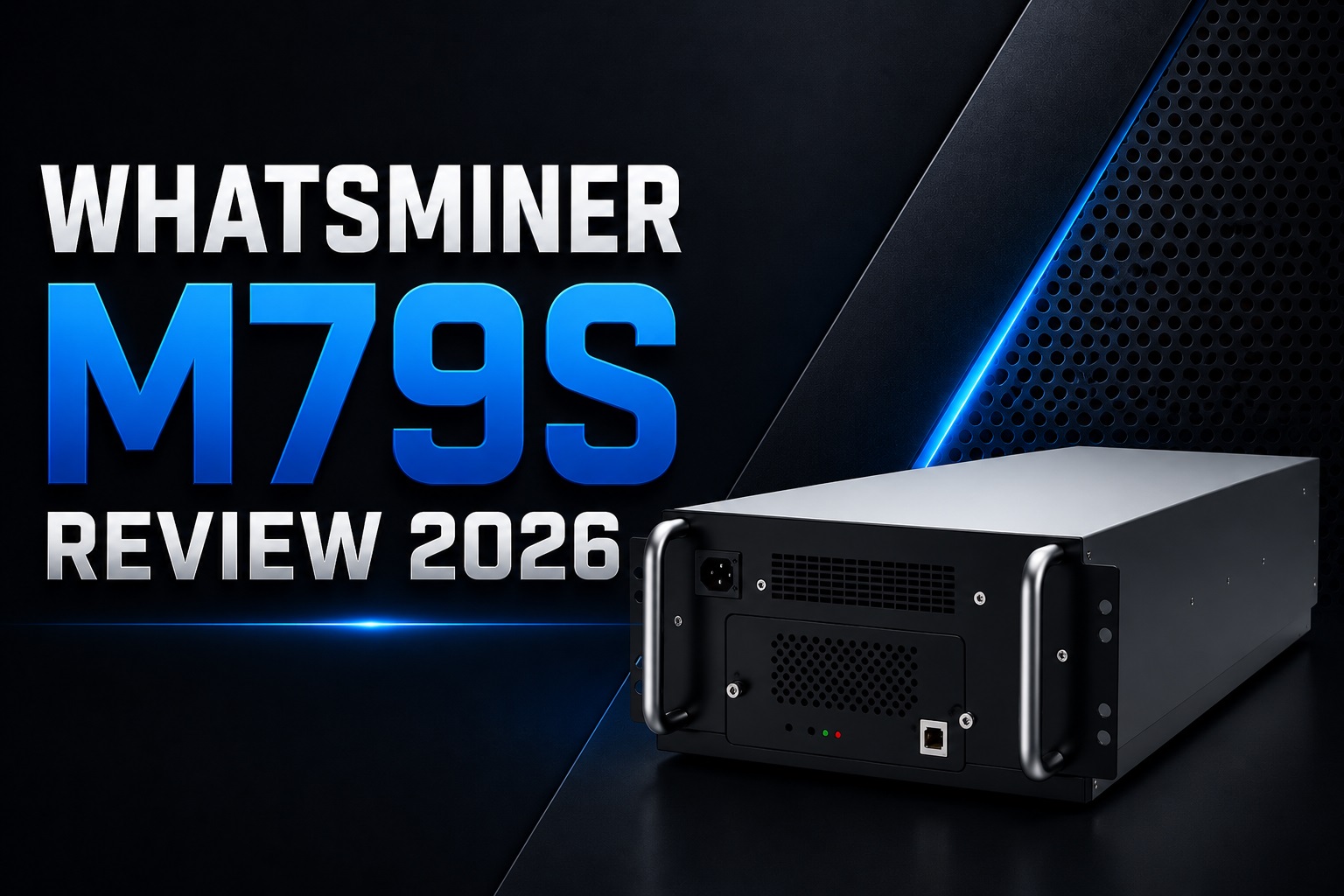
INTRUDOCTION
The year 2026 has officially ended the era of the casual miner. With network difficulty hitting a staggering 144 trillion, Bitcoin mining is no longer a game of participation—it is a war of attrition. In this climate, MicroBT has unleashed the WhatsMiner M79S, a 1350 TH/s hydro-cooled beast that isn't just a machine; it’s an industrial apex predator.
⚠️ Important Disclaimer on Profitability Estimates All profitability figures in this article are dynamic estimates and may change at any time. Actual mining results depend on several key factors:
• Bitcoin market price volatility
• Network difficulty adjustments
• Electricity costs in your region
• Mining pool fees and operational uptime
Therefore, all numbers should be treated as indicative scenarios, not guaranteed returns.
While competitors focus on incremental efficiency, the M79S focuses on total network dominance. Delivering a massive 1.35 PH/s, this rig is designed to extinguish competition by sheer force of hashrate. Its 20kW power appetite is a barrier to entry that separates the amateurs from the elite. For those with the infrastructure to harness this hydro-cooled monster, the M79S provides a unique dual-threat: it stacks sats at an unprecedented rate while its heat recovery technology transforms waste into a second revenue stream.
If you are looking to survive the 2026 hash-war, you don't need a miner. You need a weapon. Welcome to the age of the Hashrate Beast.
WhatsMiner M79S — 2026 Snapshot
Quick specs, power profile, profitability ranges, and ROI assumptions
| Category | Details | Notes / Context |
|---|---|---|
| Core Specifications | ||
| Model | MicroBT WhatsMiner M79S | 8th generation / “Hashrate Beast” (as described) |
| Release Date | December 2025 | Market availability may vary by region |
| Algorithm | SHA-256 (Bitcoin, Bitcoin Cash) | Compatible with SHA-256 pools |
| Hashrate | 1350 TH/s | Higher total hashpower than Antminer S23 U3 (1160 TH/s) |
| Efficiency | 14.815 J/TH | Less efficient than S23 U3 (9.5 J/TH), per article |
| Cooling | Advanced Hydro-Cooling (Water) | Designed for industrial setups / heat recovery potential |
| Noise Level | 50 dB | Quiet enough for professional data centers (as stated) |
| Operating Range | 5°C–45°C; 5%–95% humidity | Maintain stable intake temps & clean water loop |
| Estimated Market Price | ~ $18,000 | Pricing varies by vendor, warranty, and region |
| Power Profile & Profitability Scenarios | ||
| Power Consumption | ~ 20 kW | Highly electricity cost-sensitive (as described) |
| Profit @ $0.08/kWh | ~ $12–$14/day | Typical “regular environment” estimate in article |
| Profit @ $0.05/kWh | ~ $27/day | Article highlights this as the “sweet spot” |
| Break-even Electricity Cost | ~ $0.11/kWh | Above this, article says it turns unprofitable |
| ROI (Zero-Cost Power Assumption) | ||
| Daily Income | $50.00 | Assumes free/zero-cost electricity (solar / associated gas) |
| Monthly Income | $1,500 | Based on the article’s “Zero-Cost” scenario |
| Annual Income | $18,000 | Matches the listed device price (~$18,000) |
| Time to ROI | ~ 12 months | Article notes extended lifespan due to industrial hydro-cooling |
Profitability note: Figures are estimates at the time of writing and can change continuously with network difficulty, the mined coin, market price, pool fees, uptime, and electricity rates.
The ever-changing realm of Bitcoin mining has had a new behemoth introduced into the fray with the arrival of 2026 and the WhatsMiner M79S miner by MicroBT. Nicknamed the "Hashrate Beast," this 8th generation ASIC miner has pushed the limits of mere computational capability and set a new standard for the mining industry.
WhatsMiner M79S Hashrate Performance and Mining Power
The WhatsMiner M79S is in a league of its own regarding its hashrate of 1350 TH/s. To better understand its power, this is faster than Bitmain's 9th-generation flagship Antminer S23 U3, which was announced in January 2026 and features a 1160 TH/s hashrate.
Although the M79S outranges the other models in terms of total hash power, it still trails the Antminer S23 U3 in terms of relative efficiency, at 14.815 J/TH to the U3’s 9.5 J/TH. The new miner, in other words, is a high-performance muscle car, extremely fast but needing plenty of "gas" to keep it moving.
WhatsMiner M79S Technical Specifications and Hardware Overview
• Release Date: December 2025
• Algorithm: SHA-256 (Bitcoin, Bitcoin Cash)
• Hash Rate: 1350 TH/s
• Cooling: Advanced Hydro-Cooling (Water)
• Noise Level: 50 dB (Quiet enough for professional data centers)
• Operating Range: 5°C to 45°C; 5% to 95% Humidity
• Market Price: Around $18,000
WhatsMiner M79S Profitability and Electricity Cost Analysis
The M79S is very electricity cost-sensitive because of the huge 20kW power consumption. Running in a regular environment with an electricity cost of $0.08 per kilowatt-hour, the device makes an average daily profit of $12-$14. The actual potential of this device can be tapped when using low or green power:
• For $0.05/kWh: Profit increases to $27/day, making it an attractive choice.
• At cost of $0.11/kWh: This is where the device breaks even.
• Beyond $0.11/kWh: Any cost increment beyond this will result in loss of money.
WhatsMiner M79S ROI and Mining Return on Investment
It remains exceptional for miners who have access to free electricity. They may have excess Solar Power or associated Gas.
• Daily Income: $50.00
• Monthly Income: $1,500
• Annual Income: $18,000
• Time to ROI: 12 Months (1 Year)
In this case of Zero-Cost, the device itself pays for itself exactly one year. Since it is designed with industrial-grade hydro-cooling technology for its M79S model, its hardware is likely to have an extended lifespan beyond one year.
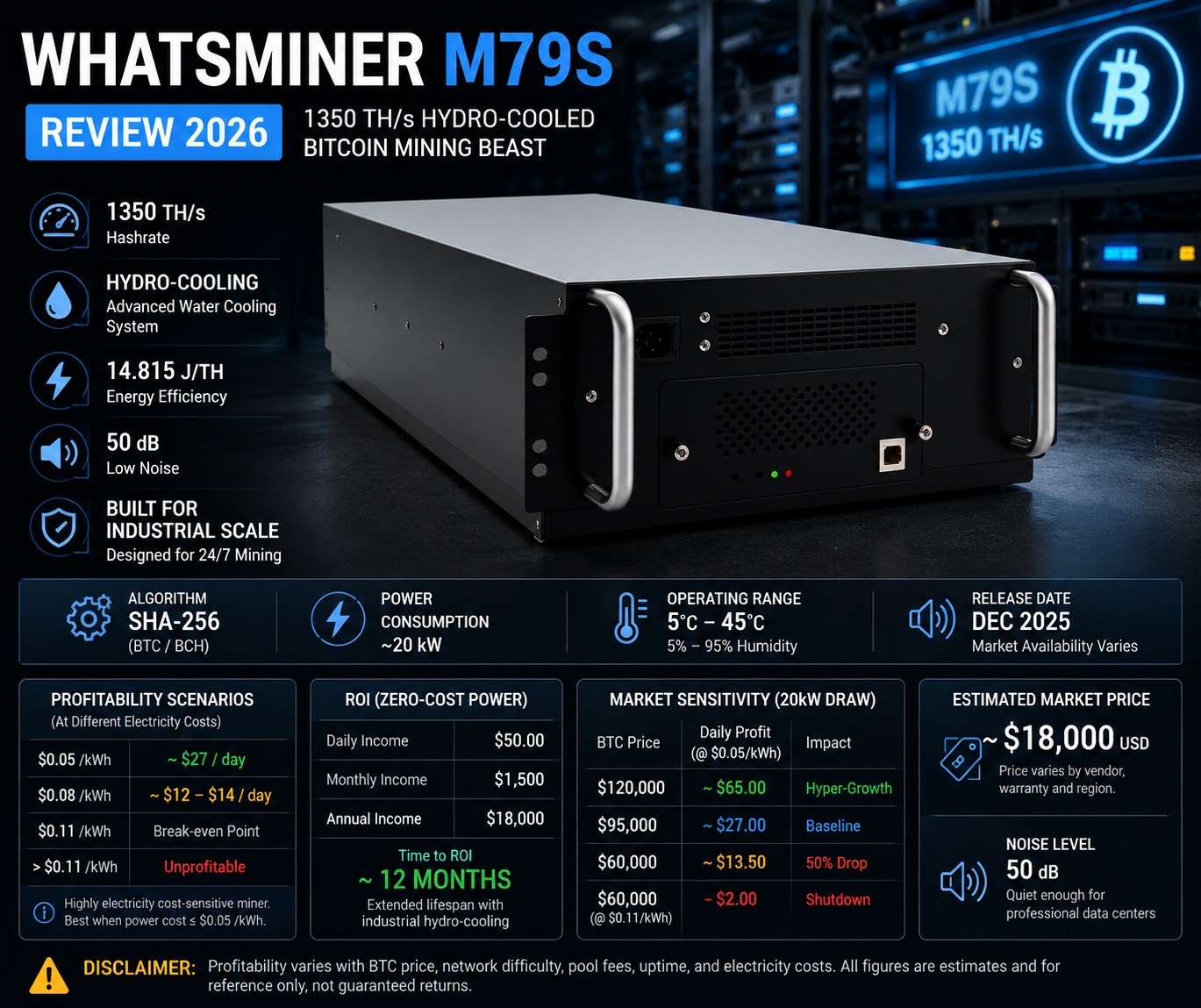
M79S Profitability Sensitivity: BTC Price vs. Electricity Costs
Market Sensitivity Analysis: The 50% Profit Volatility Risk
How BTC Price Correction impacts the M79S Profitability (20kW Draw)
| Market Scenario | BTC Price | Elec. Cost ($/kWh) | Daily Net Profit | Impact on ROI |
|---|---|---|---|---|
| Bull Case (Peak) | $120,000 | $0.05 | ~$65.00 | Hyper-Growth (ROI < 9 Months) |
| Current Baseline | $95,000 | $0.05 | ~$27.00 | Standard ROI (12 Months) |
| Bear Case (Correction) | $60,000 | $0.05 | ~$13.50 | 50% Profit Drop |
| Critical Failure Point | $60,000 | $0.11 | -$2.00 (Loss) | Operational Shutdown Required |
⚠️ Warning: As shown above, a BTC price drop from $120k to $60k isn't just a price dip—it's a 50%+ collapse in daily net income because your 20kW electrical overhead remains fixed regardless of market conditions.
Expert Verdict: Is the WhatsMiner M79S Worth It for Bitcoin Mining?
WhatsMiner M79S is not a hobby mining rig; it is an industrial behemoth. To be successful with this hardware, two things are absolute requirements: Cheap Power and Heavy Infrastructure.
The AI Viewpoint
Provided you can keep your power expenses under $0.05/kWh, the M79S is, without doubt, the top accumulating rig on the market today. The enormous hash power enables you to stack your sats faster than most competing devices. Another huge benefit of the Hydro-cooling system is Heat Recovery. Brilliant managers will be able to repurpose the 20kW of waste heat to power warehouses or greenhouses. That, in turn, can enable you to reach full profitability even faster.
Are you planning to deploy the M79S in a facility that can utilize that heat recovery, or is your focus strictly on the raw hashrate performance?
FAQ
Q1. Can I run the M79S on a standard home connection?
Short answer: Absolutely not. The Reddit consensus is clear: a 20kW draw is equivalent to running five large central air conditioning units simultaneously at full blast. You don’t just plug this in. You need an industrial-grade PDU, a dedicated transformer, and potentially a three-phase power supply. Trying to run this on a residential circuit is a one-way ticket to a house fire or a permanently melted electrical panel.
Q2. Why choose the M79S over the Antminer S23 U3 if Bitmain is more efficient?
This is the classic "Reliability vs. Paper-Specs" debate. On Reddit, the S23 U3 is the efficiency king (9.5 J/TH), but many veteran miners lean toward MicroBT because of their tank-like build quality. While Bitmain units often suffer from higher DOA (Dead on Arrival) rates or hashboard failures, WhatsMiners are known for running years without a hiccup. The M79S is for the miner who value.
Q3. Is the Hydro-Cooling heat recovery actually useful for a small operation?
It’s not just a gimmick, but it requires planning. Users on r/Greenhouses and r/HomeAutomation are already using hydro-miners to heat swimming pools, floor systems, or even small indoor farms. The M79S dumps a massive amount of thermal energy into the water loop. If you just vent that heat outside, you're wasting money; if you recycle it to replace a gas heater, your effective ROI drops significantly.
Q4. Is the 'Hashrate Beast' name just marketing, or does 1350 TH/s actually matter?
In the 2026 mining climate, Total Hash Power is a hedge against difficulty. While efficiency is vital, a higher raw hashrate allows you to capture more of the block reward now before the next difficulty adjustment. On Reddit, the M79S is seen as the ultimate accumulation machine—it’s designed to brute force Bitcoin into your wallet faster than any other single-chassis rig on the planet