Introduction : Why Power Supply Units (PSUs) Are Critical in ASIC Mining Infrastructure
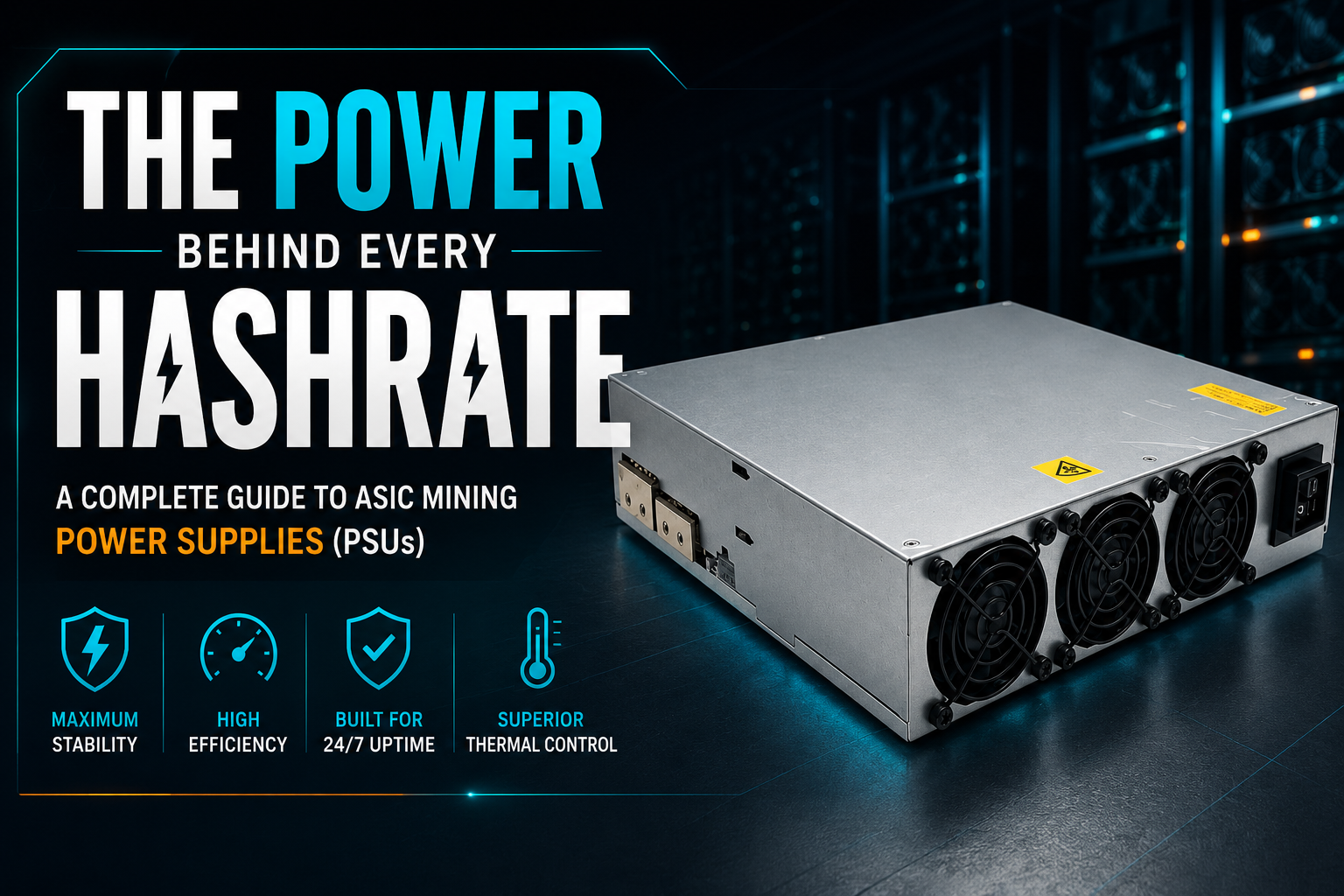
A Power Supply Unit (PSU) is one of the most critical components in a mining ecosystem. Its job is to convert mains electrical power (AC) into stable regulated DC power at the voltages and currents required by the mining devices (ASICs). For ASIC miners, inefficient or unstable PSUs lead directly to reduced uptime, overheating, electrical noise, and hardware failures.
In high-power ASIC mining (e.g., Antminer S19, S21), PSUs must operate at very high continuous loads while maintaining efficiency, thermal stability, voltage regulation, and protection. This requires design approaches far beyond consumer computer PSUs.
Core Internal Components of an ASIC Mining PSU (SMPS Architecture Explained)
Modern mining PSUs are typically switched-mode power supplies (SMPS), not simple transformers. SMPS are used because they offer high efficiency, compact size, thermal control, and high current capabilities — essential for 24/7 mining operation.
Input Stage & Electrical Safety: EMI Filtering, Rectification and Active PFC
-
EMI / Line Filter: Reduces electromagnetic interference entering or leaving the PSU. Protects mining circuits and complies with electrical standards.
-
Rectifier & Power Factor Correction (PFC): Converts AC mains to DC and improves power factor. Active PFC circuits use inductors, MOSFETs, and control circuitry to shape current. This stage ensures compliance with grid codes in industrial setups.
-
Bulk Filtering: Electrolytic capacitors smooth the raw DC and reduce peaks and valleys. Proper filtering is critical to avoid ripple that can damage ASIC control electronics.
High-Frequency Switching & Power Conversion Stage in Mining PSUs
At the heart of a mining PSU is the switching converter.
-
Controller IC: Directs high-frequency switching of power transistors. Manages voltage, current limits, protection, and feedback loops.
-
Power Transistors (MOSFETs / IGBTs): Act as high-speed switches, rapidly turning the DC power on or off. Minimizes heat by operating in saturation or cutoff. This switching feeds the transformer or converter topology (e.g., forward full-bridge).
-
Transformer / Inductors: In isolated SMPS, a high-frequency transformer changes voltages and provides safety isolation. Smaller and lighter than classic low-frequency transformers. Inductors store and release energy to stabilize output.
-
Rectifiers & Filters on Output: Convert high-frequency AC back to DC for ASIC loads. High-current diodes or synchronous MOSFET rectifiers improve efficiency. Output capacitors and inductors smooth DC ripple.
PSU Protection Systems: Overcurrent, Thermal and Voltage Regulation Controls
Robust PSUs contain:
- Over-current protection
- Over-voltage protection
- Short-circuit protection
- Thermal shutdown & fan control
- Voltage feedback loops for regulation at load changes
- Soft start & surge protection for safe connection to grid
These circuits use sensors, microcontrollers, and protection ICs to defend expensive mining hardware.
Key PSU Design Characteristics for Professional ASIC Mining Operations
Efficiency Ratings (80 PLUS Gold, Platinum, Titanium) & Thermal Performance in Mining
PSU efficiency ratings like 80 PLUS Gold, Platinum, Titanium indicate how much input power becomes usable DC versus lost as heat. Higher efficiency reduces electricity waste and heat — crucial at multi-kW loads. In mining, less than 5 percent efficiency improvements can mean thousands in yearly savings.
Voltage Regulation & High-Current Stability for ASIC Hashing Performance
ASIC miners demand tight regulation of voltage rails, especially at high currents (100-300+ A per rail). Significant fluctuations reduce hashing efficiency or cause resets.
Continuous Load Operation: Why Mining PSUs Must Handle 24/7 Full Capacity
Mining PSUs are expected to operate at or near maximum rated power 24/7. Consumer PSUs rated at 80 percent of max are undersized. Industrial ones are designed for continuous full load operation.
Real-World PSU Models Used in High-Power ASIC Mining Farms
| Model | Power Output | Efficiency | Best Use Case | Verdict |
|---|---|---|---|---|
| APW12 | ~3600W | High (Gold/Platinum) | Antminer S19 setups | Stable & Proven |
| APW17 | ~4000W+ | Platinum+ | Antminer S21 high-load | Top Performance |
| Server PSU (2400W) | 2400W | High | Custom mining rigs | Flexible |
| Custom Mining PSU | 1200–3600W | Varies | Mixed ASIC environments | Balanced Choice |
👉 For most operators, APW17 remains the best choice for modern high-efficiency ASIC mining, while server PSUs are ideal for custom deployments.
OEM ASIC-Specific PSUs for Bitmain and Similar Manufacturers
-
Bitmain Antminer PSUs (e.g., APW12, APW17): Designed specifically for Antminer models like S19, S21. Outputs are tuned to ASIC voltage requirements (e.g., 12-15V range). Provide stable current (e.g., 233A for APW12, 267A for APW17).
-
APW3++ (Bitmain / similar branding): Example of PSU made in partnership with ASIC vendor for optimal compatibility. Tailored connectors and protection logic to match mining boards.
Industrial and Third-Party PSU Options for Advanced Mining Deployments
PSUs designed for mining rigs or server use often outperform standard PC units.
-
High-wattage ASIC PSU modules (3000W+) with many PCIe connectors.
-
Custom ASIC PSU products (1200W – 3600W) with built-in protections and thermal systems compatible with Bitmain, MicroBT, WhatsMiner, Canaan, Avalon, Goldshell.
-
Server PSUs repurposed for mining (e.g., 2400W+ enterprise units with breakout boards — advanced deployments).
Trusted PSU Brands for Mining Infrastructure and Auxiliary Power
Even though most mining PSUs are custom designs, brand quality matters for auxiliary mining power.
-
Seasonic: Renowned high-quality PSU OEM for both consumer and industrial needs.
-
FSP Group: Taiwanese manufacturer of PC server and industrial power supplies with a long track record.
-
Corsair, EVGA, Hunt Key, Thermaltake: Known PSU brands often repurposed for mining rig use when appropriately configured.
These brands are reliable when adapted correctly for ASIC environments, often together with custom breakout boards and PFC considerations.
How to Choose the Best PSU for ASIC Mining: Engineering-Based Selection Criteria
| Criteria | Recommended | Why It Matters |
|---|---|---|
| Power Capacity | +10–20% | Prevents overload and extends lifespan |
| Efficiency Rating | Platinum / Titanium | Reduces heat and electricity cost |
| PSU Type | OEM ASIC PSU | Ensures compatibility & stability |
| Protection Systems | OVP / OCP / SCP | Protects expensive hardware |
| Operation Load | 80–90% | Improves durability & efficiency |
| Cooling System | Industrial Airflow | Prevents overheating in 24/7 mining |
-
Match PSU power rating to ASIC requirements plus overhead; do not push to absolute max.
-
Choose high-efficiency designs — Platinum or Titanium recommended at multi-kW scale.
-
Prefer ASIC-specific OEM PSUs when available to avoid compatibility issues.
-
Ensure protections (OVP, OVC, OCP, thermal) are built-in to prevent hardware failures.
-
Consider industrial server PSUs with breakout boards for custom mining installations.
Conclusion — Why PSU Quality Directly Impacts ASIC Mining Uptime, Stability and ROI
The PSU is far more than a power brick — it is a complex switching converter with multiple stages: input rectification, power factor correction, switching conversion, output regulation controls, and protections. Efficient and rugged PSUs are essential for maximizing uptime and protecting valuable mining hardware. Choose trusted brands, OEM compatibility, and designs aimed at continuous heavy loads to support ASIC miners effectively.
FAQ — ASIC Mining PSU Design, Efficiency and Selection Questions
Q1: What size PSU do I need for an ASIC miner like Antminer S19 or S21?
You should choose a PSU that exceeds the miner’s maximum power draw by at least 10–20%. High-performance models like the S19 or S21 can draw over 3000W, so selecting a PSU rated slightly above that ensures stable operation, reduced thermal stress, and longer component lifespan.
Q2: Is 80 PLUS Gold sufficient for ASIC mining, or should I choose Platinum or Titanium?
80 PLUS Gold can work, but for large-scale or multi-kW operations, Platinum or Titanium is recommended. Higher efficiency reduces wasted electricity, lowers heat output, and improves long-term profitability, especially in 24/7 mining environments.
Q3: Can I use a server PSU for ASIC mining?
Yes, high-wattage enterprise server PSUs (e.g., 2400W+) are commonly used in mining setups. When paired with proper breakout boards and cabling, they provide reliable continuous power designed for data center workloads similar to ASIC mining.
Q4: Why is Active PFC important in mining power supplies?
Active Power Factor Correction improves electrical efficiency and ensures compliance with grid standards. It reduces harmonic distortion, stabilizes input current, and is especially important in industrial mining farms where multiple high-load PSUs operate simultaneously.
Q5: What happens if PSU voltage regulation is unstable?
Poor voltage regulation can cause hash rate drops, system resets, hardware instability, and potential damage to ASIC control boards. Stable voltage and low ripple are essential to maintain consistent hashing performance.
Q6: Should a mining PSU run at 100% capacity continuously?
While mining PSUs are built for high loads, running permanently at absolute maximum is not ideal. Operating slightly below rated capacity improves thermal performance, increases reliability, and extends the PSU’s service life.
Q7: What protection features are essential in an ASIC mining PSU?
Essential protections include Over-Voltage Protection (OVP), Over-Current Protection (OCP), Short-Circuit Protection (SCP), Thermal Shutdown, and Surge Protection. These safeguards prevent catastrophic failures and protect expensive mining hardware investments.