
Introduction
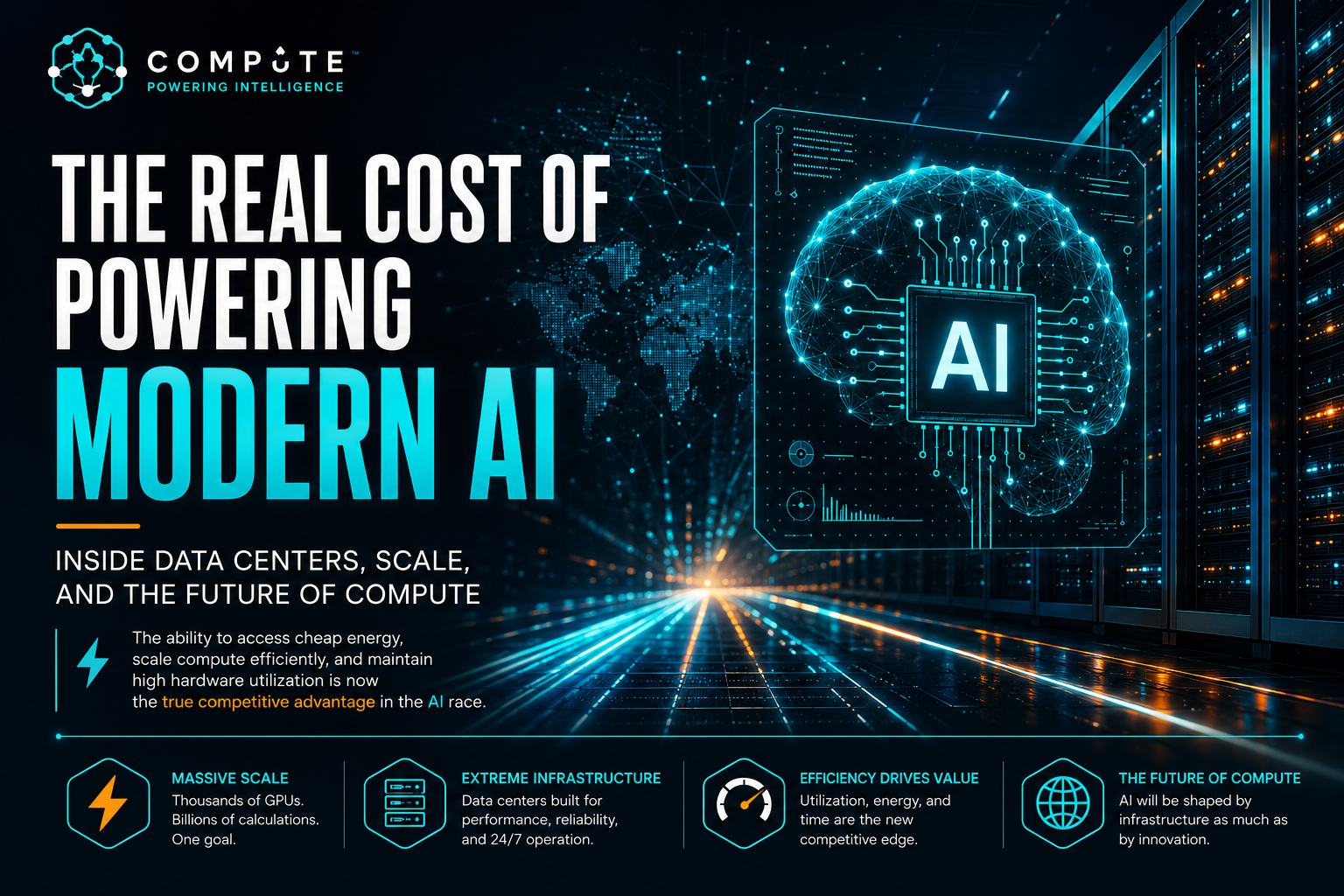
In 2026, AI training is a high-stakes industrial game. It takes more than just powerful hardware; it requires an entire ecosystem running at max capacity for months at a time. Behind every 'easy' interaction on your screen is a massive data center consuming enormous energy to sync millions of calculations every single second.
Behind every chat assistant, image generator, or intelligent system lies a hidden infrastructure race—one defined not by algorithms alone, but by access to compute, energy, and time. The real cost of AI isn’t just measured in dollars; it’s measured in electricity consumption, hardware utilization, and the ability to coordinate thousands of machines as if they were a single system.
This raises a critical question for businesses and investors alike: what does it truly take to power modern AI—and why is compute infrastructure becoming one of the most strategic assets in the global economy?
We’re taking a look at what it actually takes to run AI at scale—from the heavy lifting of training models to the logistics of keeping them competitive. Interestingly, many of the hurdles here aren’t new; they mirror the same scaling challenges that have defined success and failure in the world of crypto mining for years.
AI Training at Scale: Why Large Models Require Massive Infrastructure
From Small Machine Learning Models to Industrial-Scale AI Systems
Early machine learning models could be trained on a single workstation. Today’s leading models operate in a completely different league. They are built with hundreds of billions to trillions of parameters and trained on datasets measured in trillions of tokens or data points. This pushes training from a research task into an industrial process.
The core workload in training is mathematical: massive sequences of matrix operations repeated over and over. One machine can do this, but it would take an impractical amount of time. The solution is to split the work across thousands of machines and coordinate them so they act like one giant system.
This shift—from single machines to coordinated fleets—is one of the defining characteristics of modern AI development.
Parallel Computing in AI Training: How Large Models Scale Efficiently
To make training feasible, engineers rely on different forms of parallelism:
-
Workload parallelism: splitting large calculations into smaller pieces that can be processed at the same time.
-
Pipeline-style execution: breaking the model into stages so different parts are processed simultaneously.
-
Data-level replication: running many copies of the same model on different chunks of data and combining the results.
The key idea is simple: instead of waiting for one system to finish everything, many systems work together and share progress. This same principle appears in other compute-heavy fields. For example, cryptocurrency mining also spreads work across thousands of machines, each trying different possibilities in parallel. The goal is different, but the scaling logic is similar.
The True Cost of AI Training: Infrastructure, Energy, and Time
Compute Costs Explained: Hardware, Time, and Opportunity Cost
When a company trains a very large model, it isn’t just paying for machines—it’s paying for time on those machines. Training can take weeks or months, during which that infrastructure can’t be used for other projects. This creates a real economic trade-off: resources tied up in training are resources not available elsewhere.
As a result, companies think in terms of:
-
Throughput: how much useful work they can get done per unit of time.
-
Utilization: how efficiently their systems are kept busy.
-
Turnaround time: how fast a new model can go from idea to deployment.
These factors influence product roadmaps, research speed, and even competitive positioning. Faster training cycles can mean faster iteration, quicker improvements, and earlier market advantages.
Why Bigger Isn’t Always Better
There’s a common assumption that simply adding more machines always makes things faster. In practice, coordination costs grow as systems get larger. Communication between machines, synchronization steps, and data movement can all reduce the gains from adding more hardware.
This is why modern AI development focuses not just on scale, but on how well that scale is organized. The structure of the model, the way tasks are divided, and the efficiency of the software stack all matter as much as raw size.
The same lesson appears in large mining operations: adding more machines helps, but only if the overall system stays balanced and manageable.
AI Inference vs Training: Cost Differences and Operational Challenges
Real-Time AI Systems: Serving Millions of Users at Scale
Training a model is a huge, one-time (or occasional) effort. Running that model in production is a continuous operation. Instead of processing a fixed dataset, the system must respond to real users, all day, every day.
This changes the priorities:
-
Reliability becomes critical: downtime affects real people.
-
Latency matters: users expect quick responses.
-
Scalability must be elastic: demand changes by time of day, season, or global events.
In many ways, operating a large AI service looks more like running a global online platform than running a research lab.
AI Inference Costs: Why Running Models Becomes Expensive Over Time
Each user request triggers a sequence of computations. One request is cheap, but billions of requests per day add up. This creates a recurring operational cost that, over time, can rival or exceed the cost of training itself.
This is a familiar pattern in other compute-heavy services. For instance, in cryptocurrency mining, the initial setup is expensive, but the real business challenge is sustaining operations over long periods while staying competitive. In AI services, the same long-term thinking applies: the economics are driven by ongoing usage, not just initial development.
AI Data Centers: The Core Infrastructure Powering Modern AI
Why Big Tech Invests in AI Infrastructure and Private Data Centers
As AI workloads grow, infrastructure becomes a strategic advantage. Companies that control large, efficient data centers can:
-
Train and deploy models faster.
-
Experiment more frequently.
-
Scale products more smoothly.
-
Negotiate better terms with partners and suppliers.
This is why we see major technology firms investing heavily in their own facilities rather than relying entirely on third-party services. Infrastructure is no longer just a cost center—it’s a core part of competitive strategy.
Hyperscale Data Centers: The Backbone of AI and High-Performance Compute
Modern data centers are built at a scale that would have been unthinkable a decade ago. They are designed to host tens or hundreds of thousands of machines in tightly integrated environments. This allows:
-
High-density computing.
-
Centralized management.
-
Better coordination between systems.
-
More predictable performance at scale.
For industries like AI and large-scale data processing, these facilities are becoming as essential as factories are to manufacturing.
Global Demand for Compute: AI, Crypto Mining, and Data-Driven Industries
Growing Demand Across Multiple Industries
AI isn’t the only field driving demand for large-scale computation. Other areas include:
-
Scientific research and simulation.
-
Video streaming and content creation.
-
Financial modeling and analytics.
-
Blockchain and distributed systems.
Each of these adds pressure to global computing capacity. Cryptocurrency mining, for example, has shown how quickly demand can surge when incentives align. While the goals differ, the underlying competition for large-scale computing resources is very real.
Specialized AI Infrastructure: From General Data Centers to Purpose-Built Systems
Another trend is the move toward purpose-built platforms. Instead of one-size-fits-all data centers, companies are designing systems optimized for specific workloads, whether that’s AI training, real-time inference, or large-scale analytics.
This specialization improves efficiency and performance, but it also increases complexity and capital requirements. The barrier to entry rises, which may reshape who can compete at the highest levels of the industry.
Business Impact of AI Infrastructure: Strategy, Scaling, and Competitive Advantage
AI as a Core Product: Infrastructure-Driven Business Models
For many companies, AI is no longer a side feature—it’s the core product. Search tools, creative software, customer support systems, and developer platforms increasingly rely on large models as their main engine.
This shifts business planning toward:
-
Long-term infrastructure investment.
-
Careful capacity forecasting.
-
Balancing innovation speed with operational stability.
The same pattern can be seen in other compute-driven businesses, including large-scale mining operations, where infrastructure decisions define what strategies are even possible.
Smaller Players and the Ecosystem Effect
Not every company can build massive data centers. Many rely on shared platforms or cloud services. This creates an ecosystem where:
-
Large providers focus on infrastructure and core platforms.
-
Smaller teams focus on applications, niches, and user experience.
-
Innovation happens at multiple levels of the stack.
This division of labor helps the industry move faster overall, even if the biggest infrastructure projects remain concentrated among a few major players.
Strategy: Planning for a Compute-Driven Future
Thinking in Terms of Capacity, Not Just Features
As AI systems become more central to products, planning shifts from “What features should we build?” to “What capacity will we need to support them?” This includes:
-
Estimating growth in user demand.
-
Scheduling training and updates.
-
Ensuring enough headroom for experiments and new services.
In compute-heavy fields like mining, similar planning is essential: success depends as much on capacity management as on clever algorithms.
Balancing Innovation and Sustainability
Rapid growth is exciting, but it also introduces risk. Overbuilding can waste resources, while underbuilding can slow progress or hurt user experience. The most successful organizations treat infrastructure as a long-term investment, not a short-term expense.
Conclusion: The Future of AI Infrastructure: Why Compute Power Defines Competitive Advantage
We tend to think of AI as software, but the reality is much more physical. It’s powered by massive industrial ecosystems that stay hidden from view. Behind every model is a powerhouse of data centers and thousands of machines running around the clock, consuming enormous energy just to keep the 'intelligence' moving forward.
This is the shift most people underestimate: AI is no longer just a software game—it’s an infrastructure war. The companies that win won’t just have better algorithms; they’ll have more efficient systems, better access to energy, and the ability to scale faster than everyone else.
And AI isn’t alone. From scientific computing to cryptocurrency mining, entire industries are converging around the same reality: compute is becoming the new industrial backbone of the global economy.
The implication is simple—but powerful: in a world defined by large-scale computation, infrastructure isn’t a support system. It is the strategy. The winners of AI won’t be the smartest—they’ll be the ones who can afford to keep the machines running.
FAQ: The Real Cost of AI & Compute Infrastructure
Q1: Why is training a modern AI model so incredibly expensive?
It’s not just about buying the most expensive chips—it’s about the sheer amount of time and energy those chips consume. Training a massive model means locking down thousands of machines to run continuously at maximum capacity for months. You aren't just paying for the hardware; you're paying a massive electricity bill, cooling costs, and the opportunity cost of having all that compute tied up on a single project.
Q2: What is the actual difference between AI "training" and "inference"?
Think of training as sending the AI to school—it’s a massive, intense, and costly one-time event where the model learns from vast amounts of data. Inference, on the other hand, is when the AI goes to work. Every time you ask a chatbot a question or generate an image, that’s inference. While training is a huge upfront investment, inference is the ongoing, daily operational cost of serving millions of users—and over time, the cost of inference usually overtakes the cost of training.
Q3: How are AI data centers similar to large-scale crypto mining operations?
At their core, both industries face the exact same scaling challenge: they require massive fleets of machines working in parallel to solve intense mathematical workloads. Whether you are running matrix operations for an AI model or calculating hashes to mine crypto, the physical reality is the same. Success in both fields ultimately comes down to infrastructure—securing cheap electricity, maintaining hardware efficiency, and managing industrial-scale cooling.
Q4: Why are major tech companies rushing to build their own private AI data centers?
Because relying on rented cloud space limits how fast you can move. In the AI race, compute power is the ultimate strategic moat. By owning their own hyperscale data centers, big tech companies can control their costs, train models much faster, and ensure they have the dedicated capacity needed to launch new features without waiting in line for third-party servers.
Q5: With infrastructure costs this high, can smaller startups still compete in AI?
Yes, but they play a different game. While the tech giants fight over building massive "foundational models" and giant data centers, smaller players are thriving in the application layer. Startups don't need to build the infrastructure from scratch; they can rent access to it and focus entirely on creating niche, highly specialized AI tools and improving the user experience.
Q6: What is the biggest bottleneck in scaling AI today?
It's no longer the software—it's the power grid. You can write the most efficient algorithms in the world, but if you don't have enough physical hardware, or if your local grid can't supply the immense amount of electricity required to power and cool a massive data center, you can't scale. Infrastructure has officially become the main bottleneck in AI advancement.