Introduction
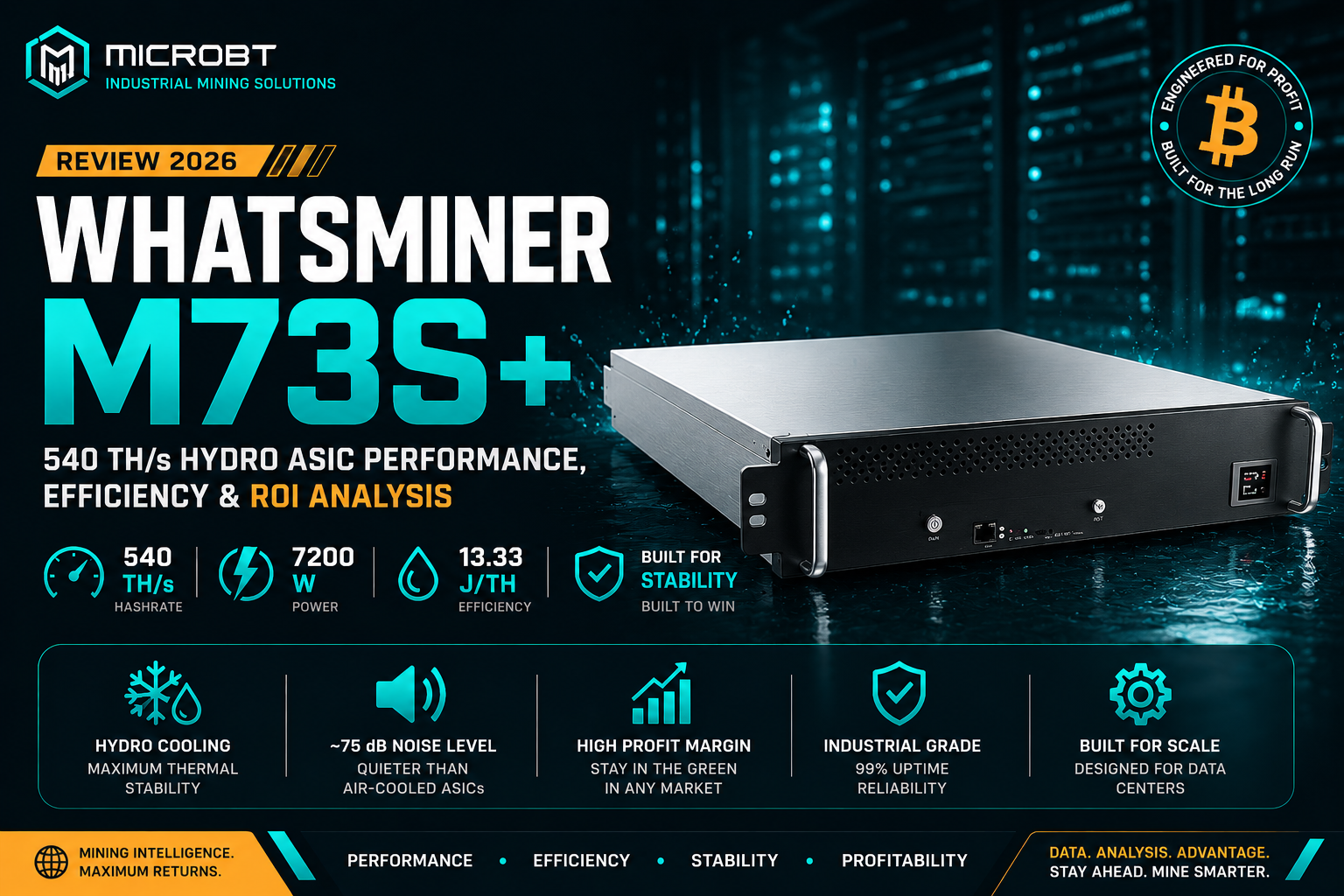
The MicroBT WhatsMiner M73S+ is not a machine designed for the casual hobbyist or the "basement miner." In the landscape of 2026, where mining difficulty and energy costs dictate survival, this ASIC stands as a purpose-built industrial tool. It is engineered for operators who view mining as a scalable, long-term infrastructure project—where every wasted watt is a hit to the bottom line and every terahash is a calculated move toward capital recovery.
Boasting a massive 540 TH/s hash rate and a continuous power draw of 7200 W, the M73S+ sits at the top tier of the hydro-cooled segment. In this bracket, thermal stability and 99% uptime aren't just perks—they are the only way to ensure the machine remains profitable over its multi-year lifespan.
What’s truly notable about the "Plus" designation is that it isn’t just a badge. It represents a genuine optimization in the silicon’s efficiency. At approximately 13.33 J/TH, the M73S+ offers a rare balance: it packs enough raw power to compete with the industry’s giants while remaining efficient enough to keep operational overhead from spiraling out of control.
Real-World Operation of the WhatsMiner M73S+: Stability, Hydro Cooling & Noise Levels
When you move from a spec sheet to a real data center, the value of the hydro-cooling system becomes immediately apparent. This isn't just about keeping the chips cool; it’s about thermal consistency. Unlike air-cooled units that suffer from "thermal cycling"—where fluctuating fan speeds cause chips to expand and contract, leading to micro-fractures—the hydro system maintains a steady, liquid-regulated temperature.
Noise Levels and Acoustic Performance of the WhatsMiner M73S+
While hydro-cooled units are "quieter" than their air-cooled counterparts, don't let the marketing fool you. Operating at roughly 75 dB, the M73S+ still produces a mechanical hum comparable to a loud vacuum cleaner or a busy highway. It remains entirely impractical for a residential setting. Furthermore, the heat dissipation of 7200 W requires a professional-grade heat exchanger or cooling tower; you simply cannot "vent" this kind of energy out of a standard window.
WhatsMiner M73S+ Profitability: Daily Revenue, Electricity Costs & ROI Breakdown
In 2026, profitability is a moving target. To understand the M73S+ as an investment, we have to look past the "best-case scenarios" and look at the actual math of energy.
| Metric Analysis | Scenario A ($0.08/kWh) | Scenario B ($0.05/kWh) |
|---|---|---|
| Gross Daily Revenue | ~$21.50 | ~$21.50 |
| Daily Power Cost | ~$14.00 | ~$8.60 |
| Net Daily Profit | +$7.50 | +$12.90 |
| Estimated ROI | ~530 Days | ~340 Days |
The takeaway? The M73S+ is a "margin game." It is designed to stay "in the green" even during market dips when less efficient 20–30 J/TH machines are forced to shut down.
WhatsMiner M73S+ vs. M73S and M79S: Hashrate, Efficiency & Power Comparison
Choosing the M73S+ is about finding the "sweet spot" in the MicroBT lineup.
-
vs. The Standard M73S: The Plus version wins on sheer density. By squeezing more hash rate out of a similar power envelope, you reduce the "rack space" cost. In a facility with 1,000 units, that extra efficiency compounds into massive yearly gains.
-
vs. The M79S: While the M79S might offer higher top-end speeds, it often requires a massive leap in electrical infrastructure. The M73S+ is more "infrastructure-friendly," allowing it to fit into existing 7kW-per-port setups without requiring a complete overhaul of your transformers and PDUs.
It occupies the strategic middle ground: it has the "teeth" to fight for blocks in a high-difficulty environment but doesn't require the power of a small neighborhood to run.
| Model | Hashrate | Power | Efficiency | Best Use Case |
|---|---|---|---|---|
| WhatsMiner M73S+ | 540 TH/s | ~7200 W | ~13.33 J/TH | Balanced industrial mining (best ROI vs infrastructure) |
| WhatsMiner M73S | 500 TH/s | ~7200 W | ~14.5 J/TH | Lower cost entry for hydro mining setups |
| WhatsMiner M79S | 600+ TH/s | ~9000+ W | ~15 J/TH | High-density farms with strong power infrastructure |
Pre-Purchase Checklist: Electrical Requirements, Cooling Setup & Cost Planning
Before you wire the funds for an M73S+, you need to ensure your "site readiness" is 100%. This is an industrial machine, and it will punish an amateur setup.
-
Electrical Infrastructure: You need a stable 220V–240V or 3-phase configuration. Do not underestimate the continuous load of 7200 W.
-
Hydro System Integration: You aren't just buying a miner; you’re buying a plumbing project. You will need a closed-loop system, an external radiator/dry cooler, and high-quality coolant.
-
Real-World Math: Calculate your ROI based on your worst month of electricity pricing, not your best.
Final Verdict: Is the WhatsMiner M73S+ Worth It in 2026?
The MicroBT WhatsMiner M73S+ is a specialist’s tool. It is built for the "survivor" era of Bitcoin mining—where reliability and efficiency are the only things that matter when the price of BTC is volatile.
It is worth it if you have access to industrial electricity rates (below $0.07/kWh) and are building a permanent, hydro-cooled facility. It is not worth it if you are mining at residential rates or lack the technical expertise to manage liquid cooling systems.
Frequently Asked Questions About the WhatsMiner M73S+
Q1: What exactly is the MicroBT WhatsMiner M73S+ and what are its key features?
A: The M73S+ is a powerful SHA-256 Bitcoin miner built for serious miners and big operations. It clocks in at about 540 TH/s, using around 7200W of power. This machine is really meant for ongoing mining projects, not just for a casual setup.
Q2: What kind of daily profit can I actually expect from this miner?
A: How much you make each day really comes down to the price of Bitcoin, your electricity rates, and how tough the network is. If your electricity costs are around $0.08/kWh, you're probably looking at $7–8 per day. If you have very cheap or even free electricity, that could go up to $20 a day. Always crunch the numbers on your return on investment based on your own local costs.
Q3: What are the electrical and cooling needs for this miner?
A: You'll typically need 220V or even 3-phase power for the M73S+, depending on your specific setup. Good cooling is super important. Using hydro cooling or really good airflow will keep temperatures steady and stop it from overheating or slowing down, especially if you're running a bunch of these units.
Q4: Should I go for the M73S+ or look at a newer model?
A: That depends on your budget, how much you care about power efficiency, and what you expect to get back. Newer models might give you a bit more hash rate or save more on electricity, but the M73S+ is still a trustworthy option. It's especially good if your electricity costs are okay and you want a machine that's known to be stable for mining.
Additional SEO FAQ: WhatsMiner M73S+ 540 TH/s Miner
Q5: Is the WhatsMiner M73S+ profitable in 2026?
A: The WhatsMiner M73S+ can be profitable in 2026 if electricity costs are low (ideally under $0.05–$0.08/kWh). Profitability depends on Bitcoin price, mining difficulty, and uptime. With average power costs, ROI may exceed 17 months, making it better suited for long-term mining strategies rather than short-term gains.
Q6: How efficient is the WhatsMiner M73S+ compared to other 500+ TH/s ASIC miners?
A: With an efficiency of around 13.33 J/TH, the M73S+ competes strongly within the 500+ TH/s class. It offers a balanced mix of hash rate and power consumption, especially for operators who prioritize stable hydro cooling and predictable performance over maximum peak hash rate.
Q7: Can you run the WhatsMiner M73S+ at home?
A: Technically yes, but it is not recommended. At around 75 dB and 7200W power draw, the M73S+ generates significant noise and heat. It is better suited for industrial environments, dedicated mining facilities, or properly ventilated technical rooms with adequate electrical infrastructure.
Q8: What type of power infrastructure is required for the M73S+?
A: The miner typically requires 220V or 3-phase power capable of handling at least 7200W continuously. Proper industrial-grade cabling, breakers, and cooling systems are essential to ensure stable operation and avoid downtime or hardware stress.
Q9: Is hydro cooling better than air cooling for ASIC miners like the M73S+?
A: Hydro cooling provides more stable temperatures during 24/7 operation and can extend hardware lifespan. Compared to high-RPM fan-based air cooling systems, hydro setups reduce thermal stress and may improve long-term stability, particularly in large-scale mining deployments.