The 2026 Mining Blueprint: Why Tools, Not Just Machines, Define Your ROI
In 2026, the era of plug-and-play mining is officially dead. If you think winning in this market is as simple as unboxing an ASIC and flipping a switch, you’ve already lost.
Most beginners fail within the first 90 days—not because the math is hard, but because they treat mining like a hobby instead of an industrial operation. In a post-halving world with razor-thin margins, the difference between a rig that prints Bitcoin and one that just heats your garage comes down to your technical ecosystem.
From custom auto-tuning firmware to real-time thermal monitoring and automated energy curtailment, every layer of your setup is a gear in a high-stakes machine. If one gear is weak, the whole system fails. This guide breaks down the essential toolchain you need in 2026 to build a mining operation that actually survives the volatility.
Crypto Mining Hardware for Beginners in 2026: GPUs, ASICs, and Essential Infrastructure
Before diving into each category, here’s a quick overview of the essential mining tools and infrastructure every beginner needs in 2026:
Breaking Down the Mining Stack: Hardware, Power, and Cooling Explained
🔧 Mining Tools Overview
| Tool Category | Recommended Tools | Primary Use Case | Skill Level |
|---|---|---|---|
| ASIC Miners | Antminer S21 / Latest-generation ASICs | High-efficiency Bitcoin mining | Advanced |
| GPU Hardware | NVIDIA RTX 30/40/50 Series | Altcoin mining, AI and compute workloads | Beginner–Advanced |
| Power Supplies (PSUs) | ASIC-specific or Server-Grade PSUs | Stable continuous power for 24/7 mining | Intermediate |
| Cooling Systems | Air Cooling / Immersion Cooling | Thermal management and hardware stability | Intermediate–Advanced |
| Mining Operating Systems | HiveOS / NiceHash | Rig deployment, management and automation | Beginner–Advanced |
| Monitoring Tools | Minerstat / HiveOS | Hashrate, temperature and uptime monitoring | Beginner |
| Profitability Calculators | WhatToMine / ASIC profitability calculators | Estimating mining revenue and operating costs | Beginner |
| Mining Pools | Antpool / F2Pool / Other major pools | Pool-based mining and reward distribution | All Levels |
| Hardware Wallets | Ledger / Trezor / Tangem | Secure long-term cryptocurrency storage | All Levels |
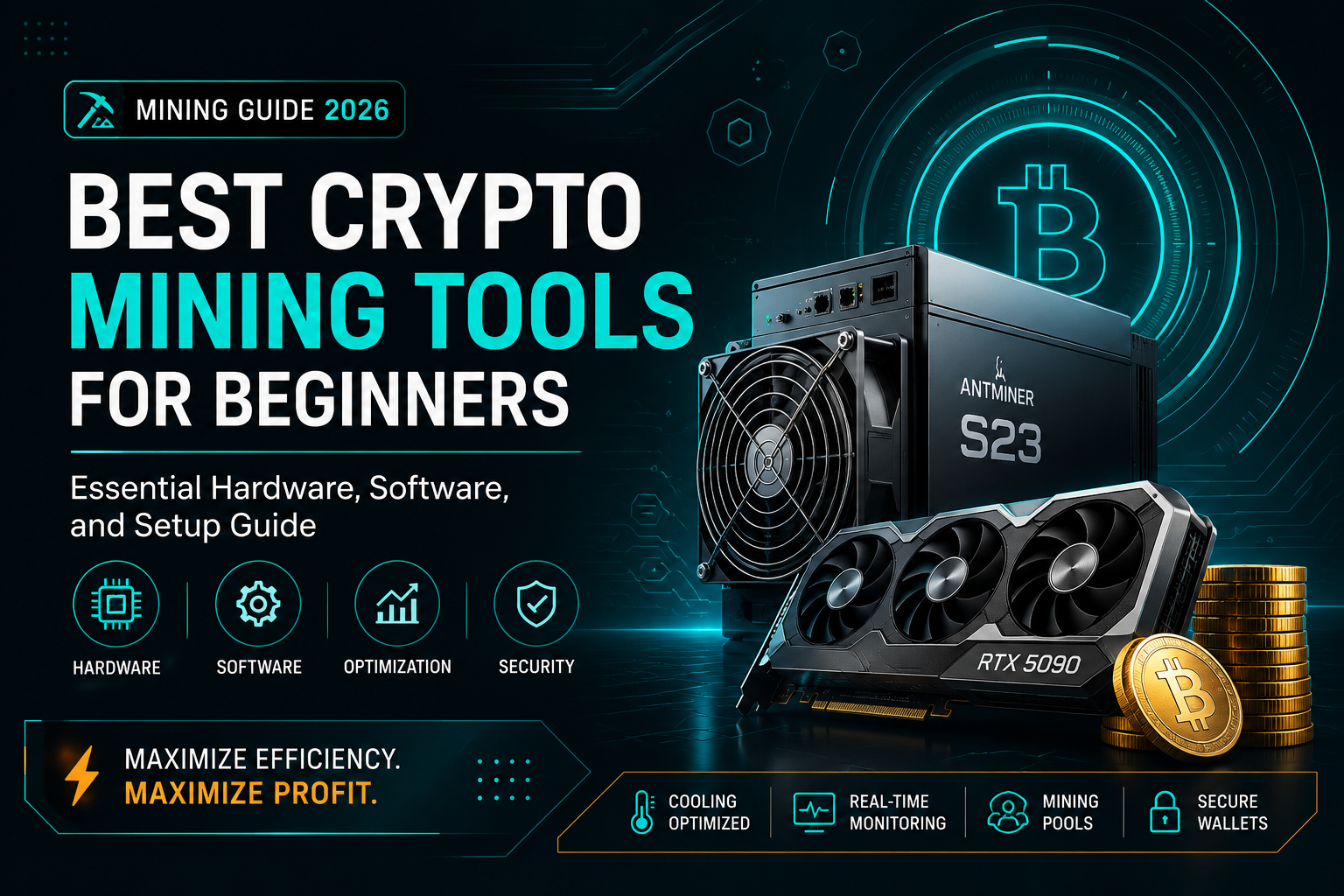
In 2026, your hardware isn't just a "machine"—it’s an industrial athlete. If you’re chasing Bitcoin, you're looking at the Antminer S23 or its equivalent. We’re talking about units that push the boundaries of TeraHash while demanding a significant capital outlay, typically between $3,000 and $8,000. But here’s the pro tip: in this market, you don't buy for the hash rate; you buy for the Efficiency Ratio (J/TH). A machine that’s $1,000 cheaper but sucks 10% more power will bleed you dry in a matter of months.
If you’re leaning toward altcoins or AI compute, the NVIDIA RTX 5090 is the gold standard, sitting in the $1,200–$2,500 range. The beauty of the 5090 isn't just its VRAM; it’s its resale value. Unlike an ASIC, which becomes a "doorstop" once it’s obsolete, a high-end GPU remains a liquid asset in the gaming and AI markets.
The "Unsung Heroes": Power & Thermal Management
The biggest rookie mistake? Over-investing in the "brain" (the miner) and under-investing in the "heart" (the PSU). In 2026, a standard power supply won't cut it. You need Server-Grade PSUs with a 94%+ efficiency rating (Titanium grade) to handle the brutal, 24/7 continuous load. If your PSU runs hot, your hash rate drops. It’s that simple.
Then there’s the silent killer: Heat. Air cooling is the "budget" choice, but in 2026, it’s noisy and inefficient for high-density setups. If you're serious, you're looking at Immersion Cooling. Submerging your ASICs in specialized dielectric fluid isn't just "cool"—it eliminates fan noise, drops chip temperatures by 20°C, and allows for overclocking that can squeeze an extra 15% performance out of your hardware. Without a rock-solid thermal strategy, your $8,000 investment is just a very expensive heater that's waiting to fail.
Best Crypto Mining Software for Beginners: Automation, Optimization, and Rig Management
Professional Mining Software & Automation
Software is the essential ‘bridge’ that connects your physical hardware to the global blockchain network. For a complete beginner, NiceHash QuickMiner is still one of the best options, especially for one-click mining, while Kryptex is a user-friendly Windows solution that automatically determines which profit option is best suited for you. For miners who want to upgrade, there is HiveOS, a full-fledged operating system that lets you manage your mining rigs in full, including overclocking and control of fans, while CGMiner remains a go-to option, especially when you want a more hands-on approach when mining using ASIC machines.
Mining Monitoring Tools and Profitability Calculators for Crypto Miners
A ‘set it and forget it’ approach to mining won't keep personal miners profitable in 2026 without the use of monitoring and optimization software. A handy cloud solution offered by Minerstat monitors the hash rate and mining temperature, immediately sending an alert to avoid damaging hardware. As for profit optimization, WhatToMine has proved to be an essential tool; it is updated daily, enabling miners to calculate which cryptocurrency is the most profitable option considering their machines and regional electricity prices. A well-balanced approach might combine the use of WhatToMine and Minerstat.
Best Mining Pools and Secure Crypto Wallets for Mining Rewards
To derive continued benefits, it is imperative that one joins a mining pool such as Foundry USA, F2Pool, or AntPool. After acquiring rewards, it is critical to find ways to secure them. The best method for this in 2026 is, without doubt, the use of offline storage such as Ledger Nano X or Trezor Model T. For those who don’t wish to deal with handling equipment, cloud mining services such as Genesis Mining or the use of the ECOS mobile application provide alternate ways to stay within the network without having to set up cooling units.
Conclusion: From Hardware to Strategy
By 2026, the era of "moonshot" chasing is dead. Mining is no longer a hobby; it's a high-stakes game of efficiency and system design. Your hardware—whether it's an S23 or a fleet of 5090s—is just the engine. The real performance comes from the oil you put in it: the cooling, the power management, and the tactical software layer. The winners in this space aren't the ones with the most machines, but the ones who build the most resilient systems.
Success today belongs to the architects who can protect their margins when the market bleeds and maximize their yield when it screams green. Don't just start a rig—build a moat.
FAQ: Crypto Mining Tools for Beginners in 2026
Q1: Which mining hardware is best for beginners in 2026?
For beginners entering crypto mining in 2026, GPUs such as the NVIDIA RTX 5090 provide flexibility for mining different cryptocurrencies. However, for Bitcoin-specific mining, ASIC machines like the Antminer S23 offer significantly higher efficiency and hash power. The best choice depends on whether the miner wants flexibility or maximum Bitcoin performance.
Q2: Can you mine cryptocurrency with a laptop or CPU in 2026?
Mining with a CPU is still technically possible for certain coins like Monero, but laptops are generally not suitable for mining due to overheating risks and hardware damage. Dedicated mining rigs with GPUs or ASIC machines are far more efficient, reliable, and profitable for long-term cryptocurrency mining operations.
Q3: What is the easiest crypto mining software for beginners?
NiceHash QuickMiner is widely considered one of the easiest mining tools for beginners. Its one-click mining setup automatically configures hardware and selects the most profitable algorithms. Alternatives such as Kryptex also simplify mining by automatically switching between coins to maximize profitability.
Q4: Why do most miners join mining pools instead of mining solo?
Mining pools combine the hash power of thousands of miners, significantly increasing the probability of earning consistent rewards. Instead of waiting months or years to solve a block individually, pool participants receive smaller but more frequent payouts based on their contributed hash power.
Q5: How can miners calculate the most profitable cryptocurrency to mine?
Tools like WhatToMine allow miners to estimate mining profitability by entering their hardware specifications, electricity costs, and hash rate. The platform compares dozens of cryptocurrencies and mining algorithms to determine which coin currently offers the highest profitability.
Q6: What tools are required to properly monitor a mining rig?
Monitoring tools such as Minerstat and HiveOS allow miners to track hash rate, hardware temperature, uptime, and performance remotely. These platforms can also send alerts if the mining rig stops working, overheats, or experiences performance drops.
Q7: How do miners safely store their mining rewards?
Hardware wallets such as Ledger Nano X and Trezor Model T are considered the most secure storage methods. These devices store private keys offline, protecting mining rewards from hackers, malware, and exchange breaches.
Q8: Is cloud mining a safe alternative to buying mining hardware?
Cloud mining services can be a convenient alternative for beginners who do not want to manage hardware or cooling systems. However, miners must carefully choose reputable platforms such as ECOS or Genesis Mining, since many fraudulent services promise unrealistic guaranteed returns.
Q9: What are the biggest risks of starting crypto mining in 2026?
The main risks include high electricity costs, fluctuations in cryptocurrency prices, increasing mining difficulty, and hardware failures. Proper cooling systems, efficient hardware, and real-time monitoring tools can significantly reduce these risks.
Q10: What infrastructure is required for a stable mining setup?
A stable mining setup requires high-capacity power supply units (PSUs), efficient cooling systems, stable internet connectivity, and proper mining software. Without reliable infrastructure, mining rigs may suffer from overheating, downtime, and reduced profitability.
Q11: What is the best crypto mining setup for beginners in 2026?
The best beginner setup in 2026 is a balanced system, not just powerful hardware. It includes:
-
Efficient ASIC or GPU
-
Reliable power supply
-
Proper cooling system
-
Easy mining software
-
Monitoring tools for optimization.