
Introduction
In 2026, losing your crypto isn’t usually down to bad luck—it’s almost always down to a single, avoidable choice.
We’ve all heard the same advice: "Get a hardware wallet and you’ll be fine." But if you’re serious about your portfolio, you know that "safe by default" is a dangerous myth. The truth is, not all cold storage is built with the same philosophy. Choosing the wrong device doesn't just make your life harder—it leaves doors open to risks you might not even see until it's too late.
The world has changed. Hackers aren't just looking for your seed phrase anymore; they’re targeting firmware, supply chains, and the very way we sign our transactions. In this high-stakes environment, your hardware wallet isn't just a gadget in a drawer—it is the final, thin line between total financial freedom and a permanent, irreversible loss.
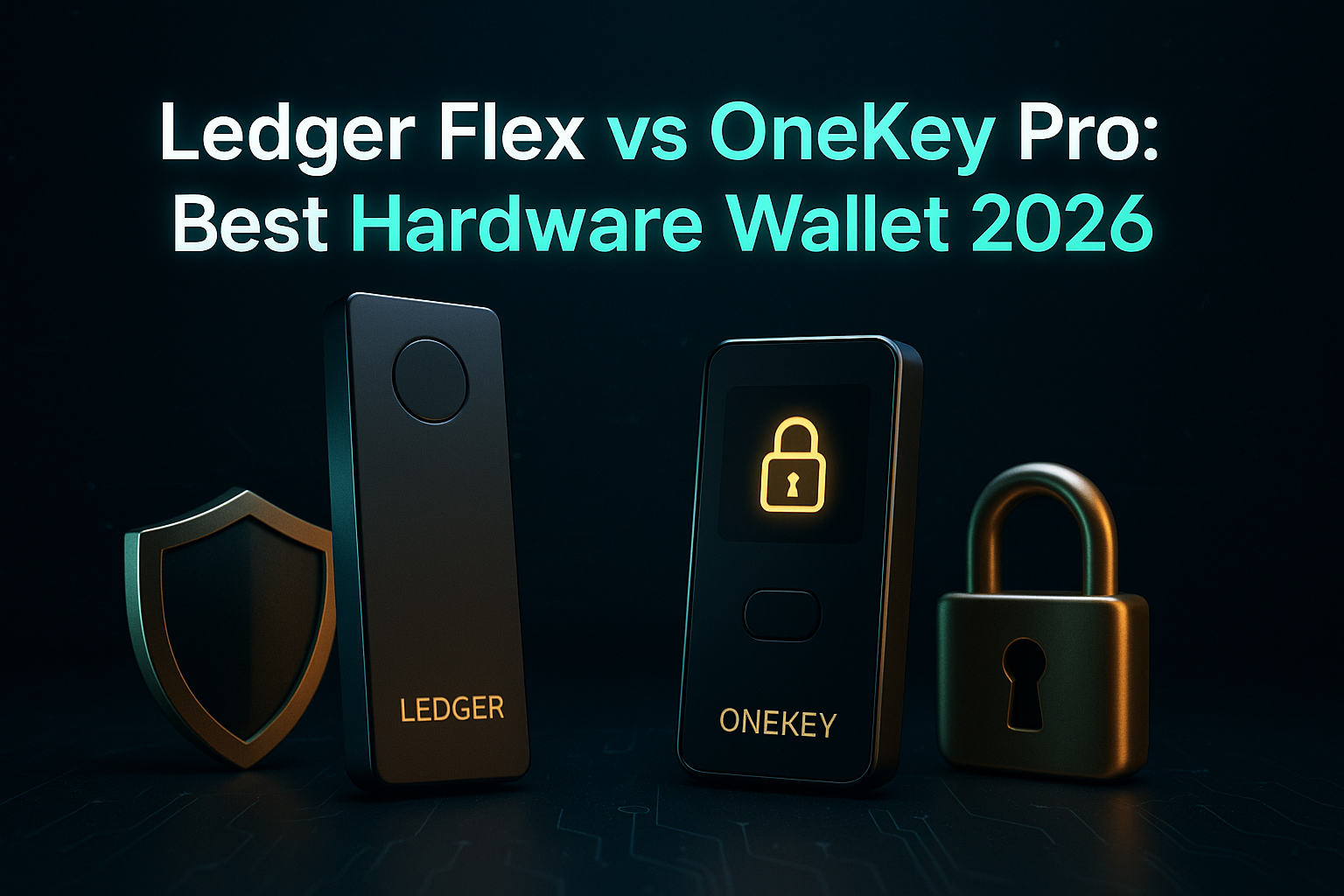
That’s why the choice between the Ledger Flex and the OneKey Pro is so critical right now. On one hand, you have Ledger: the "old guard" with years of battle-tested security, a custom Secure Element, and a closed, highly controlled ecosystem. On the other, there’s OneKey Pro: the modern contender pushing a feature-rich experience—mixing multi-chip security, biometric ease, and the transparency of air-gapped QR transactions.
So, the real question we need to answer isn't "which one is the best?" It’s this:
👉 Which one actually fits the way you trade, your personal risk tolerance, and your long-term strategy in a market that doesn't give second chances? In this deep dive, we’re stripping away the marketing talk. We’re looking at the actual security architecture, how they feel in daily use, and their long-term durability. We’re not just giving you info—we’re helping you make the one decision that is strategically right for your future.
Ledger Flex vs OneKey Pro Specifications & Feature Comparison
| Category | Ledger Flex | Rating | OneKey Pro | Rating | Notes |
|---|---|---|---|---|---|
| Security | Secure Element, BOLOS OS, PIN & Passphrase | ⭐⭐⭐⭐☆ | 4× Secure Element (EAL6+), Fingerprint, PIN, Air-gapped QR | ⭐⭐⭐⭐☆ | Different security approaches, both strong |
| User Experience | 2.84" E-Ink touchscreen, Ledger Live (PC & Mobile) | ⭐⭐⭐⭐☆ | 3.5" IPS color screen, camera, haptic feedback | ⭐⭐⭐⭐☆ | OneKey has color screen, Flex favors battery life |
| Supported Coins | 50+ wallets, 5000+ coins & NFTs | ⭐⭐⭐⭐⭐ | 30,000+ coins & NFTs across multiple chains | ⭐⭐⭐⭐⭐ | Both support wide crypto ecosystems |
| Extra Features | Bluetooth, NFC, lock-screen customization | ⭐⭐⭐⭐☆ | Fingerprint, QR camera, wireless charging | ⭐⭐⭐⭐☆ | OneKey offers more features, Flex is simpler |
| Build & Design | Aluminum frame, compact, minimalist | ⭐⭐⭐⭐☆ | Aluminum alloy, glossy finish (durability concerns) | ⭐⭐⭐☆☆ | Flex shows better long-term durability |
| Portability | 78.4×56.5×7.7 mm, 57.5 g | ⭐⭐⭐⭐☆ | Larger & heavier due to screen and battery | ⭐⭐⭐☆☆ | Flex is easier to carry daily |
| Price | $249 | ⭐⭐⭐⭐⭐ | $278 | ⭐⭐⭐⭐☆ | Lower price gets higher rating |
| Connectivity | USB-C, Bluetooth, NFC | ⭐⭐⭐⭐⭐ | USB-C, Bluetooth, NFC, QR | ⭐⭐⭐⭐⭐ | Both offer excellent connectivity |
| Total / Average | 4.38 / 5 → ⭐⭐⭐⭐☆ | 4.15 / 5 → ⭐⭐⭐⭐☆ |
Price, Security, and Daily Experience: Where the Real Divide Begins
Let’s be honest: in the world of crypto, a $29 price gap between the Ledger Flex ($249) and the OneKey Pro ($278) is practically a rounding error. But if you look closely, that slight difference in cost isn't about one device being physically "better" than the other. You are actually paying for two entirely different philosophies of wealth protection.
The Ledger Flex is a masterclass in restraint. Its true value lies in what it doesn't do. You are investing in a heavily audited, disciplined ecosystem built around proven Secure Element architecture. It doesn't try to dazzle you with unnecessary bells and whistles. Instead, it ruthlessly eliminates friction and drastically shrinks your operational attack surface. It’s a closed-off fortress designed for one thing: keeping your keys impenetrable while keeping your daily workflow psychologically simple.
The OneKey Pro takes the exact opposite approach. It justifies that slightly higher price tag by handing you a feature-rich arsenal. With a larger color display, biometric unlocking, and the distinct advantage of air-gapped, QR-based transactions, the OneKey Pro isn't just a vault—it’s an interactive command center. You aren't just paying for storage; you are paying for an advanced, dynamic workflow.
And this is where you have to look in the mirror as an investor. Security isn’t just about hardware specs; it’s about how that hardware interacts with your human behavior.
The Ledger Flex leans heavily into a conservative, highly controlled security model. It strips away distractions and unnecessary variables, which is exactly why serious, long-term holders swear by it. It limits the ways you can accidentally make a mistake.
The OneKey Pro, on the other hand, is built for the active operator. If you are constantly moving assets, interacting with multiple chains, or demanding the physical isolation of air-gapped QR flows, those extra features are a massive advantage. But remember: with greater flexibility comes a slightly wider surface area. The OneKey Pro gives you powerful tools, but it assumes you have the operational discipline to handle that flexibility safely.
Even in the hand, their physical builds tell the same story. The Ledger Flex is tight, compact, and designed to slip into your daily carry without a second thought. The OneKey Pro feels more substantial—a feature-forward tool prioritizing screen visibility and comfortable, frequent interaction over pure minimalism.
Ultimately, this is not a debate over price versus features. It is a choice between Discipline and Versatility.
⚠️ Real Risk Scenario:
A long-term holder using a feature-heavy wallet without discipline may expose themselves to unnecessary risk.
At the same time, an active DeFi user using a restricted ecosystem may take unsafe shortcuts.
👉 The real risk is not the device — it's using the wrong tool for your behavior.
-
The Ledger Flex gives you a relentlessly focused, minimized attack surface at a lower price point.
-
The OneKey Pro asks for a fraction more, but hands you a broader, more expressive toolkit in return.
And that is exactly why picking between them is a strategic move, not just a shopping decision.
🎯 Quick Decision Guide:
- Choose Ledger Flex if: You want maximum simplicity, long-term storage, and minimal attack surface.
- Choose OneKey Pro if: You actively use DeFi, move assets often, and prefer QR-based isolated signing.
⚡ The wrong choice isn't about features — it's about mismatch with your behavior.
The Bottom Line
At the end of the day, this isn’t a battle of specs—it’s a battle of philosophy.
The Ledger Flex is built for one thing above all: controlled, proven security with minimal friction. It’s the kind of device you trust when your goal is simple—store your assets, protect them, and sleep at night without second-guessing your setup. It’s for those who want their security to be "invisible" yet unbreakable.
The OneKey Pro, on the other hand, is designed for the user who wants more control, more interaction, and more flexibility. It gives you the "power tools" of crypto—QR transactions, biometrics, and a richer interface. But with that power comes a responsibility; it’s a sophisticated machine that rewards a more hands-on, disciplined approach.
So, the real decision is brutally simple:
-
If you’re a long-term holder (holding serious capital with a low tolerance for risk) → The Ledger Flex is the smarter, cleaner choice for your peace of mind.
-
If you’re an active user (heavy into DeFi, frequent transactions, and advanced workflows) → The OneKey Pro gives you the professional edge you’ve been looking for.
Both are excellent devices. Both will secure your assets. But only one aligns with how you actually operate in the real world.
→ And in 2026, that alignment is everything—because the biggest risk is no longer just the market… it’s using the wrong tool for your own behavior.
FAQ: Ledger Flex vs OneKey Pro (2026)
Q1: Is Ledger Flex more secure than OneKey Pro?
Both wallets offer strong security models but use different approaches. Ledger Flex relies on a Secure Element chip and its BOLOS operating system, while OneKey Pro integrates multiple secure elements, fingerprint authentication, and air-gapped QR functionality. In practice, both provide high-level protection when used correctly.
Q2: Does OneKey Pro support more cryptocurrencies than Ledger Flex?
Yes, according to the specifications provided, OneKey Pro supports a larger number of coins and tokens across multiple chains. However, Ledger Flex also supports thousands of coins and NFTs, which is more than sufficient for most mainstream crypto investors.
Q3: Which hardware wallet is better for mobile use?
Ledger Flex may be more convenient for daily mobile use due to its compact size and lighter weight. It supports Bluetooth and NFC, making it easy to connect with smartphones. OneKey Pro is larger but offers QR-based transactions, which some users prefer for added isolation.
Q4: Is the price difference between Ledger Flex and OneKey Pro worth it?
The price difference is relatively small. Ledger Flex offers strong value at a lower price point, while OneKey Pro justifies its higher cost with features like a larger IPS screen, fingerprint authentication, and wireless charging. The choice depends on whether you value simplicity or advanced features.
Q5: Which wallet is better for long-term durability?
Based on the comparison, Ledger Flex appears to have a more minimalist and durability-focused design. OneKey Pro uses an aluminum alloy body with a glossy finish, which may raise concerns about long-term wear. For users prioritizing longevity, Ledger Flex may have a slight edge.