
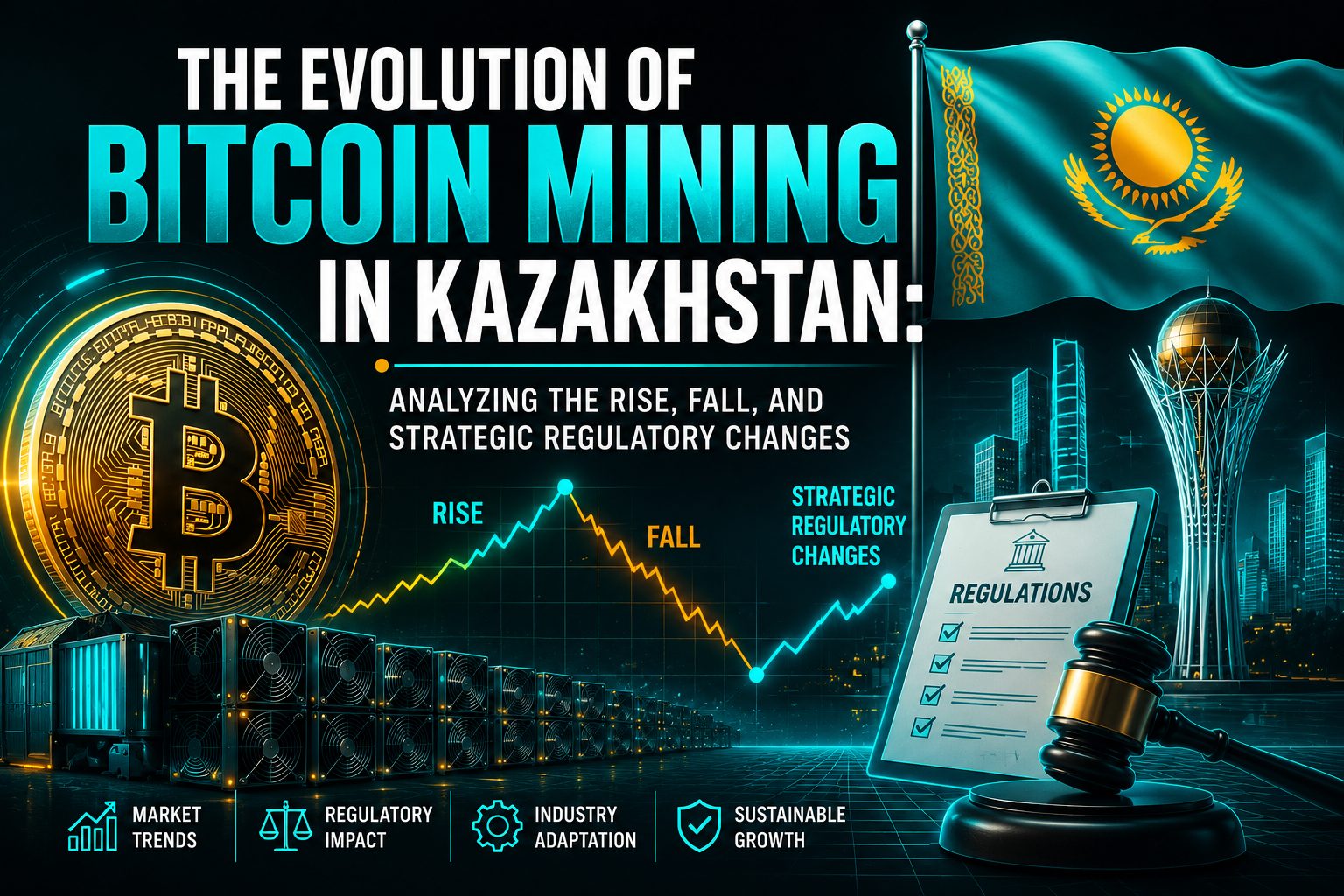
Central Asia’s Energy Landscape: How Kazakhstan Became a Global Bitcoin Production Hub
In May 2021, the global mining landscape witnessed its greatest upheaval. As China shuttered its massive operations overnight, a nomadic fleet of millions of ASICs began a desperate search for a new home. They found it in Kazakhstan. For a brief, golden window, this Central Asian giant—blessed with vast coal reserves and electricity rates that felt like a steal—became the second-most powerful mining hub on Earth.
With residential power at $0.06/kWh and industrial rates around $0.072/kWh, the country offered a perfect sanctuary. But as any veteran miner knows, "cheap" often comes with a hidden price. The story of Kazakhstan isn't just about abundance; it’s a masterclass in how rapid industrial growth can collide with the cold reality of a national power grid.
Tracking Kazakhstan’s Global Bitcoin Hashrate Share: Data Analysis from 2020 to 2025
There have been dramatic changes in the proportion of the global Bitcoin hashrate accounted for by Kazakhstan over the last six years:
-
2020: Less than 5% (pre-China ban).
-
2021: Skyrocketed to 18% due to the Chinese exodus.
-
2022: Started to decline to about 13% (Cambridge data).
-
2023: Down to 4% due to more regulatory constraints and energy bottlenecks.
-
2024: Stabilized at 2%.
-
2025: Achieved a low of 2.1%, demonstrating an ongoing relative decline.
The Impact of China’s 2021 Mining Ban on Central Asian Hashrate Distribution
Until May 2021, China dominated more than 50% of the international hash rate. However, a massive crackdown and total ban on mining initiated by the Chinese government due to concerns regarding financial stability and power/environmental impact (mainly coal dependence) forced a migration. Miners prioritized Kazakhstan for three primary reasons:
-
Bargain Power: Inexpensive power relative to almost all neighboring areas.
-
Fast Infrastructure: Availability of large mining farms and warehouses.
-
Geography: Proximity to China made transporting heavy hardware easier.
By November 2022, 14 of the world's largest mining firms had relocated more than 2 million machines out of China. BitFuFu and BIT Mining alone relocated about 88,000 machines to Kazakhstan.
Key Factors Behind the 2021 Crypto Mining Migration: Why Bitcoin Miners Chose Kazakhstan
Several conditions catalyzed this explosive growth:
-
Abundant Energy: Cheap electricity generated primarily through coal.
-
Flexible Infrastructure: Initial government promotion with minimal bureaucracy.
-
Profitability: High Bitcoin prices coupled with low operational expenses.
-
Market Gap: The sudden absence of China presented a massive opportunity for the Kazakh market.
This caused Kazakhstan's share to jump from 7.4% in May 2021 to 18.1% just months later, briefly becoming the #2 mining hub globally.
Identifying the Turning Point: Energy Grid Stability and the Crackdown on Unlicensed "Grey" Mining
The honeymoon phase was short-lived. The sector eventually faced intense criticism for:
-
Grid Pressure: Demand outweighed supply, resulting in blackouts and the need to import electricity from Russia.
-
“Grey” Mining: Unlicensed miners were using double the electricity of licensed operations.
-
Carbon Footprint: Reliance on old coal-fired plants clashed with global climate commitments.
-
Government Intervention: Authorities began levying fines and dismantling illegal farms.
Understanding Kazakhstan’s Digital Assets Act: Licensing, Compliance, and Industry Standards
To stabilize the energy market, the "Digital Assets Act" became effective on April 1, 2023. Key pillars include:
-
Compulsory Licensing: Mining is only legal with a valid 3-year license.
-
Supervised Registration: Mandatory registration with the Ministry of Digital Development.
-
Mining Pools: Individual mining is restricted; participation in licensed “Digital Mining Pools” is required.
New Mandatory Sale Requirements for Mined Digital Assets in the AIFC Ecosystem
New rules dictate how mined coins are handled:
-
By January 2024: Miners were required to sell 50% of mined coins through licensed exchanges in the Astana International Financial Centre (AIFC).
-
By January 2025: This requirement increased to 75%.
-
Energy Restrictions: Grid power is only available during a surplus. Renewable energy miners receive more leeway.
-
Taxation: New corporation and consumption-based electricity taxes were implemented.
Conclusion: Why Kazakhstan Prioritized Energy Security Over Global Bitcoin Mining Dominance
At the end of the day, Kazakhstan’s story is a hard reality check for the entire industry. It’s a reminder that you can have the cheapest power in the world, but if the lights start flickering for the local population, the party is over. The country didn’t exactly 'fail'; it just decided that keeping the national grid alive was worth more than being a global mining capital. Seeing that hashrate share drop from 18% to a tiny 2.1% is the sound of a market finally growing up. The 'easy days' of the digital gold rush are in the rearview mirror, replaced by the heavy price tag of maturity: licenses, taxes, and rules.
FAQ Strategic Insights: The Future of Mining in Kazakhstan
Q1: Why did Kazakhstan’s "cheap energy" promise eventually backfire for miners?
The 2021 migration was driven by a simple math: low electricity costs plus proximity to China. However, the surge was so rapid that it outpaced the national grid’s capacity. What miners initially saw as a "sanctuary" became a battleground for energy security. The lesson from the Kazakh experience is that electricity cost is irrelevant if the grid isn't stable enough to keep the machines running. In the end, the government had to choose between keeping the lights on for its citizens or supporting a global mining hub—and they chose the former.
Q2: What does the 87% drop in hashrate actually tell us about the new regulatory environment?
The staggering decline from an 18% global share to just 2.1% isn't necessarily a sign of failure, but a sign of "forced maturity." The introduction of the Digital Assets Act and mandatory sales through the AIFC ecosystem turned the "Wild West" into a highly audited corporate environment. For many original miners, the appeal of Kazakhstan was its lack of red tape; once the licenses, taxes, and mandatory pool participations kicked in, the "easy money" disappeared, leaving behind only the most compliant and well-capitalized operators.
Q3: Is Kazakhstan still a viable frontier for professional miners in 2026?
The short answer is yes, but the era of "plug and play" is over. Today, Kazakhstan is a market for industrial players who can navigate complex licensing and energy surplus quotas. While it’s no longer the tax-haven it once was in 2021, the new transparency rules offer a level of legal protection that didn't exist before. If you are a large-scale operation that prioritizes regulatory certainty over the lowest possible cost, Kazakhstan still offers a strategic, albeit restricted, base in Central Asia.